
Fibrin Sealants Market Size, Demand & Growth by 2034
Coverage: By Type (Liquid, Patch); Application (Orthopedic Surgery, Cardiovascular Surgery, General Surgery, Others); End User (Hospitals, Ambulatory Surgical Centers, Others); and Geography, and Geography (North America, Europe, Asia Pacific, and South and Central America)
- Status : Data Released
- Report Code : TIPRE00021654
- Category : Life Sciences
- No. of Pages : 150
- Available Report Formats :


- Last update date : November 13, 2026


2025 Market Size
US$ 11.85 Bn
Base year value
2034 Forecast
US$ 22.57 Bn
Projected by 2034
CAGR 2026-2034
7.42 %
Growth rate
Addressable Market
US$ 155.16 Bn
(2026-2034)
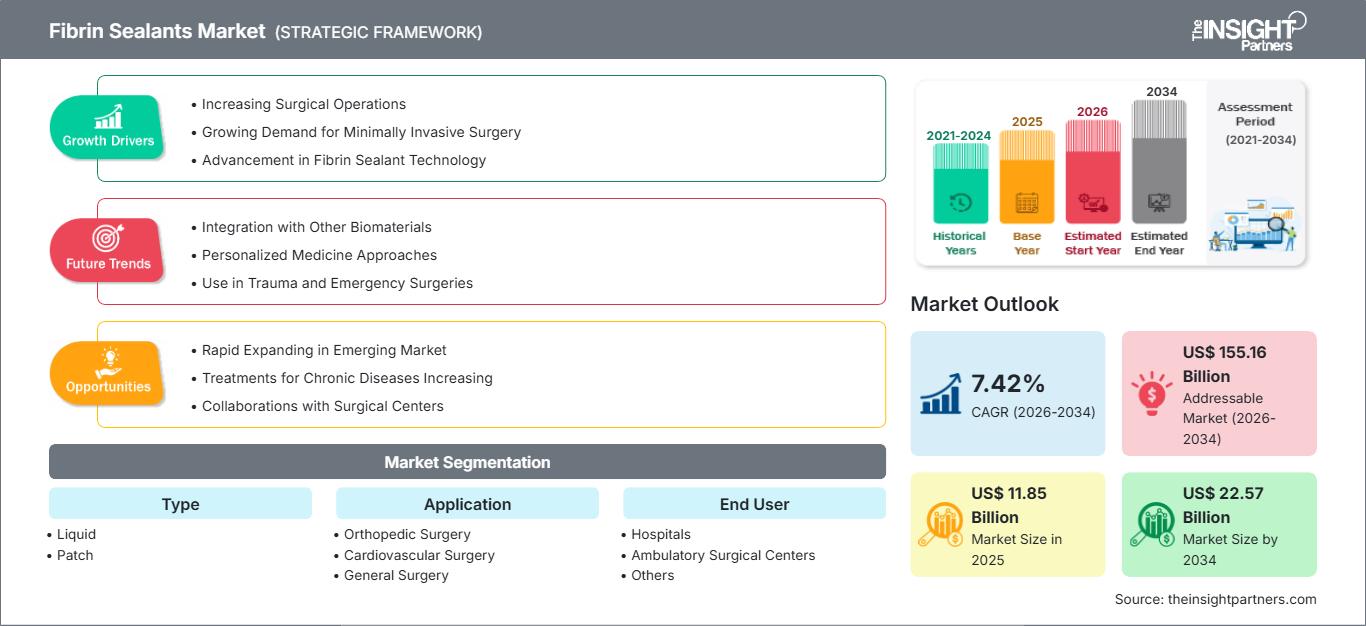
The fibrin sealants market was valued at US$ 11.85 Billion in 2025 and is projected to reach US$ 22.57 Billion by 2034, registering a CAGR of 7.42% during 2026–2034. Growth is primarily supported by increasing surgical procedure volumes, rising demand for rapid hemostasis solutions, expanding adoption of biologic sealants in complex surgeries, and growing emphasis on reducing post-operative complications. Continuous innovation in fibrin-based formulations and applicator systems is further strengthening clinical acceptance across multiple surgical specialties.
Within North America, healthcare providers continue to prioritize advanced surgical bleeding management technologies that improve procedural efficiency and patient recovery. The region is expected to expand at ~6% CAGR through 2034, supported by high surgical volumes, favorable reimbursement frameworks, strong hospital purchasing capabilities, and widespread adoption of biologic hemostatic products. The fibrin sealants market size in the region also benefits from ongoing investments in surgical innovation and increasing utilization in cardiovascular and orthopedic interventions.
Fibrin Sealants Market Assessment and Insights
Regional Outlook
- North America: ~38% of the global fibrin sealants market share in 2025 | ~6% CAGR through 2034. Market position: North America represents the leading regional market due to advanced surgical infrastructure, high adoption of biologic hemostatic technologies, and strong procedural volumes across cardiac, orthopedic, and general surgery applications.
- US: ~82% of North American market revenue in 2025 | ~6% CAGR through 2034. Market position: The US remains the dominant country within North America owing to a large base of specialty surgical centers, ongoing clinical innovation, strong manufacturer presence, and increasing use of adjunctive hemostatic technologies.
- Europe: ~29% of the global market in 2025 | ~7% CAGR through 2034. Market position: Europe is a mature market characterized by established surgical practices and widespread biologics adoption. Germany, France, and the UK remain the leading contributors across the region.
- Asia Pacific: ~24% of the global market in 2025 | ~9% CAGR through 2034. Market position: Asia Pacific is the fastest-growing region, supported by healthcare infrastructure development, expanding access to advanced surgical care, and increasing procedural volumes in China, Japan, and India.
Segment Outlook
- Application: ~44% Share in 2025 | ~8% CAGR through 2034. Market position: Application-based demand leads revenue generation as product utilization is directly linked to surgical intervention volumes, clinical outcomes, and procedure-specific bleeding management requirements.
- Type: ~41% Share in 2025 | ~9% CAGR through 2034. Market position: Growth is driven by advances in delivery formats, surgeon preference for convenient application methods, and expanding use across minimally invasive and specialty surgical procedures.
Competitive Coverage
Ethicon LLC, The Medicines Company, Baxter International Inc., LifeBond Ltd., Tissuemed Ltd., Surgical Specialties Corporation, Biegler GmbH, Cohera Medical Inc., Integra LifeSciences Corporation, Johnson & Johnson Services, Inc.
Methodology
The Insight Partners follows Data Collection & Secondary Research, Primary Research, Data Analysis, and Data Triangulation & Final Review to validate market estimates and insights.
Source: The Insight Partners' analysis based on proprietary research, government publications, company annual reports, investor presentations, industry databases, and expert interviews.
The requirements in terms of clinical use in order to achieve proper hemostasis have changed a lot over the past decade, thus there is increased need for bio-derived sealants for achieving hemostasis and tissue sealing. The companies have been focusing on stability of storage, ease of handling, precision of application and suitability for minimal invasive procedures. The hospitals are also looking for products which minimize the risks of complications, reduce the duration of surgeries and improve the surgical results.
The future is bright as the growth of the healthcare systems will increase the surgical capacity in various fields of medicine. Innovations in biologic products, higher costs in the healthcare and awareness among the doctors about the use of adjunctive hemostatics are supposed to increase the popularity of the products in developing countries.
Fibrin Sealants Market Report Scope
| Report Attribute | Details |
|---|---|
| Market size in 2025 | US$ 11.85 Billion |
| Market Size by 2034 | US$ 22.57 Billion |
| Global CAGR (2026 - 2034) | 7.42% |
| Historical Data | 2021-2024 |
| Forecast period | 2026-2034 |
Fibrin Sealants Market Analysis
The fibrin sealant market growth trend is directly connected with the increased prevalence of cardiovascular diseases, musculoskeletal conditions, injuries, and cancer surgeries. With more emphasis being placed on the reduction of bleeding during surgery and faster patient recovery after surgery by the clinicians, the demand for biologic sealants has grown significantly. The usage of such sealants is particularly high in cases when traditional sutures and cauterization fail to adequately address the issue of bleeding.
Supply chain issues are determined by the supply of the biological material, regulatory compliances, and manufacturing expertise and quality standards. The companies active along the supply chain are enhancing the product manufacturing and formula of the product in order to address the growing clinical demands.
Market analysis for fibrin sealants reflects a highly innovative and clinically driven industry environment. Key players are concentrating on innovation, evidence creation, extension of the product portfolios, and cooperation with partners. Market leaders still pay special attention to education of surgeons and differentiating their products in order to reinforce market positions.
Investment activities are directed at biologic manufacturing facilities, surgical devices integration, and research of new generation sealants. Companies Baxter International Inc., Ethicon LLC, Integra LifeSciences Corporation, LifeBond Ltd., and Tissuemed Ltd. are continuously improving their commercial approaches by developing products and processes. Competition will be growing due to the demand for outcome-oriented surgical solutions.
● REPORT CUSTOMIZATION
Tailor This Report To Align With Your Specific Business Requirements
This report can be customized to align precisely with your business objectives, scope, and target markets. Customization options include tailored segmentation, geography, competitive analysis, and strategic insights to support informed decision-making.
Customize This Report →WHAT YOU CAN ADJUST
- ● Segmentations
- ● Geography
- ● Competitive Analysis
- ● Language Preferences
Fibrin Sealants Market: Strategic Insights
Regional Insights
North America fibrin sealants market
North America maintains a leading position within the global industry due to strong healthcare spending, advanced surgical infrastructure, and broad availability of specialty care centers. The regional market is projected to expand at ~6% CAGR through 2034, supported by increasing demand for efficient bleeding management solutions and continued adoption of biologic surgical technologies.
Favorable reimbursement policies, widespread physician awareness, and clinical data on fibrin products support growth. Significant demand is being created through cardiovascular surgery, orthopedic reconstruction surgery, and general surgery. Research and development activity in the surgical biologics value chain enhances the competitiveness of the region.
U.S. fibrin sealants market
The United States accounts for ~82% of North American revenue and is expected to advance at around ~6% CAGR through 2034. Huge procedure volumes in hospitals and specialized surgical centers continue to drive the demand. The presence of key players and high levels of familiarity of surgeons with biologic hemostatic agents help create market dominance.
Adoption trends are highest in cases of cardiovascular, orthopedic, and complicated general surgery. Adoption of biologic hemostatic products is also driven by attempts of clinicians to reduce blood loss, speed up recovery times, and avoid complications. Innovation in the field of fibrin delivery systems is expected to boost adoption rates.
Europe fibrin sealants market
Europe represented ~29% of global revenue in 2025 and is projected to grow at ~7% CAGR through 2034. The territory enjoys developed healthcare systems, set surgical norms, and high popularity of biologic adjuvant technologies. The use of fibrin sealants in hospitals improves the result of procedures and performs complicated surgeries.
Germany is the dominant market of Europe due to large number of hospitals, active surgery performance, and developed medical technology environment. The second and third market players are France and the United Kingdom due to availability of specialized surgical services and concentration on patients' results. Italy maintains steady demand in the fields of cardiovascular and orthopedic applications.
Spain contributes to the territory through the development of healthcare infrastructure and slow but steady introduction of minimally invasive surgical procedures. Regulatory stability of much of the territory facilitates commercialization and clinical introduction. Reduction of surgical complications will drive the growth of the market for many years.
APAC fibrin sealants market
Asia Pacific accounted for ~24% of global revenue in 2025 and is forecast to register ~9% CAGR through 2034, making it the fastest-growing regional market. Strong healthcare infrastructure investments and expanding surgical capacity continue creating favorable growth conditions.
Being the dominant player in Asia-Pacific, China has its advantage owing to the huge number of patients as well as modernization of health care. Japan has retained its dominance owing to the highly developed standards of surgery, while India, South Korea, and Australia have an edge due to improved accessibility to health care and increased demand for specialty treatment.
Middle East & Africa fibrin sealants market
The Middle East & Africa region is expected to grow at ~8% CAGR through 2034. Market expansion is supported by healthcare infrastructure development, increasing specialist care availability, and growing investment in advanced surgical technologies across major urban healthcare centers.
Saudi Arabia is one of the best-performing countries in the ME&A region on account of ongoing healthcare upgrades programs. The UAE will continue improving surgical expertise, while South Africa will remain a healthcare hub of Africa. Future growth in tertiary healthcare centers is anticipated to spur future demand.
Segmentation Analysis
Type
The Type segment plays a critical role in product differentiation, procurement decisions, and clinical utilization patterns across surgical specialties. Advancements in delivery technologies and surgeon preference for efficient application methods continue supporting expansion opportunities. Growing demand for convenient and precise bleeding-management solutions remains a key market driver. Within this segment, Patch products are projected to register ~9% CAGR through 2034 as hospitals increasingly seek simplified application approaches.
- Liquid – Widely utilized across numerous surgical procedures because of its versatility, flexibility of application, and suitability for irregular wound surfaces requiring localized hemostatic support.
- Patch – Gains traction in procedures requiring controlled placement and enhanced handling characteristics, helping surgeons improve workflow efficiency in targeted surgical environments.
Application
The Application segment represents the primary revenue-generating category and reflects the direct relationship between surgical volumes and product demand. The expanding burden of chronic diseases requiring operative intervention continues strengthening utilization rates. Clinical emphasis on minimizing blood loss and supporting tissue sealing further increases adoption. Cardiovascular Surgery within this segment is expected to grow at ~8% CAGR through 2034.
- Orthopedic Surgery – Utilized in joint replacement, trauma repair, and musculoskeletal reconstruction procedures where blood management and tissue adhesion support are important considerations.
- Cardiovascular Surgery – Relies on advanced hemostatic solutions due to the complexity of procedures and the need for precise bleeding control during critical interventions.
- General Surgery – Represents broad utilization across abdominal, gastrointestinal, and soft tissue operations where enhanced surgical efficiency is highly valued.
Opportunity Snapshot
| Application | Revenue Contribution | Trend Tag | Adoption Stage |
| Orthopedic Surgery | High | Joint Repair | Mature |
| Cardiovascular Surgery | High | Hemostasis Focus | Mature |
| General Surgery | High | Minimally Invasive | Mature |
Fibrin Sealants Market Growth Drivers and Impact Analysis
Rising Surgical Procedure Volumes Worldwide
The increasing number of surgical procedures performed globally continues to create substantial demand for effective hemostatic and tissue-sealing technologies. Aging populations, higher prevalence of chronic diseases, growing incidence of cardiovascular disorders, and expanded access to healthcare services are collectively driving procedure volumes across hospitals and surgical centers. Fibrin sealants provide surgeons with enhanced control of intraoperative bleeding while supporting wound closure and tissue adhesion. Their ability to improve surgical efficiency is particularly valuable in complex procedures where blood loss management is critical. As healthcare systems continue expanding surgical capacity and investing in advanced treatment capabilities, demand for biologic sealants is expected to remain strong across cardiovascular, orthopedic, and general surgery applications.
Growing Preference for Advanced Hemostatic Solutions
Modern surgical practices increasingly emphasize outcome improvement, complication reduction, and recovery optimization. This trend has accelerated adoption of biologic sealants that complement traditional sutures, staples, and cauterization methods. Healthcare providers are focused on minimizing postoperative bleeding, reducing transfusion requirements, and shortening hospital stays. Fibrin sealants align well with these objectives because they provide localized hemostatic action and support tissue healing. Their growing acceptance among surgeons has resulted in broader utilization across both open and minimally invasive procedures. Continued clinical evidence demonstrating procedural benefits is expected to strengthen integration into surgical protocols throughout the forecast period.
Expansion of Specialized Healthcare Infrastructure
Investments in tertiary hospitals, specialty surgery centers, and advanced operating facilities are creating favorable conditions for market expansion. Emerging economies are increasing healthcare expenditures while developed regions continue upgrading surgical capabilities. Improved access to complex surgical procedures directly supports demand for biologic adjunctive products. Manufacturers also benefit from expanding physician training programs and improved awareness of advanced hemostasis technologies. Increased availability of specialty care services in cardiovascular, orthopedic, oncology, and trauma surgery further broadens the addressable patient population. These developments collectively reinforce adoption momentum and contribute to sustainable long-term industry growth.
Fibrin Sealants Market Future Trends
Integration of Next-Generation Delivery Technologies
Future product development is expected to focus on enhanced delivery systems that improve precision, handling efficiency, and surgeon usability. The fibrin sealants market trends increasingly indicate demand for applicators capable of supporting minimally invasive and robotic-assisted procedures. Manufacturers are investing in technologies that improve storage stability, simplify preparation, and enable controlled administration in complex surgical environments. These innovations are anticipated to improve procedural consistency while supporting broader adoption across additional clinical applications. As hospitals continue prioritizing efficiency and outcome optimization, advanced delivery platforms are likely to become a key differentiating factor among suppliers.
Broader Utilization Across Complex Surgical Specialties
Increasing clinical familiarity with biologic hemostatic products is expected to expand utilization beyond traditional applications. Surgeons are evaluating fibrin-based technologies in procedures requiring enhanced tissue sealing, leakage prevention, and blood management. Continued accumulation of clinical evidence may support wider use in reconstructive, oncology, and transplant surgery settings. At the same time, healthcare providers are expected to adopt more comprehensive perioperative blood-management strategies, creating additional opportunities for biologic sealants. This evolution will contribute to diversification of end-use applications and strengthen long-term market demand.
Fibrin Sealants Market Opportunities
Expansion into Emerging Healthcare Markets
Healthcare infrastructure development across Asia Pacific, Latin America, and selected Middle Eastern countries presents substantial commercial potential. Many healthcare systems are increasing investments in specialty surgical services while expanding access to advanced treatment options. Suppliers that establish local distribution networks, physician education initiatives, and regulatory pathways can benefit from increasing adoption. The availability of favorable demographics and rising healthcare expenditure supports longer-term demand creation. These factors suggest that fibrin sealants market Forecasts remain strongly influenced by expansion opportunities in underpenetrated healthcare environments where access to biologic surgical technologies continues improving.
Product Innovation for High-Complexity Procedures
Manufacturers have opportunities to develop differentiated products tailored for specialized surgical environments. Innovations focused on improved adhesion performance, faster application, and compatibility with minimally invasive procedures are expected to gain attention among healthcare providers. Strategic investments in research, clinical validation, and product customization could improve penetration within cardiovascular, orthopedic, and reconstructive surgery applications. Companies capable of addressing unmet procedural requirements while maintaining regulatory compliance may strengthen their competitive positions and capture incremental market share throughout the forecast period.
Frequently Asked Questions

- Comprehensive Market Sizing and Forecast Analysis
- Detailed Segmentation Analysis
- In-Depth Market Dynamics Assessment
- Regional and Country-Level Insights
- Competitive Landscape and Company Benchmarking
- Strategic Business Intelligence
Recent Reports
Testimonials

The Insight Partners provided valuable market intelligence that supported our global go-to-market strategy. Their team was professional, responsive, and attentive to our feedback, providing thoughtful analysis and helpful methodological clarifications throughout the project.
Junmo Kim Chief Financial Officer (CFO), Enertech Co., Ltd.
The Insight Partners' SCADA System Market report is comprehensive, with valuable insights on current trends and future forecasts. The team was highly professional, responsive, and supportive throughout. We are very satisfied and highly recommend their services.
RAN KEDEM Partner, Reali Technologies LTDs
I requested a report on a very specific software market and the team produced the report in a few days. The information was very relevant and well presented. I then requested some changes and additions to the report. The team was again very responsive and I got the final report in less than a week.
JEAN-HERVE JENN Chairman, Future Analytica
We worked with The Insight Partners for an important market study and forecast. They gave us clear insights into opportunities and risks, which helped shape our plans. Their research was easy to use and based on solid data. It helped us make smart, confident decisions. We highly recommend them.
PIYUSH NAGPAL Sr. Vice President, High Beam Global
The Insight Partners delivered insightful, well-structured market research with strong domain expertise. Their team was professional and responsive throughout. The user-friendly website made accessing industry reports seamless. We highly recommend them for reliable, high-quality research services
YUKIHIKO ADACHI CEO, Deep Blue, LLC.
This is the first time I have purchased a market report from The Insight Partners.While I was unsure at first, I visited their web site and felt more comfortable to take the risk and purchase a market report.I am completely satisfied with the quality of the report and customer service. I had several questions and comments with the initial report, but after a couple of dialogs over email with their analyst I believe I have a report that I can use as input to our strategic planning process.Thank you so much for taking the extra time and making this a positive experience.I will definitely recommend your service to others and you will be my first call when we need further market data.
JOHN SUZUKI President and Chief Executive Officer, Board Director, BK Technologies
I wish to appreciate your support and the professionalism you displayed in the course of attending to my request for information regarding to infectious disease IVD market in Nigeria. I appreciate your patience, your guidance, and the fact that you were willing to offer a discount, which eventually made it possible for us to close a deal. I look forward to engaging The Insight Partners in the future, all thanks to the impression you have created in me as a result of this first encounter.
DR CHIJIOKE ONYIA MANAGING DIRECTOR, PineCrest Healthcare Ltd.Reason to Buy
- Informed Decision-Making
- Understanding Market Dynamics
- Competitive Analysis
- Identifying Emerging Markets
- Customer Insights
- Market Forecasts
- Risk Mitigation
- Boosting Operational Efficiency
- Strategic Planning
- Investment Justification
- Tracking Industry Innovations
- Aligning with Regulatory Trends





 Get Free Sample for