
Flat Glass Market Share, Growth & Demand by 2034
Coverage: By Product (Basic, Tempered, Laminated, Insulated, Others); Application (Architectural, Automotive, Others) , and Geography (North America, Europe, Asia Pacific, and South and Central America)
- Status : Data Released
- Report Code : TIPRE00017578
- Category : Chemicals and Materials
- No. of Pages : 150
- Available Report Formats :


- Last update date : September 17, 2026


2025 Market Size
US$ 160.11 Bn
Base year value
2034 Forecast
US$ 323.18 Bn
Projected by 2034
CAGR 2026-2034
8.12 %
Growth rate
Addressable Market
US$ 2,172.59 Bn
(2026-2034)
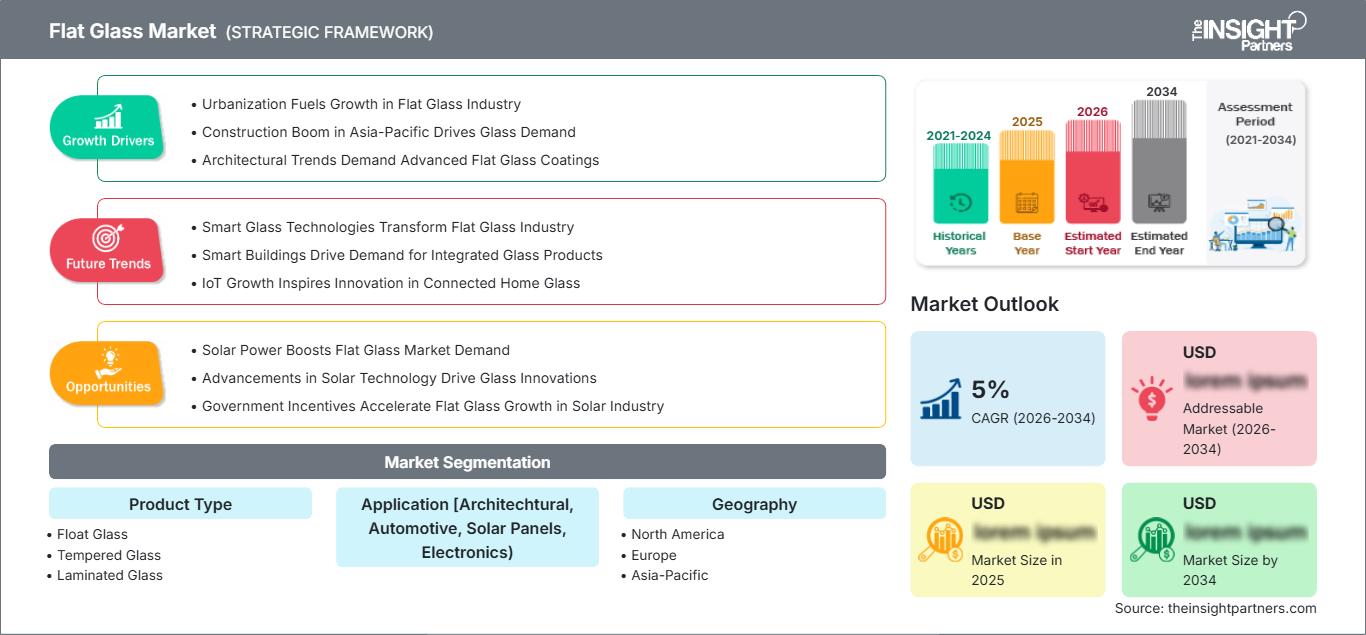
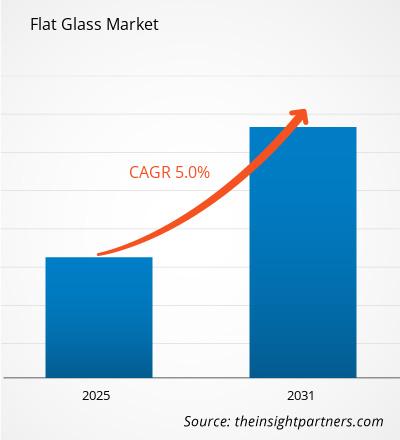
The Flat Glass Market size was valued at US$ 160.11 Billion in 2025 and is projected to reach US$ 323.18 Billion by 2034, registering a CAGR of 8.12% during 2026–2034. Expansion is supported by construction activity, automotive glazing, solar photovoltaic deployment, and increasing use of higher-performance glass products. Product innovation around safety, thermal performance, optical properties, lightweighting, and energy efficiency is also widening the role of flat glass across architectural, mobility, renewable-energy, and electronics applications.
North America is expected to record a CAGR of 7.4–8.2% during 2026–2034, supported by commercial renovation, energy-efficient building requirements, automotive production, and solar installations. The regional outlook is also strengthened by replacement demand for aging glazing systems and increasing adoption of laminated and tempered products. Established glass processors, automotive manufacturers, and building-material suppliers provide a mature ecosystem for higher-value flat glass applications.
Flat Glass Market Assessment and Insights
- North America: North America is estimated to account for 18–22% of global Flat Glass Market share in 2025 and is projected to expand at a CAGR of 7.4–8.2% during 2026–2034, supported by construction renovation, automotive glazing, solar deployment, and advanced safety glass demand.
- US: The US is estimated to represent 72–77% of North American revenue in 2025 and is expected to grow at a CAGR of 7.5–8.3% during 2026–2034, driven by construction, automotive, and solar applications.
- Europe: Europe is estimated to hold a 17–21% share in 2025 and grow at a CAGR of 6.5–7.4% during 2026–2034, with Germany, Italy, France, Spain, and the UK supported by renovation, automotive, and renewable-energy demand.
- Asia Pacific: Asia Pacific is estimated at a 50–55% share in 2025 and is projected to grow at a CAGR of 8.7–9.6% during 2026–2034, led by China, India, Japan, South Korea, and Australia.
- Largest Segment: Float Glass is estimated to hold a 44–48% market share in 2025 and is projected to grow at a CAGR of 7.7–8.5% during 2026–2034.
- High Growth Segment: Solar Panels are estimated to account for a 14–18% market share in 2025 and are projected to grow at a CAGR of 10.0–11.2% during 2026–2034.
- Key companies analyzed in detail: AGC Inc., Cardinal Glass Industries, Inc., Compagnie de Saint-Gobain S.A., SCHOTT AG, Türkiye Şişe ve Cam Fabrikaları A.Ş., Almana Glass Co. Ltd., Dallas Flat Glass, Inc., CEVITAL, Guardian Industries Holdings, LLC, and Nippon Sheet Glass Co., Ltd.
Source: The Insight Partners' analysis based on proprietary research, government publications, company annual reports, investor presentations, industry databases, and expert interviews.
The Flat Glass Market trend is moving away from commodity glass to specialized products for purposes of safety, energy efficiency, solar transmission, acoustics, and aesthetics. Float glass continues to be the main platform in the manufacturing process, but downstream processes such as tempering, lamination, coating, cutting, and processing become more value-added activities. The emphasis on furnace efficiencies, cullet recycling, automation, and digital quality control will help mitigate the high energy intensity and improve yield rates.
The future demand in the Flat Glass Market will largely depend on the convergence between construction upgrading, automobile electrification, renewable energy deployment, and sustainability regulations. Asia Pacific is bound to continue being the main volume driver due to economies of scale and infrastructure investments. Europe may focus on low carbon and circularity initiatives, whereas North America may see some benefits through renovation and manufacturing investments. Solar applications could offer another increment in demand.
Flat Glass Market Report Scope
| Report Attribute | Details |
|---|---|
| Market size in 2025 | US$ 160.11 Billion |
| Market Size by 2034 | US$ 323.18 Billion |
| Global CAGR (2026 - 2034) | 8.12% |
| Historical Data | 2021-2024 |
| Forecast period | 2026-2034 |
Flat Glass Market Analysis
The increase in demand is very much connected to the production of buildings, vehicles, and solar-modules. The growth profile of the Flat Glass Market is increasingly dependent on the substitution of traditional glazing material for laminated, tempered, coated and energy-efficient glazing materials. The value chain consists of suppliers of raw materials, float glass manufacturers, processors, fabricators, modules manufacturers, automakers, architects, contractors and distributors. At each stage of the value chain specifications and delivery conditions as well as profit margins can be affected.
Manufacturing of glass is still energy-intensive, which makes natural gas, electricity, batch materials and cullet availability among the main cost elements. The cost of soda ash, silica sand, dolomite, limestone and recycled glass will affect manufacturing costs. Transport costs will affect competitiveness of the region as the flat glass is relatively heavy and fragile.
Positioning in the Flat Glass Market becomes more and more contingent upon factors such as manufacturing scale, geographical reach, product line, efficiency of furnaces, processing capability, and client base. AGC Inc. brings together architectural, automotive, and specialized capabilities, whereas Compagnie de Saint-Gobain S.A. boasts a comprehensive building materials environment.Türkiye Şişe ve Cam Fabrikaları A.Ş. is a leader in international flat glass production, whereas Guardian Industries Holdings, LLC and Nippon Sheet Glass Co., Ltd. bring specific regional and specialized capabilities.
The Flat Glass Market report shows that Cardinal Glass Industries, Inc. dominates the North American market of architectural glazing, whereas SCHOTT AG specializes in specialized glass applications. Almana Glass Co. Ltd. and Dallas Flat Glass, Inc. are contributing through their regional processing and fabrication capabilities. CEVITAL and other regional players can meet local needs, whereas big integrated manufacturers tend to focus on furnace modernization, recycling, automation, and differentiated products.
● REPORT CUSTOMIZATION
Tailor This Report To Align With Your Specific Business Requirements
This report can be customized to align precisely with your business objectives, scope, and target markets. Customization options include tailored segmentation, geography, competitive analysis, and strategic insights to support informed decision-making.
Customize This Report →WHAT YOU CAN ADJUST
- ● Segmentations
- ● Geography
- ● Competitive Analysis
- ● Language Preferences
Flat Glass Market: Strategic Insights
Regional Insights
North America Flat Glass Market
North America is estimated to account for 18–22% of global Flat Glass Market in 2025 and is projected to grow at a CAGR of 7.4–8.2% during 2026–2034. The demand will be driven by the commercial renovation, residential replacement, automobile glazing, manufacture of photovoltaic modules, and higher performance standards for building envelopes. Both the tempered and laminated glass types will increase in significance due to the emphasis placed on safety and resilience.
The United States leads regional demand, while Canada enjoys energy-efficient construction and replacement glazing applications. The contribution of Mexico in demand is because of its automotive and industrial activities. The regional supply system consists of integrated glass manufacturers, processors, fabricators, and distributors that offer customers access to local supply of standard and high-value added glass.
U.S. Flat Glass Market
The US represents an estimated 72–77% of North American revenue in 2025 and is projected to expand at a CAGR of 7.5–8.3% through 2034. Diversified demand from commercial construction, replacement residential, automotive manufacturing, and solar installation. Energy efficient glazing has gained significance because of lower operating costs and better comfort.
The companies Cardinal Glass Industries, Inc., Guardian Industries Holdings, LLC, AGC Inc., and Compagnie de Saint-Gobain S.A. are among those that have significant market involvement. The architectural use is the biggest consumer base for energy efficient glazing, while the automotive use and solar use represent other sources of demand. The demand factors include hurricane resistance, safety, acoustic performance, and aging replacement.
Europe Flat Glass Market
Europe is estimated to hold a 17–21% share in 2025 and is projected to grow at a CAGR of 6.5–7.4% through 2034. The top countries for the market include Germany, followed by Italy, France, Spain, and the UK. The construction industry, automotive manufacturing, solar panel installation, and increasing strictness on energy performance are the forces affecting the region.
The country with its well-developed industries and construction sectors offers architectural and automotive glazing opportunities. Italy has a long history of glass processing technologies and renovation. France offers modernization of the construction sector and investments in renewables. Spain can be attributed to solar installation and business development in the country. Opportunities in the UK can be found through refurbishment, energy-efficient windows, and architectural glazing.
APAC Flat Glass Market
APAC is estimated to represent 50–55% of global revenue in 2025 and is projected to grow at a CAGR of 8.7–9.6% through 2034. China continues to be the dominant player, aided by construction, automotive manufacture, solar panels, and large-scale glass production within the nation. India is playing an increasingly significant role due to growing investments in infrastructure and manufacturing.
The Flat Glass Market forecast shows that Japan and South Korea participate by means of automotive production, electronics, and high-performance glazing. Australia gets its support from construction and solar panel installations. The policies of the region in favor of renewable energy generation and industrialization help boost demand. Large-scale production, construction activity, and solar panel manufacturing make APAC the main source of volumes.
Middle East & Africa Flat Glass Market
Middle East and Africa is projected to grow at a CAGR of 7.6–8.7% during 2026–2034. Demand in the region is led by Saudi Arabia and the UAE due to their substantial construction, infrastructure, hospitality, and solar power projects. South Africa remains one of the significant markets in Africa due to construction, automotive, and renewable energy applications.
The rest of MEA presents long-term growth prospects owing to further urbanization and investments in infrastructures. Demand for the product is highly correlated with energy-efficient buildings, solar power generation, and large architectural projects. Proximity of regional producers to construction sites is a great advantage since transportation expenses may significantly affect cost competitiveness of the final product.
Segmentation Analysis
Product Type
Product Type is projected to expand at a CAGR of 7.7–8.5% during 2026–2034. Float Glass provides the primary substrate for downstream processing, while tempered and laminated products capture higher-value safety applications. Reflective Glass serves architectural and solar-control requirements. Product selection increasingly depends on safety, thermal performance, aesthetics, durability, and compliance with building and automotive specifications.
- Float Glass: Float Glass remains the foundational product because its uniform thickness, optical quality, and scalable production support windows, facades, automotive substrates, and solar applications. It also provides the base for extensive downstream processing.
- Tempered Glass: Tempered Glass is strategically important where improved mechanical strength and thermal-shock resistance are required. Demand spans building facades, doors, shower enclosures, automotive glazing, appliances, and selected solar applications.
- Laminated Glass: Laminated Glass provides safety, security, acoustic, and impact-performance benefits through an interlayer structure. Its importance is increasing in architectural glazing, transportation, skylights, and applications requiring controlled breakage behavior.
- Reflective Glass: Reflective Glass supports solar-control and aesthetic requirements by managing solar radiation and visible reflectance. It remains relevant in commercial facades, energy-efficient buildings, and projects requiring distinctive external appearances.
Application
Application is projected to grow at a CAGR of 8.3–9.2% during 2026–2034. Architectural applications provide the largest established demand base, while solar panels represent a faster-growing opportunity because photovoltaic installations continue expanding globally. Automotive glazing benefits from vehicle production and increasing glass content, while electronics applications require specialized substrates with tight dimensional and optical specifications.
- Architechtural: Architechtural applications remain the principal consumption base because glass supports windows, facades, doors, interiors, and energy-efficient building envelopes. Demand increasingly favors processed products with safety, insulation, and solar-control properties.
- Automotive: Automotive demand centers on windshields, side windows, rear glazing, and panoramic roof systems. Vehicle electrification, lightweighting, acoustic comfort, and integrated sensors are increasing the technical requirements for automotive glass.
- Solar Panels: Solar Panels require durable, optically efficient glass capable of protecting photovoltaic cells while supporting light transmission. Rapid solar deployment and continued module manufacturing expansion make this a strategically important application.
- Electronics: Electronics applications use specialized flat glass for displays, touch interfaces, appliances, and other precision components. Demand is shaped by dimensional control, surface quality, optical performance, and compatibility with advanced manufacturing processes.
Opportunity Snapshot
| Application | Revenue Contribution | Trend Tag | Adoption Stage |
| Architechtural | High | Energy Glazing | Mature |
| Automotive | Medium | Panoramic Roofs | Scaling |
| Solar Panels | High | PV Glass | Scaling |
| Electronics | Medium | Display Glass | Scaling |
Flat Glass Market Growth Drivers and Impact Analysis
Expansion of Energy-Efficient Architectural Glazing
Increasingly, building owners are considering the energy performance over the lifecycle of glazing as opposed to just the upfront cost. High-performance glass can be used for effective daylighting, heat insulation, solar control, and occupant comfort, promoting its use in new constructions and renovations. There are building efficiency programs in Europe that are having a similar effect in North America and Asia, increasing the specifications requirements. This effect will have an impact throughout the value chain, as it increases the demand for high-performing products, which means that special coating, tempering, lamination, and insulating glass equipment is necessary. Manufacturers that have their processing integrated can benefit from this trend more than manufacturers of only commodity substrates.
Accelerating Global Solar Photovoltaic Deployment
Solar deployment is becoming a major structural demand driver for flat glass because photovoltaic modules require durable glass substrates capable of maintaining optical and mechanical performance over long operating periods. IEA PVPS reported that global cumulative photovoltaic capacity exceeded 2,260 GW at the end of 2024, while new installations reached between 553 GW and 601 GW during that year. This scale is increasing demand for ultra-clear, tempered, and increasingly glass-glass module configurations. China remains the dominant solar manufacturing and installation center, while India, Europe, the US, and Middle Eastern markets are expanding deployment. The resulting requirement for consistent high-volume glass supply is encouraging investments in dedicated production, processing, logistics, and recycling systems close to photovoltaic manufacturing clusters.
Increasing Adoption of Safety and High-Performance Glass
Safety regulations, consumer expectations, and architectural design requirements are increasing the role of tempered and laminated products across construction and transportation. Laminated glass can retain fragments after breakage and provide acoustic and security benefits, while tempered glass offers improved strength and thermal resistance. Automotive manufacturers are also integrating larger windshields, panoramic roofs, and advanced glazing configurations, increasing the technical value of glass per vehicle. These changes encourage suppliers to invest in automated processing, precision cutting, edge finishing, lamination, and quality inspection. The impact is particularly relevant for integrated manufacturers because downstream processing can create higher margins than basic float production. Product differentiation therefore provides an avenue for suppliers to manage cyclicality in commodity glass markets while meeting increasingly complex customer specifications.
Flat Glass Market Future Trends
Greater Use of Recycled Cullet in Furnace Operations
Future production strategies in the Flat Glass Market are expected to place greater emphasis on recycled glass because cullet can reduce the energy required during melting and lower the raw-material intensity of furnace operations. Leading producers are developing closed-loop systems that collect waste from construction, automotive replacement, and photovoltaic applications and return suitable material to glass production. AGC Inc. has demonstrated recycling initiatives involving architectural and automotive glass, while European producers are also exploring higher cullet ratios. As circularity requirements become more prominent, access to clean, consistent cullet may become a competitive factor alongside energy costs and raw-material availability. Suppliers with collection networks, sorting capabilities, and established recycling partnerships should gain greater flexibility in managing both environmental performance and material procurement.
Electrified and Hybrid Flat Glass Furnaces
Furnace technology is likely to become a major differentiator in the Flat Glass Market as producers seek to reduce direct carbon emissions from glass melting. Hybrid systems combining electricity with conventional fuels can lower fossil-fuel consumption while maintaining the high temperatures and process stability required for float production. The VOLTA collaboration between AGC and Compagnie de Saint-Gobain S.A. has demonstrated hybrid melting at industrial scale, while the planned FurHy project in Spain is intended to advance highly electrified flat-glass production. Wider adoption will depend on electricity availability, grid reliability, renewable-power costs, furnace economics, and technical validation. Over time, lower-carbon production may become an important procurement criterion for architects, automotive companies, solar manufacturers, and construction-material distributors.
Flat Glass Market Opportunities
Localized Solar Glass Manufacturing
The continued expansion of photovoltaic manufacturing creates opportunities for flat-glass producers to establish dedicated capacity close to solar-module clusters. Localization can reduce transportation exposure, shorten delivery times, improve inventory management, and enable closer coordination between glass producers and module manufacturers. India, Southeast Asia, the Middle East, and selected North American markets are particularly relevant because governments are encouraging domestic clean-energy supply chains. Investors should prioritize plants capable of producing ultra-clear and tempered substrates while maintaining flexibility across thickness and size requirements. Recycling infrastructure should be considered alongside new capacity because future photovoltaic waste streams will create an additional source of secondary material. Long-term supply agreements with module manufacturers can improve capacity utilization and reduce demand volatility.
Premium Automotive and Architectural Glass Processing
Higher-value processing offers an attractive opportunity for companies seeking to move beyond commodity float-glass competition. Automotive manufacturers are increasingly specifying panoramic roofs, acoustic glazing, solar-control glass, and specialized windshield systems, while architects favor large-format facades, laminated structures, and customized visual effects. Investments in tempering, lamination, digital printing, coating, bending, and automated inspection can therefore increase revenue per tonne without requiring proportional expansion of primary melting capacity. Suppliers can also collaborate directly with automotive and construction customers during product development to secure specifications earlier in the purchasing cycle. Such relationships can create stronger customer retention because qualified products often require extensive testing and process validation before commercial adoption.
Recent Developments
- August 2026: AGC Glass Europe announced a major investment to upgrade its magnetron coater at Lodelinsart, Belgium. The upgraded line will expand the company’s range of high-performance coated glass, including low-emissivity and solar-control products, while increasing manufacturing flexibility for complex and innovative coated-glass solutions. The upgraded coater is expected to become operational in the third quarter of 2026.
- September 2025: Saint-Gobain Glass and LuxWall announced a strategic partnership to introduce INSIO®, a next-generation vacuum glazing solution, to the European market. Saint-Gobain Glass is integrating LuxWall’s transparent insulation technology into INSIO® to improve building energy efficiency while maintaining slim glazing profiles. The solution targets renovation and new-build applications requiring enhanced thermal performance without compromising daylight or architectural design.
Frequently Asked Questions

- Comprehensive Market Sizing and Forecast Analysis
- Detailed Segmentation Analysis
- In-Depth Market Dynamics Assessment
- Regional and Country-Level Insights
- Competitive Landscape and Company Benchmarking
- Strategic Business Intelligence
Recent Reports
Testimonials

The Insight Partners' SCADA System Market report is comprehensive, with valuable insights on current trends and future forecasts. The team was highly professional, responsive, and supportive throughout. We are very satisfied and highly recommend their services.
RAN KEDEM Partner, Reali Technologies LTDs
I requested a report on a very specific software market and the team produced the report in a few days. The information was very relevant and well presented. I then requested some changes and additions to the report. The team was again very responsive and I got the final report in less than a week.
JEAN-HERVE JENN Chairman, Future Analytica
We worked with The Insight Partners for an important market study and forecast. They gave us clear insights into opportunities and risks, which helped shape our plans. Their research was easy to use and based on solid data. It helped us make smart, confident decisions. We highly recommend them.
PIYUSH NAGPAL Sr. Vice President, High Beam Global
The Insight Partners delivered insightful, well-structured market research with strong domain expertise. Their team was professional and responsive throughout. The user-friendly website made accessing industry reports seamless. We highly recommend them for reliable, high-quality research services
YUKIHIKO ADACHI CEO, Deep Blue, LLC.
This is the first time I have purchased a market report from The Insight Partners.While I was unsure at first, I visited their web site and felt more comfortable to take the risk and purchase a market report.I am completely satisfied with the quality of the report and customer service. I had several questions and comments with the initial report, but after a couple of dialogs over email with their analyst I believe I have a report that I can use as input to our strategic planning process.Thank you so much for taking the extra time and making this a positive experience.I will definitely recommend your service to others and you will be my first call when we need further market data.
JOHN SUZUKI President and Chief Executive Officer, Board Director, BK Technologies
I wish to appreciate your support and the professionalism you displayed in the course of attending to my request for information regarding to infectious disease IVD market in Nigeria. I appreciate your patience, your guidance, and the fact that you were willing to offer a discount, which eventually made it possible for us to close a deal. I look forward to engaging The Insight Partners in the future, all thanks to the impression you have created in me as a result of this first encounter.
DR CHIJIOKE ONYIA MANAGING DIRECTOR, PineCrest Healthcare Ltd.Reason to Buy
- Informed Decision-Making
- Understanding Market Dynamics
- Competitive Analysis
- Identifying Emerging Markets
- Customer Insights
- Market Forecasts
- Risk Mitigation
- Boosting Operational Efficiency
- Strategic Planning
- Investment Justification
- Tracking Industry Innovations
- Aligning with Regulatory Trends





 Get Free Sample for