
Flexible Foam Market Size, Share & Trends by 2034
Coverage: By Type (Polyurethane (PU) Foam, Polyethylene (PE) Foam, Polypropylene (PP) Foam, Others); Application (Furniture and Bedding, Transportation, Packaging, Others), and Geography (North America, Europe, Asia Pacific, and South and Central America)
- Status : Data Released
- Report Code : TIPRE00014789
- Category : Chemicals and Materials
- No. of Pages : 150
- Available Report Formats :


- Last update date : September 17, 2026


2025 Market Size
US$ 21.74 Bn
Base year value
2034 Forecast
US$ 45.99 Bn
Projected by 2034
CAGR 2026-2034
8.68 %
Growth rate
Addressable Market
US$ 303.55 Bn
(2026-2034)
The Flexible Foam Market generated revenue of US$ 21.74 Billion in 2025 and is projected to reach US$ 45.99 Billion by 2034, registering a CAGR of 8.68% during 2026–2034. Growth will be driven by increased demand for low-weight cushioning, resilient seating, bedding, protective packaging and specialized polymer foams for use in a wide range of consumer and industrial products. Product innovation will focus on attributes including comfort, durability, light-weighting, efficient processibility and higher material efficiency.
North America will continue to play an important role as a manufacturer and consumer of these products, with a forecast CAGR of 7.0–7.7% for the 2026–2034 period. Drivers include structural demand resulting from furniture and bedding replacement consumption, automotive interior applications, and the continued use of engineered cushioning materials. North America Flexible Foam Market Size also possesses strong conversion capabilities and advanced foam processing facilities.
Flexible Foam Market Assessment and Insights
- North America: The region is expected to represent a 23–27% share in 2025 and grow at a 7.0–7.7% CAGR between 2026–2034, supported by automotive seating, bedding replacement, and advanced foam conversion capabilities.
- US: The US is projected to account for 72–76% of North American revenue in 2025 and expand at a 6.8–7.5% CAGR between 2026–2034, led by furniture, bedding, automotive, and packaging demand.
- Europe: Europe is estimated at a 23–27% share in 2025, growing at a 7.4–8.1% CAGR between 2026–2034, with Germany, the UK, France, Italy, and Spain supporting demand through automotive production, furniture manufacturing, and circular-material initiatives.
- Asia Pacific: Asia Pacific is estimated to command a 37–40% share in 2025 and grow at a 9.1–9.8% CAGR between 2026–2034, led by China, India, Japan, South Korea, and Australia through expanding automotive and consumer-product manufacturing.
- Largest Segment: Polyurethane is estimated to hold a 60–64% market share in 2025, with an 8.3–8.9% CAGR from 2026–2034, reflecting broad cushioning, resilience, and processing advantages.
- High Growth Segment: Polypropylene is estimated at a 6–9% market share in 2025, with a 10.2–11.1% CAGR from 2026–2034, supported by lightweight, impact-resistant applications.
- Key companies analyzed in detail: The Foam Company Pty Ltd, Covestro AG, INTERPLASP S.L., Recticel NV/SA, Pelma S.p.A., BASF SE, INOAC CORPORATION, Wisconsin Foam Products, Inc., MEGAFLEX Schaumstoff GmbH, Carpenter Co., Dow Inc., Huntsman International LLC.
Source: The Insight Partners' analysis based on proprietary research, government publications, company annual reports, investor presentations, industry databases, and expert interviews.
Flexible Foam Market has transitioned from mainly cushioning-type polyurethane products to engineered cellular materials intended for weight reduction, resiliency, sound absorption, temperature management, and recovery. Methods include continuous slabstock, molding, extruding, cross-linking, and converting. Polyurethane is still the key material platform, whereas polyethylene, polypropylene, silicone, and ethylene vinyl acetate foam are used for specific performance attributes. According to BASF, continuous slabstock is a manufacturing method in which the reaction between polyols and isocyanates occurs on moving conveyors. INOAC utilizes polyurethane, polyolefin, rubber, and specialty-polymer foaming techniques for differentiated applications.
The future developments will be driven by circularity requirements, local production needs, and formulations optimization. Companies are developing new feedstocks, recycled-based systems, better process control, and material designs for easy recovery at end of life stage. Asia Pacific region becomes increasingly important for capacity addition and further downstream converting, whereas Europe emphasizes circularity and product sustainability. The regulatory pressure related to waste management and chemical usage will drive companies to prove material traceability and recycled content.
Flexible Foam Market Report Scope
| Report Attribute | Details |
|---|---|
| Market size in 2025 | US$ 21.74 Billion |
| Market Size by 2034 | US$ 45.99 Billion |
| Global CAGR (2026 - 2034) | 8.68% |
| Historical Data | 2021-2024 |
| Forecast period | 2026-2034 |
Flexible Foam Market Analysis
The demand is diversified into furniture, bedding, transportation, aerospace, defense, and packaging segments that limit dependency on a particular end-use industry. Furniture and bedding have demands for controlled hardness, resilience, pressure distribution and longevity. In contrast, the requirements from automotive manufacturers include lightweighting, acoustics, comfort and dimensionally stable foams. On the other hand, packaging needs absorbent and protective foams. Hence, the supply chain is made up of chemical suppliers, foam manufacturers, molding facilities, converters, laminate makers, component companies, distributors and OEMs. The supply environment is therefore dependent on polymer feedstocks, energy prices, formulation and local converter capacity.
The dynamics in the supply side are now favoring companies that can develop formulations and fabricate foams based on customer requirements. The feedstock availability is especially important for polyurethanes since the cost, processability, density and mechanical properties are affected by polyols and isocyanates used. There are polyolefin and EVA foams as alternatives for special performance characteristics such as moisture resistance, toughness and lightweighting. The Flexible Foam Market players have to therefore manage the volumes and engineered foams with high value.
The level of competition in the Flexible Foam Market Report is influenced by geographical manufacturing network, knowledge of formulations, application engineering, and consistency of foam performance at scale. Upstream in the value chain, Covestro AG and BASF SE dominate through their expertise in polyurethane chemistry, while INOAC CORPORATION brings together polymer technology and downstream foams applications. Downstream companies include Recticel NV/SA, Pelma S.p.A., and MEGAFLEX Schaumstoff GmbH with unique foams manufacturing technologies, as well as Carpenter Co. serving various foams applications in several regions.
In addition to that, the industry comprises regional specialists and converting companies who compete through faster response time and customer-specific process capability. Among the companies specializing in foam manufacturing and conversion, one can name The Foam Company Pty Ltd and Wisconsin Foam Products, Inc. who focus on providing flexible foam supply and conversion solutions, as well as INTERPLASP S.L. which specializes in polyurethane foam manufacture. Increasing investments are being made in recycling technologies, process efficiency, unique formulations, and regional capacity.
● REPORT CUSTOMIZATION
Tailor This Report To Align With Your Specific Business Requirements
This report can be customized to align precisely with your business objectives, scope, and target markets. Customization options include tailored segmentation, geography, competitive analysis, and strategic insights to support informed decision-making.
Customize This Report →WHAT YOU CAN ADJUST
- ● Segmentations
- ● Geography
- ● Competitive Analysis
- ● Language Preferences
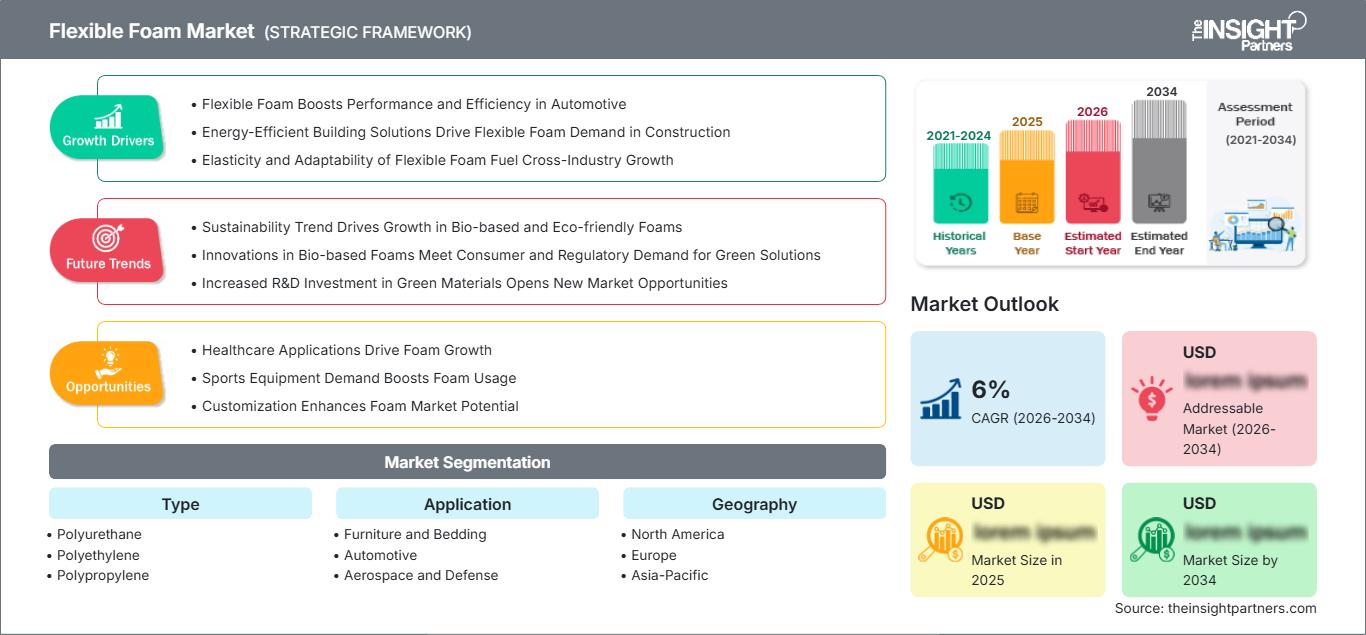
Flexible Foam Market: Strategic Insights
Regional Insights
North America Flexible Foam Market
North America is predicted to account for a 23-27% Flexible Foam Market share in 2025 and to witness growth at a 7.0-7.7% CAGR up to 2034. The US leads regional demand for flexible polyurethane foam driven by furniture replacement, bedding, vehicle manufacturing, packaging demands, and a developed network of foam converters. Canada makes its contributions through furniture, transportation, cushioning in construction projects, and industrial uses.
The Middle East & Africa region will witness a CAGR of 7.0% – 7.8% up to 2034. Construction, hospitality, transportation, furniture, and diversification initiatives make for Saudi Arabia and UAE, whereas South Africa gives the region the most developed manufacturing and converting facility. Rest of MEA participates in bedding, furniture, packaging, and industrial applications.
The abundance of energy sources and infrastructure development help downstream manufacturing despite import of raw material and logistics being key factors. Increasingly, local producers are looking for inputs available locally and efficient manufacturing technology. The demand for bedding, seating, protective packaging, and transportation components is anticipated to increase.
U.S. Flexible Foam Market
The US is expected to contribute towards 72-76% of North America revenues in 2025 and is predicted to register a CAGR between 6.8% and 7.5% until 2034. Applications’ diversity is expected to drive the demand with furniture, mattresses, automotive seats, packaging and industrial padding being the key sectors of application.
Some of the international manufacturers and converters play a considerable role within the territory of the United States. Such companies include Carpenter Co., Wisconsin Foam Products, Inc., BASF SE, Covestro AG and Huntsman International LLC among others. The demand will be driven by replacement furniture, mattresses, automobiles comfort and engineered packaging. The companies have started exploring recycled feedstocks and reduced material intensity design in order to meet sustainable development needs of the customers.
Europe Flexible Foam Market
The Europe region is expected to have a market share of 23–27% in 2025, with a CAGR of 7.4–8.1% for the period of 2025 to 2034. Germany continues to be a prominent market due to the presence of the automotive manufacturing base and industrial supply chain. The UK is benefiting from applications of furniture, bedding, automotive, and packaging. France is generating demand in transportation and consumer goods segments, whereas Italy is having demand generation owing to manufacturing of furniture and upholstery. Spain is contributing by automotive components, furniture, and industrial conversion. The increasing link between the demand generation in this region and the requirement of circular material, recycling, energy efficiency, and material waste regulations is making manufacturers produce low impact formulations, improve collection mechanisms, and use technology to recycle the polyurethane feedstock.
APAC Flexible Foam Market
The APAC region is expected to hold a 37-40% market share in 2025 and grow at a CAGR of 9.1-9.8% up to 2034. China will be the dominant nation with its major contribution through manufacturing, auto manufacturing, furniture manufacturing, and packaging conversion. The role played by Japan and South Korea will come through its automotive and electronic applications, whereas the increasing consumer base and industrial development will drive the Indian market. Australia will be a technically advanced but small market in APAC.
Middle East & Africa Flexible Foam Market
The Middle East & Africa region will witness a CAGR of 7.0% – 7.8% up to 2034. Construction, hospitality, transportation, furniture, and diversification initiatives make for Saudi Arabia and UAE, whereas South Africa gives the region the most developed manufacturing and converting facility. Rest of MEA participates in bedding, furniture, packaging, and industrial applications.
The abundance of energy sources and infrastructure development help downstream manufacturing despite import of raw material and logistics being key factors. Increasingly, local producers are looking for inputs available locally and efficient manufacturing technology. The demand for bedding, seating, protective packaging, and transportation components is anticipated to increase.
Segmentation Analysis
Type
The Type segment in the Flexible Foam Market is projected to grow at an 8.7–9.2% CAGR from 2026–2034. Polyurethane remains the dominant material because it combines cushioning, resilience, processability, and broad formulation flexibility. Polyolefin, silicone, and EVA foams occupy more specialized positions where moisture resistance, temperature stability, lightweighting, or impact absorption provide greater value.
- Polyurethane: Polyurethane maintains the broadest application base across furniture, bedding, automotive seating, and cushioning because manufacturers can tailor density, hardness, resilience, and recovery characteristics to specific requirements.
- Polyethylene: Polyethylene foam is positioned strongly in protective packaging and industrial cushioning, where closed-cell structures provide moisture resistance, impact absorption, low weight, and dependable handling performance.
- Polypropylene: Polypropylene foam is gaining strategic importance in lightweight automotive and packaging applications because its low density, toughness, thermal resistance, and recyclability support material-reduction strategies.
- Silicone: Silicone foam serves specialized applications requiring temperature stability, flexibility, chemical resistance, and long service life, particularly where conventional organic polymer foams face demanding operating conditions.
- Ethylene-Vinyl Acetate: EVA foam remains important for cushioning, footwear-related components, sports products, protective packaging, and specialty goods where softness, resilience, and lightweight construction are prioritized.
Application
The Application segment in the Flexible Foam Market is expected to expand at an 8.1–8.7% CAGR from 2026–2034. Demand is distributed across comfort products, mobility, specialized transportation, protective packaging, and high-performance applications. Automotive and packaging are increasingly influenced by lightweighting and component redesign, while furniture and bedding remain important volume contributors.
- Furniture and Bedding: Furniture and bedding represent a major demand center because flexible foam provides pressure distribution, comfort, resilience, and design flexibility across mattresses, sofas, chairs, cushions, and upholstered products.
- Automotive: Automotive applications increasingly use foam for seats, headrests, armrests, acoustic components, and interior systems, with lightweighting and occupant comfort driving formulation and component optimization.
- Aerospace and Defense: Aerospace and defense applications prioritize low weight, controlled flammability, durability, acoustic performance, and specialized cushioning, creating opportunities for engineered foam grades with stringent qualification requirements.
- Packaging: Packaging demand is driven by impact protection, lightweight construction, reusable cushioning, and product-specific designs, particularly for electronics, industrial equipment, sensitive components, and high-value goods.
Opportunity Snapshot
| Application | Revenue Contribution | Trend Tag | Adoption Stage |
| Furniture and Bedding | High | Comfort Design | Mature |
| Automotive | High | Vehicle Lightweighting | Scaling |
| Aerospace and Defense | Low | Lightweight Cushioning | Emerging |
| Packaging | Medium | Protective Packaging | Scaling |
Flexible Foam Market Growth Drivers and Impact Analysis
Automotive Lightweighting and Comfort Optimization
Automotive manufacturers are redesigning interiors to reduce vehicle mass while preserving comfort, acoustic performance, and durability. Flexible foams support this transition because density, resilience, hardness, and geometry can be adjusted without requiring major changes to component architecture. Growth in electric vehicles further increases attention to mass reduction because every kilogram removed can contribute to efficiency and range. Foam suppliers are consequently developing thinner, lighter, and multifunctional components for seating, headliners, acoustic insulation, armrests, and interior structures. The impact extends beyond volume demand because vehicle programs require qualification, dimensional consistency, and repeatable processing. Suppliers capable of combining formulation expertise with molded and converted component production can capture higher-value automotive programs and build longer-term relationships with vehicle manufacturers and tier suppliers.
Replacement Furniture and Bedding Demand
Furniture and bedding remain structurally important because foam products are replaced periodically as households, hospitality properties, healthcare facilities, and institutional buyers refresh mattresses, seating, and upholstered products. Consumer preference is also shifting toward differentiated comfort characteristics, including pressure distribution, adaptive support, breathability, and longer service life. These requirements encourage producers to formulate foams with controlled resilience and density rather than competing solely on material cost. Hospitality and healthcare applications create additional opportunities because institutional buyers often specify durability and consistent performance across large procurement volumes. The resulting demand supports both commodity slabstock production and specialized foam conversion. Producers with broad product portfolios can serve multiple comfort categories while improving manufacturing utilization, whereas converters can differentiate through cutting, profiling, lamination, and component assembly. This combination strengthens volume stability and supports premium product development.
Expansion of Protective and Engineered Packaging
Packaging is creating a broader role for flexible foams as supply chains become more sensitive to product damage, handling efficiency, and transportation costs. High-value electronics, industrial components, medical equipment, and precision products require cushioning systems that absorb shock without excessive packaging weight. Flexible foam can be cut, profiled, laminated, or molded to closely match product geometry, reducing movement during transport. Reusable packaging systems are also becoming more attractive where repeated shipment cycles justify higher initial material costs. The impact on producers is a shift toward application engineering rather than standardized sheet sales. Packaging customers increasingly expect dimensional precision, rapid prototyping, and repeatable performance. Foam manufacturers that integrate design support, converting, and material selection can therefore participate earlier in packaging development and secure recurring component programs. This favors specialized converters alongside large-scale polymer and foam suppliers.
Flexible Foam Market Future Trends
Design for Recycling and Circular Feedstocks
Future product development will increasingly incorporate end-of-life considerations into foam architecture. Manufacturers are likely to design flexible foams for easier separation, recovery, and reprocessing while increasing the use of recycled or renewable feedstocks. Chemical recycling will remain relevant for polyurethane streams that are difficult to process mechanically, while thermoplastic and mechanically recyclable foam systems can expand in selected furniture, automotive, and consumer applications. Procurement teams are expected to request documented recycled content, carbon-footprint information, and material traceability more frequently. This will change product qualification because recyclability may become an explicit purchasing criterion rather than a secondary sustainability feature. Companies that develop recovery partnerships with converters, furniture producers, automotive suppliers, and waste operators can create closed-loop supply arrangements and reduce dependence on virgin feedstocks.
Data-Driven Foam Formulation and Process Control
Digital technologies in the Flexible Foam Market Trends are expected to influence foam formulation, quality control, and production optimization more strongly over the forecast period. Manufacturers can combine formulation databases, laboratory measurements, process parameters, and performance results to identify relationships between chemistry and final foam properties. Machine-learning tools can potentially reduce development cycles by predicting density, hardness, resilience, and processing behavior before full-scale trials. Production systems can similarly monitor temperature, mixing, rise profiles, and cutting accuracy to reduce variability and material losses. The commercial effect will be strongest where customers require narrow tolerances or customized grades. Digitalization may also support faster regional replication of successful formulations, helping multinational producers maintain consistent specifications across plants. As foam complexity increases, process data will become an important competitive asset alongside chemistry, equipment, and manufacturing scale.
Flexible Foam Market Opportunities
Regionalized Production and Application Engineering
Emerging manufacturing centers provide opportunities in the Flexible Foam Market Forecast for companies to establish regional foam production and conversion capabilities closer to automotive, furniture, bedding, and packaging customers. Local production can reduce transport distances, shorten lead times, improve customization, and reduce exposure to international logistics disruptions. India and Southeast Asia offer particularly attractive opportunities where downstream manufacturing is expanding and customers increasingly seek technically supported materials. Investors can prioritize facilities combining slabstock production with cutting, profiling, lamination, and component assembly because integrated operations can capture greater value per unit of material. Partnerships with local converters may provide a lower-risk entry strategy than fully owned greenfield facilities. Companies should also evaluate regional raw-material availability, energy reliability, skilled labor, and waste-recovery infrastructure before committing capital.
Recycling Infrastructure and Low-Impact Foam Platforms
Investment opportunities are expanding around the collection, sorting, recycling, and reintegration of post-consumer flexible foams. Mattress waste is particularly relevant because large volumes of polyurethane foam enter disposal streams after product retirement. Companies can develop collection partnerships with retailers, mattress manufacturers, municipalities, and recycling operators while creating recovered-polyol or mechanically recycled material pathways. Additional opportunities exist in recyclable thermoplastic foams, bio-based feedstocks, and formulation systems designed to maintain performance with recycled content. The commercial opportunity is not limited to recyclers; chemical suppliers, foam producers, equipment manufacturers, and converters can each capture value through technology licensing, processing equipment, recovered materials, or certified low-impact products. Successful models will require consistent feedstock quality, reliable economics, and customer acceptance of recycled material.
Recent Developments
- August 2026: Momentive announced the upcoming introduction of SilOptx Silicone Y-16652, a new surfactant for flexible polyurethane foam, at Feipur 2026 in São Paulo, Brazil. The additive is designed to support foam openness, comfort, emissions control, processing efficiency, scrap reduction, and cost optimization, expanding formulation flexibility for flexible PU foam producers.
- December 2025: EUROPUR launched CertiPUR™ for Bonded Foam, extending its certification program to mechanically recycled flexible polyurethane foam. The module establishes third-party verified health and safety requirements for rebonded foam used in mattresses, upholstered furniture, and other comfort applications, supporting greater confidence in recycled PU materials and advancing circularity across the flexible foam industry.
Frequently Asked Questions

- Comprehensive Market Sizing and Forecast Analysis
- Detailed Segmentation Analysis
- In-Depth Market Dynamics Assessment
- Regional and Country-Level Insights
- Competitive Landscape and Company Benchmarking
- Strategic Business Intelligence
Recent Reports
Testimonials

The Insight Partners' SCADA System Market report is comprehensive, with valuable insights on current trends and future forecasts. The team was highly professional, responsive, and supportive throughout. We are very satisfied and highly recommend their services.
RAN KEDEM Partner, Reali Technologies LTDs
I requested a report on a very specific software market and the team produced the report in a few days. The information was very relevant and well presented. I then requested some changes and additions to the report. The team was again very responsive and I got the final report in less than a week.
JEAN-HERVE JENN Chairman, Future Analytica
We worked with The Insight Partners for an important market study and forecast. They gave us clear insights into opportunities and risks, which helped shape our plans. Their research was easy to use and based on solid data. It helped us make smart, confident decisions. We highly recommend them.
PIYUSH NAGPAL Sr. Vice President, High Beam Global
The Insight Partners delivered insightful, well-structured market research with strong domain expertise. Their team was professional and responsive throughout. The user-friendly website made accessing industry reports seamless. We highly recommend them for reliable, high-quality research services
YUKIHIKO ADACHI CEO, Deep Blue, LLC.
This is the first time I have purchased a market report from The Insight Partners.While I was unsure at first, I visited their web site and felt more comfortable to take the risk and purchase a market report.I am completely satisfied with the quality of the report and customer service. I had several questions and comments with the initial report, but after a couple of dialogs over email with their analyst I believe I have a report that I can use as input to our strategic planning process.Thank you so much for taking the extra time and making this a positive experience.I will definitely recommend your service to others and you will be my first call when we need further market data.
JOHN SUZUKI President and Chief Executive Officer, Board Director, BK Technologies
I wish to appreciate your support and the professionalism you displayed in the course of attending to my request for information regarding to infectious disease IVD market in Nigeria. I appreciate your patience, your guidance, and the fact that you were willing to offer a discount, which eventually made it possible for us to close a deal. I look forward to engaging The Insight Partners in the future, all thanks to the impression you have created in me as a result of this first encounter.
DR CHIJIOKE ONYIA MANAGING DIRECTOR, PineCrest Healthcare Ltd.Reason to Buy
- Informed Decision-Making
- Understanding Market Dynamics
- Competitive Analysis
- Identifying Emerging Markets
- Customer Insights
- Market Forecasts
- Risk Mitigation
- Boosting Operational Efficiency
- Strategic Planning
- Investment Justification
- Tracking Industry Innovations
- Aligning with Regulatory Trends





 Get Free Sample for