
Homocystinuria Market Size, Growth, Trends & Forecast by 2034
Coverage: By Method (Diagnostics and Treatment) and End User (Hospitals and Clinics, Diagnostic and Imaging Laboratories, Specialty Clinics, and Academic and Research Institutes), and Geography
- Status : Data Released
- Report Code : TIPRE00026172
- Category : Life Sciences
- No. of Pages : 150
- Available Report Formats :


- Last update date : February 04, 2026


2025 Market Size
US$ 66.25 Mn
Base year value
2034 Forecast
US$ 94.50 Mn
Projected by 2034
CAGR 2026-2034
4.03 %
Growth rate
Addressable Market
US$ 730.26 Mn
(2026-2034)
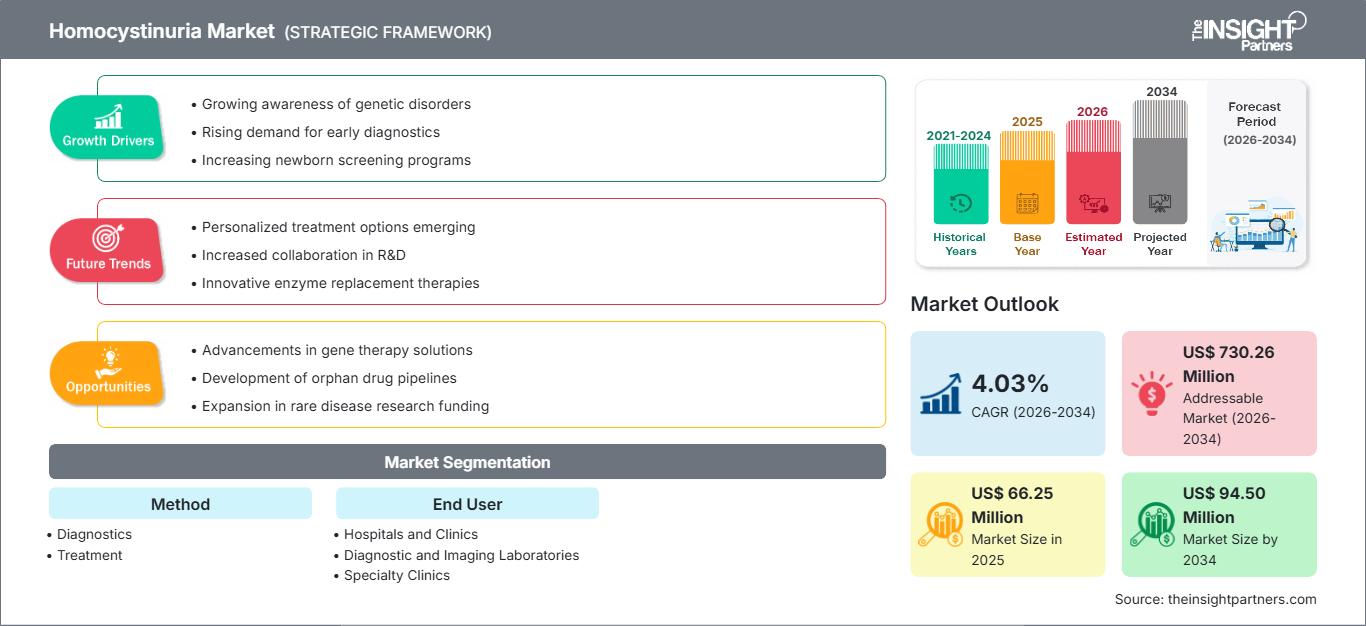
The global homocystinuria market size is expected to reach US$ 94.50 million by 2034 from US$ 66.25 million in 2025. The market is anticipated to register a CAGR of 4.03% during 2026–2034.
Homocystinuria Market Analysis
The homocystinuria market is undergoing a high-stakes shift from traditional dietary management to advanced biological interventions, especially enzyme replacement therapies and gene-editing research. To achieve competitive differentiation, stakeholders must move from general amino acid formulations to precision-guided therapeutic platforms that address the unmet need in pyridoxine-nonresponsive patients. The main opportunity is in integrating diagnostic-therapeutic pipelines, where rapid genetic sequencing at the newborn stage links directly to early-intervention orphan drug protocols. Strategically, market leaders are focusing on securing "Orphan Drug Designation" to leverage tax credits and extended market exclusivity, while simultaneously investing in patient registry data to better quantify the true global prevalence and clinical burden of Classical Homocystinuria (CBS deficiency).
Homocystinuria Market Overview
The homocystinuria market includes diagnostic tools and medical therapies for managing rare autosomal recessive metabolic disorders. The market mainly serves a pediatric demographic that requires lifelong monitoring of plasma total homocysteine (tHcy) levels to prevent severe skeletal, ocular, and thromboembolic complications. The industry is increasingly shaped by the digitalization of rare disease registries and the global expansion of Newborn Screening (NBS) mandates. Once a niche segment focused on vitamin B6, B12, and folate supplementation, the market now features a sophisticated infrastructure of specialized metabolic clinics, academic research institutes, and multinational pharmaceutical companies. This sector is a key part of the broader medical genetics market, supporting providers through high-value specialty drug delivery and long-term diagnostic monitoring.
Market Assessment and Insights
- Global market for Homocystinuria was valued at US$ 66.25 Million in 2025
- Annual market size is expected to reach US$ 94.50 Million by 2034
- Total addressable market (TAM) during 2026-2034 is projected to reach approximately US$ 730.26 Million
- Market is anticipated to register a CAGR of 4.03% during the forecast period
- The United States represents a key market, supported by Growing awareness of genetic disorders, Rising demand for early diagnostics, Increasing newborn screening programs, as well as evolving industry dynamics
- Market analysis covers North America, Europe, Asia-Pacific, South and Central America, Middle East and Africa, with growth evaluated across the forecast period
- Market opportunities such as Advancements in gene therapy solutions, Development of orphan drug pipelines, Expansion in rare disease research funding are expected to influence market dynamics and addressable market
- Report profiles industry participants, including BASF SE - Germany, HUAZHONG PHARMACEUTICAL - China, Pfizer Inc. - United States, MYLAN N.V (Viatris) - United States, Aeglea BioTherapeutics - United States, Amino GMBH - Germany, KAO Corporation - Japan, DSM Corporation - Netherlands, Orphan Technologies (Travere Therapeutics) - United States, while analyzing competitive strategies and innovation developments
-
Source: The Insight Partners' analysis based on proprietary research, government publications, company annual reports, investor presentations, industry databases, and expert interviews.
● REPORT CUSTOMIZATION
Tailor This Report To Align With Your Specific Business Requirements
This report can be customized to align precisely with your business objectives, scope, and target markets. Customization options include tailored segmentation, geography, competitive analysis, and strategic insights to support informed decision-making.
Customize This Report →WHAT YOU CAN ADJUST
- ● Segmentations
- ● Geography
- ● Competitive Analysis
- ● Language Preferences
Homocystinuria Market: Strategic Insights
-
Get Top Key Market Trends of this report.This FREE sample will include data analysis, ranging from market trends to estimates and forecasts.
Homocystinuria Market Drivers and Opportunities
Market Drivers:
- Rising Demand for Operational Efficiency in Rare Disease Delivery: Healthcare systems are seeking streamlined diagnostic-to-treatment pathways for metabolic crises. The growing demand for integrated homocystinuria management has increased to reduce the high costs associated with late-stage complications such as stroke and lens dislocation.
- Growing Telemedicine and Remote Monitoring Models: The shift to digital health has expanded the scope of chronic metabolic care. Remote monitoring of methionine-restricted diets and digital counseling for genetic screening are improving to support patients in decentralized locations.
- Increasing Government Initiatives and Regulatory Mandates: The widespread implementation of newborn screening for homocystinuria is actively driven by global health authorities. Projects such as the HITECH Act and various European Rare Disease Actions incentivize providers to adopt digital platforms for genetic data management.
Market Opportunities:
- Expansion in Emerging Markets: Regions such as Asia-Pacific and South America are witnessing increased adoption of metabolic screening due to rising healthcare IT investments and expanding pediatric specialty networks.
- Integration with Electronic Health Records (EHR) and Genetic Analytics: Integrating metabolic data with EHR systems makes data management easier and provides real-time alerts for high homocysteine levels, which helps improve healthcare delivery.
- Demand for AI-Driven Automation in Patient Identification: The trend for intelligent healthcare infrastructure is driving demand for AI solutions that can identify "at-risk" patients within large datasets, reducing the diagnostic odyssey for rare genetic conditions.
Homocystinuria Market Report Segmentation Analysis
The homocystinuria market share is analyzed across various segments to provide a clearer understanding of its structure, growth potential, and emerging trends. Below is the standard segmentation approach used in most industry reports:
By Method:
- Diagnostics: Includes biochemical assays for tHcy testing and molecular genetic testing for CBS, MTHFR, and MTRR mutations; this segment is the critical base for all market ecosystem activities.
- Treatment: Encompasses pyridoxine (Vitamin B6) therapy, betaine anhydrous (Cystadane), enzyme replacement therapies, and medical-grade amino acid supplements.
By End User:
- Hospitals and Clinics: High-volume settings for acute management and initial diagnostic evaluations.
- Diagnostic and Imaging Laboratories: Essential for supporting the successful implementation of neonatal screening programs.
- Specialty Clinics: The primary growth segment, focusing on specialized metabolic care and long-term patient engagement.
- Academic and Research Institutes: Drive innovation and advance clinical understanding through metabolic disorder research and translational studies.
By Geography:
- North America
- Europe
- Asia Pacific
- South & Central America
- Middle East & Africa
Asia Pacific is expected to grow fastest, with emerging opportunities in South & Central America, the Middle East, and Africa offering expansion potential for diagnostics and biopharmaceutical providers.
Homocystinuria Market Report Scope
| Report Attribute | Details |
|---|---|
| Market size in 2025 | US$ 66.25 Million |
| Market Size by 2034 | US$ 94.50 Million |
| Global CAGR (2026 - 2034) | 4.03% |
| Historical Data | 2021-2024 |
| Forecast period | 2026-2034 |
| Segments Covered |
By Method
|
| Regions and Countries Covered |
North America
|
| Market leaders and key company profiles |
|
Homocystinuria Market Players Density: Understanding Its Impact on Business Dynamics
The Homocystinuria Market is growing rapidly, driven by increasing end-user demand due to factors such as evolving consumer preferences, technological advancements, and greater awareness of the product's benefits. As demand rises, businesses are expanding their offerings, innovating to meet consumer needs, and capitalizing on emerging trends, which further fuels market growth.
Homocystinuria Market Share Analysis by Geography
Asia Pacific is expected to grow fastest in the coming years. Emerging markets in South & Central America, the Middle East, and Africa also have many untapped opportunities for biopharmaceutical and diagnostic providers to expand.
The homocystinuria market shows a different growth trajectory in each region due to factors such as rare disease infrastructure, newborn screening (NBS) policies, and the development of novel enzyme replacement therapies (ERT). Below is a summary of market share and trends by region:
1. North America
- Market Share: Holds the largest market share as a result of advanced rare disease infrastructure and early adoption of enzyme-based therapies.
- Key Drivers:
- Widespread integration of Homocystinuria into state-mandated Newborn Screening (NBS) panels
- The FDA's Orphan Drug Act and Rare Pediatric Disease designations provide strong regulatory support.
- Major companies such as Travere Therapeutics and Recordati Rare Diseases have a strong presence in the market.
- Trends: Shift toward home-based blood spot testing for methionine monitoring and the integration of telehealth for specialized genetic counseling and dietary management.
2. Europe
- Market Share: Public healthcare systems and strict data governance (GDPR) drive a significant share, with high prevalence rates noted in Ireland and Germany.
- Key Drivers:
- Unified European Reference Networks (ERNs) help provide specialized care for people with metabolic disorders.
- The National Health Service (NHS) is moving towards digitization and supporting research on rare diseases with government funding.
- Strong adherence to E-HOD (European Network and Registry for Homocystinurias) clinical guidelines
- Trends: Increasing use of interoperable patient registries to support cross-border clinical trials and the development of standardized, low-protein medical foods.
3. Asia Pacific
- Market Share: Fastest-growing region owing to rapid urbanization and the expansion of private pediatric centers in China and India.
- Key Drivers:
- Surge in government-supported health IT initiatives and "Digital India" / "Healthy China 2030" missions
- An expanding middle-class population with increasing access to genetic diagnostic testing
- Growing presence of local biopharmaceutical firms focusing on affordable generic betaine and vitamin supplements
- Trends: Adoption of localized diagnostic panels and AI-driven screening tools designed to identify regional genetic variants and improve early detection in decentralized clinics.
4. South and Central America
- Market Share: Emerging market with a growing focus on expanding NBS programs to include inborn errors of metabolism.
- Key Drivers:
- Private genetics laboratories in Brazil and Argentina are being modernized.
- Rare disease advocacy groups are helping to raise public awareness about metabolic disorders.
- Public health sectors are putting more emphasis on early intervention to help lower long-term disability costs.
- Trends: Increasing reliance on public-private partnerships to facilitate technology transfer for diagnostic screening and the distribution of specialized amino-acid formulas.
5. Middle East and Africa
- Market Share: Developing market with significant growth potential, particularly in the GCC region, where consanguinity leads to higher prevalence rates.
- Key Drivers:
- Saudi Arabia and the UAE are investing heavily in 'Health Cities' and specialized centers for metabolic conditions.
- Countries like Qatar have a very high incidence rate, such as 1 in 1800 people, which has led to the creation of a national priority program.
- National e-health strategies now focus on tracking chronic genetic conditions throughout a person's life.
- Trends: Implementation of aggressive, nationwide newborn screening initiatives and a heavy market shift toward advanced medical foods and therapeutic enzyme trials.
Homocystinuria Market Players Density: Understanding Its Impact on Business Dynamics
High Market Density and Competition
Competition is intensifying due to the presence of global pharmaceutical leaders such as Pfizer Inc. and Viatris (Mylan N.V.), alongside specialized biotechnology innovators like Travere Therapeutics and Aeglea BioTherapeutics. Major nutritional and chemical vendors, including BASF SE and DSM Corporation, also contribute to the crowded market landscape by providing essential medical-grade amino acids and cofactors.
This competitive environment pushes vendors to differentiate through:
- Enzyme Replacement Therapy (ERT) Innovation: Developing PEGylated recombinant enzymes, such as pegtibatinase, to address the underlying enzymatic deficiency in classical homocystinuria.
- Specialized Amino Acid Formulation: Engineering high-purity, methionine-free medical foods and amino acid blends to improve long-term dietary compliance and palatability for patients.
- Orphan Drug Lifecycle Management: Leveraging orphan drug designations to secure market exclusivity and fast-track regulatory approvals for novel therapies in underserved pediatric populations.
- Advanced Remethylation Strategies: Improving how betaine and vitamin cofactors (B6, B12, and Folate) are made and delivered to better control homocysteine levels in people with different genetic backgrounds.
Opportunities and Strategic Moves
- Collaborate with newborn screening programs and genetic testing laboratories to enhance early diagnosis rates and establish a robust patient funnel for lifelong metabolic management.
- Incorporate digital health tools and patient support programs to enhance real-time monitoring of blood homocysteine levels and improve adherence to restrictive nutritional protocols.
Major Companies operating in the Homocystinuria Market are:
- BASF SE – Germany
- HUAZHONG PHARMACEUTICAL – China
- Pfizer Inc. – United States
- MYLAN N.V (Viatris) – United States
- Aeglea BioTherapeutics – United States
- Amino GMBH – Germany
- KAO Corporation – Japan
- DSM Corporation – Netherlands
- Orphan Technologies (Travere Therapeutics) – United States
Disclaimer: The companies listed above are not ranked in any particular order.
Homocystinuria Market News and Recent Developments
- In October 2025, Denovo Sciences, Sidra Medicine, and Weill Cornell Medicine-Qatar announced a collaboration to discover and develop novel drug candidates for homocystinuria (HCU) using AI-driven drug discovery and advanced preclinical research. The partnership aims to address significant unmet medical needs, particularly in high-prevalence regions such as the MENA region.
- In June 2024, Syntis Bio launched as a clinical-stage biopharmaceutical company with $15.5 million in seed funding and announced the advancement of its rare metabolic disease pipeline, including SYNT-202, a first-in-class, orally administered enzyme therapy for homocystinuria. The company completed non-human primate studies and plans to file an IND in 2025, reinforcing momentum in disease-modifying and patient-friendly treatment approaches for HCU.
Homocystinuria Market Report Coverage and Deliverables
The "Homocystinuria Market Size and Forecast (2021–2034)" report provides a detailed analysis of the market covering below areas:
- Homocystinuria Market size and forecast at global, regional, and country levels for all the key market segments covered under the scope
- Homocystinuria Market trends, as well as market dynamics such as drivers, restraints, and key opportunities
- Detailed PEST and SWOT analysis
- Homocystinuria Market analysis covering key market trends, global and regional framework, major players, regulations, and recent market developments
- Industry landscape and competition analysis covering market concentration, heat map analysis, prominent players, and recent developments in the Homocystinuria Market
- Detailed company profiles
Frequently Asked Questions

- Comprehensive Market Sizing and Forecast Analysis
- Detailed Segmentation Analysis
- In-Depth Market Dynamics Assessment
- Regional and Country-Level Insights
- Competitive Landscape and Company Benchmarking
- Strategic Business Intelligence
Recent Reports
Testimonials

The Insight Partners' SCADA System Market report is comprehensive, with valuable insights on current trends and future forecasts. The team was highly professional, responsive, and supportive throughout. We are very satisfied and highly recommend their services.
RAN KEDEM Partner, Reali Technologies LTDs
I requested a report on a very specific software market and the team produced the report in a few days. The information was very relevant and well presented. I then requested some changes and additions to the report. The team was again very responsive and I got the final report in less than a week.
JEAN-HERVE JENN Chairman, Future Analytica
We worked with The Insight Partners for an important market study and forecast. They gave us clear insights into opportunities and risks, which helped shape our plans. Their research was easy to use and based on solid data. It helped us make smart, confident decisions. We highly recommend them.
PIYUSH NAGPAL Sr. Vice President, High Beam Global
The Insight Partners delivered insightful, well-structured market research with strong domain expertise. Their team was professional and responsive throughout. The user-friendly website made accessing industry reports seamless. We highly recommend them for reliable, high-quality research services
YUKIHIKO ADACHI CEO, Deep Blue, LLC.
This is the first time I have purchased a market report from The Insight Partners.While I was unsure at first, I visited their web site and felt more comfortable to take the risk and purchase a market report.I am completely satisfied with the quality of the report and customer service. I had several questions and comments with the initial report, but after a couple of dialogs over email with their analyst I believe I have a report that I can use as input to our strategic planning process.Thank you so much for taking the extra time and making this a positive experience.I will definitely recommend your service to others and you will be my first call when we need further market data.
JOHN SUZUKI President and Chief Executive Officer, Board Director, BK Technologies
I wish to appreciate your support and the professionalism you displayed in the course of attending to my request for information regarding to infectious disease IVD market in Nigeria. I appreciate your patience, your guidance, and the fact that you were willing to offer a discount, which eventually made it possible for us to close a deal. I look forward to engaging The Insight Partners in the future, all thanks to the impression you have created in me as a result of this first encounter.
DR CHIJIOKE ONYIA MANAGING DIRECTOR, PineCrest Healthcare Ltd.Reason to Buy
- Informed Decision-Making
- Understanding Market Dynamics
- Competitive Analysis
- Identifying Emerging Markets
- Customer Insights
- Market Forecasts
- Risk Mitigation
- Boosting Operational Efficiency
- Strategic Planning
- Investment Justification
- Tracking Industry Innovations
- Aligning with Regulatory Trends





 Get Free Sample for