
Milking Robots Market Size, Share & Demand by 2034
Coverage: by System Type (Single-Stall Unit, Multi-Stall Unit, Rotary System); Herd Size (Below 100, 100-1000, Above 1000) , and Geography (North America, Europe, Asia Pacific, and South and Central America)
- Status : Data Released
- Report Code : TIPRE00008359
- Category : Electronics and Semiconductor
- No. of Pages : 150
- Available Report Formats :


- Last update date : October 29, 2026


2025 Market Size
US$ 3.72 Bn
Base year value
2034 Forecast
US$ 9.79 Bn
Projected by 2034
CAGR 2026-2034
11.36 %
Growth rate
Addressable Market
US$ 59.57 Bn
(2026-2034)
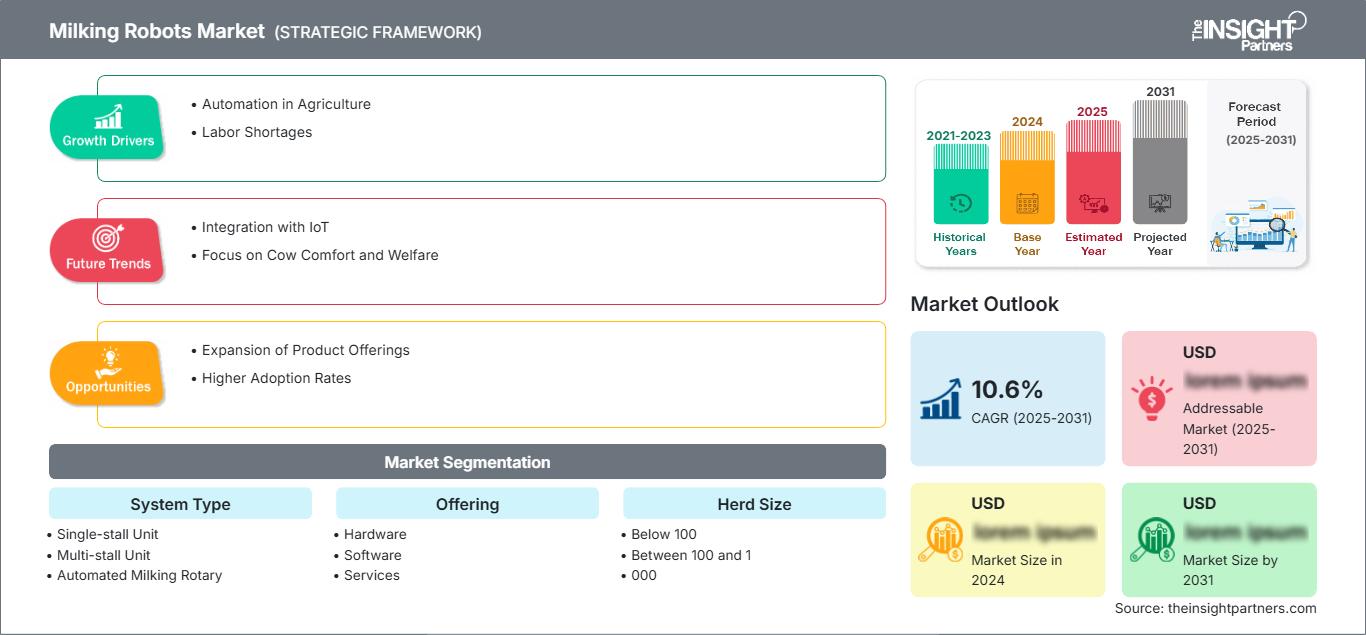
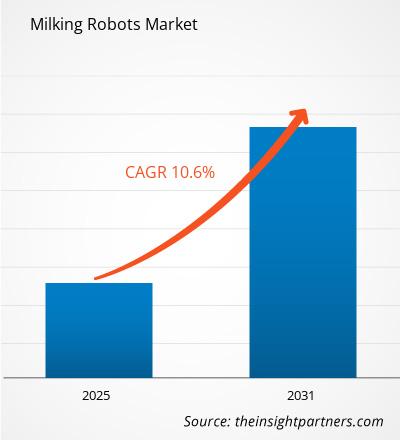
The milking robots market was valued at US$ 3.72 Billion in 2025 and is projected to reach US$ 9.79 Billion by 2034, expanding at a CAGR of 11.36% during 2026–2034. Increasing automation across dairy farming, persistent labor shortages, and the growing need for precision livestock management continue to support long-term industry expansion. Advanced robotic milking technologies are enabling dairy producers to improve herd productivity, enhance animal welfare, and optimize operational efficiency through data-driven decision-making.
Across North America, commercial dairy farms are accelerating investments in automated livestock technologies as herd consolidation, labor constraints, and digital farm management become increasingly important. The milking robots market size continues to strengthen across the region, supported by favorable financing programs, expanding precision agriculture initiatives, and greater adoption among medium- and large-scale dairy operations. Regional demand is expected to expand at an estimated CAGR of 10.5–11.5% through 2034, with the United States remaining the principal contributor.
Milking Robots Market Assessment and Insights
- North America: Accounted for an estimated 34–38% share in 2025 and is projected to register a CAGR of 10.5–11.5% during 2026–2034. Strong dairy automation investments, widespread adoption of precision livestock technologies, and sustained replacement demand continue supporting regional expansion.
- US: Represented approximately 72–76% of the North American market in 2025 and is anticipated to grow at a CAGR of 10.7–11.7% during 2026–2034, supported by large commercial dairy farms, advanced automation infrastructure, and continuous investment in digital herd management.
- Europe: Held approximately 30–34% share in 2025 and is forecast to expand at a CAGR of 10.8–11.8% during 2026–2034. The Netherlands, Germany, Denmark, France, and Sweden continue leading adoption through technologically advanced dairy farming and supportive agricultural modernization initiatives.
- Asia Pacific: Accounted for nearly 20–24% share in 2025 and is expected to record a CAGR of 12.5–13.5% during 2026–2034. China, Japan, South Korea, Australia, and India are increasing investments in automated dairy production, driven by rising milk demand and modernization of livestock operations.
- Largest Segment: Hardware represented an estimated 62–66% market share in 2025 and is projected to expand at a CAGR of 10.8–11.8% during 2026–2034, reflecting continued investment in robotic milking units, sensors, and integrated automation equipment.
- High Growth Segment: Automated Milking Rotary is expected to hold approximately 12–16% market share in 2025 while registering the fastest CAGR of 13.5–14.5% during 2026–2034, supported by growing deployment across large commercial dairy farms requiring high-throughput milking capacity.
- Key companies analyzed in detail: Afimilk Ltd., BouMatic LLC, Dairymaster, DeLaval Holding AB, Fullwood Packo Ltd., GEA Group AG, Hokofarm Group B.V., Lely Industries N.V., SCR Engineers Ltd., Waikato Milking Systems LP.
Source: The Insight Partners' analysis based on proprietary research, government publications, company annual reports, investor presentations, industry databases, and expert interviews.
Automation has shifted dairy farm operations from traditional mechanized milking to advanced, connected livestock management platforms. The current systems integrate sensors, AI, cloud-based computing, computer vision, and automatic teat cleaning to ensure high-quality milk production as well as consistency in operations. The rise in the size of herds, the increase in labor costs, and the importance of animal welfare are pushing technology adoption in developed dairy farms. Equipment suppliers are integrating advanced software, predictive maintenance, and remote monitoring tools to help farmers maximize their productivity without much intervention in their daily milking operations.
In the future, investment in this area is projected to spread to emerging dairy-producing nations where modernization of farms is a priority strategy. Government-led initiatives such as automation, sustainability, and digital farming are creating an enabling environment for adoption. There are financial institutions offering financing options for equipment, which are making it easier for mid-size dairy farms to acquire equipment. Furthermore, improvements in the reliability of robots, AI-driven herd analysis, and integration with farm management systems are bound to improve the competitiveness of this industry.
Milking Robots Market Report Scope
| Report Attribute | Details |
|---|---|
| Market size in 2025 | US$ 3.72 Billion |
| Market Size by 2034 | US$ 9.79 Billion |
| Global CAGR (2026 - 2034) | 11.36% |
| Historical Data | 2021-2024 |
| Forecast period | 2026-2034 |
Milking Robots Market Analysis
The milking robots market growth is primarily supported by persistent labor shortages affecting dairy farming and increasing pressure to improve operational efficiency. Robotic milking reduces reliance on manual labor and provides for regular milking schedules that increase animal comfort and milk output. The integration of precision livestock technologies helps to provide for round-the-clock monitoring of animal health, milk conductivity, feed consumption, and reproduction. The listed features help to detect health problems in a timely manner, to decrease veterinary expenses and to improve the productivity of herds in general, increasing the economic justification of investments in robotic milking.
In addition to being equipped with technological equipment, the modern value chain is being transformed into a digitally integrated ecosystem that combines robotic milking units, farm management software, sensors, and cloud analytics platforms. Technology vendors are increasingly cooperating with dairy cooperatives, distributors, veterinary experts, and financial institutions to offer complete solutions for farm automation. Regular software upgrades, preventive maintenance and remote diagnostics ensure the highest equipment uptime, decreasing the life cycle costs of the technology. All these aspects motivate the adoption of robotic milking even by mid-sized farms.
The milking robots market analysis indicates that competition is increasingly centered on technology innovation, software integration, and after-sales service capabilities rather than equipment pricing alone. Leading manufacturers, including DeLaval Holding AB, Lely Industries N.V., GEA Group AG, BouMatic LLC, Dairymaster, and Fullwood Packo Ltd., continue expanding intelligent automation portfolios with advanced sensing technologies, artificial intelligence, and data-driven herd management platforms. In the meantime, companies like Afimilk Ltd., SCR Engineers Ltd., Hokofarm Group B.V., and Waikato Milking Systems LP enhance their competitiveness through dedicated dairy automation systems and regional partnerships.
Current investments in new developments focus on the scalability of robotized platforms that would be able to accommodate different herd sizes and work within the context of the current facilities available at the farms. The research and development expenses increase for enhancing the precision, speed of operations, energy efficiency, and data analysis capabilities of robots. Strategic partnerships with dairy technology developers, software companies, and agricultural research organizations keep bringing the development of new dairy solutions closer.
● REPORT CUSTOMIZATION
Tailor This Report To Align With Your Specific Business Requirements
This report can be customized to align precisely with your business objectives, scope, and target markets. Customization options include tailored segmentation, geography, competitive analysis, and strategic insights to support informed decision-making.
Customize This Report →WHAT YOU CAN ADJUST
- ● Segmentations
- ● Geography
- ● Competitive Analysis
- ● Language Preferences
Milking Robots Market: Strategic Insights
Regional Insights
North America Milking Robots Market
North America accounted for an estimated 34–38% share in 2025 and is projected to expand at a CAGR of 10.5–11.5% during 2026–2034. The milking robots market share in the region remains significant because of high dairy farm mechanization, favorable financing options, and widespread deployment of precision livestock technologies. Large commercial farms increasingly adopt robotic milking systems to address labor shortages, improve herd productivity, and maintain consistent milk quality while reducing operating costs.
Technology adoption continues to accelerate as dairy producers integrate robotic milking equipment with automated feeding, herd health monitoring, and cloud-based farm management platforms. The United States and Canada benefit from established equipment suppliers, advanced dairy infrastructure, and continuous investment in digital agriculture. Government support for sustainable farming, coupled with growing emphasis on animal welfare and operational efficiency, is expected to sustain steady market expansion throughout the forecast period.
U.S. Milking Robots Market
The United States represented approximately 72–76% of the North American Milking Robots Market in 2025 and is anticipated to register a CAGR of 10.7–11.7% during 2026–2034. Large-scale dairy operations across Wisconsin, California, Idaho, New York, and Texas continue investing in robotic milking technologies to improve labor efficiency and maximize milk production. Strong presence of leading manufacturers, distributors, and dairy technology providers further supports continued equipment deployment.
Commercial dairy farms increasingly combine robotic milking systems with artificial intelligence-enabled herd monitoring, automated feeding solutions, and predictive maintenance software. Rising farm consolidation and increasing investment in digital livestock management are encouraging adoption among medium- and large-sized producers. Continuous technological innovation and availability of financing programs are expected to strengthen the country's leadership position within the regional market over the coming decade.
Europe Milking Robots Market
Europe held an estimated 30–34% share of the Milking Robots Market in 2025 and is forecast to grow at a CAGR of 10.8–11.8% during 2026–2034. The Netherlands remains the regional leader owing to its highly automated dairy sector and strong concentration of robotics manufacturers. Germany follows with extensive deployment across commercial dairy farms supported by precision agriculture initiatives and continuous modernization of livestock operations.
The United Kingdom continues expanding robotic milking adoption as dairy producers address labor shortages and pursue productivity improvements. France, Italy, and Spain are witnessing steady investment in automated dairy technologies, supported by modernization funding and increasing focus on sustainable livestock production. Across the region, stringent animal welfare regulations, energy-efficient farming practices, and digital farm management solutions continue encouraging the replacement of conventional milking systems with advanced robotic alternatives.
APAC Milking Robots Market
Asia Pacific accounted for approximately 20–24% share of the Milking Robots Market in 2025 and is projected to register the fastest CAGR of 12.5–13.5% during 2026–2034. China leads regional demand through commercial dairy expansion, while Japan and South Korea continue investing in advanced agricultural automation to improve operational efficiency and reduce labor dependency.
Australia remains an important adopter because of its large commercial dairy farms, whereas India is gradually increasing deployment through modernization initiatives and expanding organized dairy operations. Government support for smart agriculture and growing investment in precision livestock technologies are expected to accelerate long-term regional adoption.
Middle East & Africa Milking Robots Market
The Middle East & Africa Milking Robots Market is anticipated to witness steady expansion with an estimated CAGR of 9.5–10.5% during 2026–2034. Saudi Arabia and the United Arab Emirates continue investing in technologically advanced dairy farms to improve production efficiency under challenging climatic conditions, while South Africa remains the leading market in Sub-Saharan Africa.
Growing investments in food security, modern livestock infrastructure, and sustainable dairy production are supporting gradual adoption across the region. Although market penetration remains comparatively lower than in developed regions, increasing awareness of automated dairy technologies and expanding commercial farming operations are expected to create favorable long-term growth opportunities.
Segmentation Analysis
System Type
The System Type segment is expected to register a CAGR of 11.4–12.4% during 2026–2034 as dairy farms increasingly invest in automation solutions tailored to herd size, milking frequency, and farm layout. Demand is shifting toward scalable robotic systems capable of maximizing throughput while maintaining animal welfare and operational efficiency. The milking robots market scope continues to broaden as manufacturers introduce modular designs, advanced sensor technologies, and artificial intelligence-enabled milking processes suitable for diverse dairy production environments.
- Single-stall Unit: Widely adopted by small and medium-sized dairy farms because of lower installation costs, simplified operation, and flexible integration with existing barn infrastructure, making it an attractive entry point for automation.
- Multi-stall Unit: Designed for expanding dairy operations requiring higher daily milking capacity, improved labor efficiency, and simultaneous processing of multiple cows while maintaining accurate animal identification and milk quality monitoring.
- Automated Milking Rotary: Preferred by large commercial dairy enterprises seeking high-throughput automation, continuous cow flow, advanced robotic integration, and centralized management to maximize productivity across extensive herd operations.
Offering
The Offering segment is projected to expand at a CAGR of 11.2–12.2% during 2026–2034. Technology suppliers are increasingly delivering integrated hardware, intelligent software, and lifecycle support services to improve system performance and maximize long-term operational value. As dairy automation becomes more data-driven, demand continues shifting toward complete solutions that combine robotics with predictive analytics and remote monitoring capabilities.
- Hardware: Represents the largest revenue contributor owing to sustained investment in robotic milking units, robotic arms, sensors, cameras, milk quality analyzers, vacuum systems, and automated cleaning equipment required for efficient dairy operations.
- Software: Enables herd monitoring, production analytics, health management, predictive maintenance, and cloud-based reporting, allowing dairy producers to optimize productivity through real-time operational insights and automated decision support.
- Services: Includes installation, operator training, preventive maintenance, equipment upgrades, technical support, and consulting services that improve system reliability, extend equipment lifespan, and enhance return on investment.
Herd Size
The Herd Size segment is anticipated to record a CAGR of 11.8–12.8% during 2026–2034 as robotic milking adoption expands across farms of varying operational scales. Manufacturers increasingly develop flexible automation platforms capable of serving both family-owned dairy farms and large commercial enterprises while supporting future capacity expansion and digital herd management.
- Below 1,00: Smaller dairy farms adopt robotic systems to overcome labor shortages, improve milking consistency, and increase productivity while maintaining manageable capital investment and operational flexibility.
- Between 1,00 and 1,000: Medium-sized commercial farms increasingly deploy multiple robotic units to enhance workflow efficiency, optimize herd management, and support expanding milk production with reduced labor dependency.
- Above 1,000: Large integrated dairy enterprises invest in highly automated robotic systems, centralized monitoring platforms, and advanced analytics to maximize operational efficiency across extensive livestock operations and multiple production facilities.
Species
The Species segment is forecast to grow at a CAGR of 10.9–11.9% during 2026–2034. Adoption remains strongest in dairy cattle production, while specialized robotic technologies for goat and sheep farming continue gaining traction in regions emphasizing premium dairy products and improved livestock management practices.
- Dairy Cattle: Dominates adoption because of large commercial dairy operations, higher milk production volumes, established automation infrastructure, and strong economic returns achieved through robotic milking technologies.
- Goat: Demand continues to increase among specialized dairy producers seeking consistent milk quality, improved herd monitoring, and greater operational efficiency for premium cheese and dairy product manufacturing.
- Sheep: Robotic milking systems are gradually expanding within commercial sheep dairies, particularly where labor availability is limited and producers prioritize productivity improvements, animal welfare, and standardized milking procedures.
Opportunity Snapshot
| Species | Revenue Contribution | Trend Tag | Adoption Stage |
| Dairy Cattle | High | Precision Dairy | Mature |
| Goat | Medium | Specialty Milk | Scaling |
| Sheep | Low | Automated Flocks | Emerging |
Milking Robots Market Growth Drivers and Impact Analysis
Growing labor shortages accelerate investment in dairy automation
Labor shortages in all dairy-producing areas are leading to a shift from manual milking to robotic milking because of wage inflation and the aging of the agricultural workforce, coupled with the challenges of hiring skilled workers. Automating the process facilitates twenty-four hours of activity at regular milking intervals without relying on labor, hence boosting productivity. Moreover, connecting the robot with herd management software helps make decisions using the information about milk output, the well-being of the animals, and their behavior. Robotic milking becomes increasingly advantageous for commercial dairy operations in making profits and adhering to production levels despite a shortage of the labor force. Dairy farming operations are likely to adopt robotic milking technology as they continue increasing their herds.
Expansion of precision livestock farming enhances technology adoption
Intelligent robotic milking has emerged as one of the main approaches used in dairy productivity, sustainability, and animal welfare improvement. Today, robotic milkers work in tandem with wearable sensors, automatic feeders, environmental sensors, and AI-powered analytics in order to deliver a holistic approach to herd management. Information gathered in real time allows farmers to identify problems in animals' health, arrange breeding, and enhance feed utilization. Cloud computing and mobile apps help to control farms remotely and perform predictive maintenance in order to minimize the risks of equipment breakdowns. As government bodies and industry associations continue to push forward digital agriculture programs, usage of connected livestock technology is likely to grow in developed and developing dairy markets alike.
Focus on animal welfare and milk quality supports market expansion
The consumer desire for quality dairy products and increased animal welfare in the regulatory framework have prompted milk producers to improve their technology of milk collection through the introduction of robotics. The use of robots provides the chance for natural behavior from the cows by being milked at their own times, thus reducing the stress level and the general health condition of the herd. Cleaning, teat preparation, quality control, and contamination prevention of the milk ensure consistency and adherence to the growing food safety regulations. Traceability and transparency will also improve as a result. With the processors and retailers focusing on sustainability and quality milk production, such investment is likely to grow.
Milking Robots Market Future Trends
Artificial intelligence is transforming autonomous dairy management
Artificial intelligence is becoming an integral component of next-generation robotic milking systems. The milking robots market trends indicate growing deployment of machine learning algorithms capable of analyzing milk production, animal movement, feeding behavior, and health conditions in real time. These smart systems optimize the time spent in milking operations, detect disease threats even before any clinical symptoms develop, and suggest actions that increase the efficiency of the herd. Further advances will likely entail more automation, advanced predictive capabilities, and tighter integration into digital livestock systems.
Cloud-connected robotic ecosystems gain widespread acceptance
The integration of cloud technologies into farm management systems will impact the process of dairy automation because the robotic milking equipment is linked with feeding systems, medical databases, environmental sensors, and financial management applications. The integration ensures real-time synchronization and helps manage the processes at several farms from one central platform. The companies producing agricultural equipment start developing digital solutions, providing remote diagnostics and regular updates to improve the functionality of machines during their entire lifecycle. Growth of the cloud infrastructure and expansion of Internet access in rural areas will contribute to the process.
Milking Robots Market Opportunities
Expansion opportunities across emerging commercial dairy farms
Commercial dairy industries in Asia Pacific, Latin America, Eastern Europe, and selected Middle Eastern countries are entering a modernization phase characterized by larger herd sizes, stronger investment in digital agriculture, and improved access to equipment financing. Milking robots market forecasts indicate that manufacturers can benefit by developing modular robotic systems tailored to medium-sized farms with lower installation complexity and scalable capacity. Setting up regional service networks, local production collaborations, and operator training initiatives can help enhance market penetration further. Organizations adopting flexible financing schemes, predictive maintenance services, and cloud-based herd management solutions are more likely to forge better customer relationships in addition to catering to increasing demands from growing commercial dairy farming facilities.
Service-led business models create recurring revenue potential
Apart from sales of the equipment, there are also many chances for the manufacturers to increase their recurring revenue by selling software subscriptions, monitoring devices, maintenance services, and upgrade services to their customers. Increasingly, dairy farmers demand packages where robotics, analysis, cybersecurity, and technical assistance are combined into one service offered on an agreement basis. This allows companies to retain their clients and earn additional income after installation of the equipment. Cooperation with agriculture technology providers, veterinarians, dairies, and banks could help speed up the integration of value-added services. Further development of AI, cloud computing, and herd management is expected to generate business opportunities in the forecast period.
Frequently Asked Questions

- Comprehensive Market Sizing and Forecast Analysis
- Detailed Segmentation Analysis
- In-Depth Market Dynamics Assessment
- Regional and Country-Level Insights
- Competitive Landscape and Company Benchmarking
- Strategic Business Intelligence
Recent Reports
Testimonials

The Insight Partners provided valuable market intelligence that supported our global go-to-market strategy. Their team was professional, responsive, and attentive to our feedback, providing thoughtful analysis and helpful methodological clarifications throughout the project.
Junmo Kim Chief Financial Officer (CFO), Enertech Co., Ltd.
The Insight Partners' SCADA System Market report is comprehensive, with valuable insights on current trends and future forecasts. The team was highly professional, responsive, and supportive throughout. We are very satisfied and highly recommend their services.
RAN KEDEM Partner, Reali Technologies LTDs
I requested a report on a very specific software market and the team produced the report in a few days. The information was very relevant and well presented. I then requested some changes and additions to the report. The team was again very responsive and I got the final report in less than a week.
JEAN-HERVE JENN Chairman, Future Analytica
We worked with The Insight Partners for an important market study and forecast. They gave us clear insights into opportunities and risks, which helped shape our plans. Their research was easy to use and based on solid data. It helped us make smart, confident decisions. We highly recommend them.
PIYUSH NAGPAL Sr. Vice President, High Beam Global
The Insight Partners delivered insightful, well-structured market research with strong domain expertise. Their team was professional and responsive throughout. The user-friendly website made accessing industry reports seamless. We highly recommend them for reliable, high-quality research services
YUKIHIKO ADACHI CEO, Deep Blue, LLC.
This is the first time I have purchased a market report from The Insight Partners.While I was unsure at first, I visited their web site and felt more comfortable to take the risk and purchase a market report.I am completely satisfied with the quality of the report and customer service. I had several questions and comments with the initial report, but after a couple of dialogs over email with their analyst I believe I have a report that I can use as input to our strategic planning process.Thank you so much for taking the extra time and making this a positive experience.I will definitely recommend your service to others and you will be my first call when we need further market data.
JOHN SUZUKI President and Chief Executive Officer, Board Director, BK Technologies
I wish to appreciate your support and the professionalism you displayed in the course of attending to my request for information regarding to infectious disease IVD market in Nigeria. I appreciate your patience, your guidance, and the fact that you were willing to offer a discount, which eventually made it possible for us to close a deal. I look forward to engaging The Insight Partners in the future, all thanks to the impression you have created in me as a result of this first encounter.
DR CHIJIOKE ONYIA MANAGING DIRECTOR, PineCrest Healthcare Ltd.Reason to Buy
- Informed Decision-Making
- Understanding Market Dynamics
- Competitive Analysis
- Identifying Emerging Markets
- Customer Insights
- Market Forecasts
- Risk Mitigation
- Boosting Operational Efficiency
- Strategic Planning
- Investment Justification
- Tracking Industry Innovations
- Aligning with Regulatory Trends





 Get Free Sample for