
Mobile ECG Devices Market Size, Share & Forecast to 2034
Coverage: By Type (Diagnostics ECG Systems, Monitoring ECG Systems), Lead Type (12-Lead ECG, 3-6 Lead ECG, Single Lead), Modality (Handheld ECG Devices, Holter Monitors, Wearable ECG Patches, Others), End User (Hospital and Clinics, Ambulatory Surgical Centers, Cardiac Centers, Home Healthcare, Others), and Geography (North America, Europe, Asia Pacific, Middle East & Africa, South and Central America and Asia Pacific)
- Status : Published
- Report Code : TIPRE00026061
- Category : Life Sciences
- No. of Pages : 355
- Available Report Formats :


- Last update date : November 24, 2026


2025 Market Size
US$ 4,195.59 Mn
Base year value
2034 Forecast
US$ 6,752.25 Mn
Projected by 2034
CAGR 2026-2034
5.4 %
Growth rate
Addressable Market
US$ 49,571.86 Mn
(2026-2034)
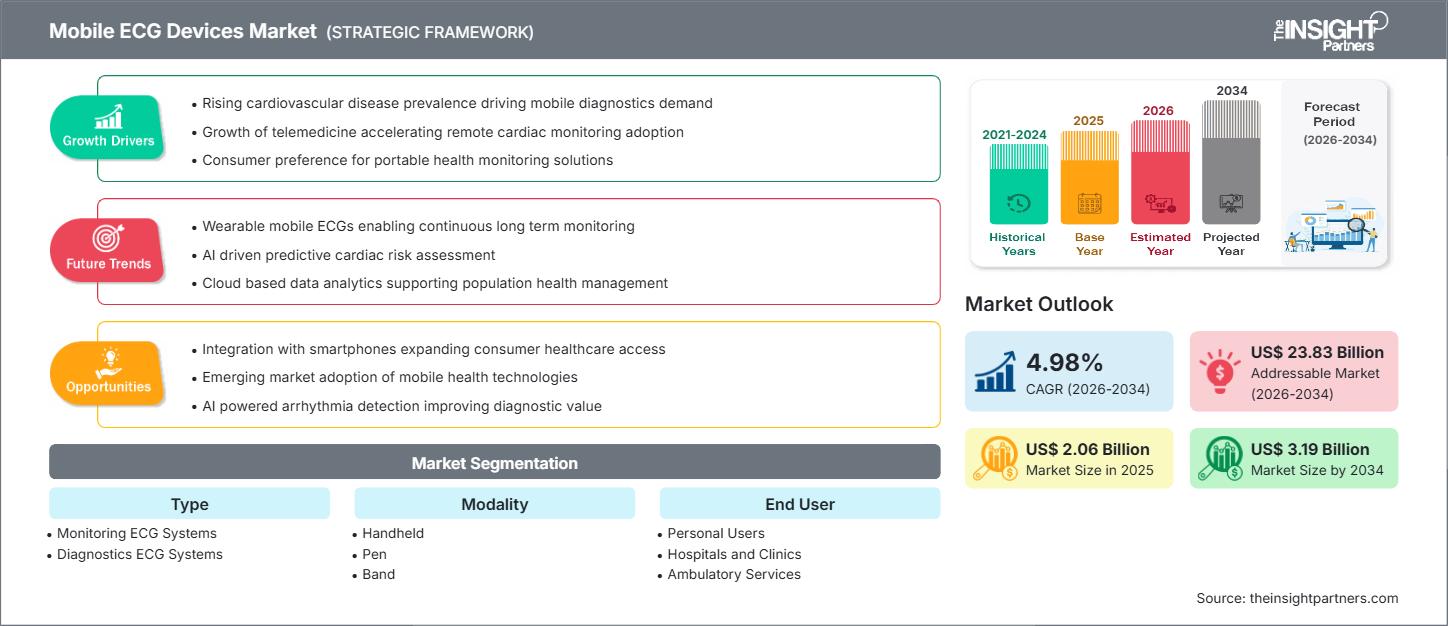
The Mobile ECG Devices Market is projected to grow from US$ 4,195.59 million in 2025 to US$ 6,752.25 million by 2034, registering a CAGR of 5.4% during 2026–2034. The growth driver is due to an increase in the incidence of rhythm disturbances, the growing usage of ambulatory cardiac monitoring, miniaturization of electrocardiography device technology, and cloud-based interpretation. Portability of the systems is being used by health-care professionals in order to reach more patients than traditional cardiologist clinics can provide.
Within North America, the Mobile ECG Devices Market size is supported by established reimbursement pathways, high adoption of ambulatory monitoring, and a broad installed base of connected cardiac technologies. The region is projected to register a CAGR of ~6% through 2034. The growth is driven by the network of outpatient cardiologists, remote patient monitoring, and increased usage of portable ECG equipment.
Mobile ECG Devices Market Assessment and Insights
Regional Outlook
- North America: ~39% of the global market in 2025 | ~6% CAGR through 2034. Market position: North America stands first on account of the cardiac care infrastructure already present, funding options available, high digital health adoption rate, and a good presence of the commercial side of ECG products.
- US: ~86% of North American market revenue in 2025 | ~6% CAGR through 2034. Market position: US dominates in this region because of the outpatient monitoring process, technological commercialization, testing with the help of funding, and implementation across hospitals, cardiology clinics, general practice, and at home.
- Europe: ~27% of the global market in 2025 | ~5% CAGR through 2034. Market position: Mature hospital infrastructure, arrhythmia pathways, aging population, and purchases of connected diagnostics systems drive up the demand. Germany, UK, and France make the leading countries of Europe.
- Asia Pacific: ~25% of the global market in 2025 | ~6% CAGR through 2034. Market position: The Asia Pacific region boasts of the highest growth potential, driven by growing cardiologists' capabilities, manufacturing within the region, investments in digital health, and wider access to portable diagnostics in China, Japan, India, and South Korea.
Segment Outlook
- Monitoring ECG Systems: ~56% Share in 2025 | ~6% CAGR through 2034. Market position: Monitoring systems win out because continuous monitoring increases the chance of detecting irregular heart rhythms and facilitates ambulatory patient monitoring.
- Home Healthcare: ~11% Share in 2025 | ~6% CAGR through 2034. Market position: The home health care industry offers a positive growth forecast in view of connectivity of devices, doctor reviewing services, aging-in-place strategies, and user recordings in ECG measurements.
Methodology
The Insight Partners follows Data Collection & Secondary Research, Primary Research, Data Analysis, and Data Triangulation & Final Review to validate market estimates and insights.
Source: The Insight Partners' analysis based on proprietary research, government publications, company annual reports, investor presentations, industry databases, and expert interviews.
Portable ECG technologies have developed from simple recording devices into connected systems that include small sensors, automatic interpretation capabilities, secure data transmission, and clinical review of data. Manufacturing of such systems includes production of lighter electrodes, low power consumption components, re-usable acquisition modules and disposable patches. Increasingly, competition in the market has moved from the hardware side into signal quality, workflow integration, analysis software, reporting process and cybersecurity. Such development has allowed expanding usage in outpatient care, ambulatory care and community facilities while keeping the demand of hospitals for multilead diagnostics.
Until 2034, investment will be focused on scalable interpretation solutions, regional distribution, clinical evidence and regulatory approval for algorithm expansion. New healthcare systems give room for growth because portable ECGs can compensate for lack of specialists and reduced need for central diagnostic labs. Favorable regulatory environment will require accurate measurements, transparent clinical decision support, secure data transfer and clear supervision by physicians. Manufacturers who will combine low cost acquisition hardware and services for analytics will benefit from such situation.
Mobile ECG Devices Market Report Scope
| Report Attribute | Details |
|---|---|
| Market size in 2025 | US$ 4,195.59 Million |
| Market Size by 2034 | US$ 6,752.25 Million |
| Global CAGR (2026 - 2034) | 5.4% |
| Historical Data | 2021-2024 |
| Forecast period | 2026-2034 |
Mobile ECG Devices Market Analysis
Growth in the Mobile ECG Devices Market is a result of the overlap between the screening, outpatient treatment, and periodic rhythm detection segments. There are various sources of demand, including hospitals, cardiac clinics, ambulatory centers, primary care providers, and patients who need post-discharge monitoring. These are component manufacturers, device makers, software and algorithm providers, contract manufacturers, cloud platform providers, distributors, clinicians, and payers.
In terms of supply, an advantage is given to those companies which will be able to ensure the quality of electrodes, batteries, signal integrity, and software compatibility in large volumes. The diagnostic value of a Mobile ECG Devices is not solely determined by the recording equipment but also by artifact filtering, secure transmission, reporting speed, and integration with medical records.
Differentiation in Competitive Mobile ECG Devices Market can be based on lead configuration, wear time, mobility, AI and clinician review services. GE Healthcare Technologies Inc., Koninklijke Philips N.V., Nihon Kohden Corporation and SCHILLER AG rely on their connections in the institutions as well as their wider range of cardiology products, while AliveCor, Inc., D-Heart S.r.l. and Personal MedSystems GmbH have portable and user-friendly applications.
Software-driven recurring revenue model, algorithms collaborations and interoperable platforms are gaining investments now. Koninklijke Philips N.V. has enlarged its ECG artificial intelligence ecosystem, while AliveCor, Inc. offers small acquisition and subscription-based interpretation. Asian manufacturers such as Shenzhen Mindray Bio-Medical Electronics Co., Ltd., Fukuda Denshi Co., Ltd. and BPL Medical Technologies Private Limited increase competition with their localized production and affordable product configurations.
● REPORT CUSTOMIZATION
Tailor This Report To Align With Your Specific Business Requirements
This report can be customized to align precisely with your business objectives, scope, and target markets. Customization options include tailored segmentation, geography, competitive analysis, and strategic insights to support informed decision-making.
Customize This Report →WHAT YOU CAN ADJUST
- ● Segmentations
- ● Geography
- ● Competitive Analysis
- ● Language Preferences
Mobile ECG Devices Market: Strategic Insights
Regional Insights
North America Mobile ECG Devices Market
North America accounts for a Mobile ECG Devices Market share of ~39% in 2025 and is projected to expand at a CAGR of ~6% through 2034. Leadership from regional countries is tied to strong cardiology infrastructure, high diagnostic rates, availability of ambulatory monitoring, and timely adoption of the connectivity of ECG solutions. There is an increasing trend of linking portable ECG acquisition and analysis to handle patients in their emergency, inpatient, outpatient, and post-discharge treatment processes.
Canada has a role to play through its public healthcare system, its remote care programs, and the need for diagnostics in a dispersed population. Mexico is a nascent market where there is potential through the investment of private hospitals and increasing use of portable solutions, although affordability and access to specialists is an issue.
U.S. Mobile ECG Devices Market
The US represents ~86% of North American revenue in 2025 and is expected to register a CAGR of ~6% through 2034. This market opportunity is justified due to heavy investments made in cardiac diagnostics, existence of large ambulatory monitoring market segment, and implementation of ECG systems in hospitals, physicians' practices, urgent care facilities, employer-based clinics, and at-home patient monitoring programs.
The commercialization is represented by institutional platforms from GE HealthCare Technologies Inc. and Koninklijke Philips N.V., hospital and ambulatory products from Nihon Kohden Corporation, and consumer ECG devices from AliveCor, Inc. The reimbursement becomes an important factor in the case of portable multi-lead testing. In January 2025, AliveCor noted the Medicare outpatient rate for use of its Kardia 12L device to be US$ 59.40, thus facilitating the business process of implementation in appropriate outpatient settings.
Europe Mobile ECG Devices Market
Europe holds ~27% of global revenue in 2025 and is forecast to record a CAGR of ~5% through 2034. Demand is driven by aging populations, existing cardiology networks, national arrhythmia treatment plans, and procurement of interconnected diagnostic systems. Germany leads in Europe because of the presence of hospitals, specialists, medical device industry, and adoption of ambulatory cardiac diagnostics.
In the UK, remote monitoring relies on digitally enabled primary and secondary care but may be slowed down by procurement cycles and evidence needs, whereas in France, there is hospital demand and management of chronic disease. Italy and Spain provide room for growth by virtue of their regional healthcare system development, private diagnostic networks, and focus on the early diagnosis of arrhythmias. Their procurement is regional, meaning that companies have to develop regional partnerships, not just national ones.
Other players include European SCHILLER AG, Koninklijke Philips N.V., D-Heart S.r.l., and Personal MedSystems GmbH, and international providers of hospital equipment. Product choice is driven by the issues of patient safety, interactivity with electronic health records, disposable/reusable economics, and transmission of clinically readable recordings. Europe’s regulatory maturity makes suppliers' experience in the market a plus.
APAC Mobile ECG Devices Market
Asia Pacific accounts for ~25% of global revenue in 2025 and is projected to expand at a CAGR of ~6% through 2034, making it the fastest-growing region. China is the foremost nation in the region thanks to hospital development, local manufacture of devices, digital healthcare use, and high demand for affordable cardiovascular diagnosis technology.
Japan participates in the market thanks to its well-established use of ECG and companies like Nihon Kohden Corporation and Fukuda Denshi Co., Ltd. South Korea fosters the development of connected care solutions, and India offers volume opportunities due to private hospitals, diagnostic centers, and local manufacturing. Australia sustains its demand for ambulatory and remote monitoring.
Middle East & Africa Mobile ECG Devices Market
The Middle East & Africa Mobile ECG Devices Market is forecast to register a CAGR of ~4% through 2034. Saudi Arabia emerges as a key player in the Middle East & Africa region via investments in hospitals, digital health solutions, and cardiac specialties. United Arab Emirates helps provide high-end diagnostic services via its advanced hospitals and healthcare facilities.
South Africa becomes the key driver of demand for Sub-Saharan Africa owing to its relatively well-developed hospital infrastructure and private insurance market. The Rest of MEA region is diverse, with lack of specialists making portability and centralized reading a practical proposition. Market adoption is hampered by budget constraints, limited connectivity, maintenance capability, and reimbursement limitations. Training of distributors and efficient, battery-powered products become the key to success.
Segmentation Analysis
By Type
Type Segmentation differentiates the use of systems that are used for acquiring diagnostics from those that have been made for continuous observation. This type segmentation is very important within the scope of the Mobile ECG Devices Market due to the fact that the factors affecting the decision to buy differ based on the setting, recording period, analysis depth, and urgency. The monitoring ECG Systems will have a CAGR of ~6% between 2026 and 2034.
- Diagnostics ECG Systems: These devices help perform assessments where the recording is needed with high resolution, standardization, and fast analysis. The demand for them still persists in hospitals, cardiology clinics, emergency centers, and testing centers.
- Monitoring ECG Systems: The devices for monitoring allow repeated, continuous, or event-driven monitoring beyond a short resting session. Their strategic benefit can be seen in increasing the chances of capturing transient arrhythmias while patients are in their normal activities.
By Lead Type
Configurations of leads impact diagnostic capability, mobility, installation ease, patient comfort, and application. Waveform capability vs. data capture speed and ease of operation is balanced by the purchaser. Single Lead ECG systems are forecast to experience a CAGR of around 6% between 2026 and 2034 due to expanded usage in consumer accessible recordings and rhythm monitoring.
- 12-Lead ECG: This design configuration represents the benchmark for thorough resting assessment and morphology analysis. Portability enables its use in urgent care, primary care, emergency care, and other restricted settings.
- 3-6 Lead ECG: Intermediate configurations give more rhythm information than basic personal devices but retain small form factors. They are useful in ambulatory settings, selective monitoring, and doctor-managed remote work flows.
- Single Lead: Single-lead devices focus on ease of use, accessibility, and quick recording when symptoms occur. Their implementation is best suited for personal monitoring, rhythm screening, teleconsultations, and longitudinal monitoring.
By Modality
Modalities chosen depend on the period of recording, mobility, process flow, and whether the test is performed by the clinician’s discretion or by the patients themselves. This modality will help in purchasing in any clinical or decentralized setting. Wearable ECG Patches are predicted to grow at a CAGR of around 6% during 2026-2034 due to increased recording time and compliance.
- Handheld ECG Devices: Hand-held devices allow for instant recording in absence of any fixed diagnostic facility. These are suited for primary care, urgent evaluations, consultations in telemedicine and rhythm assessments managed by patients themselves.
- Holter Monitors: The Holter monitoring systems continue to find widespread use for unattended ambulatory recording in accordance with set clinical practices. Installed base, experience of clinicians, channel flexibility and report consistency contribute to their significance.
- Wearable ECG Patches: Patch recordings minimize cable hassles and enable prolonged recordings under conditions of regular activity. The best applicability for these devices arises when uninterrupted recording and ease of return are likely to help increase recording time.
- Others: Other types of devices include special event recorders, telemetry connected systems and specialized portable units. The need for such devices depends on clinical processes, recording duration, connections and local reimbursement schemes.
By End User
There are variations in user requirements based on patient acuity levels, personnel levels, diagnostic numbers, and the ability to read recordings sent from the device. The hospital and clinics will continue to be the key buyers, while decentralized operations will be beneficial for future demand growth. The Home Healthcare segment is expected to have a CAGR of ~6% from 2026 to 2034.
- Hospital and Clinics: These facilities systems that will scale well and connect seamlessly with cardiologists' work process, patients' files, and centralized interpretation. Procurement will be based on accuracy, speed, infection control, connectivity, and customer service..
- Ambulatory Surgical Centers: Outpatient facilities utilize small ECG machines for pre-surgical evaluation, during surgical procedures, and post-procedure care. Space saving, fast set up, and accurate data recording determine utilization.
- Cardiac Centers: Specialist centers will demand advanced rhythm analysis as well as large amounts of interpretations. Market demand calls for systems that have multilead capacity, detailed analysis, comparison and connectivity in diagnostic and treatment pathways.
- Home Healthcare: The home environment is where user-friendliness, guidance, reliability of data transfer, and availability of professional interpretation become essential. Utilization will depend on education and guidelines separating serious ECG results from unimportant ones.
- Others: Other end-users of ECG technology include employee clinics, emergency services, research facilities, sports medicine facilities, and screening programs. Utilization is dependent on clinical governance and skill level.
Opportunity Snapshot
| End User | Revenue Contribution | Trend Tag | Adoption Stage |
| Hospital and Clinics | High | Workflow Integration | Mature |
| Ambulatory Surgical Centers | Medium | Perioperative Screening | Scaling |
| Cardiac Centers | High | Rhythm Analytics | Mature |
| Home Healthcare | Medium | Remote Monitoring | Scaling |
| Others | Low | Community Screening | Emerging |
Mobile ECG Devices Market Growth Drivers and Impact Analysis
Rising Need to Detect Intermittent Cardiac Rhythm Abnormalities
It is possible that the short duration of ECGs may not be sufficient to record rhythm abnormalities that take place randomly, leading to the need for portable and continuous ECG recordings, and in addition, ones where the recording is initiated by the patient. The influence of this invention goes beyond just the number of devices sold because longer ECGs require more interpretation software, data storage, analysis by the technicians, and reporting by physicians. Healthcare professionals can use these ECGs for patient triage and for surveillance following treatment. The success of the business will rely on eliminating artifacts and alarms.
Decentralization of Cardiac Testing Across Care Settings
Acquisition of electrocardiograms is not restricted anymore to the cardiology department and is increasingly used in general practice clinics, urgent care clinics, outpatient settings, occupational health centers, and even at home. The use of small equipment reduces the need for space and the complexity of setup, whereas the sending of data over the cloud allows experts to examine the results in a different location. This decentralization can be helpful in cases where there is limited expertise in cardiology in the community. Vendors benefit from an extended market, but they have to change some aspects of their business model.
Growing Integration of ECG Hardware with Digital Clinical Workflows
The purchasing process has become more concerned with the whole process of signal acquisition to review, document, escalate, and make longitudinal comparisons. The integration of the systems into the clinical information platforms would minimize human intervention and facilitate access to previous recording. Integration would also create recurrent chances for software licensing, analytics, technical support, and fleet management. Nevertheless, the issue of fragmented interfaces remains as a barrier, especially in multisite health organizations that have devices from different suppliers. Suppliers that integrate open connectivity, data security, and reporting could increase retention due to the expense of changing an embedded system versus an isolated system.
Mobile ECG Devices Market Future Trends
AI-Assisted Interpretation Moves Toward Managed Clinical Ecosystems
Trends in Mobile ECG Devices market are changing from standalone automated results to systems where a number of validated algorithms work within current clinical environment. This system is capable of performing classification of rhythms, waveform triaging, morphological analysis, and identification of patterns that require additional attention. An ECG AI Marketplace was created by Koninklijke Philips N.V. in July 2025, which started integrating an FDA-approved low-ejection-fraction algorithm developed by Anumana within their ECG ecosystem. The future adoption of the algorithms will be determined by transparency of performance, population-specific validation, clinician’s control, and algorithm drift monitoring.
Multimodal Wearables Expand Beyond Rhythm-Only Monitoring
The next generation of wearables is anticipated to incorporate ECG along with other physiological metrics to evaluate a wide range of functions of the heart instead of just its rhythm. Other possible measurements include photoplethysmography, motion detection, hemodynamic measures, oxygen saturation, or symptoms. Such an evolution of wearable technology would help monitor heart failure and subsequent decompensation at home, although such an evolution will complicate validation and interpretation. Companies will have to prove that these signals provide better patient management than more data. Collaboration between sensor manufacturers, algorithms, and healthcare providers will thus be more important until 2034.
Mobile ECG Devices Market Opportunities
Portable Multilead Testing for Primary and Underserved Care Settings
Reduced lead solutions provide an avenue for investment in the areas of primary care, urgent care, rural facilities, ambulances, and community health networks that do not have conventional ECG setups. According to Mobile ECG Devices Market Forecasts, such solutions can be adopted if there is a combination of portable devices along with appropriate positioning, quality assurance, remote diagnosis, and proper reimbursement. One of the companies taking the business route in this regard is the AliveCor Kardia 12L, which combines reduced-lead devices with diagnostic results using algorithms.
Subscription-Based Monitoring and Longitudinal Cardiac Services
Repeatable services can transform transient hardware sales to recurring engagements through analytics, cloud storage, expert analysis, patient engagement, and repeat replacement of the devices. The potential exists when care providers have a need for scaleable monitoring without having a large expert team for interpretation of results. AliveCor introduced its KardiaMobile 6L Max with KardiaAlert service in May 2025 by offering personal ECG recording, baseline comparisons, subscription services, and cardiologist analysis. Commercial models must however prevent alert fatigue, establish clinical liability, and remain affordable.
Recent Developments
- September 2026: Nihon Kohden entered into a strategic partnership agreement with Japan Activation Capital aimed at sustainable growth and enhancing corporate value. The company described its business as including development and sale of ECGs alongside patient monitors, EEGs, AEDs, and ventilators.
- November 2025: Koninklijke Philips N.V. received FDA 510(k) clearance for the latest release of Cardiovascular Workspace, including cloud-hosted availability through HealthSuite. The solution supports cloud-based cardiovascular data access and creates a foundation for further AI-enabled cardiac analysis and reporting.
Frequently Asked Questions

- Comprehensive Market Sizing and Forecast Analysis
- Detailed Segmentation Analysis
- In-Depth Market Dynamics Assessment
- Regional and Country-Level Insights
- Competitive Landscape and Company Benchmarking
- Strategic Business Intelligence
Recent Reports
Testimonials

The Insight Partners provided valuable market intelligence that supported our global go-to-market strategy. Their team was professional, responsive, and attentive to our feedback, providing thoughtful analysis and helpful methodological clarifications throughout the project.
Junmo Kim Chief Financial Officer (CFO), Enertech Co., Ltd.
The Insight Partners' SCADA System Market report is comprehensive, with valuable insights on current trends and future forecasts. The team was highly professional, responsive, and supportive throughout. We are very satisfied and highly recommend their services.
RAN KEDEM Partner, Reali Technologies LTDs
I requested a report on a very specific software market and the team produced the report in a few days. The information was very relevant and well presented. I then requested some changes and additions to the report. The team was again very responsive and I got the final report in less than a week.
JEAN-HERVE JENN Chairman, Future Analytica
We worked with The Insight Partners for an important market study and forecast. They gave us clear insights into opportunities and risks, which helped shape our plans. Their research was easy to use and based on solid data. It helped us make smart, confident decisions. We highly recommend them.
PIYUSH NAGPAL Sr. Vice President, High Beam Global
The Insight Partners delivered insightful, well-structured market research with strong domain expertise. Their team was professional and responsive throughout. The user-friendly website made accessing industry reports seamless. We highly recommend them for reliable, high-quality research services
YUKIHIKO ADACHI CEO, Deep Blue, LLC.
This is the first time I have purchased a market report from The Insight Partners.While I was unsure at first, I visited their web site and felt more comfortable to take the risk and purchase a market report.I am completely satisfied with the quality of the report and customer service. I had several questions and comments with the initial report, but after a couple of dialogs over email with their analyst I believe I have a report that I can use as input to our strategic planning process.Thank you so much for taking the extra time and making this a positive experience.I will definitely recommend your service to others and you will be my first call when we need further market data.
JOHN SUZUKI President and Chief Executive Officer, Board Director, BK Technologies
I wish to appreciate your support and the professionalism you displayed in the course of attending to my request for information regarding to infectious disease IVD market in Nigeria. I appreciate your patience, your guidance, and the fact that you were willing to offer a discount, which eventually made it possible for us to close a deal. I look forward to engaging The Insight Partners in the future, all thanks to the impression you have created in me as a result of this first encounter.
DR CHIJIOKE ONYIA MANAGING DIRECTOR, PineCrest Healthcare Ltd.Reason to Buy
- Informed Decision-Making
- Understanding Market Dynamics
- Competitive Analysis
- Identifying Emerging Markets
- Customer Insights
- Market Forecasts
- Risk Mitigation
- Boosting Operational Efficiency
- Strategic Planning
- Investment Justification
- Tracking Industry Innovations
- Aligning with Regulatory Trends






 Get Free Sample for