
Opaque Polymers Market Trends, Demand & Growth by 2034
Coverage: by Type (Solid Content 30%, and Solid Content 40%), Application (Detergents, Paints & Coatings, and Personal Care), and Geography (North America, Europe, Asia Pacific, and South and Central America)
- Status : Data Released
- Report Code : TIPRE00003207
- Category : Chemicals and Materials
- No. of Pages : 150
- Available Report Formats :


- Last update date : October 26, 2026


2025 Market Size
US$ 3.80 Bn
Base year value
2034 Forecast
US$ 9.89 Bn
Projected by 2034
CAGR 2026-2034
11.21 %
Growth rate
Addressable Market
US$ 60.39 Bn
(2026-2034)
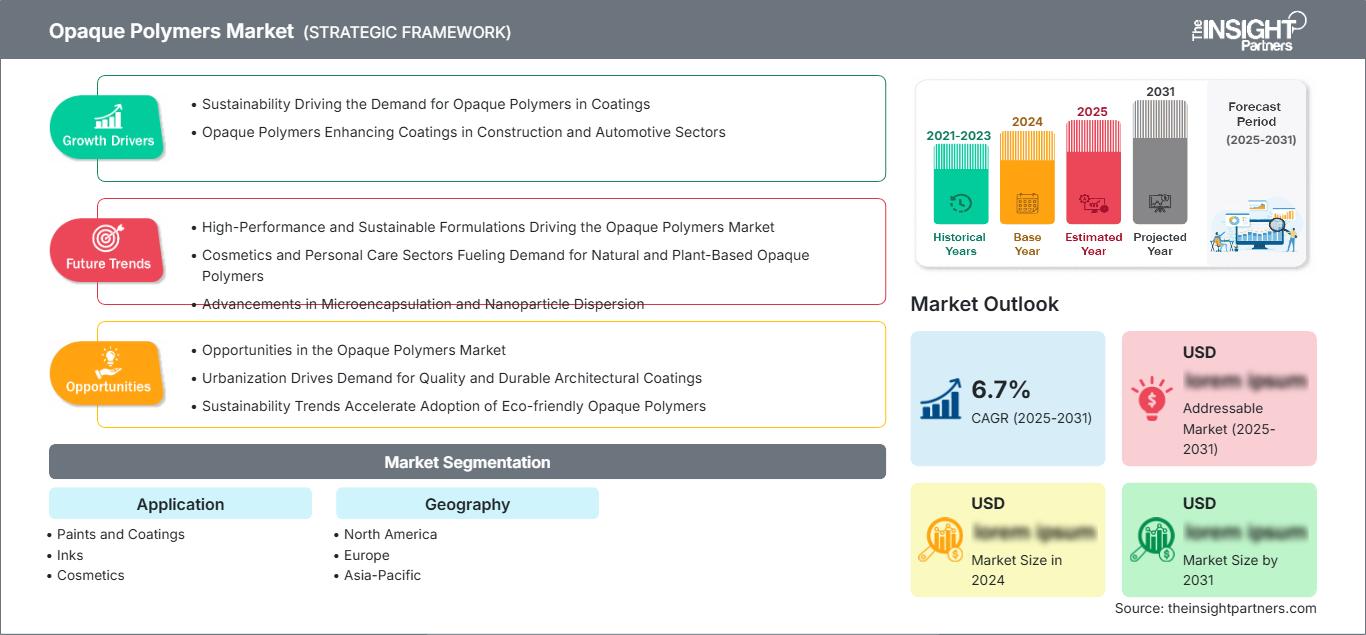
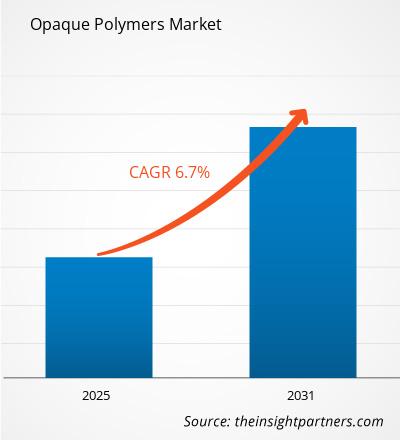
The opaque polymers market size was valued at US$ 3.80 Billion in 2025 and is projected to reach US$ 9.89 Billion by 2034, expanding at a CAGR of 11.21% during 2026-2034. The market covers polymeric opacifiers supplied primarily as aqueous dispersions, with the defined taxonomy segmented by Type into Solid Content 30% and Solid Content 40%, and by Application into Paints and Coatings, Inks, Cosmetics, and Adhesives.
North America is estimated to account for 22.5% of the global market in 2025 and is expected to expand at a 9.70% CAGR through 2034. Mature architectural-coatings formulation practices and established adoption of polymeric opacifiers support regional demand, while TiO2 optimization and low-VOC waterborne coating development continue to influence purchasing decisions. Dow and BASF maintain established opaque-polymer portfolios for coating formulators, reinforcing technical availability in the region.
Opaque Polymers Market Assessment and Insights
- North America: North America is estimated to hold 22.5% of the global opaque polymers market share in 2025 and grow at a 9.70% CAGR through 2034. Mature waterborne coatings and established TiO2-spacing technologies support adoption, while replacement economics sustain formulation demand.
- U.S.: The U.S. is estimated to represent 67.0% of North American demand in 2025 and expand at a 9.90% CAGR. Architectural coatings remain central, supported by commercial availability of ROPAQUE and AQACell technologies.
- Europe: Europe is estimated to represent 24.0% of global demand in 2025 and grow at a 10.10% CAGR. Germany, France, Italy, the UK, and Spain form the principal demand base, with low-emission coatings, APEO avoidance, and TiO2 optimization differentiating procurement requirements.
- Asia Pacific: Asia Pacific is estimated to account for 37.0% of global demand in 2025 and grow at a 12.50% CAGR. China, Japan, South Korea, and India lead regional activity, supported by expanding coatings production, local latex manufacturing, and increasing formulation localization.
- Largest Segment: Application is the largest main segment, with a 11.10% CAGR through 2034, led by paints and coatings where opaque polymers improve light scattering, extend TiO2 efficiency, and support waterborne formulation economics.
- High Growth Segment: Type is the high-growth main segment, with a 11.45% CAGR through 2034, as higher-solids opaque-polymer formulations can improve material efficiency, shipping economics, and formulation flexibility for industrial users.
- Key companies analyzed in detail: BASF SE; Dow Inc.; Arkema S.A.; Ashok Dyestuff (P) Limited; Hankuck Latices Co., Ltd.; Vimal Chemicals; Colorchem Industries Ltd.; Trison Polymers; Shree Shyam Global; Visen Industries Limited; Organik Kimya; Zschimmer & Schwarz GmbH & Co. KG.
Source: The Insight Partners' analysis based on proprietary research, government publications, company annual reports, investor presentations, industry databases, and expert interviews.
The opaque polymers market has moved from relatively primitive latex hollow sphere technology to controlled polymer morphology, particle size distribution, void structure, and formulation compatibility. The core principle of performance stays light scattering by air-filled voids resulting from water evaporation from polymer particles, and better TiO2 dispersion provides better pigment performance. New generation products focus on being ammonia free, APEO free, odorless, and with low VOC, which reflects current formulation demands in architectural paints and sustainability considerations. Currently, BASF, Dow, and Arkema are positioning their opaque polymers based on TiO2 optimization and coating performance advantages.
In the future, commercialization in the opaque polymers market will expand with localization of production in Asia and other developing coating markets, as well as investment in new generations of opaque polymer which will have lower odor, regulatory compatibility, and better formulation flexibility. The trend of supply chain localization is becoming increasingly important as regional paint companies seek shorter lead times and formulation expertise. Also, there is product development toward high-solids dispersion and application-specific polymer morphology to allow suppliers to compete not just in opacity but performance efficiency as well.
Opaque Polymers Market Report Scope
| Report Attribute | Details |
|---|---|
| Market size in 2025 | US$ 3.80 Billion |
| Market Size by 2034 | US$ 9.89 Billion |
| Global CAGR (2026 - 2034) | 11.21% |
| Historical Data | 2021-2024 |
| Forecast period | 2026-2034 |
Opaque Polymers Market Analysis
The driving factor in the case of demand is the coating formulators' need to strike a balance between hiding power, TiO2 usage, formulation cost, and environmental demands. This cause-and-effect relationship is quite simple – increasing costs of pigments and tightening formulations result in TiO2 spacing technology that boosts efficiency of existing white pigment systems, hence generating demand for hollow sphere polymer dispersions. The value chain starts from acrylic/styrenic monomers, surfactants, initiators, water, and specialty formulation components, emulsion polymerization, particle conditioning, quality control, packaging, and distribution to coating, ink, cosmetic and adhesive formulators.
The opaque polymers market report shows that factors affecting supply include expertise in the area of polymerization, particle morphology control, latex stability and consistent solids contents. Particle size distribution should be narrow, since opaque polymers have to scatter predictably and should be compatible with binders, pigments, rheology modifiers and other ingredients. Competitiveness among suppliers of these technologies includes, besides lower costs of polymer, the aspects of formulation flexibility, low-VOC compatibility, smell characteristics, regulatory aspects and TiO2 replacement efficiency. Examples of suppliers positioning their opaque polymers as formulation efficiency technologies rather than standard extenders include Dow ROPAQUE range, BASF AQACell products and Arkema CELOCOR family.
The opaque polymers market trends indicate that competitive environment includes international specialty chemicals providers and local producers of latex and coating material. BASF, Dow, and Arkema offer unique product differentiating by the proprietary technology of hollow spheres and comprehensive formulation support services, whereas Hankuck Latices, Trison Polymers, Ashok Dyestuff, Organik Kimya, and Visen Industries meet local requirements using synthetic emulsions, opaque polymers, and additives to formulations. For example, Trison Polymers runs an emulsion polymer manufacturing facility for serving paint, coating, adhesive, and textile markets, while Hankuck Latices offers dedicated products for opaque polymer and hollow spheres applications in paint and paper industry.
More and more investments go to the development of formulation-specific solutions and not only capacity expansion. Suppliers are working on developing ammonia-free and APEO-free systems, more effective opacifiers, and polymers capable to work in low-emission paints. Arkema CELOCOR AF is a product devoted to ammonia-free formulation and hiding power optimization, while BASF AQACell HIDE 6299 na pays special attention to TiO2 spacing and formulated cost reduction. It becomes clear from the above examples that positioning of companies relies upon formulation economics, regulation readiness, technical service, and opaque polymer integration into formulations.
● REPORT CUSTOMIZATION
Tailor This Report To Align With Your Specific Business Requirements
This report can be customized to align precisely with your business objectives, scope, and target markets. Customization options include tailored segmentation, geography, competitive analysis, and strategic insights to support informed decision-making.
Customize This Report →WHAT YOU CAN ADJUST
- ● Segmentations
- ● Geography
- ● Competitive Analysis
- ● Language Preferences
Opaque Polymers Market: Strategic Insights
Regional Insights
North America opaque polymers market
North America is estimated to hold 22.5% of global demand in 2025 and grow at a 9.70% CAGR through 2034. The region benefits from established waterborne architectural-coating manufacturing, sophisticated formulation practices, and widespread awareness of TiO2 optimization. The U.S. accounts for most regional demand because of its large architectural and industrial coatings base and strong presence of multinational polymer and additive suppliers.
Product supply within the region is bolstered by the presence of product portfolios of companies like Dow and BASF, with ROPAQUE and AQACell technologies focusing on aspects of opacity, TiO2 spacing, and formula cost efficiency. Present-day developments include an increase in products that are free of ammonia and APEO for reduced odor and emission of products. The market in Canada is relatively small but technologically advanced.
U.S. opaque polymers market
The U.S. is estimated to account for 67.0% of North American demand and grow at a 9.90% CAGR through 2034. The dominance is driven by the magnitude of the architectural coatings market and the presence of suppliers of formulated technology solutions. Both Dow's ROPAQUE series and BASF's AQACell line offer local formulators proven avenues to increase opacity at reduced reliance on TiO2.
Demand is centered around interior and exterior architectural coatings; although some industrial coating and certain paper applications offer diversity. The distinguishing element is the sophistication of the formulation optimization process: consumers tend to judge opaque polymers based on their hiding performance, pigment distribution, odor, VOCs, and formulation costs. This creates an advantage for suppliers who can provide both technology and formulation services.
Europe opaque polymers market
Europe is estimated to represent 24.0% of global demand in 2025 and expand at a 10.10% CAGR through 2034. Germany is the leading country within the region, supported by a substantial coatings and specialty-chemicals ecosystem, while France and Italy contribute through architectural, industrial, and decorative coatings. The UK and Spain provide additional demand from construction-related coatings and renovation activity.
European purchasing gives importance to the qualities such as low-VOC, low-odor, APEO-free, ammonia-free, and in general, chemical compliance. In this scenario, the preference for the opaque polymer resins that allow for the reduction in the level of TiO2 concentration without affecting the hiding power and longevity is justified. It can be seen in Dow’s European ROPAQUE range of products and Arkema’s CELOCOR AF range of products. Zschimmer & Schwarz also offers its range of water-based polymer resins internationally.
APAC opaque polymers market
Asia Pacific is estimated to hold 37.0% of global demand in 2025 and grow at a 12.50% CAGR through 2034, making it the largest regional market and the fastest-expanding major geography. China leads regional demand through its large coatings manufacturing base, while Japan and South Korea contribute technically advanced formulation capabilities and established synthetic-emulsion suppliers.
India is supported by expanding domestic coatings production and increasing availability of locally manufactured polymer emulsions, while Australia represents a smaller but established waterborne-coatings market. Hankuck Latices provides a South Korean example of local opaque-polymer production, while Ashok Dyestuff and Visen Industries illustrate India's growing supplier ecosystem. Regional growth is therefore linked to both downstream coating production and localization of polymer-emulsion technology.
Middle East & Africa opaque polymers market
Middle East & Africa is estimated to account for 8.0% of global demand in 2025 and expand at an 11.30% CAGR through 2034. Saudi Arabia and the UAE benefit from construction activity, coatings demand, and industrial diversification, while South Africa provides the region's more established coatings and chemical-manufacturing base.
Demand is closely connected with architectural coatings, infrastructure maintenance, and industrial finishing. Import dependence remains relevant in several markets, making regional distribution networks and technical support important competitive factors. The UAE also functions as a commercial gateway for specialty chemical distribution into neighboring markets, while Saudi Arabia's industrial localization agenda can encourage broader regional availability of formulation materials.
South & Central America opaque polymers market
South & Central America is estimated to represent 8.5% of global demand in 2025 and grow at a 10.80% CAGR through 2034. Brazil leads regional consumption because of its large construction, architectural coatings, industrial manufacturing, and domestic chemical-distribution base. Argentina contributes through decorative and industrial coatings demand but remains more exposed to macroeconomic and import conditions.
Regional opportunity is influenced by local availability, import economics, and demand for cost-efficient waterborne coating formulations. Brazil's broader manufacturing base supports greater formulation localization, whereas smaller markets depend more heavily on imported specialty additives and regional distributors. Suppliers that combine reliable delivery with technical assistance can therefore differentiate themselves in markets where opaque polymers compete directly with conventional TiO2 and mineral-extender strategies.
Segmentation Analysis
Type
The Type segment is expected to expand at an 11.45% CAGR through 2034. The category distinguishes opaque-polymer dispersions by solids concentration, influencing water content, handling, transportation economics, formulation design, and compatibility with customer production systems. Demand is moving toward grades that deliver efficient optical performance while minimizing unnecessary aqueous content. Suppliers compete through solids consistency, particle morphology, storage stability, and application-specific formulation support.
- Solid Content 30%: This grade is widely suited to conventional waterborne coating formulations and provides a balance between dispersion stability, handling, opacity, and formulation flexibility. It is particularly relevant to established architectural coating systems.
- Solid Content 40%: Higher-solids formulations support material-efficiency objectives by reducing the amount of aqueous carrier transported with the product. Adoption is encouraged where formulators prioritize concentration, logistics efficiency, and formulation productivity.
Application
The Application segment is projected to grow at an 11.10% CAGR through 2034. Paints and coatings remain the principal commercial use because opaque polymers directly address hiding, TiO2 utilization, whiteness, and formulation economics. Inks, cosmetics, and adhesives provide additional avenues as formulators seek controlled opacity and optical effects. Future demand will depend on compatibility with application-specific binders, regulatory requirements, and the ability to deliver predictable optical performance.
- Paints and Coatings: Opaque polymers function as hollow-sphere opacifiers that improve light scattering and TiO2 utilization. Architectural coatings are the principal demand source, with low-VOC and low-odor formulations supporting adoption.
- Inks: The material can support opacity and optical consistency in waterborne printing systems. Demand is linked to packaging and graphic-arts formulations where controlled appearance and substrate coverage are important.
- Cosmetics: Polymeric opacifiers can create uniform white or milky visual effects in personal-care formulations. Adoption depends on sensory properties, formulation stability, ingredient compatibility, and regulatory acceptance.
- Adhesives: Opaque polymers can contribute optical modification in selected waterborne adhesive systems. Adoption is application-specific and depends on compatibility with the adhesive binder, viscosity profile, film formation, and final appearance.
Opportunity Snapshot
| Application | Revenue Contribution (High/Medium/Low) | Trend Tag | Adoption Stage |
| Paints and Coatings | High | TiO2 Efficiency | Mature |
| Inks | Medium | Waterborne Printing | Scaling |
| Cosmetics | Low | Milky Opacity | Scaling |
| Adhesives | Low | Optical Control | Emerging |
Opaque Polymers Market Growth Drivers and Impact Analysis
TiO2 efficiency and formulation-cost optimization
The strongest structural driver is the need to improve TiO2 utilization without sacrificing hiding performance. Opaque polymers create controlled air voids within hollow polymer particles, generating refractive-index differences that scatter light, while their particle geometry can improve spacing between TiO2 particles. This gives formulators a mechanism to maintain visual coverage while reducing reliance on inorganic pigment intensity. Dow, BASF, and Arkema all position opaque-polymer technologies around this formulation mechanism. As coating producers face pressure to control raw-material costs while maintaining opacity, procurement increasingly evaluates the total formulation rather than the unit price of individual ingredients. This strengthens the strategic value of polymeric opacifiers across architectural and industrial coatings.
Shift toward waterborne and lower-emission formulations
The transition toward waterborne coatings is expanding the addressable role of aqueous polymeric opacifiers. Waterborne systems require additives that remain stable in aqueous formulations while delivering opacity, compatibility, low odor, and acceptable film performance after drying. Opaque polymers fit this architecture because they are supplied as aqueous dispersions and develop their optical effect as the internal water-filled void becomes air-filled during drying. Product development increasingly emphasizes APEO-free, ammonia-free, low-odor, and low-VOC characteristics, aligning the technology with evolving formulation requirements. This driver increases the value of application-specific grades and favors suppliers with strong dispersion chemistry and formulation support capabilities.
Expansion of regional polymer-emulsion manufacturing
Regional availability is becoming an important driver as paint and coating manufacturers seek shorter supply chains and more responsive technical support. Opaque-polymer production requires controlled emulsion polymerization, particle-size management, shell formation, and stable dispersion processing, creating technical barriers to rapid commoditization. Companies such as Hankuck Latices, Trison Polymers, Ashok Dyestuff, Organik Kimya, and Visen Industries demonstrate the widening geographic base of polymer-emulsion and opaque-polymer supply. This localization reduces dependence on a small group of global suppliers and allows regional formulators to test grades tailored to local raw materials and application requirements. The result is a broader competitive ecosystem and greater adoption potential in Asia and other developing coatings markets.
Opaque Polymers Market Future Trends
Higher-efficiency hollow-sphere architectures
Opaque-polymer technology is moving toward more controlled particle architecture, including improved shell design, void stability, particle-size distribution, and refractive-index management. The reason is that formulators increasingly expect opacity improvement to coexist with gloss, tint strength, scrub resistance, durability, and compatibility across different PVC ranges. BASF, Dow, and Arkema are already positioning newer products around improved TiO2 efficiency and formulation latitude. The affected buyers are architectural and industrial coating formulators that need predictable performance across different binder and pigment systems. The likely implication is greater differentiation between polymer grades based on optical efficiency and formulation compatibility, reducing the relevance of opaque polymers that compete only on basic opacity or price.
Regulatory-ready polymer dispersions
Future product development is likely to place greater emphasis on formulation ingredients that support low-emission, low-odor, APEO-free, ammonia-free, and broader chemical-compliance objectives. This trend is emerging because coatings manufacturers increasingly design products around regulatory and indoor-air-quality requirements from the outset rather than reformulating after market entry. Suppliers are responding with polymer dispersions engineered for waterborne systems and application-specific compliance needs. Buyers affected include architectural coating manufacturers, ink producers, and personal-care formulators that need consistent appearance without introducing unwanted formulation attributes. The commercial implication is that regulatory readiness and ingredient transparency will become stronger differentiators alongside optical performance, especially in Europe and mature North American markets.
Opaque Polymers Market Opportunities
Localized supply for Asian coating formulators
A significant opportunity exists in localized opaque-polymer supply for Asian architectural and industrial coating manufacturers. China, India, and South Korea combine large downstream coating industries with growing polymer-emulsion capabilities, but formulators still require grades adapted to local binder systems, pigment packages, water quality, climate, and production practices. Suppliers can target regional paint manufacturers with application-specific opaque polymers supported by laboratory formulation assistance, local inventory, and technical service. The principal barrier is the qualification period required before a coating producer changes an established formulation. Companies that provide reproducible particle morphology, stable supply, and formulation-equivalence testing can reduce this barrier and capture demand as Asian coating producers increasingly optimize TiO2 consumption.
Specialty opaque polymers for inks and personal care
A second opportunity lies in extending opaque-polymer technology beyond conventional architectural coatings into selected inks and personal-care formulations. Ink manufacturers require controlled opacity and appearance while maintaining printability, adhesion, and drying behavior, whereas cosmetic formulators prioritize stable optical effects, sensory properties, ingredient compatibility, and regulatory acceptability. The opportunity exists because these applications value controlled light scattering but impose different formulation constraints from architectural coatings. Suppliers can develop application-specific grades rather than simply transferring coating products into new markets. Strategic beneficiaries would include polymer-emulsion manufacturers with formulation laboratories and established customer-development capabilities, particularly those able to demonstrate stable performance across waterborne systems and provide regulatory documentation required for specialized end uses.
Frequently Asked Questions

- Comprehensive Market Sizing and Forecast Analysis
- Detailed Segmentation Analysis
- In-Depth Market Dynamics Assessment
- Regional and Country-Level Insights
- Competitive Landscape and Company Benchmarking
- Strategic Business Intelligence
Recent Reports
Testimonials

The Insight Partners provided valuable market intelligence that supported our global go-to-market strategy. Their team was professional, responsive, and attentive to our feedback, providing thoughtful analysis and helpful methodological clarifications throughout the project.
Junmo Kim Chief Financial Officer (CFO), Enertech Co., Ltd.
The Insight Partners' SCADA System Market report is comprehensive, with valuable insights on current trends and future forecasts. The team was highly professional, responsive, and supportive throughout. We are very satisfied and highly recommend their services.
RAN KEDEM Partner, Reali Technologies LTDs
I requested a report on a very specific software market and the team produced the report in a few days. The information was very relevant and well presented. I then requested some changes and additions to the report. The team was again very responsive and I got the final report in less than a week.
JEAN-HERVE JENN Chairman, Future Analytica
We worked with The Insight Partners for an important market study and forecast. They gave us clear insights into opportunities and risks, which helped shape our plans. Their research was easy to use and based on solid data. It helped us make smart, confident decisions. We highly recommend them.
PIYUSH NAGPAL Sr. Vice President, High Beam Global
The Insight Partners delivered insightful, well-structured market research with strong domain expertise. Their team was professional and responsive throughout. The user-friendly website made accessing industry reports seamless. We highly recommend them for reliable, high-quality research services
YUKIHIKO ADACHI CEO, Deep Blue, LLC.
This is the first time I have purchased a market report from The Insight Partners.While I was unsure at first, I visited their web site and felt more comfortable to take the risk and purchase a market report.I am completely satisfied with the quality of the report and customer service. I had several questions and comments with the initial report, but after a couple of dialogs over email with their analyst I believe I have a report that I can use as input to our strategic planning process.Thank you so much for taking the extra time and making this a positive experience.I will definitely recommend your service to others and you will be my first call when we need further market data.
JOHN SUZUKI President and Chief Executive Officer, Board Director, BK Technologies
I wish to appreciate your support and the professionalism you displayed in the course of attending to my request for information regarding to infectious disease IVD market in Nigeria. I appreciate your patience, your guidance, and the fact that you were willing to offer a discount, which eventually made it possible for us to close a deal. I look forward to engaging The Insight Partners in the future, all thanks to the impression you have created in me as a result of this first encounter.
DR CHIJIOKE ONYIA MANAGING DIRECTOR, PineCrest Healthcare Ltd.Reason to Buy
- Informed Decision-Making
- Understanding Market Dynamics
- Competitive Analysis
- Identifying Emerging Markets
- Customer Insights
- Market Forecasts
- Risk Mitigation
- Boosting Operational Efficiency
- Strategic Planning
- Investment Justification
- Tracking Industry Innovations
- Aligning with Regulatory Trends





 Get Free Sample for