Skin Toner Market Demand, Share & Growth by 2034
Skin Toner Market Size and Forecast (2021 - 2034), Global and Regional Share, Trend, and Growth Opportunity Analysis Report Coverage: By Type (Hydrating Toners, Exfoliating Toners, and Treatment Toners), Category (Organic and Conventional), and Distribution Channel (Supermarkets and Hypermarkets, Drugstores and Pharmacies, Health and Beauty Stores, Online Retail, and Others)
Historic Data: 2021-2024 | Base Year: 2025 | Forecast Period: 2026-2034- Report Date : Apr 2026
- Report Code : TIPRE00027893
- Category : Consumer Goods
- Status : Upcoming
- Available Report Formats :


- No. of Pages : 150

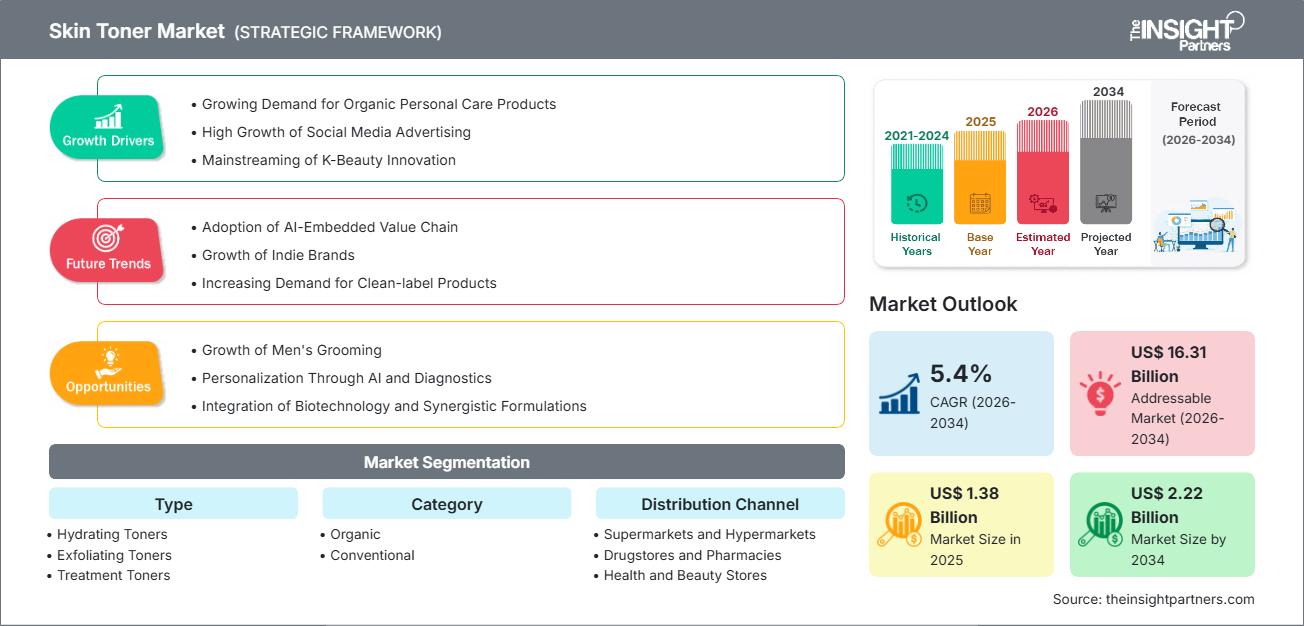
The global skin toner market size is projected to reach US$ 2.22 billion by 2034 from US$ 1.38 billion in 2025. The market is anticipated to register a CAGR of 5.4% during the forecast period 2026–2034. Key market dynamics include the normalization of multi-step skincare routines, a marked shift toward alcohol‑free, dermatologically tested, and ingredient-transparent formulas, and the rapid rise of online retail that shortens discovery‑to‑purchase cycles. Additionally, the market is expected to benefit from clean beauty and sensitive‑skin positioning, together with treatment-oriented toners (e.g., exfoliating acids, barrier-repair actives), that are solidifying toner's status as a core step rather than an optional add-on.
Skin Toner Market Analysis
The skin toner market analysis indicates an unequivocal pivot from "basic refreshers" to performance-led, skin-goal toners that deliver hydration, pore refinement, tone correction, and barrier support in one step. Brands are segmenting portfolios across hydrating, exfoliating, and treatment formats, pairing humectants (hyaluronic acid, glycerin), barrier lipids (ceramides), niacinamide, and gentle acids (PHA/BHA/AHA) to create fast-absorbing products. These pH-balanced toners layer well in routines and reduce regimen complexity. Strategically, incumbents and indie labels alike are leaning into alcohol‑free and organic claims, tightening INCI transparency, and emphasizing dermatologist-recommended credentials to premiumize. Go‑to‑market plays prioritize D2C and marketplace storefronts, creator partnerships, and diagnostic content to capture mid‑to‑high intent shoppers. Suppliers and brands that can demonstrate clinically framed benefits (hydration kinetics, TEWL reduction, comedogenic risk) while ensuring global compliance will gain shelf advantage and pricing power.
Skin Toner Market Overview
Skin toners, once primarily alcohol‑based astringents, have evolved into targeted, daily-use liquids that remove residual impurities, rebalance pH, and prep skin for actives while adding hydration and comfort. In line with clean beauty and ingredient literacy, alcohol‑free, low‑pH, and multifunctional toners are now mainstream, supported by social and derm-led education. Asia‑Pacific trends (J‑/K‑Beauty) continue to influence layering routines and ferment‑rich formulations globally, while Europe and North America emphasize safety, transparency, and sensitivity-friendly profiles. The blended channel model, super/hypermarkets, health & beauty chains, pharmacies, and fast-growing online retail, broadens access and fosters rapid iteration through consumer feedback loops. For instance, the market in the US favors alcohol‑free, derm‑tested toners that address hydration, barrier repair, and acne control within simplified routines. Ingredient transparency, sensitive‑skin claims, and clean‑label positioning drive adoption. At the same time, omnichannel retail, especially e-commerce and creator-led education, accelerates discovery, trial, and repurchase across mass and prestige tiers.
Customize This Report To Suit Your Requirement
Get FREE CUSTOMIZATIONSkin Toner Market: Strategic Insights
-
Get Top Key Market Trends of this report.This FREE sample will include data analysis, ranging from market trends to estimates and forecasts.
Skin Toner Market Drivers and Opportunities
Market Drivers:
- Clean Beauty & Sensitive‑Skin Shift: Consumers seek alcohol‑free, hypoallergenic toners with short, transparent INCI lists. Ingredient-aware shoppers prioritize niacinamide, ceramides, HA, and botanical extracts; stringent regulatory focus in developed markets amplifies safety narratives.
- Routine Layering & Performance: Multi-step routines normalize toner use as a prep and treatment step. Performance claims around hydration, pore appearance, and texture correction, supported by mild acids (BHA/AHA/PHA), increase category stickiness and basket size.
- Digital Commerce & Education: Social platforms and retailer content demystify acids, pH, and barrier care, driving higher conversion online. Brand diagnostics and reviews accelerate category confidence and trial among first-time users.
Market Opportunities
- Barrier‑First, Alcohol‑Free Innovation: Develop ceramide/niacinamide-rich hydrating toners with validated TEWL reduction and microbiome-friendly claims; pair with sensitive‑skin positioning to unlock mass prestige.
- Hyper‑Personalization & Guided Selling: Use AI-driven questionnaires/skin tools and dynamic sampling to tailor toner recommendations by skin concern, routine complexity, and climate, particularly effective in D2C and marketplace storefronts.
- Organic & Ethical Sourcing: Expand certified‑organic and vegan SKUs; emphasize traceability and low-irritant botanicals to capture ingredient-conscious consumers and premiumize price‑mix.
Skin Toner Market Report Segmentation Analysis
The Skin Toner Market share is analyzed across various segments to provide a clearer understanding of its structure, growth potential, and emerging trends. Below is the standard segmentation approach used in most industry reports:
By Type:
- Hydrating Toners: Lightweight, pH-balanced formats designed to replenish moisture and prime the skin barrier for subsequent actives.
- Exfoliating Toners: Daily‑gentle acids (AHA/BHA/PHA) that smooth texture, clarify pores, and enhance radiance when layered responsibly.
- Treatment Toners: Targeted solutions infusing niacinamide, antioxidants, or soothing agents for tone, oil balance, or sensitivity support.
By Category:
- Organic: Plant-forward formulations emphasizing clean‑label and low‑irritant profiles; growing preference among ingredient-conscious users.
- Conventional: Broad portfolio addressing diverse concerns and price bands, with continued relevance in mass channels.
By Distribution Channel:
- Supermarkets and Hypermarkets
- Drugstores and Pharmacies
- Health and Beauty Stores
- Online Retail
- Others
By Geography:
- North America
- Europe
- Asia Pacific
- South & Central America
- Middle East & Africa
Skin Toner Market Report Scope
| Report Attribute | Details |
|---|---|
| Market size in 2025 | US$ 1.38 Billion |
| Market Size by 2034 | US$ 2.22 Billion |
| Global CAGR (2026 - 2034) | 5.4% |
| Historical Data | 2021-2024 |
| Forecast period | 2026-2034 |
| Segments Covered |
By Type
|
| Regions and Countries Covered |
North America
|
| Market leaders and key company profiles |
|
Skin Toner Market Players Density: Understanding Its Impact on Business Dynamics
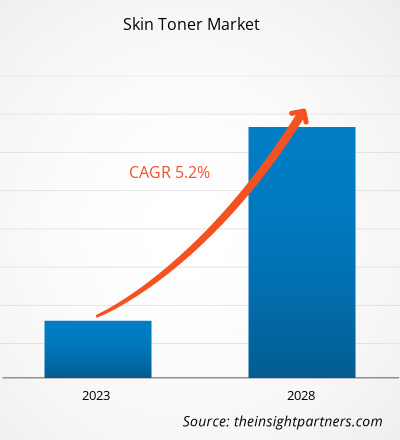
The Skin Toner Market is growing rapidly, driven by increasing end-user demand due to factors such as evolving consumer preferences, technological advancements, and greater awareness of the product's benefits. As demand rises, businesses are expanding their offerings, innovating to meet consumer needs, and capitalizing on emerging trends, which further fuels market growth.
Skin Toner Market Share Analysis by Geography
Asia‑Pacific is expected to grow fastest in the coming years. Emerging markets in South & Central America, the Middle East, and Africa also hold untapped opportunities for performance-oriented, sensitive‑skin solutions, especially via online retail and beauty specialty formats.
The skin toner category is transitioning from refreshers to science-backed, multifunctional treatments. Growth is catalyzed by clean beauty adoption, social/derm education, and e-commerce scale. Below is a summary of market share dynamics and trends by region:
North America
- Market Share: Mature, innovation-forward landscape with strong presence of performance and derm‑recommended portfolios.
- Key Drivers:
- High Demand for alcohol‑free, sensitive‑skin toners and transparent labeling.
- Strong influence of clinical content and dermatologist endorsements across retail.
- Omnichannel depth, drugstore, prestige beauty chains, and online, accelerate trial and repeat.
- Trends: Growth in barrier‑repair toners; exfoliating toners positioned for texture and acne management with usage education.
Europe
- Market Share: Leading focus on safety, compliance, and clean‑label; premium heritage supports treatment-led toners.
- Key Drivers:
- Regulatory emphasis and consumer scrutiny of alcohol and irritants.
- Preference for dermatologist-tested and fragrance-moderated formulations.
- Growth in organic/sustainable sourcing narratives across retailers.
- Trends: Expansion of gentle acid formats with buffering; refillable packaging pilots in specialty retail.
Asia‑Pacific
- Market Share: Fastest‑growing region; K‑/J‑Beauty drives layering culture and innovation in low‑pH/ferment-based toners.
- Key Drivers:
- Large consumer base adopting multi-step routines and brightening/UV‑care adjacencies.
- Local expertise in fermentation and gentle acids enables differentiated SKUs.
- Digital marketplaces and live‑commerce amplify discovery and speed to scale.
- Trends: Proliferation of essence‑toner hybrids; seasonal hydration and mask‑pairing bundles.
South & Central America
- Market Share: Emerging, with biodiversity-inspired ingredients and rising sun‑damage repair needs in routines.
- Key Drivers:
- Growing awareness of skin health and pollution mitigation.
- Modernization of local beauty manufacturing and distribution hubs.
- Increasing middle-class adoption of clean-label and natural toners via specialty and online retail.
- Trends: Indie brands spotlighting regional botanicals within hydrating toners.
Middle East & Africa
- Market Share: Developing, with a strong interest in hydration and barrier‑repair under arid climates.
- Key Drivers:
- Cultural familiarity with botanical waters and oils evolving into standardized toners.
- Investment in modern retail and cross-border e-commerce access.
- Early moves toward Halal-aligned toners and minimal‑irritant formulations.
- Trends: Adoption of soothing, alcohol‑free toners; travel and value packs for hot climates.
High Market Density and Competition
Competition is intensifying due to the presence of established leaders such as Dickinson Brands, La Mer Technology Inc., Mario Badescu Skin Care Inc., L'Oréal Paris, Shiseido Co. Ltd., Procter & Gamble, Burt's Bees, Lush Retail Ltd, and The Bodyshop International Ltd, which also contribute to a diverse and rapidly expanding market landscape.
This competitive environment pushes vendors to differentiate through:
- Premiumization & Clinical Signals: Positioning toners with measurable outcomes (hydration curves, texture smoothing) and safety assurances (derm‑tested, fragrance‑controlled).
- Portfolio Expansion into Treatment Toners: Layering niacinamide, acids, antioxidants, and probiotics to address oil control, post-blemish marks, and barrier comfort, delivering one-step efficacy.
- Sourcing & Transparency: Elevating organic inputs and ethical sourcing to meet clean‑label expectations and justify pricing tiers.
- Delivery/Texture Innovation: Fast-absorbing liquids and mists with low‑pH buffering for daily tolerance; essence‑toner hybrids for routine simplification.
Opportunities and Strategic Moves
- Partner with Prestige & Derm Channels: Co-develop sensitive‑skin and barrier‑repair toners with clinical skincare brands and derm chains to secure authority and win high-value cohorts in North America and APAC.
- Scale Organic & Alcohol‑Free Lines: Pursue certifications and short‑INCI, vegan propositions; connect sustainability with skin‑comfort benefits to resonate with Gen Z and Millennials.
Major Companies operating in the Skin Toner Market are:
- Dickinson Brands
- La Mer Technology Inc
- Mario Badescu Skin Care Inc
- Loreal Paris
- Shiseido Co Ltd
- Procter & Gamble
- Burt's Bees
- Lush Retail Ltd
- The Bodyshop International Ltd
- Johnson & Johnson
Disclaimer: The companies listed above are not ranked in any particular order.
Skin Toner Market News and Recent Developments
- In February 2025, L'Oréal Groupe announced that it had entered into a long-term, exclusive beauty partnership with JACQUEMUS, a move further strengthened by a minority investment that supported the brand's independent development. As part of L'Oréal's broader strategy to expand its skincare and treatment-focused offerings, the partnership was expected to open opportunities for future product innovation, including potential skin toner formulations aligned with JACQUEMUS' minimalist, luxury aesthetic.
- In January 2025, American Exchange Group (AXNY Group) announced its acquisition of Urban Skin Rx®. Founded in 2010 by licensed aesthetician Rachel Roff and led by CEO Victoria Payne, Urban Skin Rx® has established itself as a trusted name in skincare, offering targeted solutions for hyperpigmentation, dark marks, and uneven skin tone. As part of its broader product portfolio, the brand's Treatment‑oriented approach also supported the growing demand for skin toner solutions designed for melanin-rich and sensitive skin. Rooted in a mission to provide accessible and effective skincare, Urban Skin Rx continued to empower customers to feel confident in their skin.
Skin Toner Market Report Coverage and Deliverables
The Skin Toner Market Size and Forecast (2021–2034) report provides a detailed analysis of the market covering below areas:
- Skin Toner Market size and forecast at global, regional, and country levels for all the key market segments covered under the scope
- Skin Toner Market trends, as well as market dynamics such as drivers, restraints, and key opportunities
- Detailed PEST and SWOT analysis
- Skin Toner Market analysis covering key market trends, global and regional framework, major players, regulations, and recent market developments
- Industry landscape and competition analysis covering market concentration, heat map analysis, prominent players, and recent developments in the Skin Toner Market.
- Detailed company profiles
Frequently Asked Questions

- Historical Analysis (2 Years), Base Year, Forecast (7 Years) with CAGR
- PEST and SWOT Analysis
- Market Size Value / Volume - Global, Regional, Country
- Industry and Competitive Landscape
- Excel Dataset
Recent Reports
Testimonials

The Insight Partners' SCADA System Market report is comprehensive, with valuable insights on current trends and future forecasts. The team was highly professional, responsive, and supportive throughout. We are very satisfied and highly recommend their services.
RAN KEDEM Partner, Reali Technologies LTDs
I requested a report on a very specific software market and the team produced the report in a few days. The information was very relevant and well presented. I then requested some changes and additions to the report. The team was again very responsive and I got the final report in less than a week.
JEAN-HERVE JENN Chairman, Future Analytica
We worked with The Insight Partners for an important market study and forecast. They gave us clear insights into opportunities and risks, which helped shape our plans. Their research was easy to use and based on solid data. It helped us make smart, confident decisions. We highly recommend them.
PIYUSH NAGPAL Sr. Vice President, High Beam Global
The Insight Partners delivered insightful, well-structured market research with strong domain expertise. Their team was professional and responsive throughout. The user-friendly website made accessing industry reports seamless. We highly recommend them for reliable, high-quality research services
YUKIHIKO ADACHI CEO, Deep Blue, LLC.
This is the first time I have purchased a market report from The Insight Partners.While I was unsure at first, I visited their web site and felt more comfortable to take the risk and purchase a market report.I am completely satisfied with the quality of the report and customer service. I had several questions and comments with the initial report, but after a couple of dialogs over email with their analyst I believe I have a report that I can use as input to our strategic planning process.Thank you so much for taking the extra time and making this a positive experience.I will definitely recommend your service to others and you will be my first call when we need further market data.
JOHN SUZUKI President and Chief Executive Officer, Board Director, BK Technologies
I wish to appreciate your support and the professionalism you displayed in the course of attending to my request for information regarding to infectious disease IVD market in Nigeria. I appreciate your patience, your guidance, and the fact that you were willing to offer a discount, which eventually made it possible for us to close a deal. I look forward to engaging The Insight Partners in the future, all thanks to the impression you have created in me as a result of this first encounter.
DR CHIJIOKE ONYIA MANAGING DIRECTOR, PineCrest Healthcare Ltd.Reason to Buy
- Informed Decision-Making
- Understanding Market Dynamics
- Competitive Analysis
- Identifying Emerging Markets
- Customer Insights
- Market Forecasts
- Risk Mitigation
- Boosting Operational Efficiency
- Strategic Planning
- Investment Justification
- Tracking Industry Innovations
- Aligning with Regulatory Trends




 Get Free Sample For