
Smart Water Meter Market Size, Share & Demand by 2034
Smart Water Meter Market Size and Forecast (2021 - 2034), Global and Regional Share, Trend, and Growth Opportunity Analysis Report Coverage: By Type (AMI and AMR), Application (Residential, Commercial, Industrial), and Geography (North America, Europe, Asia Pacific, Middle East and Africa, and South and Central America)
Historic Data: 2021-2024 | Base Year: 2025 | Forecast Period: 2026-2034- Status : Published
- Report Code : TIPTE100000347
- Category : Electronics and Semiconductor
- No. of Pages : 216
- Available Report Formats :



The Smart Water Meter Market size is expected to reach US$15.84 billion by 2034 from US$ 6.20 billion in 2025. The market is anticipated to register a CAGR of 11.5% during 2026–2034.
Smart Water Meter Market Analysis
The smart water meter market is expanding due to urbanization, water scarcity, and smart city initiatives. Advanced Metering Infrastructure (AMI) helps in leak detection, real-time monitoring, and data analysis, which increases the operational efficiency of the utilities. The key players in the market include Sensus, Itron, and Honeywell.
Smart Water Meter Market Overview
Smart water meters rely on IoT, LPWAN, and cloud technology to facilitate remote metering, consumption analysis, and predictive maintenance. Adoption is increasing in the residential, commercial, and industrial segments as a result of regulatory requirements and sustainable development strategies. Industry trends include collaborations and platform strategies by companies such as Badger Meter and Kamstrup.
Market Assessment and Insights
- North America dominated the market with 42.1% share in 2023.
- Europe is poised to grow at a CAGR of 10.7% over the forecast period.
- United States market is projected to grow at a CAGR of 8.5% over the forecast period.
- By Type, the AMR segment accounted for the largest market share of 73.7% in 2023.
- By Component, the Display Storage and Integrated Software segment is anticipated to witness the fastest growth, registering a CAGR of 9.3% over the forecast period
- By End User, the Residential segment accounted for the largest market share of 74.4% in 2023.
- By Meter Type, the Ultrasonic Meters segment is anticipated to witness the fastest growth, registering a CAGR of 9.3% over the forecast period
- The report profiles key industry players such as Itron Inc, Kamstrup AS, Diehl Stiftung & Co KG, Mueller Water Products Inc, Arad Ltd, Neptune Technology Group Inc, Badger Meter Inc, Sensus USA Inc, Bmeters SRL, WAVIoT Integrated Systems LLC, while also analyzing key developments in novel ideas, disruptive products, and innovative services that could reshape the future market and reveal emerging themes across the industry.
Customize This Report To Suit Your Requirement
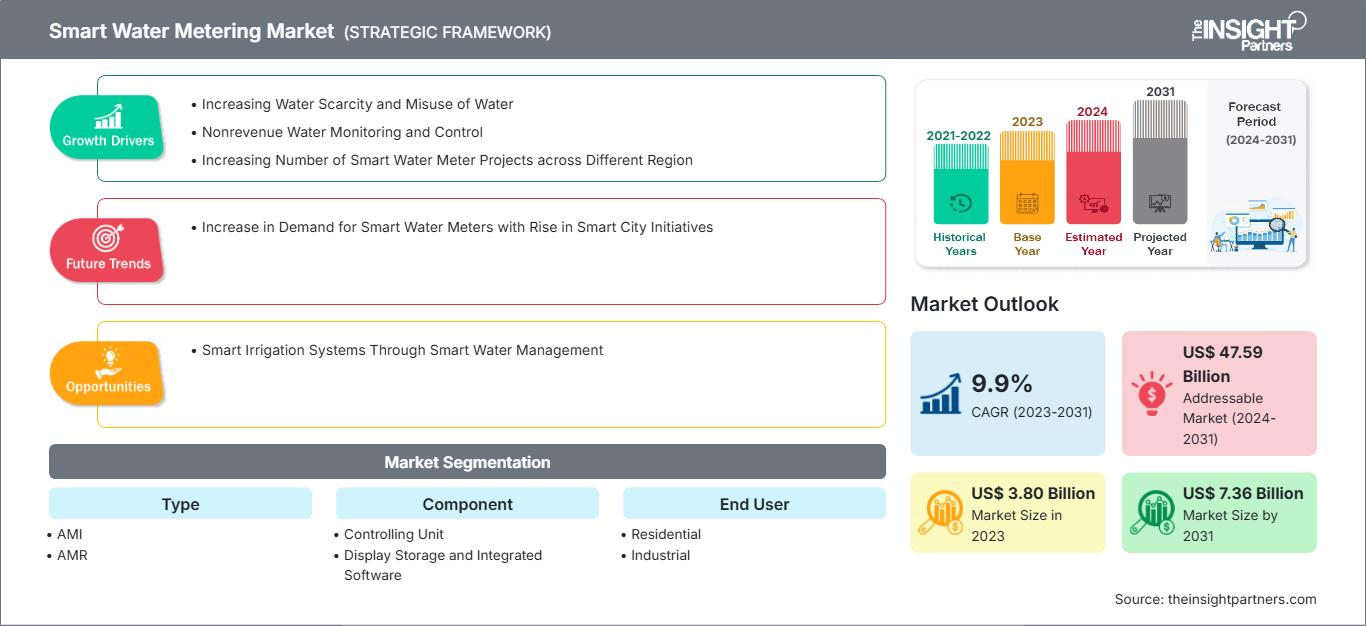
Get FREE CUSTOMIZATIONSmart Water Meter Market: Strategic Insights
-
Get Top Key Market Trends of this report.This FREE sample will include data analysis, ranging from market trends to estimates and forecasts.
Smart Water Meter Market Drivers and Opportunities
Market Drivers:
- Urbanization and Infrastructure Modernization: Rapid urbanization puts pressure on water utilities to optimize distribution efficiency. Smart meters allow for automated readings, leak detection, and consumption analysis, which help cities optimize their old infrastructure and lower operational costs.
- Rising Water Scarcity and Conservation Mandates: The rising water scarcity and tougher government regulations force the adoption of advanced metering by the utilities. Smart meters allow real-time consumption data, promote consumer accountability, and facilitate conservation initiatives through accurate monitoring and reporting systems.
- Technological Advancements in IoT and Connectivity: Integration of IoT, LPWAN, and cloud analytics capabilities improves the functionality of smart meters. Organizations such as Itron utilize connected platforms to provide predictive maintenance, remote monitoring, and data-driven decision-making capabilities.
Market Opportunities:
- Expansion in Emerging Economies: The developing regions are investing in smart cities and digital utility projects. The increasing infrastructure investment creates opportunities for large-scale smart meter deployments to improve billing accuracy and water resource management.
- Integration with Smart City Ecosystems: Smart meters can integrate with smart city platforms, enabling centralized utility management. Collaboration with technology providers such as Siemens supports advanced analytics and cross-utility optimization solutions.
- Advanced Data Analytics and AI Applications: Growing adoption of AI-driven analytics unlocks opportunities for consumption forecasting and demand management. Smart meters generate valuable datasets, enabling utilities to optimize supply planning and enhance customer engagement strategies.
Smart Water Meter Market Report Segmentation Analysis
The smart water meter market is categorized into distinct segments to understand its structure, growth prospects, and emerging trends. Below is the standard segmentation approach used in industry reports:
By Technology:
- AMI: AMI technology in smart water meters enables two-way communication between utilities and consumers. AMI systems provide real-time data collection, allowing utilities to monitor water usage, detect leaks, and optimize distribution efficiently. This technology supports remote reading, dynamic pricing, and predictive maintenance, improving operational efficiency and reducing water loss.
- AMR: AMR technology allows one-way remote reading of water meters, eliminating the need for manual meter reading. AMR systems use radio frequency (RF) or cellular networks to transmit consumption data to the utility company at scheduled intervals. While it does not offer the real-time insights of AMI, AMR improves billing accuracy, operational efficiency, and labor cost reduction.
By End User:
- Residential: There is increasing consumption of water in residential areas and growing awareness about the conservation of water. Smart water meters help in accurate billing, leak detection, and real-time monitoring of consumption, which helps in reducing wastage and managing the monthly expenses of homeowners.
- Commercial: Commercial establishments such as offices, hotels, hospitals, and retail complexes adopt smart water meters to monitor high-volume consumption. These systems support cost control, sustainability compliance, and early leak detection, ensuring operational efficiency while meeting environmental and regulatory standards.
- Industrial: Industries require precise water monitoring for manufacturing, processing, and cooling operations. Smart water meters provide detailed consumption analytics, helping companies optimize resource usage, maintain regulatory compliance, and minimize production disruptions caused by leaks or inefficient water management practices.
By Geography:
- North America
- Europe
- Asia Pacific
- South & Central America
- Middle East & Africa
Smart Water Meter Market Report Scope
| Report Attribute | Details |
|---|---|
| Market size in 2025 | US$ 6.20 Billion |
| Market Size by 2034 | US$ 15.84 Billion |
| Global CAGR (2026 - 2034) | 11.5% |
| Historical Data | 2021-2024 |
| Forecast period | 2026-2034 |
| Segments Covered |
By Type
|
| Regions and Countries Covered |
North America
|
| Market leaders and key company profiles |
|
Smart Water Meter Market Players Density: Understanding Its Impact on Business Dynamics
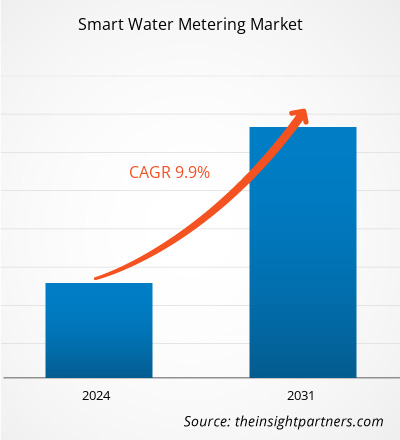
The Smart Water Meter Market is growing rapidly, driven by increasing end-user demand due to factors such as evolving consumer preferences, technological advancements, and greater awareness of the product's benefits. As demand rises, businesses are expanding their offerings, innovating to meet consumer needs, and capitalizing on emerging trends, which further fuels market growth.
Smart Water Meter Market Share Analysis by Geography
The Smart Water Meter Market in APAC is experiencing rapid growth driven by accelerating urbanization, government-led smart city initiatives, and increasing water scarcity concerns. Countries such as China, India, and Japan are investing in digital water infrastructure, advanced metering technologies, and IoT integration to improve efficiency, reduce non-revenue water, and support sustainable resource management. Additional demand is supported by rising infrastructure investments, public–private partnerships, and regulatory reforms promoting accurate billing systems. Expanding urban utilities and increasing adoption of cloud-based monitoring platforms accelerate smart meter deployment.
The smart water meter market growth differs in each region due to variations in infrastructure maturity, regulatory policies, water scarcity levels, government funding, and the pace of digital technology adoption. Below is a summary of market share and trends by region:
1. North America
- Market Share: Holds a significant portion of the global market
- Key Drivers:
- Advanced utility infrastructure modernization : Aging water infrastructure across the US and Canada is driving utilities to adopt smart meters to improve operational efficiency, reduce leakage losses, enable remote monitoring, and enhance long-term asset management strategies.
- Strong regulatory compliance requirements
- High adoption of IoT-enabled metering technologies
- Trends: Growing deployment of AMI platforms enhances real-time analytics, customer engagement, and automated billing accuracy.
2. Europe
- Market Share: Substantial share owing to early, stringent EU regulations
- Key Drivers:
- Strict water conservation regulations : European Union directives promote efficient water usage and transparency in billing, encouraging utilities to implement smart meters that support leak detection, consumption tracking, and compliance with environmental sustainability frameworks.
- Sustainability and carbon neutrality goals
- Government-backed digital transformation programs.
- Trends: Integration of smart meters within broader smart city ecosystems improves cross-utility data coordination and sustainability planning.
3. Asia Pacific
- Market Share: Fastest-growing region with dominant market share
- Key Drivers:
- Rapid urbanization and population growth : Expanding metropolitan populations in countries such as China and India increase pressure on utilities to deploy smart meters for efficient distribution management and the reduction of non-revenue water.
- Smart city infrastructure investments
- Rising water scarcity concerns
- Trends: Utilities adopt IoT-enabled platforms and cloud analytics to modernize water management systems.
4. Middle East and Africa
- Market Share: Although small, it is growing quickly
- Key Drivers:
- Severe water scarcity challenges : Arid climates and limited freshwater resources compel governments to deploy smart water meters for consumption tracking, demand management, and improved sustainability in urban and industrial sectors.
- Government desalination and water management investments
- Smart infrastructure diversification programs
- Trends: Smart metering supports long-term water conservation strategies aligned with national sustainability visions and infrastructure modernization goals.
5. South & Central America
- Market Share: Growing Market with steady progress
- Key Drivers:
- Infrastructure development initiatives : High levels of water loss due to leakage and theft push utilities to implement smart metering systems that improve monitoring accuracy, strengthen revenue collection, and enhance operational transparency.
- Reduction of water losses (non-revenue water).
- Growing public-private partnerships
- Trends: Pilot projects and phased deployments characterize regional smart meter implementation strategies.
High Market Density and Competition
Competition is intense due to the presence of major global players such as Siemens AG, Schneider Electric SE, Honeywell International Inc, Hubbell Inc, Landis+Gyr Group AG, Itron Inc, BOVE Technology, ZENNER International GmbH & Co. KG, Xylem Inc., and Sagemcom UK Ltd.
This high level of competition urges companies to stand out by offering:
- Innovative meter designs
- Advanced IoT-enabled smart metering
- Cost-effective solutions
- Comprehensive customer support
- Expanded product portfolio.
Opportunities and Strategic Moves
- Integration with Smart City Initiatives– Collaborating with smart city projects allows companies to offer interconnected utility solutions, enhancing cross-utility data analytics and operational efficiency.
- AI and Data Analytics Applications– Leveraging AI for predictive maintenance, demand forecasting, and consumption optimization creates value-added services for utilities and consumers.
Other companies analyzed during the course of research include
- Arad Group
- Kamstrup
- Badger Meter, Inc.
- Neptune Technology Group Inc.
- Diehl Metering
- Aclara Technologies LLC
- Master Meter, Inc.
- Mueller Systems LLC
- Ningbo Water Meter Co., Ltd.
- Sanchuan Wisdom Technology Co., Ltd.
- Suntront Tech Co., Ltd
- Datamatic, Inc.
- B METERS s.r.l.
- Aquiba Pty Ltd
- BETAR Company
Smart Water Meter Market News and Recent Developments
- ZENNER presented the IUWS ultrasonic water meter in May 2025. At the LoRa Alliance, ZENNER presented the IUWS ultrasonic water meter, which enables seamless metering. The parallel radio function enables the meter to send measurement data via wireless M-Bus and LoRaWAN simultaneously. The new ZENNER IoT Gateway Outdoor 16 attracted a lot of attention – a powerful gateway that was specially developed for the requirements of IoT applications and offers energy-saving data transmission over long distances.
- BOVE accelerated 4G Cat. 1 smart water meter deployment in June 2025. BOVE accelerated 4G Cat. 1 smart water meter deployment to empower smart utility in emerging markets. As smart cities and digital utilities continue to gain momentum, 4G cellular technology has emerged as a widely adopted connectivity solution within the smart metering sector.
Smart Water Meter Market Report Coverage and Deliverables
The "Smart Water Meter Market Size and Forecast (2021–2034)" report provides a detailed analysis of the market covering below areas:
- Smart Water Meter Market size and forecast at global, regional, and country levels for all the segments covered under the scope
- Smart Water Meter Market trends, as well as dynamics such as drivers, restraints, and key opportunities
- Detailed PEST and SWOT analysis
- Smart Water Meter Market For Healthcare analysis covering key trends, global and regional framework, major players, regulations, and recent developments
- Industry landscape and competition analysis covering market concentration, heat map analysis, prominent players, and recent developments for the smart water meter market
- Detailed company profiles
Frequently Asked Questions

- Historical Analysis (2 Years), Base Year, Forecast (7 Years) with CAGR
- PEST and SWOT Analysis
- Market Size Value / Volume - Global, Regional, Country
- Industry and Competitive Landscape
- Excel Dataset
Recent Reports
Testimonials

The Insight Partners' SCADA System Market report is comprehensive, with valuable insights on current trends and future forecasts. The team was highly professional, responsive, and supportive throughout. We are very satisfied and highly recommend their services.
RAN KEDEM Partner, Reali Technologies LTDs
I requested a report on a very specific software market and the team produced the report in a few days. The information was very relevant and well presented. I then requested some changes and additions to the report. The team was again very responsive and I got the final report in less than a week.
JEAN-HERVE JENN Chairman, Future Analytica
We worked with The Insight Partners for an important market study and forecast. They gave us clear insights into opportunities and risks, which helped shape our plans. Their research was easy to use and based on solid data. It helped us make smart, confident decisions. We highly recommend them.
PIYUSH NAGPAL Sr. Vice President, High Beam Global
The Insight Partners delivered insightful, well-structured market research with strong domain expertise. Their team was professional and responsive throughout. The user-friendly website made accessing industry reports seamless. We highly recommend them for reliable, high-quality research services
YUKIHIKO ADACHI CEO, Deep Blue, LLC.
This is the first time I have purchased a market report from The Insight Partners.While I was unsure at first, I visited their web site and felt more comfortable to take the risk and purchase a market report.I am completely satisfied with the quality of the report and customer service. I had several questions and comments with the initial report, but after a couple of dialogs over email with their analyst I believe I have a report that I can use as input to our strategic planning process.Thank you so much for taking the extra time and making this a positive experience.I will definitely recommend your service to others and you will be my first call when we need further market data.
JOHN SUZUKI President and Chief Executive Officer, Board Director, BK Technologies
I wish to appreciate your support and the professionalism you displayed in the course of attending to my request for information regarding to infectious disease IVD market in Nigeria. I appreciate your patience, your guidance, and the fact that you were willing to offer a discount, which eventually made it possible for us to close a deal. I look forward to engaging The Insight Partners in the future, all thanks to the impression you have created in me as a result of this first encounter.
DR CHIJIOKE ONYIA MANAGING DIRECTOR, PineCrest Healthcare Ltd.Reason to Buy
- Informed Decision-Making
- Understanding Market Dynamics
- Competitive Analysis
- Identifying Emerging Markets
- Customer Insights
- Market Forecasts
- Risk Mitigation
- Boosting Operational Efficiency
- Strategic Planning
- Investment Justification
- Tracking Industry Innovations
- Aligning with Regulatory Trends
Unlock Exclusive Report Discounts
Enquire Now




 Get Free Sample For