
Zero Liquid Discharge Systems Market Size, Share & Demand by 2034
Coverage: by System (Conventional Zero Liquid Discharge Systems, Hybrid Zero Liquid Discharge Systems); Process (Pretreatment, Filtration, Evaporation, Crystallization); End-Use Industry (Energy and Power, Chemicals and Petrochemicals, Food and Beverages, Textiles, Pharmaceuticals, Semiconductors and Electronics, Others) , and Geography (North America, Europe, Asia Pacific, and South and Central America)
- Status : Data Released
- Report Code : TIPRE00005133
- Category : Manufacturing and Construction
- No. of Pages : 150
- Available Report Formats :


- Last update date : September 28, 2026


2025 Market Size
US$ 9.07 Bn
Base year value
2034 Forecast
US$ 15.76 Bn
Projected by 2034
CAGR 2026-2034
6.33 %
Growth rate
Addressable Market
US$ 112.35 Bn
(2026-2034)
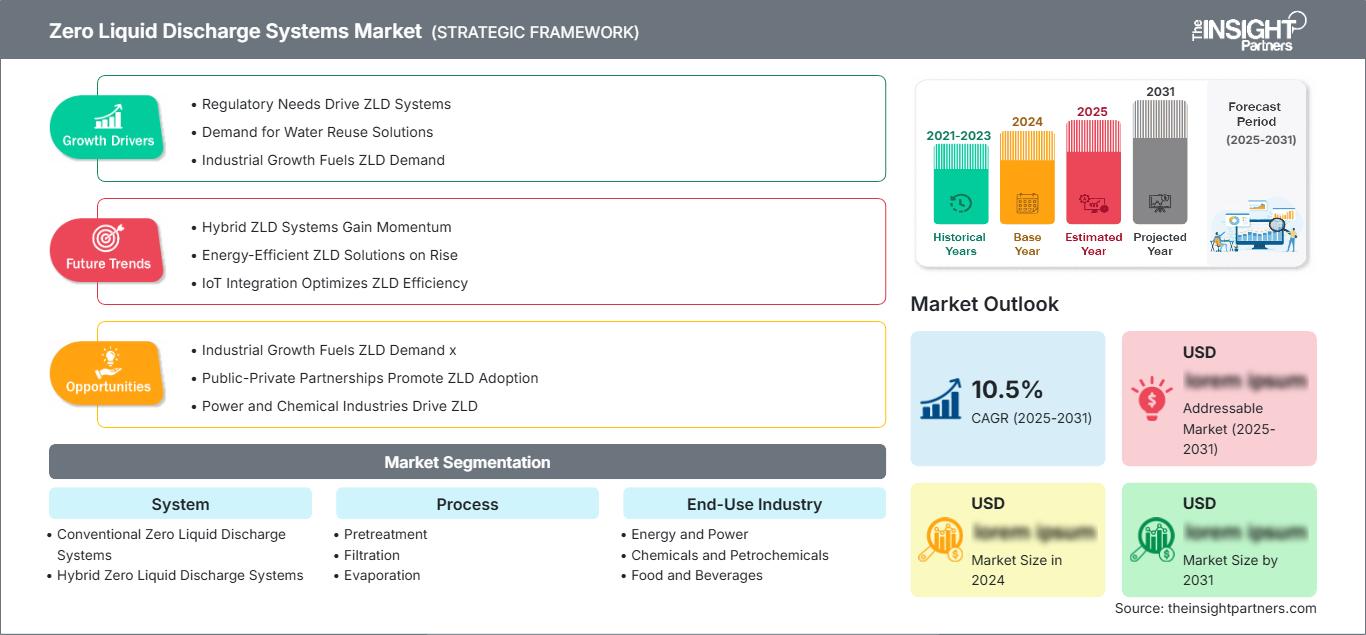
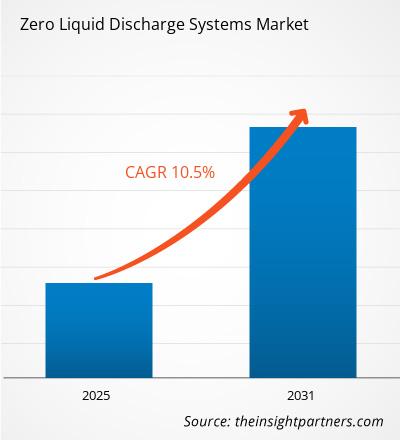
The global Zero Liquid Discharge Systems market was valued at US$ 9.07 billion in 2025 and is expected to reach US$ 15.76 billion by 2034; it is estimated to record a CAGR of 6.33% during 2026-2034.
Zero Liquid Discharge Systems Market Assessment and Insights
- North America: North America represented an estimated 33–35% zero liquid discharge systems market share in 2025 and is expected to expand at 6.8–7.4% CAGR during 2026–2034, supported by mature industrial wastewater infrastructure, compliance requirements, and water-reuse investments.
- US: The US accounted for approximately 88–90% of North American demand in 2025 and is projected to grow at 6.9–7.5% CAGR as industrial facilities pursue tighter wastewater controls and reuse.
- Europe: Europe held an estimated 22–24% share in 2025 and is forecast to advance at 6.3–6.9% CAGR. Germany, the UK, France, Italy, and Spain remain important markets because of industrial water efficiency and environmental requirements.
- Asia Pacific: Asia Pacific captured approximately 36–38% share in 2025 and is expected to register 8.1–8.7% CAGR through 2034, led by China, India, Japan, and South Korea across power, chemicals, textiles, and electronics.
- Largest Segment: Conventional Zero Liquid Discharge Systems represented approximately 58–62% market share in 2025 and is expected to grow at 6.6–7.2% CAGR through 2034, reflecting its established industrial deployment.
- High Growth Segment: Hybrid Zero Liquid Discharge Systems accounted for approximately 38–42% share in 2025 and is projected to grow at 8.4–9.0% CAGR as membrane-thermal integration improves energy and recovery economics.
- Key companies analyzed in detail: Aquarion AG; Aquatech International LLC; GE Water and Process Technologies; GEA Group AG; H2O GmbH; IDE Technologies; Petro Sep Corporation; Praj Industries Limited; U.S. Water Services, Inc.; Veolia Water Technologies.
Source: The Insight Partners' analysis based on proprietary research, government publications, company annual reports, investor presentations, industry databases, and expert interviews.
Disposal-based wastewater treatment is evolving to the closed-loop resource recovery concept in the industry. Increasingly membranes and reverse osmosis separate the recoverable portion of water from brine that will be treated thermally. Advanced technologies like mechanical vapor recompression, enhanced heat recovery, crystallizer design improvements, and control automation are making operations less complex. The evolution of the technology is expanding the scope of application of ZLD from conventional power and chemical plants to food, pharma, electronic, mining, and advanced manufacturing industries.
Over the forecast period, growth of the zero liquid discharge systems market will be driven by modular plant designs, energy-efficient concentrate separation technologies, and digital supervision of the plant operation. Industrial development in emerging regions of India, Southeast Asia, the Middle East, and Africa offer the chance to combine water scarcity with industrial growth. Pressure on discharge from industry, corporate water management programs, and high cost of raw water acquisition and transportation will create economic benefits especially with water/salt recovery from process.
Zero Liquid Discharge Systems Market Report Scope
| Report Attribute | Details |
|---|---|
| Market size in 2025 | US$ 9.07 Billion |
| Market Size by 2034 | US$ 15.76 Billion |
| Global CAGR (2026 - 2034) | 6.33% |
| Historical Data | 2021-2024 |
| Forecast period | 2026-2034 |
Zero Liquid Discharge Systems Market Analysis
Industrial demand in the zero liquid discharge systems market is driven by three interrelated needs: minimizing freshwater consumption, meeting stricter discharge requirements, and managing the costs of disposing of concentrated wastewater streams. Growth of the market for zero liquid discharge technology is thus dependent on wastewater composition, flow variation, availability of energy resources, and the value of recycled water. The power generation, chemical, petrochemical, textile, and pharmaceutical industries will continue to play an important role since their discharges may have significant dissolved solids concentrations.
Activities within the value chain range from wastewater characterization to design engineering, pretreatment, membrane separation, thermal concentration, crystallization, control systems, installation, and performance during operation and maintenance. Competitive advantage has become more linked to process integration than to any individual pieces of equipment. High-salinity influent requires robust equipment, scaling, and the proper sequencing of the process. Regional engineering knowledge is yet another variable that can influence project selection, because permitting, changes in feed water, energy prices, and disposal can all influence economics.
In the zero liquid discharge systems market report, there is an increasing trend of rivalry among global system providers and engineering contractors. Veolia Water Technologies, Aquatech International LLC, GEA Group AG, and IDE Technologies compete using their technology range, reference projects, and engineering expertise. On the other hand, Praj Industries Limited provides custom solutions for industrial wastewater treatment. GE Water and Process Technologies, H2O GmbH, Petro Sep Corporation, Aquarion AG, and U.S. Water Services, Inc. provide solutions to special process needs.
As per the zero liquid discharge systems market forecast, competitive positioning is shifting towards hybrid approaches, modularity, energy efficiency, and lifecycle services. Aquatech offers a hybrid approach to treatment combining membrane and thermal treatment. GEA focuses on evaporation and crystallization technology. Veolia Water Technologies has extensive experience in installations with evaporation technology. IDE Technologies provides high recovery membranes for challenging industrial streams. The technology is increasingly being screened with pilot testing and guaranteed performance criteria.
● REPORT CUSTOMIZATION
Tailor This Report To Align With Your Specific Business Requirements
This report can be customized to align precisely with your business objectives, scope, and target markets. Customization options include tailored segmentation, geography, competitive analysis, and strategic insights to support informed decision-making.
Customize This Report →WHAT YOU CAN ADJUST
- ● Segmentations
- ● Geography
- ● Competitive Analysis
- ● Language Preferences
Zero Liquid Discharge Systems Market: Strategic Insights
Regional Insights
North America zero liquid discharge systems market
North America is estimated to hold 33–35% of global demand in 2025 and is expected to grow at 6.8–7.4% CAGR through 2034. Water shortages in industry, the need to get discharge permits, and replacing aging equipment all facilitate adoption within the power generation, chemical, refining, mining, and high-tech manufacturing sectors. Engineering knowledge and lifecycle-based treatment economics are additional positive factors in the regional market.
The focus on recovering water before going to the thermally driven concentration process is becoming more and more common and results in lower evaporator requirements and costs. In the US, there are about 88-90% of North American market demands, but Canada also makes its contribution via mining, energy, chemicals, and natural resources processing industries. Further growth areas include semiconductors, power plant waste treatment, and produced water treatment.
U.S. zero liquid discharge systems market
The U.S. represents approximately 88–90% of North American demand and is expected to grow at 6.9–7.5% CAGR through 2034. Discharge regulations from both federal and state governments, industrial regions facing water shortages, and wastewater reuse initiatives promote investment. Power production is still key; meanwhile, chemical, pharmaceutical, semiconductor manufacture, and mining industries expand the customer base.
In today’s world, larger industrial facilities are comparing the cost-effectiveness of zero liquid discharge with the purchase of freshwater, discharge costs, transportation costs, and permitting risk instead of just capital cost. States like California, Texas, Arizona, and many others that face challenges in water supply create good opportunities for reuse technologies. Veolia Water Technologies, Aquatech International LLC, GE Water and Process Technologies, GEA Group AG, and U.S. Water Services, Inc., have the technology to serve the purpose.
Europe zero liquid discharge systems market
Europe is estimated to account for 22–24% share in 2025 and is forecast to expand at 6.3–6.9% CAGR. Germany emerges as the largest market owing to advanced industrial wastewater systems and emphasis on resource efficiency. UK, France, Italy, and Spain participate through their industries of chemicals, food processing, pharmaceuticals, manufacturing, and water-consuming industrial activities.
Germany continues to retain its position due to the preference of industrial clients for process water recovery and stringent environmental performance. The UK focuses on industrial efficiency and resilience, whereas France promotes water reuse and process optimization. Italy and Spain offer prospects in textile, food, chemical, and water-constrained industrial sectors. Electrification of the thermal process and salt recovery across Europe help optimize the economics of ZLD systems due to the high cost of energy and environmental regulations.
APAC zero liquid discharge systems market
APAC represents approximately 36–38% zero liquid discharge systems market share in 2025 and is projected to grow at 8.1–8.7% CAGR. China is the leader, followed by India, Japan, South Korea, and Australia. Controls on industrial wastewater management, growth in industrialization, water scarcity, and more advanced reuse requirements are some of the factors which will drive market growth in sectors such as power generation, chemicals, textile, pharmaceutical, and electronics.
China offers both the biggest industrial base and advanced standards for wastewater management, whereas India offers a bright future in textile, distillation industries, chemicals, and power. Japan and South Korea focus on pure water recycling for the electronics sector, while Australia offers possibilities in mining and resources recycling.
Middle East & Africa zero liquid discharge systems market
Middle East and Africa demand is expected to rise at 7.0–7.6% CAGR through 2034. Saudi Arabia and the UAE are leading markets because water scarcity, industrial diversification, refining, petrochemicals, and desalination infrastructure create strong demand for advanced wastewater recovery. South Africa contributes through mining, power, and industrial water-management applications.
The regional opportunity becomes increasingly focused on closed loop systems as far as water management for high-energy industries goes. The high evaporation factor and low availability of fresh water make reuse all the more attractive, and development initiatives for industries provide funds to build modern treatment plants. Zero liquid discharge, on the other hand, is always a project-dependent decision.
Segmentation Analysis
System
System segmentation centers on conventional and hybrid architectures. Conventional configurations remain widely used where established thermal treatment and predictable wastewater chemistry justify dedicated evaporation and crystallization trains. Hybrid systems are gaining attention because membrane concentration can reduce downstream thermal duty. The system segment is expected to expand at 6.6–7.2% CAGR, with technology selection increasingly determined by energy prices and recovery targets.
- Conventional Zero Liquid Discharge Systems: Established configurations integrate pretreatment, concentration, evaporation, and crystallization. They remain strategically important for high-salinity industrial streams where proven operating practices and robust solids handling outweigh energy-efficiency considerations.
- Hybrid Zero Liquid Discharge Systems: Hybrid architectures combine membranes with thermal concentration to improve recovery and reduce evaporator loading. Their strategic importance is increasing where customers seek lower energy consumption without compromising high overall water recovery.
Process
Process segmentation covers pretreatment, filtration, evaporation, and crystallization. The process segment is projected to grow at 7.0–7.6% CAGR as customers optimize treatment sequences according to feedwater chemistry. Pretreatment and filtration are becoming increasingly important because improved contaminant removal protects membranes and thermal equipment, while evaporation and crystallization remain essential for final liquid elimination.
- Pretreatment: Pretreatment stabilizes downstream operations by controlling hardness, suspended solids, silica, organics, and scaling precursors. Its importance rises as industrial users seek longer equipment life and more predictable performance.
- Filtration: Filtration and membrane separation recover usable water before high-energy concentration. Demand is strengthened by advances in membrane materials, high-pressure operation, fouling control, and the need to minimize concentrate volumes.
- Evaporation: Evaporation handles concentrated brines that are difficult to treat through membranes alone. Falling-film and mechanical vapor recompression configurations remain important for managing energy demand and achieving high concentration.
- Crystallization: Crystallization converts concentrated dissolved solids into recoverable or disposable solids, completing liquid elimination. System design increasingly considers salt purity, solids handling, energy integration, and potential by-product value.
End-Use Industry
End-Use Industry segmentation is projected to grow at 7.3–7.9% CAGR, reflecting broader adoption beyond traditional power applications. Industrial users increasingly evaluate wastewater systems through water-security, compliance, operating-cost, and resource-recovery objectives. Sector-specific wastewater chemistry remains central to equipment selection, process sequencing, and lifecycle economics.
- Energy and Power: Power facilities use ZLD for cooling-tower blowdown, flue-gas-treatment wastewater, and other concentrated streams. The segment remains strategically important because compliance and water reuse directly affect plant reliability.
- Chemicals and Petrochemicals: Complex effluents with high dissolved solids and variable chemistry create strong demand for integrated treatment. Closed-loop water strategies can reduce disposal exposure while supporting operational continuity.
- Food and Beverages: Food and beverage producers increasingly seek water recovery and lower effluent volumes. Organic loading, cleaning chemicals, and seasonal production patterns require carefully engineered pretreatment and concentration systems.
- Textiles: Textile facilities face challenging wastewater streams containing salts, dyes, chemicals, and variable organic loads. ZLD supports water reuse while helping manufacturers address discharge restrictions in water-stressed production clusters.
- Pharmaceuticals: Pharmaceutical wastewater requires controlled treatment because contaminants can be chemically complex and variable. High-recovery systems support water conservation while helping facilities manage strict environmental and operational requirements.
- Semiconductors and Electronics: Electronics manufacturing requires high-purity water and tight contamination control. Advanced recycling and ZLD architectures can reduce wastewater volumes while recovering water suitable for demanding process applications.
Opportunity Snapshot
| End-Use Industry | Revenue Contribution (High/Medium/Low) | Trend Tag | Adoption Stage |
| Energy and Power | High | Cooling Reuse | Mature |
| Chemicals and Petrochemicals | High | Brine Recovery | Scaling |
| Food and Beverages | Medium | Process Reuse | Scaling |
| Textiles | Medium | Salt Recovery | Scaling |
| Pharmaceuticals | Medium | High-Purity Reuse | Scaling |
| Semiconductors and Electronics | Medium | Fab Recycling | Emerging |
| Others | Low | Custom Reuse | Emerging |
Zero Liquid Discharge Systems Market Growth Drivers and Impact Analysis
Industrial Water Stress and Rising Value of Water Security
Water stress is influencing the way industrial operators consider their wastewater management structures. Industries situated in water-stressed areas are at risk of higher operational exposure when the availability of water supply is questionable or there are limitations on discharge capacity. The implementation of ZLD technology provides a closed loop system, which can ensure stability in process water supply and less dependency on other ways of wastewater disposal. The economic benefits of ZLD go beyond environmental regulation, as the reclaimed water can be used for cooling, washing, utilities, and processes. The strongest effect is observed in water-intensive industries with uninterrupted operation, as any interruption results in costly production downtime. With the establishment of water stewardship goals by firms, decisions about investments are made on the basis of total water risk exposure rather than treatment cost alone.
Stricter Industrial Discharge Requirements and Compliance Risk
Growing environmental regulation makes treatment performance reliability more relevant for industrial clients. Discharge permits now place more stringent requirements on the levels of dissolved solids, specific pollutants, temperatures, and effects on receiving water, especially in environmentally delicate or water-deficient areas. ZLD is a solution where normal discharge methods are not feasible from technical or economic viewpoints. The market effect is most pronounced where non-conformance will result in production shutdowns, permitting problems, cleanup costs, or damage to reputation. Engineering will thus increasingly consider backup systems, automated control, chemical dosage control, and solids handling facilities. Clients are also looking for systems which allow for changes in the wastewater stream without impacting recovery. This need will be met better by suppliers that have good process integration, pilot testing ability, and experience in long-term services.
Advances in Hybrid Treatment and Energy Optimization
Technology development is improving the economics of ZLD by shifting more separation work toward membranes before energy-intensive thermal stages. High-recovery reverse osmosis, improved pretreatment, mechanical vapor recompression, heat integration, and better crystallizer design can reduce the volume requiring final evaporation. The resulting impact is particularly significant in regions with high electricity or steam costs. Hybrid architectures also allow customers to configure treatment around wastewater chemistry rather than relying on a single technology pathway. Digital instrumentation can further improve performance by identifying scaling, fouling, and energy inefficiencies earlier. As these technologies mature, suppliers can offer smaller thermal equipment, modular deployment, and more predictable operating costs. This trend should broaden adoption among industries that previously considered conventional ZLD too energy-intensive for their wastewater profile.
Zero Liquid Discharge Systems Market Future Trends
Digital Process Intelligence and Autonomous Optimization
The zero liquid discharge systems market trends indicate that digitalization is expected to become a defining feature of advanced ZLD installations as operators seek more consistent performance across variable wastewater conditions. Future systems will increasingly combine online conductivity, pressure, temperature, flow, and chemistry measurements with predictive analytics. These tools can identify scaling risk, membrane fouling, crystallizer instability, and energy inefficiency before they become major operational problems. Digital twins may allow operators to test process changes virtually before altering plant conditions. Remote monitoring can also support centralized technical teams managing multiple facilities across industrial clusters. The resulting architecture will shift ZLD from a primarily mechanical treatment asset toward a continuously optimized process platform. Suppliers able to integrate controls, analytics, service contracts, and performance guarantees should gain stronger positions in complex industrial projects.
Resource Recovery Beyond Water Reuse
Future ZLD projects are likely to place greater emphasis on recovering valuable materials from concentrated waste streams rather than treating solids solely as disposal products. Depending on wastewater chemistry, crystallization can produce salts, minerals, or other compounds with potential commercial value. This approach can alter project economics by creating secondary revenue or reducing waste-handling expenses. Material recovery will require better feed characterization, selective precipitation, crystallization control, product-quality management, and downstream logistics. Industrial sectors producing relatively pure salt streams are likely to lead adoption because recovered products can have clearer market pathways. Over time, ZLD design may therefore become more closely linked with circular-economy strategies, where wastewater treatment, water recovery, and resource extraction are engineered as one integrated industrial process rather than separate environmental activities.
Zero Liquid Discharge Systems Market Opportunities
Modular ZLD for Expanding Industrial Clusters
Industrial parks and manufacturing clusters create opportunities for modular ZLD infrastructure that can be deployed in phases as production capacity expands. Instead of designing a single oversized plant, operators can install standardized treatment modules and add capacity as wastewater volumes increase. This approach can shorten project schedules, reduce construction complexity, and align capital expenditure with production ramp-up. It is particularly relevant to semiconductor, pharmaceutical, specialty chemical, textile, and food-processing clusters where multiple wastewater streams may coexist. Shared infrastructure can also improve utilization of specialist operating personnel and laboratory capabilities. Suppliers that combine modular equipment with standardized engineering packages, remote monitoring, and flexible feedwater handling could capture demand from rapidly developing industrial zones. Financing models based on treated-water service agreements may further reduce upfront barriers for smaller industrial customers.
Water-Positive Manufacturing and Industrial Reuse Platforms
A second opportunity lies in integrating ZLD with broader industrial water strategies rather than purchasing it as a standalone compliance system. Manufacturers increasingly seek coordinated solutions covering wastewater segregation, process-water reuse, rainwater management, cooling optimization, and recovery of valuable constituents. ZLD can serve as the final barrier for streams that remain too concentrated for conventional reuse. Integrating these stages allows customers to reduce the volume reaching energy-intensive treatment while increasing overall water productivity. The approach is especially relevant to large manufacturing sites with multiple production lines and differentiated wastewater chemistries. Engineering providers can create value through water audits, process mapping, pilot programs, and performance-based contracts. Such integrated offerings should encourage investment where conventional ZLD economics alone are insufficient to justify a major capital project.
Frequently Asked Questions

- Comprehensive Market Sizing and Forecast Analysis
- Detailed Segmentation Analysis
- In-Depth Market Dynamics Assessment
- Regional and Country-Level Insights
- Competitive Landscape and Company Benchmarking
- Strategic Business Intelligence
Recent Reports
Testimonials

The Insight Partners provided valuable market intelligence that supported our global go-to-market strategy. Their team was professional, responsive, and attentive to our feedback, providing thoughtful analysis and helpful methodological clarifications throughout the project.
Junmo Kim Chief Financial Officer (CFO), Enertech Co., Ltd.
The Insight Partners' SCADA System Market report is comprehensive, with valuable insights on current trends and future forecasts. The team was highly professional, responsive, and supportive throughout. We are very satisfied and highly recommend their services.
RAN KEDEM Partner, Reali Technologies LTDs
I requested a report on a very specific software market and the team produced the report in a few days. The information was very relevant and well presented. I then requested some changes and additions to the report. The team was again very responsive and I got the final report in less than a week.
JEAN-HERVE JENN Chairman, Future Analytica
We worked with The Insight Partners for an important market study and forecast. They gave us clear insights into opportunities and risks, which helped shape our plans. Their research was easy to use and based on solid data. It helped us make smart, confident decisions. We highly recommend them.
PIYUSH NAGPAL Sr. Vice President, High Beam Global
The Insight Partners delivered insightful, well-structured market research with strong domain expertise. Their team was professional and responsive throughout. The user-friendly website made accessing industry reports seamless. We highly recommend them for reliable, high-quality research services
YUKIHIKO ADACHI CEO, Deep Blue, LLC.
This is the first time I have purchased a market report from The Insight Partners.While I was unsure at first, I visited their web site and felt more comfortable to take the risk and purchase a market report.I am completely satisfied with the quality of the report and customer service. I had several questions and comments with the initial report, but after a couple of dialogs over email with their analyst I believe I have a report that I can use as input to our strategic planning process.Thank you so much for taking the extra time and making this a positive experience.I will definitely recommend your service to others and you will be my first call when we need further market data.
JOHN SUZUKI President and Chief Executive Officer, Board Director, BK Technologies
I wish to appreciate your support and the professionalism you displayed in the course of attending to my request for information regarding to infectious disease IVD market in Nigeria. I appreciate your patience, your guidance, and the fact that you were willing to offer a discount, which eventually made it possible for us to close a deal. I look forward to engaging The Insight Partners in the future, all thanks to the impression you have created in me as a result of this first encounter.
DR CHIJIOKE ONYIA MANAGING DIRECTOR, PineCrest Healthcare Ltd.Reason to Buy
- Informed Decision-Making
- Understanding Market Dynamics
- Competitive Analysis
- Identifying Emerging Markets
- Customer Insights
- Market Forecasts
- Risk Mitigation
- Boosting Operational Efficiency
- Strategic Planning
- Investment Justification
- Tracking Industry Innovations
- Aligning with Regulatory Trends





 Get Free Sample for