
Affiliate Software Market Share, Size & Demand by 2034
Coverage: By Deployment Type (Cloud, On-premises); Enterprise Size (Small and Medium-Size Enterprises, Large Enterprises); Application (E-Commerce, Finance, Gaming, Nutraceuticals, Others) , and Geography (North America, Europe, Asia Pacific, and South and Central America)
- Status : Data Released
- Report Code : TIPRE00011341
- Category : Technology, Media and Telecommunications
- No. of Pages : 150
- Available Report Formats :


- Last update date : August 04, 2026


2025 Market Size
US$ 22.20 Bn
Base year value
2034 Forecast
US$ 42.84 Bn
Projected by 2034
CAGR 2026-2034
7.58 %
Growth rate
Addressable Market
US$ 293.06 Bn
(2026-2034)
The affiliate software market was valued at US$ 22.20 Billion in 2025 and is projected to reach US$ 42.84 Billion by 2034, expanding at a CAGR of 7.58% during 2026–2034. The increasing use of digital marketing based on performance, growing use of partner ecosystems, and automation of commission tracking are some factors that are helping in the development of the market. Companies operating in the fields of e-commerce, finance, gaming, and health-related businesses are making use of affiliate management tools.
Across North America, enterprise adoption remains supported by mature digital advertising infrastructure, strong cloud software penetration, and the presence of major affiliate technology vendors. The affiliate software market size in the region is expected to continue to be boosted by growing economies of creators and measurable marketing spending. There is growing focus on attribution accuracy, fraud protection tools, and customer relationship management integration for companies, resulting in regional growth rate projection of 6.8% to 7.6%.
Affiliate Software Market Assessment and Insights
- North America: Accounted for 34–38% share in 2025 and is anticipated to grow at a CAGR of 6.8–7.6% during 2026–2034. Strong digital advertising maturity, widespread cloud deployment, and a large concentration of affiliate network operators sustain regional leadership.
- US: Represented 72–76% of North America in 2025 and is projected to expand at a CAGR of 6.9–7.7% during 2026–2034. Demand is supported by large online retail ecosystems and increasing marketing automation investments.
- Europe: Held 27–31% share in 2025 and is expected to register a CAGR of 6.6–7.4% during 2026–2034. Germany, the UK, and France remain key contributors due to advanced digital commerce adoption.
- Asia Pacific: Captured 24–28% share in 2025 and is forecast to grow at a CAGR of 8.8–9.6% during 2026–2034. China, India, Japan, South Korea, and Australia are leading demand generation through digital platform expansion.
- Largest Segment: Cloud deployment held a 64–68% market share in 2025 and is expected to grow at a CAGR of 8.0–8.8% during 2026–2034 owing to scalability, lower implementation costs, and improved accessibility.
- High Growth Segment: Gaming application accounted for 17–21% market share in 2025 and is anticipated to expand at a CAGR of 9.4–10.2% during 2026–2034 due to rising user acquisition spending and creator-led promotion models.
- Key companies analyzed in detail: Affise Inc., CircleWise, Impact Tech, Inc., LeadDyno LLC, Omnistar Interactive, Quality Unit, LLC, Refersion, Inc., Tapfiliate B.V., TUNE, Inc., Vene International GmbH
Source: The Insight Partners' analysis based on proprietary research, government publications, company annual reports, investor presentations, industry databases, and expert interviews.
The affiliate software market has matured from rudimentary referral tools to partner relationship management solutions that can automate campaigns, prevent fraud, provide attribution services and analytics across channels. The increased amount of digital commerce transactions and the need for quantifiable marketing results have motivated businesses to automate their affiliate management operations. Cloud integration and APIs have improved the ability of affiliate software solutions to work seamlessly with other marketing technologies.
Investment activities in the future will increase in new economies, where online retail reach will keep increasing. The regulatory focus on data transparency and management is driving platform providers to improve their compliance practices. Additionally, investment opportunities are growing in Asia Pacific, the Middle East, and some Latin American countries, as companies look for ways of acquiring customers based on performance without the risks of traditional advertising spending.
Affiliate Software Market Report Scope
| Report Attribute | Details |
|---|---|
| Market size in 2025 | US$ 22.20 Billion |
| Market Size by 2034 | US$ 42.84 Billion |
| Global CAGR (2026 - 2034) | 7.58% |
| Historical Data | 2021-2024 |
| Forecast period | 2026-2034 |
Affiliate Software Market Analysis
The affiliate software market growth trajectory remains closely associated with the growing demand for performance marketing systems. The organizations need to become more efficient in their customer acquisition process, while being able to show that there are tangible benefits from their ad spend. The affiliate software offers them tracking, management of commissions, and conversion attribution. There is an extended value chain beyond the affiliate networks due to e-commerce sales growth, influencer involvement, and content monetization.
From an ecosystem point of view, software suppliers have been making integration with payment gateways, customer relationship management software, analytics, and eCommerce solutions. These help in end-to-end campaign management and long-term customer retention. Growth is also supported by rising demand for fraud monitoring technologies that help advertisers mitigate invalid traffic, unauthorized referrals, and commission leakage.
An increasingly competitive environment defines the current affiliate software market analysis landscape. Firms distinguish themselves based on their automation capabilities, real-time reporting, optimized by artificial intelligence solutions, and integration environments. Affise Inc. and Impact Tech, Inc. enjoy high visibility in the enterprise segment, and Tapfiliate B.V., Refersion, Inc., and LeadDyno LLC build their presence in small and midsize companies using various deployment strategies.
There is an increasing trend toward strategic investments being made on managing partners' abilities, development of technology for attributing campaigns, and improving analytics. There are examples of TUNE, Inc., CircleWise, Omnistar Interactive, Quality Unit, LLC, and Vene International GmbH making improvements to their products for the sake of improving scalability and customer retention of campaigns.
● REPORT CUSTOMIZATION
Tailor This Report To Align With Your Specific Business Requirements
This report can be customized to align precisely with your business objectives, scope, and target markets. Customization options include tailored segmentation, geography, competitive analysis, and strategic insights to support informed decision-making.
Customize This Report →WHAT YOU CAN ADJUST
- ● Segmentations
- ● Geography
- ● Competitive Analysis
- ● Language Preferences
Affiliate Software Market: Strategic Insights
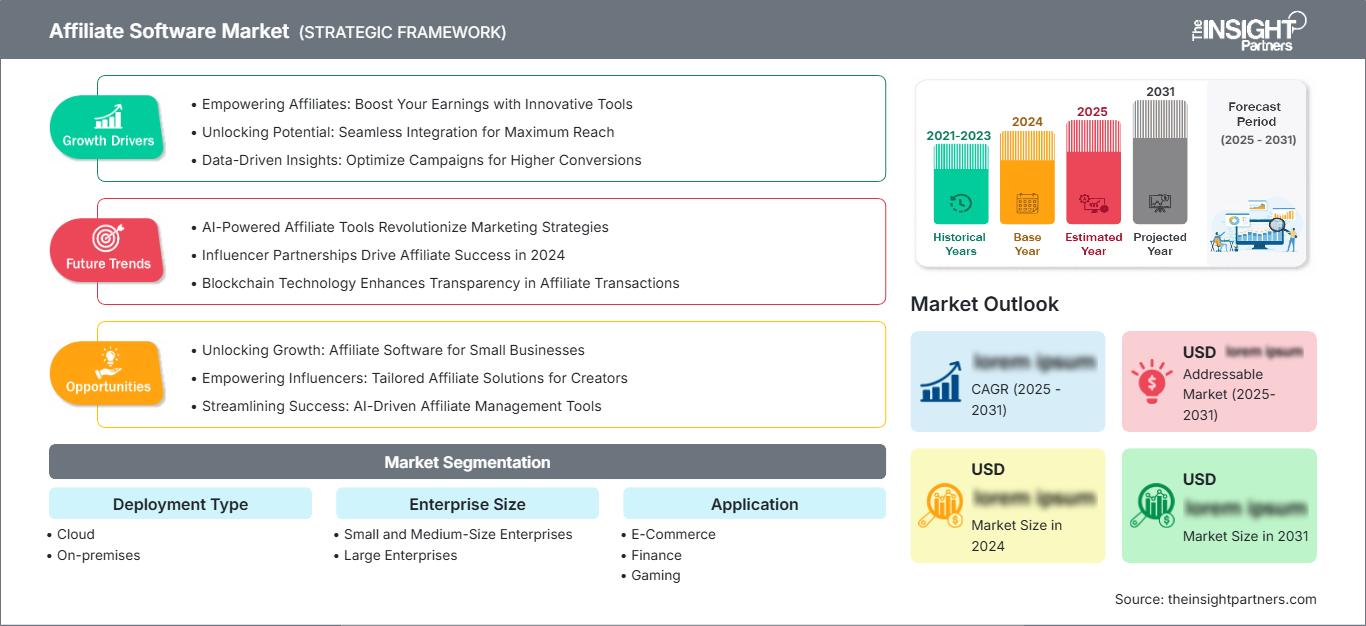
Regional Insights
North America Affiliate Software Market
North America represented approximately 34–38% of the affiliate software market share in 2025 and remains the largest regional marketplace. There is significant investment in digital advertising, widespread use of software-as-a-service products, and high-end analytical capabilities that drive regional expansion. Businesses in the fields of e-commerce, financial services, and gaming value the measurable success of their marketing efforts, making it more likely that they will implement affiliate management solutions. Growth during the forecast period will be in the range of 6.8–7.6%.
The United States and Canada will still have the advantage of developed online sales systems and an established ecosystem for affiliate marketing. More companies are starting to embrace automated commission management and fraud detection as a means of increasing efficiency. Active venture capital interest in marketing technologies and constant investments in cloud-based software applications continue to support future regional demand.
U.S. Affiliate Software Market
The United States accounted for approximately 72–76% of North American revenue in 2025, making it the leading national market. Adoption is supported by large e-commerce players, digital publishers, marketing firms, and commerce networks led by creators. Companies use affiliate marketing solutions to enhance transparency and efficiency of their acquisition spend.
Growth of the industry is forecast to continue with a CAGR of 6.9–7.7% until 2034. Vendor consolidation remains rampant in the sense that most of the biggest vendors operate from or even have significant operations all across the country. Increased need for partner management, omnichannel attribution, and performance marketing is used to justify investment. Some of the biggest spenders include financial services, direct-to-consumer, subscription companies, and gaming companies.
Europe Affiliate Software Market
Europe accounted for approximately 27–31% of global market revenue in 2025 and is projected to expand at a CAGR of 6.6–7.4% through the forecast period. The region benefits from modern digital commerce infrastructure, increased online customer interaction, and broad adoption of platforms among merchants and service providers.
The United Kingdom remains a key player due to the presence of a very advanced affiliate marketing community and a very advanced technology services sector. Germany would keep benefiting from its massive e-commerce base as well as its initiatives for digital transformation of its businesses. Affiliate technology would be adopted increasingly by France, Italy, and Spain to reduce the risks of customer acquisition.
APAC Affiliate Software Market
Asia Pacific held an estimated 24–28% affiliate software market share in 2025 and represents the fastest-growing major region. The market is projected to expand at a CAGR of 8.8–9.6% through 2034. China and India continue generating significant online commerce activity, while Japan and South Korea provide strong technology adoption foundations.
Government-supported digitalization initiatives, expanding internet penetration, and increasing mobile commerce transactions are strengthening regional demand. Australia also contributes through widespread adoption of cloud-based marketing platforms and data-driven advertising strategies.
Middle East & Africa Affiliate Software Market
The Middle East and Africa region is witnessing gradual adoption of affiliate platforms, supported by growing digital commerce ecosystems and expanding online consumer engagement. Demand is increasing across Saudi Arabia and the United Arab Emirates as businesses accelerate digital transformation initiatives.
The market is expected to register a CAGR of 7.4–8.2% through the forecast period. South Africa remains an important regional contributor, while infrastructure modernization and technology investments across the broader region continue creating opportunities for performance-based digital marketing solutions.
Segmentation Analysis
Deployment Type
The Deployment Type segment is expected to expand at a CAGR of 7.8–8.6% during 2026–2034. Deployment selection remains strongly influenced by scalability requirements, compliance obligations, integration complexity, and operational budgets. The affiliate software market scope continues to widen as organizations increasingly adopt cloud-native infrastructures that support distributed partner networks, real-time analytics, and flexible integration capabilities. While cloud platforms dominate new deployments, on-premises solutions maintain relevance among organizations requiring enhanced data control and customized deployment environments.
- Cloud: Cloud deployment represents the largest portion of the market due to lower upfront costs, faster implementation cycles, remote accessibility, and seamless integration with e-commerce, analytics, and customer relationship management platforms.
- On-premises: On-premises solutions remain important among highly regulated sectors and large organizations requiring extensive customization, direct infrastructure control, and internal governance over affiliate marketing operations and performance data.
Enterprise Size
The Enterprise Size segment is projected to record a CAGR of 7.1–7.9% during 2026–2034. Adoption patterns vary according to operational scale, marketing budgets, and partner ecosystem complexity. Large enterprises generally prioritize advanced analytics and multi-regional affiliate management capabilities, while smaller organizations focus on automation and cost efficiency. Growing digital commerce activity continues encouraging platform adoption across organizations of varying sizes.
- Small and Medium-Size Enterprises: SMEs increasingly adopt affiliate software to improve customer acquisition efficiency, automate commission processing, and compete effectively with larger brands through performance-based marketing programs and influencer partnerships.
- Large Enterprises: Large organizations utilize advanced partner management solutions to support extensive affiliate ecosystems, complex attribution requirements, and cross-border campaign execution while maintaining governance and performance visibility.
Application
The Application segment is forecast to expand at a CAGR of 8.2–9.0% during 2026–2034. Industry-specific adoption continues to diversify as businesses seek measurable acquisition channels and stronger engagement with digital audiences. Application requirements increasingly emphasize conversion tracking, attribution transparency, partner onboarding efficiency, and fraud prevention capabilities, encouraging continuous technological enhancement across affiliate platforms.
- E-Commerce: E-commerce remains the dominant application area due to significant online transaction volumes, extensive affiliate ecosystems, and strong demand for measurable traffic generation and conversion optimization.
- Finance: Financial service providers increasingly deploy affiliate platforms to support customer acquisition campaigns, improve compliance monitoring, and efficiently manage referral-based promotional partnerships.
- Gaming: Gaming companies represent one of the most dynamic user groups, leveraging affiliate programs, content creators, and competitive acquisition strategies to expand user communities and monetization opportunities.
- Nutraceuticals: Nutraceutical brands increasingly utilize affiliate marketing solutions to enhance product visibility, strengthen direct-to-consumer engagement, and support targeted promotional activities across digital channels.
Opportunity Snapshot
| Application | Revenue Contribution | Trend Tag | Adoption Stage |
|---|---|---|---|
| E-Commerce | High | Social Commerce | Mature |
| Finance | Medium | Digital Onboarding | Scaling |
| Gaming | High | Creator Economy | Scaling |
| Nutraceuticals | Medium | Wellness Retail | Emerging |
Affiliate Software Market Growth Drivers and Impact Analysis
Expansion of Performance-Based Marketing Models
Organizations increasingly prioritize measurable marketing expenditure as advertising budgets face greater scrutiny. Affiliate platforms allow businesses to compensate partners based on conversions rather than impressions or estimated audience reach, improving return-on-investment visibility. The growing importance of data-driven customer acquisition has accelerated platform adoption across retail, finance, subscription services, and gaming sectors. As digital competition intensifies, enterprises seek channels that balance customer acquisition costs with conversion quality. Affiliate software supports this objective by providing transparent attribution, commission automation, and campaign performance monitoring. These capabilities continue attracting organizations seeking efficient marketing structures, thereby strengthening long-term platform demand across both developed and emerging digital economies.
Rapid Growth of Global Digital Commerce Ecosystems
The continued expansion of online retail platforms and digital consumer engagement has created significant opportunities for affiliate marketing technologies. Businesses increasingly rely on partner-driven traffic generation to broaden audience reach without substantially increasing advertising risk. Affiliate software enables merchants to manage expanding partner networks while maintaining operational efficiency and compliance oversight. Rising mobile commerce activity, improved digital payment adoption, and growing consumer trust in online transactions further support affiliate software market expansion. As brands seek differentiated customer acquisition channels, affiliate partnerships have become a strategic component of broader digital marketing programs. This environment continues generating demand for advanced tracking, reporting, and partnership management capabilities.
Increasing Need for Attribution Accuracy and Fraud Prevention
Affiliate ecosystems involve multiple stakeholders, referral pathways, and conversion events, making accurate attribution essential. Organizations increasingly invest in software platforms capable of identifying invalid traffic, commission manipulation, and fraudulent activity. Enhanced monitoring tools support campaign integrity while improving confidence among advertisers and affiliate partners. Modern solutions leverage automation, analytics, and machine learning techniques to reduce operational risk and improve performance visibility. As advertising environments become more complex, businesses require stronger governance mechanisms that ensure partner accountability and transparent compensation structures. Consequently, demand for sophisticated affiliate software capabilities continues expanding across industries that rely heavily on digital customer acquisition models.
Affiliate Software Market Future Trends
Artificial Intelligence-Enhanced Partner Optimization
The affiliate software market trends increasingly point toward greater use of artificial intelligence for campaign management, affiliate recruitment, and predictive performance analysis. Future platforms are expected to automatically identify high-value partners, optimize commission structures, and forecast conversion outcomes based on historical campaign performance. AI-driven insights will likely reduce manual administration while improving decision quality. Vendors are also expected to expand machine learning capabilities for fraud detection, attribution refinement, and customer segmentation. As organizations pursue operational efficiency and marketing precision, intelligent automation is anticipated to become a standard platform requirement across enterprise and SME deployments.
Convergence of Affiliate, Influencer, and Partnership Management
Future platform development is expected to support broader partnership ecosystems rather than traditional affiliate programs alone. Businesses increasingly engage creators, influencers, publishers, and strategic referral partners through integrated marketing initiatives. Technology providers are therefore expanding platform architectures to accommodate multiple partnership models within unified environments. This convergence is expected to simplify campaign management while enhancing reporting consistency and performance measurement. Organizations are also likely to favor solutions that combine relationship management, attribution, communication tools, and payment functionality in a single interface. Such developments will reshape affiliate software market competition and increase platform differentiation.
Affiliate Software Market Opportunities
Expansion Across Emerging Digital Commerce Economies
The increasing sophistication of online commerce ecosystems across Southeast Asia, the Middle East, and selected African markets presents a substantial growth avenue for platform vendors. Businesses operating in these regions are actively seeking cost-efficient marketing approaches capable of generating measurable customer acquisition outcomes. Affiliate technologies offer an attractive alternative to traditional advertising by linking expenditures directly to performance metrics. As internet penetration, digital payment adoption, and mobile commerce activity continue rising, demand for partnership management solutions is expected to increase accordingly. Affiliate software market Forecasts indicate that emerging economies will contribute a higher proportion of new platform deployments during the coming decade. Companies capable of providing localized payment processing, multilingual support, regulatory compliance functionality, and regional partner discovery tools are expected to secure competitive advantages. Strategic investment in local partnerships and platform customization may further accelerate market penetration.
Advanced Analytics and Partner Intelligence Solutions
Growing demand for actionable marketing intelligence creates an attractive opportunity for vendors developing next-generation analytics capabilities. Enterprises increasingly require detailed visibility into partner performance, customer lifetime value, incremental revenue generation, and attribution quality. Solutions that combine artificial intelligence, predictive modeling, and real-time reporting functionality can help advertisers improve campaign efficiency while optimizing partner relationships. As affiliate ecosystems become larger and more complex, manual analytical approaches become less practical. Vendors capable of delivering automated recommendations, fraud risk assessment, performance forecasting, and unified partnership measurement frameworks will likely attract higher-value enterprise customers. This opportunity extends beyond traditional affiliate programs and includes creator partnerships, influencer ecosystems, referral marketing initiatives, and broader performance-based commerce networks.
Frequently Asked Questions

- Comprehensive Market Sizing and Forecast Analysis
- Detailed Segmentation Analysis
- In-Depth Market Dynamics Assessment
- Regional and Country-Level Insights
- Competitive Landscape and Company Benchmarking
- Strategic Business Intelligence
Recent Reports
Testimonials

The Insight Partners' SCADA System Market report is comprehensive, with valuable insights on current trends and future forecasts. The team was highly professional, responsive, and supportive throughout. We are very satisfied and highly recommend their services.
RAN KEDEM Partner, Reali Technologies LTDs
I requested a report on a very specific software market and the team produced the report in a few days. The information was very relevant and well presented. I then requested some changes and additions to the report. The team was again very responsive and I got the final report in less than a week.
JEAN-HERVE JENN Chairman, Future Analytica
We worked with The Insight Partners for an important market study and forecast. They gave us clear insights into opportunities and risks, which helped shape our plans. Their research was easy to use and based on solid data. It helped us make smart, confident decisions. We highly recommend them.
PIYUSH NAGPAL Sr. Vice President, High Beam Global
The Insight Partners delivered insightful, well-structured market research with strong domain expertise. Their team was professional and responsive throughout. The user-friendly website made accessing industry reports seamless. We highly recommend them for reliable, high-quality research services
YUKIHIKO ADACHI CEO, Deep Blue, LLC.
This is the first time I have purchased a market report from The Insight Partners.While I was unsure at first, I visited their web site and felt more comfortable to take the risk and purchase a market report.I am completely satisfied with the quality of the report and customer service. I had several questions and comments with the initial report, but after a couple of dialogs over email with their analyst I believe I have a report that I can use as input to our strategic planning process.Thank you so much for taking the extra time and making this a positive experience.I will definitely recommend your service to others and you will be my first call when we need further market data.
JOHN SUZUKI President and Chief Executive Officer, Board Director, BK Technologies
I wish to appreciate your support and the professionalism you displayed in the course of attending to my request for information regarding to infectious disease IVD market in Nigeria. I appreciate your patience, your guidance, and the fact that you were willing to offer a discount, which eventually made it possible for us to close a deal. I look forward to engaging The Insight Partners in the future, all thanks to the impression you have created in me as a result of this first encounter.
DR CHIJIOKE ONYIA MANAGING DIRECTOR, PineCrest Healthcare Ltd.Reason to Buy
- Informed Decision-Making
- Understanding Market Dynamics
- Competitive Analysis
- Identifying Emerging Markets
- Customer Insights
- Market Forecasts
- Risk Mitigation
- Boosting Operational Efficiency
- Strategic Planning
- Investment Justification
- Tracking Industry Innovations
- Aligning with Regulatory Trends





 Get Free Sample for