
CAM Software Market Share, Size & Demand by 2034
Coverage: By Model Type (3D , 2D); Deployment Type (On Premises, Cloud Based); Organization Size (Large Enterprises, SMEs); Manufacturing Process (Milling, Multi-Axis Machining, Turning, Mill-Turn, Sheet Metal, Additive Manufacturing, Others); Axis Capability (2 Axis to 3 Axis, 5 Axis and Above, 4 Axis); , and Geography (North America, Europe, Asia Pacific, and South and Central America)
- Status : Published
- Report Code : TIPRE00007479
- Category : Technology, Media and Telecommunications
- No. of Pages : 392
- Available Report Formats :


- Last update date : September 01, 2026


2025 Market Size
US$ 3,642.84 Mn
Base year value
2034 Forecast
US$ 9,172.52 Mn
Projected by 2034
CAGR 2026-2034
10.8 %
Growth rate
Addressable Market
US$ 56,689.10 Mn
(2026-2034)
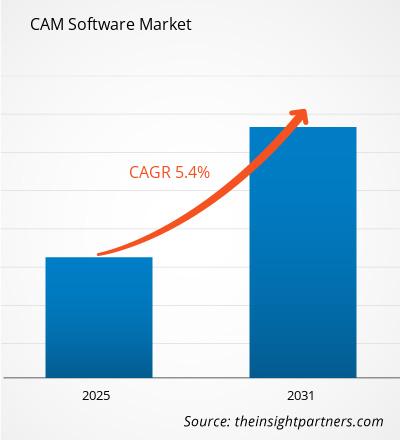
CAM Software Market is valued at US$ 3642.84 Million in 2025 and is projected to reach US$ 9172.52 Million by 2034, expanding at a CAGR of 10.8% during 2026–2034. The market encompasses software used to program, simulate, optimize, and manage computer numerical control manufacturing processes across discrete and process-oriented production environments, with adoption increasingly linked to advanced machining, connected production, and digital engineering workflows.
The CAM Software Market size in North America is supported by established CNC infrastructure, high-value aerospace and automotive production, and sustained investment in manufacturing automation. Adoption is also influenced by skilled-labor constraints, increasing machining complexity, and demand for integrated design-to-production workflows. Cloud-connected platforms, simulation, automated programming, and multi-axis capabilities are becoming increasingly relevant as manufacturers seek shorter programming cycles and greater utilization of installed machine capacity.
CAM Software Market Assessment and Insights
- North America: The region represents an estimated 29.50% share in 2025, supported by advanced machining and aerospace production, and is expected to expand at a 10.5% CAGR between 2026–2034 as automation investment continues.
- US: The US accounts for an estimated 69.4% of North American demand in 2025, with adoption supported by aerospace, defense, automotive, and precision engineering and 11.0% CAGR through 2034.
- Europe: Europe holds an estimated 24.41% share in 2025 and is projected to grow at a 9.7% CAGR, led by Germany, France, Italy, and the UK through industrial automation and precision manufacturing.
- Asia Pacific: Asia Pacific represents an estimated 37.01% share in 2025 and is expected to record a 12.1% CAGR, led by China, Japan, South Korea, and India as production capacity and automation deepen.
- Largest Segment: 3D model-based solutions represent an estimated 58.9% market share in 2025 and are projected to grow at a 11.3% CAGR during 2026–2034.
- High Growth Segment: Cloud-based deployment represents an estimated 28–32.9% market share in 2025 and is projected to grow at a 12.1% CAGR during 2026–2034.
- Key companies analyzed in detail: Autodesk Inc.; Dassault Systèmes SE; Siemens AG; Hexagon AB; PTC Inc.; CNC Software, LLC (Mastercam); SolidCAM Inc.; OPEN MIND Technologies AG; TOPSOLID SAS; Tebis AG; Cimatron Ltd.; HCL Technologies Ltd.; Hypertherm, Inc.; SigmaTEK Systems, LLC; MecSoft Corporation.
Source: The Insight Partners' analysis based on proprietary research, government publications, company annual reports, investor presentations, industry databases, and expert interviews.
Production-oriented CAM platforms have evolved from standalone numerical-control programming tools into integrated environments connecting CAD data, toolpath generation, simulation, post-processing, machining verification, and shop-floor information. Increasingly sophisticated 3D geometry, five-axis machining, mill-turn equipment, automated nesting, and additive processes are changing programming requirements. Cloud connectivity and data synchronization are also reducing separation between engineering and manufacturing teams, while AI-assisted programming is beginning to address repetitive programming tasks and the shortage of experienced CNC personnel. Autodesk describes integrated CAD/CAM workflows, automated programming, and four- and five-axis machining within its current manufacturing offering.
Over the forecast period, investment is expected to broaden beyond traditional high-value machining centers toward connected production environments and distributed manufacturing networks. Asia Pacific offers substantial expansion potential because of industrial capacity additions, while emerging manufacturing clusters in India and Southeast Asia can accelerate adoption among smaller suppliers. Regulatory emphasis on traceability, quality, energy efficiency, and digital manufacturing can further support investment as manufacturers modernize production systems and seek repeatable processes.
CAM Software Market Report Scope
| Report Attribute | Details |
|---|---|
| Market size in 2025 | US$ 3,642.84 Million |
| Market Size by 2034 | US$ 9,172.52 Million |
| Global CAGR (2026 - 2034) | 10.8% |
| Historical Data | 2021-2024 |
| Forecast period | 2026-2034 |
CAM Software Market Analysis
The CAM Software Market growth is being shaped by demand for shorter production cycles, greater machine utilization, and reliable machining of increasingly complex components. The value chain begins with CAD and product engineering data, moves through CAM programming, post-processing, machine simulation, tooling and fixture preparation, and culminates in CNC execution and inspection. Suppliers therefore compete on interoperability, post-processor quality, simulation fidelity, automation, and compatibility with diverse machine configurations.
Demand is reinforced by aerospace backlogs, automotive electrification, medical-device precision requirements, and industrial equipment modernization. IATA reported an aircraft order backlog exceeding 17,000 units, illustrating the sustained manufacturing workload facing aerospace supply chains. At the same time, software suppliers must accommodate heterogeneous machine fleets, legacy controllers, proprietary post-processors, and differing operator capabilities, making implementation support and ecosystem partnerships important components of competitive positioning.
Competitive positioning increasingly depends on the breadth of supported machining strategies and the ability to integrate CAM with broader engineering or manufacturing platforms. Autodesk, Dassault Systèmes, Siemens, Hexagon, and PTC compete through integrated digital-engineering ecosystems, while CNC Software, SolidCAM, OPEN MIND Technologies, TOPSOLID, Tebis, Cimatron, HCL Technologies, Hypertherm, SigmaTEK Systems, and MecSoft emphasize specialized machining workflows and manufacturing productivity. Differentiation increasingly centers on automation, machine awareness, simulation, connectivity, and ease of deployment.
Investment priorities are moving toward AI-assisted programming, cloud-connected manufacturing, digital twins, and closed-loop machining. Siemens' 2026 NX manufacturing releases include CAM-only cloud-connected packages, AI-assisted machining functions, automated fixture capabilities, and closed-loop probing workflows. Hexagon has similarly introduced AI capabilities within ESPRIT EDGE to simplify Swiss machining and address programming skills gaps. These developments indicate competition is shifting from basic toolpath generation toward intelligent manufacturing orchestration.
● REPORT CUSTOMIZATION
Tailor This Report To Align With Your Specific Business Requirements
This report can be customized to align precisely with your business objectives, scope, and target markets. Customization options include tailored segmentation, geography, competitive analysis, and strategic insights to support informed decision-making.
Customize This Report →WHAT YOU CAN ADJUST
- ● Segmentations
- ● Geography
- ● Competitive Analysis
- ● Language Preferences
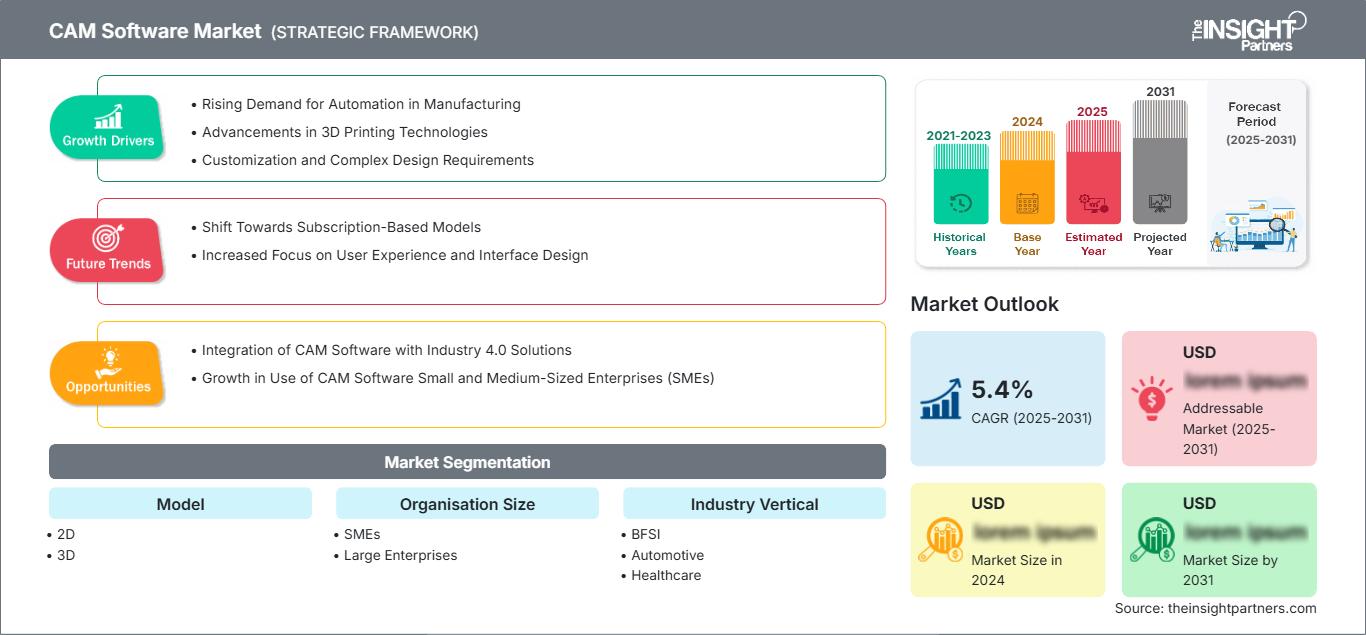
CAM Software Market: Strategic Insights
Regional Insights
North America CAM Software Market
North America accounts for an estimated 29.5% share in 2025 and is projected to expand at a 10.5% CAGR through 2034. The region benefits from established CNC infrastructure, aerospace production, automotive manufacturing, defense programs, and sophisticated job-shop networks. Demand is reinforced by reshoring initiatives and manufacturers seeking greater productivity from existing machine assets.
The US dominates regional adoption, while Canada contributes through aerospace, industrial equipment, energy, and precision manufacturing. Software selection increasingly emphasizes multi-axis machining, simulation, automated programming, and integration with enterprise engineering environments. Labor availability is another structural consideration because manufacturers need to reduce dependence on highly experienced programmers. Cloud-connected deployment is gaining relevance among distributed operations, although security, intellectual-property protection, and integration with legacy systems continue influencing deployment decisions.
U.S. CAM Software Market
The US represents an estimated 69.4% of North American demand in 2025 and is expected to grow at a 11.0% CAGR. Aerospace, defense, automotive, medical devices, and industrial machinery provide substantial application breadth, while reshoring strengthens domestic machining investment.
Major software providers maintain significant US presence, including Autodesk, Siemens, Hexagon, PTC, CNC Software, Hypertherm, SigmaTEK Systems, and MecSoft. Application trends are moving toward five-axis machining, automated toolpath generation, machine simulation, and connected production data. High aircraft demand remains an important manufacturing signal; IATA reported 2025 passenger demand growth of 5.3%, while supply constraints continued to limit fleet renewal. These conditions support sustained demand for efficient programming and machining workflows.
Europe CAM Software Market
Europe represents an estimated 24.4% share in 2025 and is projected to expand at a 9.7% CAGR through 2034. Germany remains the leading country, supported by automotive, machinery, aerospace, tooling, and industrial automation. France, Italy, the UK, and Spain provide additional demand through specialized engineering and manufacturing clusters.
The UK market is supported by aerospace, defense, motorsport, medical technology, and precision engineering. Manufacturers increasingly require software capable of handling complex surfaces and high-value components while maintaining production traceability. Adoption of simulation and advanced post-processing is important where machining errors carry high material costs.
Germany combines strong machine-tool manufacturing with large automotive and industrial-equipment ecosystems. Demand is therefore concentrated around sophisticated five-axis, mill-turn, simulation, and automated programming capabilities. Industry digitization also encourages integration between CAM, manufacturing execution, product lifecycle management, and shop-floor systems.
France, Italy, and Spain contribute through aerospace, automotive, industrial machinery, tooling, furniture, and metalworking. France has strong aerospace and defense activity, Italy maintains extensive machinery and component manufacturing networks, while Spain benefits from automotive and industrial engineering. European manufacturers increasingly prioritize interoperability, production efficiency, and digital continuity.
APAC CAM Software Market
APAC represents an estimated 37.01% share in 2025 and is expected to grow at a 12.1% CAGR. China is the leading market, followed by Japan, South Korea, India, and Australia. Industrial automation, electronics manufacturing, automotive production, and machine-tool investment support regional adoption.
China's manufacturing scale creates demand for production-oriented CAM, while Japan and South Korea emphasize precision, automation, and advanced machining. India is expanding engineering and export-oriented manufacturing capabilities, with policy attention increasingly directed toward domestic technology development. Australia provides specialized demand in mining equipment, aerospace, defense, and advanced manufacturing.
Middle East & Africa CAM Software Market
Middle East and Africa demand is projected to expand at a 8.9% CAGR through 2034, with Saudi Arabia representing a leading market. Industrial diversification, energy equipment manufacturing, infrastructure projects, and localization initiatives are strengthening the case for digital production technologies.
The UAE supports adoption through aerospace, advanced manufacturing, and industrial investment, while South Africa contributes automotive, mining equipment, and engineering demand. Across the rest of MEA, infrastructure modernization and energy-sector investment remain important. The IEA estimated global energy investment at US$ 3.3 trillion in 2025, providing broader context for continued investment in equipment-intensive energy and industrial value chains.
Segmentation Analysis
Model Type
Model Type segmentation is led by 3D, which is expected to grow at a 11.3% CAGR during 2026–2034. Complex components, surface machining, simulation, and integrated CAD/CAM workflows favor three-dimensional programming, while 2D remains important for simpler production tasks.
- 3D: Maintains the dominant position because aerospace, automotive, medical, tooling, and industrial components increasingly involve complex surfaces requiring accurate visualization, collision checking, adaptive strategies, and multi-axis toolpath planning.
- 2D: Remains strategically important for prismatic components, profiles, drilling, basic milling, and cost-sensitive workshops where straightforward programming and rapid setup remain more valuable than advanced surface capabilities.
Deployment Type
Deployment Type is increasingly influenced by cloud adoption, with Cloud Based solutions expected to grow at a 12.1% CAGR during 2026–2034. On-premises systems remain critical where control and legacy integration dominate purchasing decisions.
- On Premises: Retains strong relevance among manufacturers requiring local data control, offline operation, established post-processors, and integration with legacy engineering and shop-floor infrastructure.
- Cloud Based: Gains strategic importance through centralized updates, distributed collaboration, subscription economics, scalable access, and easier coordination across engineering, programming, and manufacturing locations.
Organization Size
Organization Size is supported by both enterprise modernization and SME digitization. Large Enterprises are expected to grow at a 910.9 % CAGR during 2026–2034, while smaller manufacturers increasingly seek accessible systems.
- Large Enterprises: Prioritize standardized manufacturing processes, multi-site governance, advanced simulation, PLM integration, centralized libraries, and enterprise security across geographically distributed production operations.
- SMEs: Represent an important adoption pool because affordable subscriptions, integrated CAD/CAM environments, automation, and simplified programming can reduce dependence on scarce specialist skills.
Manufacturing Process
Manufacturing Process demand is diversified across machining and fabrication workflows.
- Milling: Remains foundational across discrete manufacturing, with demand spanning basic three-axis work through sophisticated high-speed and multi-axis operations.
- Multi-Axis Machining: Gains strategic importance for complex components because fewer setups, improved accessibility, and controlled tool orientation can improve production consistency.
- Turning: Continues to support high-volume cylindrical component manufacturing across automotive, industrial, energy, and general engineering applications.
- Mill-Turn: Benefits manufacturers seeking consolidated machining operations, reduced handling, and greater utilization of sophisticated multitasking machine tools.
- Sheet Metal: Serves fabrication-intensive industries requiring nesting, cutting, forming, and material-utilization workflows integrated with downstream production.
- Additive Manufacturing: Expands as manufacturers combine deposition, machining, simulation, and hybrid production methods for complex or customized components.
- Others: Includes specialized processes serving niche manufacturing requirements where compatibility, post-processing, and workflow integration influence purchasing decisions.
Axis Capability
Axis Capability is becoming more advanced as component complexity rises. 5 Axis and Above is expected to grow at a 12.1% CAGR during 2026–2034, reflecting aerospace, medical, tooling, and high-precision applications.
- 2 Axis to 3 Axis: Remains widely deployed for conventional milling, drilling, profiling, and turning-related applications where programming simplicity and machine availability dominate.
- 5 Axis and Above: Supports complex geometry, fewer setups, improved surface quality, and high-value machining where collision avoidance and accurate tool orientation are critical.
- 4 Axis: Provides an intermediate capability for rotary machining, indexing, and specialized components requiring additional accessibility without full simultaneous five-axis functionality.
End Use Industry
End Use Industry demand is broad, with the Automotive and Transportation segment expected to expand at a 11.5 because machining errors can materially affect cost and quality.
- Automotive and Transportation: Uses CAM for powertrain, chassis, tooling, electric-vehicle components, and increasingly complex lightweight structures.
- Aerospace and Defense: Requires advanced simulation, five-axis programming, traceability, and high-precision machining for safety-critical components.
- Industrial Manufacturing: Provides broad demand across machinery, equipment, tooling, pumps, valves, and engineered components.
- Healthcare and Medical Device Manufacturing: Requires accurate machining for implants, instruments, prosthetics, and highly customized components.
- Electronics and High-Tech Manufacturing: Uses CAM for precision enclosures, tooling, connectors, thermal components, and miniaturized production hardware.
- Energy and Power: Supports machining of turbines, valves, pumps, generators, and specialized equipment used across conventional and emerging energy systems.
- Construction and Infrastructure Equipment: Applies CAM to heavy machinery components, attachments, structural parts, and replacement components.
- Furniture and Woodworking: Uses CAD/CAM-linked programming for cutting, nesting, routing, drilling, and customized production.
- Others: Includes specialized manufacturing sectors where CNC programming, process repeatability, and complex component production support software adoption.
Opportunity Snapshot
| End Use Industry | Revenue Contribution (High/Medium/Low) | Trend Tag (MAX 2 words) | Adoption Stage (Emerging/Scaling/Mature) |
| Automotive and Transportation | High | EV Components | Scaling |
| Aerospace and Defense | High | Complex Machining | Mature |
| Industrial Manufacturing | High | Smart Machining | Mature |
| Healthcare and Medical Device Manufacturing | Medium | Precision Implants | Scaling |
| Electronics and High-Tech Manufacturing | Medium | Miniaturized Parts | Scaling |
| Energy and Power | Medium | Energy Equipment | Scaling |
| Construction and Infrastructure Equipment | Medium | Heavy Components | Mature |
| Furniture and Woodworking | Low | CNC Routing | Mature |
| Others | Low | Specialized CNC | Emerging |
CAM Software Market Growth Drivers and Impact Analysis
Rising complexity of precision-machined components
Manufacturers are increasingly producing components with complex surfaces, tighter tolerances, lightweight structures, and fewer opportunities for manual intervention. This directly increases the value of sophisticated toolpath generation, simulation, collision detection, and multi-axis programming. Aerospace supply constraints provide a strong example of production pressure, with IATA reporting an aircraft order backlog above 17,000 units and continued manufacturing bottlenecks. As component complexity increases, manufacturers can justify higher-value CAM capabilities because programming errors, scrap, and machine downtime carry greater economic consequences. The resulting demand favors platforms capable of managing complex geometry, machine kinematics, fixtures, tooling, and post-processors within unified workflows. This driver also encourages investment in simulation and verification before production begins, reducing physical trial-and-error during machining.
Manufacturing labor shortages accelerate programming automation
The availability of experienced CNC programmers is becoming an operational constraint as production requirements increase and skilled personnel approach retirement in several industrial economies. CAM vendors are responding by embedding automated feature recognition, templates, knowledge-based machining, AI-assisted suggestions, and reusable process libraries. Siemens introduced AI-assisted machining suggestions and automated kinematics capabilities in its recent NX releases, while Hexagon added AI services to ESPRIT EDGE. These capabilities can reduce repetitive programming effort and help less-experienced personnel produce consistent programs under supervision. The market impact extends beyond software licenses because manufacturers can standardize institutional knowledge into templates and rules. Consequently, automation becomes a workforce-productivity strategy rather than solely a technology upgrade.
Digital manufacturing investment strengthens connected CAM adoption
Investment in connected industrial infrastructure is creating stronger demand for CAM platforms that exchange data with engineering, production, inspection, and asset-management systems. The IEA estimates that global energy investment reached US$3.3 trillion in 2025, with clean-energy investment substantially exceeding fossil-fuel investment, demonstrating the scale of equipment-intensive industrial transformation. Manufacturers participating in these investment cycles increasingly require digital continuity from design through production. Cloud-connected CAM can support centralized libraries, version management, remote collaboration, and standardized processes across facilities. The resulting opportunity is particularly significant for enterprises operating multiple production sites because common manufacturing data can reduce duplicated programming work and improve process consistency while supporting faster deployment of standardized production methods.
CAM Software Market Future Trends
AI-guided machining becomes embedded in programming workflows
Future CAM environments are likely to shift from command-driven programming toward context-aware assistance that recommends machining strategies based on geometry, machine capabilities, tooling, material, and historical production knowledge. AI will increasingly operate alongside human programmers rather than replace them, generating candidate operations that engineers validate before posting. Machine-aware functions can further constrain recommendations to actual spindle limits, axes, fixtures, and tooling. As confidence improves, systems may automate routine feature recognition, setup planning, tool selection, and optimization. The strategic implication is a gradual change in programmer responsibilities from repetitive operation creation toward process validation, exception handling, and production optimization. Vendors with large installed bases and extensive manufacturing datasets may possess advantages in developing reliable recommendation engines.
Closed-loop machining connects CAM with inspection
The next stage of manufacturing software development will increasingly connect CAM programming with measurement, inspection, and adaptive correction. Instead of treating NC generation and quality verification as separate activities, integrated workflows can use in-process measurement results to adjust machining parameters and automatically compensate for deviations. Siemens' recent NX capabilities already incorporate probing, alignment, tool control, and adaptive machining into a connected workflow. Wider adoption will depend on reliable machine connectivity, standardized measurement procedures, and validated post-processors. Over time, closed-loop capabilities should become particularly valuable for aerospace, medical, tooling, and other high-value applications where material costs and dimensional requirements make repeated manual correction expensive. This direction also supports greater autonomy on increasingly sophisticated CNC equipment.
CAM Software Market Opportunities
Cloud platforms for distributed manufacturing networks
Cloud deployment creates an opportunity for vendors to serve manufacturers operating multiple plants, external suppliers, engineering centers, and contract machining partners. A centralized environment can provide controlled access to manufacturing models, standardized process templates, tool libraries, and approved post-processors while reducing the administrative burden associated with local software installations. The strongest opportunity lies in organizations undergoing geographic expansion or supplier diversification because shared digital workflows can improve consistency without requiring identical local infrastructure. Vendors can strengthen this opportunity through role-based access, offline capabilities, cybersecurity controls, and integrations with PLM and manufacturing execution platforms. Subscription models can additionally lower initial acquisition barriers for smaller manufacturers, creating a pathway from basic programming tools toward broader digital manufacturing environments as operational requirements mature.
CAM expansion into additive and hybrid production
Hybrid manufacturing creates an opportunity to extend CAM beyond conventional subtractive machining into workflows combining deposition, machining, inspection, and finishing. Manufacturers producing high-value components can use additive methods to create near-net-shape structures and then apply precision machining to achieve final tolerances. This approach is relevant to aerospace, energy, tooling, medical devices, and repair applications where material efficiency and component customization are important. Software vendors can capture value by integrating additive toolpath planning with conventional machining, process simulation, build preparation, and inspection data. The opportunity also extends to repair operations, where deposited material can restore worn surfaces before machining. As additive equipment becomes more industrialized, interoperable software workflows can reduce fragmentation between specialized production stages and support broader adoption of hybrid manufacturing.
Recent Developments
- February 2026: Autodesk has invested US$ 200 million in World Labs, an advanced AI research company co-founded by Fei-Fei Li (CEO), Justin Johnson, Christoph Lassner, and Ben Mildenhall. The move underscores a shared belief that the most impactful AI technologies should enhance human creativity—helping people imagine, design, and build more—rather than replace them
- February 2026: Dassault Systèmes (Euronext Paris: FR0014003TT8, DSY.PA) and NVIDIA announced a long-term strategic partnership to establish a shared industrial architecture for mission-critical artificial intelligence across industries. Combining Dassault Systèmes’ Virtual Twin technologies with NVIDIA AI infrastructure, open models and accelerated software libraries will establish science-validated industry World Models, and new ways of working through skilled virtual companions on the agentic 3DEXPERIENCE platform, that empower professionals with new expertise.
- June 2026: Dassault Systèmes announces the successful issuance of a bond that was significantly oversubscribed by institutional investors. The Company has also refinanced its maturing Revolving Credit Facility.
Frequently Asked Questions

- Comprehensive Market Sizing and Forecast Analysis
- Detailed Segmentation Analysis
- In-Depth Market Dynamics Assessment
- Regional and Country-Level Insights
- Competitive Landscape and Company Benchmarking
- Strategic Business Intelligence
Recent Reports
Testimonials

The Insight Partners' SCADA System Market report is comprehensive, with valuable insights on current trends and future forecasts. The team was highly professional, responsive, and supportive throughout. We are very satisfied and highly recommend their services.
RAN KEDEM Partner, Reali Technologies LTDs
I requested a report on a very specific software market and the team produced the report in a few days. The information was very relevant and well presented. I then requested some changes and additions to the report. The team was again very responsive and I got the final report in less than a week.
JEAN-HERVE JENN Chairman, Future Analytica
We worked with The Insight Partners for an important market study and forecast. They gave us clear insights into opportunities and risks, which helped shape our plans. Their research was easy to use and based on solid data. It helped us make smart, confident decisions. We highly recommend them.
PIYUSH NAGPAL Sr. Vice President, High Beam Global
The Insight Partners delivered insightful, well-structured market research with strong domain expertise. Their team was professional and responsive throughout. The user-friendly website made accessing industry reports seamless. We highly recommend them for reliable, high-quality research services
YUKIHIKO ADACHI CEO, Deep Blue, LLC.
This is the first time I have purchased a market report from The Insight Partners.While I was unsure at first, I visited their web site and felt more comfortable to take the risk and purchase a market report.I am completely satisfied with the quality of the report and customer service. I had several questions and comments with the initial report, but after a couple of dialogs over email with their analyst I believe I have a report that I can use as input to our strategic planning process.Thank you so much for taking the extra time and making this a positive experience.I will definitely recommend your service to others and you will be my first call when we need further market data.
JOHN SUZUKI President and Chief Executive Officer, Board Director, BK Technologies
I wish to appreciate your support and the professionalism you displayed in the course of attending to my request for information regarding to infectious disease IVD market in Nigeria. I appreciate your patience, your guidance, and the fact that you were willing to offer a discount, which eventually made it possible for us to close a deal. I look forward to engaging The Insight Partners in the future, all thanks to the impression you have created in me as a result of this first encounter.
DR CHIJIOKE ONYIA MANAGING DIRECTOR, PineCrest Healthcare Ltd.Reason to Buy
- Informed Decision-Making
- Understanding Market Dynamics
- Competitive Analysis
- Identifying Emerging Markets
- Customer Insights
- Market Forecasts
- Risk Mitigation
- Boosting Operational Efficiency
- Strategic Planning
- Investment Justification
- Tracking Industry Innovations
- Aligning with Regulatory Trends





 Get Free Sample for