
Automatic Content Recognition Market Share, Growth & Demand by 2034
Coverage: By Type (Solution, Services); Technology (Passive Fingerprinting, Speech Recognition, Digital Watermarks); End Users (Media and Entertainment, Military and Defense, IT and Telecommunication, Automotive, Consumer Electronics, Education, Others) , and Geography (North America, Europe, Asia Pacific, and South and Central America)
- Status : Data Released
- Report Code : TIPTE100000498
- Category : Electronics and Semiconductor
- No. of Pages : 150
- Available Report Formats :


- Last update date : July 17, 2026


2025 Market Size
US$ 4.33 Bn
Base year value
2034 Forecast
US$ 21.81 Bn
Projected by 2034
CAGR 2026-2034
19.69 %
Growth rate
Addressable Market
US$ 106.36 Bn
(2026-2034)
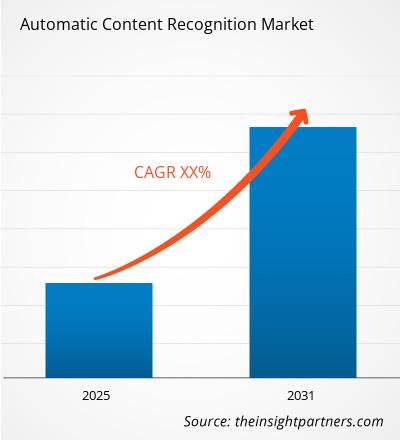
The Automatic Content Recognition Market was valued at US$ 4.33 Billion in 2025 and is projected to reach US$ 21.81 Billion by 2034, growing at a CAGR of 19.69% during 2026–2034. The Automatic Content Recognition Market is expanding as platforms, connected devices, and enterprise systems require reliable identification of audio, video, speech, and watermark signals across fragmented digital environments.
North America remains a high-value adoption base, with Automatic Content Recognition Market size supported by connected TV measurement, streaming analytics, digital advertising verification, and defense-grade media monitoring. The region is expected to grow at a CAGR range of 18.5–19.2% during 2026–2034. Structural demand is reinforced by smart TV penetration, privacy-compliant audience data partnerships, and enterprise investment in AI-enabled content intelligence.
Automatic Content Recognition Market Assessment and Insights
- North America: The region holds 38–42% share in 2025 and grows at a CAGR range of 18.5–19.2% during 2026–2034, supported by CTV advertising, broadcast monitoring, and enterprise content verification.
- US: The country represents 82–86% of North America in 2025 and grows at a CAGR range of 18.7–19.4% during 2026–2034, led by platforms, adtech, and media analytics.
- Europe: The region accounts for 22–26% share in 2025 and grows at a CAGR range of 17.4–18.1% during 2026–2034, with the UK, Germany, France, Italy, and Spain leading adoption.
- Asia Pacific: The region holds 24–28% share in 2025 and grows at a CAGR range of 21.0–21.8% during 2026–2034, led by China, Japan, South Korea, India, and Australia.
- Largest Segment: Solution holds 62–66% market share in 2025 and grows at a CAGR range of 18.8–19.5% during 2026–2034 due to platform licensing and analytics integration.
- High Growth Segment: Services holds 34–38% market share in 2025 and grows at a CAGR range of 20.4–21.1% during 2026–2034 as managed deployment and model tuning scale.
- Key companies analyzed in detail: ArcSoft, Inc.; ACRCloud Limited; Audible Magic Corporation; Civolution B.V.; Clarifai, Inc.; Digimarc Corporation; Enswers Inc.; Gracenote, Inc.; Google LLC; Microsoft Corporation.
Source: The Insight Partners' analysis based on proprietary research, government publications, company annual reports, investor presentations, industry databases, and expert interviews.
Content identification has moved from isolated broadcast monitoring toward cloud-native, AI-assisted recognition across connected TVs, mobile devices, vehicles, learning platforms, and security systems. The Automatic Content Recognition Market now depends on fingerprint databases, watermark robustness, speech models, metadata enrichment, and consent-based data governance. Production dynamics are shifting toward API delivery, modular analytics, and managed services because customers want fast deployment without owning large reference libraries or recognition infrastructure.
Forward demand will be shaped by emerging streaming markets, national digitalization programs, advertising transparency rules, and enterprise requirements for provenance in synthetic media. Investment is likely to move into India, Southeast Asia, the Gulf, and Latin America as platforms localize language models and content catalogs. Regulatory tailwinds around copyright enforcement, accessibility, and public-safety monitoring should widen adoption of automated recognition workflows.
Automatic Content Recognition Market Report Scope
| Report Attribute | Details |
|---|---|
| Market size in 2025 | US$ 4.33 Billion |
| Market Size by 2034 | US$ 21.81 Billion |
| Global CAGR (2026 - 2034) | 19.69% |
| Historical Data | 2021-2024 |
| Forecast period | 2026-2034 |
Automatic Content Recognition Market Analysis
The Automatic Content Recognition Market growth is driven by the need to identify content in real time when audiences shift between linear television, streaming apps, social video, gaming, and in-vehicle infotainment. Media owners use ACR to verify distribution, advertisers use it to measure exposure, and device makers use it to personalize experiences. Supply dynamics favor vendors that combine high-accuracy matching, low-latency processing, and privacy-aware consent management.
The ecosystem includes fingerprint database owners, watermarking specialists, speech recognition providers, cloud platforms, content metadata companies, broadcasters, smart TV OEMs, automotive software suppliers, telecom operators, and education technology platforms. The Automatic Content Recognition Market analysis indicates that value increasingly sits in data normalization, application programming interfaces, model maintenance, and reporting layers rather than recognition alone. Buyers require scalable reference libraries and evidence-grade audit trails.
Competition is moderately concentrated because large technology companies and specialized recognition providers address different customer needs. Google LLC and Microsoft Corporation bring cloud AI, speech, and developer ecosystems, while Gracenote, Inc. contributes entertainment metadata and content identifiers. ACRCloud Limited, Audible Magic Corporation, Digimarc Corporation, Clarifai, Inc., Enswers Inc., ArcSoft, Inc., and Civolution B.V. compete through fingerprinting, watermarking, visual AI, rights monitoring, and media intelligence capabilities.
Investment is moving toward generative AI provenance, CTV ad measurement, multilingual speech interfaces, and content security. Vendors are strengthening strategic positioning through partnerships with device manufacturers, streaming platforms, broadcasters, labels, publishers, and public-sector agencies. The strongest providers will combine recognition accuracy with compliance documentation, regional catalog coverage, and workflow integration for advertising, copyright, security, and user experience teams.
● REPORT CUSTOMIZATION
Tailor This Report To Align With Your Specific Business Requirements
This report can be customized to align precisely with your business objectives, scope, and target markets. Customization options include tailored segmentation, geography, competitive analysis, and strategic insights to support informed decision-making.
Customize This Report →WHAT YOU CAN ADJUST
- ● Segmentations
- ● Geography
- ● Competitive Analysis
- ● Language Preferences
Automatic Content Recognition Market: Strategic Insights

Regional Insights
North America Automatic Content Recognition Market
North America accounts for 38–42% share in 2025 and is projected to grow at a CAGR range of 18.5–19.2% during 2026–2034. The Automatic Content Recognition Market share is supported by connected TV advertising, audience measurement modernization, content rights monitoring, and cloud AI adoption. Broadcasters and platforms require census-level signals, while advertisers seek deterministic verification across fragmented viewing environments.
Growth is strengthened by large smart TV installed bases, premium streaming spend, and advanced programmatic advertising infrastructure. Industry bodies such as IAB Tech Lab and W3C privacy discussions influence how consent, identifiers, and measurement data are handled. Vendors with transparent data governance, scalable reference matching, and trusted metadata relationships are favored in enterprise procurement.
U.S. Automatic Content Recognition Market
The U.S. Automatic Content Recognition Market accounts for 82-86% of North America in 2025 and is forecast to grow at a CAGR of 18.7-19.4% between 2026-2034. Adoptions include connected TV solutions, music monitoring, ad attribution, streaming discovery, copyright protection, and military media analysis. The company landscape includes global cloud operators, pure-play ACR solution providers, metadata operators, and advertising technology integrators.
Applications are likely to include show-level targeted ads, shoppable TV, multilingual voice search, content origin, and automated compliance. Media owners adopt ACR solutions to analyze consumer habits across linear and apps, while automotive and consumer electronics companies integrate recognition to enable voice-led infotainment. Procurement involves privacy settings, accurate detection, reliability, and a customer-specific reference base.
Europe Automatic Content Recognition Market
Europe's share is 22–26%, growing at a CAGR of 17.4%-18.1% from 2026 through 2034. The United Kingdom is prominent in broadcast technology, ad measurement, and streaming innovations, whereas Germany is leading in automotive infotainment, industry content monitoring, and applications in public broadcasting. Compliance with GDPR maintains consent-driven deployments.
In France, Italy, and Spain, there is demand from national broadcasters, telecommunications companies, TV, music licensing, and educational technology. Buyers in Europe usually expect transparent data processing, language support within regions, and copyright management workflows. Those who localize their metadata services, watermarking, and speech recognition will be able to cater to buyers in public media, telecom, defense, and consumer electronics.
APAC Automatic Content Recognition Market
APAC has a market share of 24–28% in 2025 and is expected to grow at a CAGR of 21.0-21.8% from 2026 to 2034. China is the top player owing to its number of connected devices, video services, smart TV shipments, and investments in AI. Japan and South Korea focus on consumer electronics, music identification technologies, and high-quality metadata.
The rising prominence of India can be attributed to the development of OTT, multilingual content, digital advertising, and EdTech. Australia's contribution can be seen in broadcasting organizations and in the analysis of sports licensing. Digital infrastructure, AI localization, and copyright policies prove essential for audio description.
Middle East & Africa Automatic Content Recognition Market
Middle East & Africa market will grow at a CAGR of 16.2%–16.9% in 2026-2034. The leading country in the region for deployment is Saudi Arabia, owing to investments in entertainment, smart cities, education, and security, which drive demand for automated media monitoring and intelligence solutions. Premium streaming, telecom TV, and advertising are facilitated by the UAE.
South Africa participates through broadcast media channels, telecommunications packages, music monitoring, and education, while projects in the Rest of MEA focus on procurement. It is possible to use identification instruments thanks to the energy mix, spectacular events, and investments in digital infrastructure, even though procurement is localization- and service-based.
Segmentation Analysis
Type
Type is projected to grow at a CAGR range of 19.3–20.0% during 2026–2034. The Automatic Content Recognition Market scope by type is shaped by licensing models, deployment complexity, and customer preference for either integrated software platforms or expert-led services. Solutions dominate because media, advertising, and device teams need dashboards, APIs, and analytics; services grow faster as enterprises outsource model tuning, reference management, and compliance support.
- Solution: Solution demand is strongest among broadcasters, platforms, adtech firms, and device makers that need scalable recognition engines, dashboards, data connectors, and reference library access for continuous operations.
- Services: Services are strategically important where customers require integration, catalog preparation, managed monitoring, privacy reviews, model optimization, and support across multiple languages, formats, and territories.
Technology
Technology is expected to grow at a CAGR range of 19.0–19.7% during 2026–2034. Passive fingerprinting remains central for ambient content matching, speech recognition extends ACR into conversational interfaces, and digital watermarks support rights tracking and provenance. Technology selection depends on content type, latency tolerance, privacy expectations, robustness against compression, and whether the customer controls the media asset before distribution.
- Passive Fingerprinting: Passive fingerprinting holds the strongest market position because it identifies content from audio or video signatures without modifying the source asset, supporting measurement, monitoring, and discovery.
- Speech Recognition: Speech recognition expands use cases in vehicles, education, accessibility, and customer interfaces by converting spoken content into searchable signals for identification and contextual services.
- Digital Watermarks: Digital watermarks are strategically important for rights management, provenance, leak tracing, and authentication because invisible identifiers can survive distribution when engineered for robustness.
End Users
End Users is projected to grow at a CAGR range of 19.5–20.2% during 2026–2034. Media and entertainment is the largest adopter, while automotive and education represent expanding frontiers. Demand is shaped by content volume, safety requirements, personalization needs, and compliance exposure. Organizations with fragmented digital workflows use ACR to create structured signals from unstructured audio, video, and speech streams.
- Media and Entertainment: Media and entertainment leads adoption as broadcasters, streaming platforms, labels, studios, and sports rights owners require audience measurement, discovery, copyright control, and advertising verification.
- Military and Defense: Military and defense users apply recognition to media monitoring, open-source intelligence, training archives, and operational communications where timely identification supports situational awareness and compliance.
- IT and Telecommunication: IT and telecommunication providers use recognition within cloud services, telecom TV, network analytics, fraud monitoring, and enterprise collaboration platforms requiring searchable media intelligence.
- Automotive: Automotive demand is rising as infotainment, voice interaction, in-cabin entertainment, and contextual services require recognition across audio, speech, and media streams inside connected vehicles.
- Consumer Electronics: Consumer electronics adoption is tied to smart TVs, smartphones, speakers, wearables, and set-top boxes that personalize recommendations, synchronize experiences, and support content-based advertising.
- Education: Education uses recognition to index lectures, identify copyrighted media, support accessibility, monitor digital classrooms, and connect learning content with searchable metadata and assessment workflows.
Opportunity Snapshot
| End Users | Revenue Contribution | Trend Tag | Adoption Stage |
| Media and Entertainment | High | CTV Measurement | Mature |
| Military and Defense | Medium | Media Intelligence | Scaling |
| IT and Telecommunication | High | Telecom TV | Scaling |
| Automotive | Medium | In-Car Voice | Emerging |
| Consumer Electronics | High | Smart TV | Mature |
| Education | Medium | Lecture Indexing | Emerging |
Automatic Content Recognition Market Growth Drivers and Impact Analysis
Connected TV Advertising Needs Deterministic Measurement
The connected TV landscape is creating a valuable measurement challenge as viewers navigate broadcast television channels, OTT streaming applications, FAST channels, and HDMI-connected devices. ACR is an identification technology that can help determine which content and advertisements were displayed on the screen, thereby enabling frequency management, attribution, and competitive analysis. This market driver has the most significant effect on media sellers and advertisers, who want better signals than traditional panel measurement provides. With increasing privacy regulations, buyers prefer companies that have separate signals for households giving permission versus personally identifiable information.
Copyright, Provenance, and Synthetic Media Risks Are Rising
The rise of AI-driven audio and video editing, user-generated content, and cross-platform distribution is increasing the need for ownership, use, and authenticity verification. The benefits of ACR technologies for rights owners include identifying music, television shows, clips, and watermarked material across broadcast, streaming, and social media distribution channels. In terms of commercial impact, this means an expansion in spending by film studios, record companies, publishers, and governments that require forensic-level logs. Watermarking based on Digimarc technology and fingerprinting can complement each other when an asset is edited, compressed, and reuploaded. In addition, this factor contributes to the expansion of the market beyond entertainment into corporate communication, government, and education.
Speech Interfaces Expand Recognition into Mobility and Learning
Speech recognition is helping to push ACR beyond media identification into areas such as interactions, accessibility, and workflow management. Speech and audio information can be used by vehicles to facilitate infotainment operations; in the educational sector, lectures and media content can be indexed and paired with captioning services, while enterprises can leverage recordings of meetings, training sessions, and customer service calls once speech has been matched with metadata. The result is a larger pool of customers for cloud-based AI providers and specialized vendors that support multilingual capabilities. What is needed is accuracy in noise, latency, accent recognition, and management of recorded speech.
Automatic Content Recognition Market Future Trends
Privacy-Preserving ACR for Addressable Media
Automatic Content Recognition Market trends will increasingly focus on privacy-preserving data flows that enable measurement without leaking any household-specific data. Clean rooms, on-device computation, consent prompts, and aggregated metrics will become the mainstay for future implementations. Advertisers continue to need granular exposure data, while regulatory bodies and consumers demand greater control over how their data is collected and used. Solution providers that can demonstrate their ability to minimize, retain, and offer an opt-out option will have an advantage in both the platform space and the telecom operator segment.
Multimodal Recognition for AI Discovery and Verification
Fusion of audio fingerprints, visual embeddings, transcription, watermark signal, metadata, and knowledge graphs would help future systems to classify content with increased accuracy. Multimodal ACR solutions can be deployed in cases where media gets edited, dubbed, translated, modified, and created using AI-based technologies. These systems would be utilized by platforms for discovery, moderation, rights authentication, and contextual recommendations. Future developments in the field will be advantageous for providers with a wide range of datasets, model-orchestration skills, and domain-specific reference libraries. Future developments will lead to conversational search in entertainment media and the provision of recognition results to AI assistants.
Automatic Content Recognition Market Opportunities
Managed Recognition Services for Regional Streaming Platforms
Regional streaming platforms present a sensible opportunity, as they require measurement, discovery, and rights-monitoring capabilities but lack ACR technology within their organizations. Automatic Content Recognition Market forecasts will drive investments in managed services, including ingest, fingerprinting, multilingual metadata, dashboard reporting, and compliance. Suppliers can target broadcasters, telco TV operators, sports channels, and OTT services where catalog changes fast. The service-oriented approach will reduce implementation overhead and create opportunities for recurring revenue through monitoring, model updates, and catalog maintenance. The best opportunity is in regions where different languages are spoken.
Automotive Infotainment and Contextual Voice Partnerships
Connected vehicles create an action-oriented opportunity for ACR vendors that can partner with automakers, Tier 1 suppliers, and cloud providers. Automobiles now integrate media playing, podcasts, passenger video entertainment, navigation, commerce, and voice control. Voice identification is important for recognizing media, providing recommendations, invoking specific services, and enabling control functions without diverting attention from driving. Voice recognition vendors must focus on low-latency speech recognition, offline functionality, local-language capability, and privacy-by-design. A successful design would be sustainable due to the lengthy testing process for car software platforms. The business opportunity is different from advertising due to safety and usability requirements.
Recent Developments
- August 2025: Nexxen announced a major enhancement to its TV Intelligence solution in Australia. With newly expanded automatic content recognition (“ACR”) data from more than 1.9 million VIDAA-enabled smart TVs, Nexxen can now offer advertisers greater visibility into household-level viewership across both linear and streaming environments.
- October 2022: LG Electronics (LG) announced a rollout of LG Ads Solutions' proprietary automatic content recognition (ACR) technology across LG TVs globally, beginning this September. The rollout will replace legacy technology and put the new ACR solution on millions of smart TVs across 27 countries in Europe, Africa, Asia-Pacific, Latin America and Australia.
- September 2022: LG Ads Solutions, the connected TV and cross-screen advertising service, announced the launch of proprietary automatic content recognition (ACR) technology across LG TVs globally. This will replace legacy technology and put the new ACR solution on millions of smart TVs across Europe, Africa, Asia-Pacific, Latin America, and Australia.
Frequently Asked Questions

- Comprehensive Market Sizing and Forecast Analysis
- Detailed Segmentation Analysis
- In-Depth Market Dynamics Assessment
- Regional and Country-Level Insights
- Competitive Landscape and Company Benchmarking
- Strategic Business Intelligence
Recent Reports
Testimonials

The Insight Partners' SCADA System Market report is comprehensive, with valuable insights on current trends and future forecasts. The team was highly professional, responsive, and supportive throughout. We are very satisfied and highly recommend their services.
RAN KEDEM Partner, Reali Technologies LTDs
I requested a report on a very specific software market and the team produced the report in a few days. The information was very relevant and well presented. I then requested some changes and additions to the report. The team was again very responsive and I got the final report in less than a week.
JEAN-HERVE JENN Chairman, Future Analytica
We worked with The Insight Partners for an important market study and forecast. They gave us clear insights into opportunities and risks, which helped shape our plans. Their research was easy to use and based on solid data. It helped us make smart, confident decisions. We highly recommend them.
PIYUSH NAGPAL Sr. Vice President, High Beam Global
The Insight Partners delivered insightful, well-structured market research with strong domain expertise. Their team was professional and responsive throughout. The user-friendly website made accessing industry reports seamless. We highly recommend them for reliable, high-quality research services
YUKIHIKO ADACHI CEO, Deep Blue, LLC.
This is the first time I have purchased a market report from The Insight Partners.While I was unsure at first, I visited their web site and felt more comfortable to take the risk and purchase a market report.I am completely satisfied with the quality of the report and customer service. I had several questions and comments with the initial report, but after a couple of dialogs over email with their analyst I believe I have a report that I can use as input to our strategic planning process.Thank you so much for taking the extra time and making this a positive experience.I will definitely recommend your service to others and you will be my first call when we need further market data.
JOHN SUZUKI President and Chief Executive Officer, Board Director, BK Technologies
I wish to appreciate your support and the professionalism you displayed in the course of attending to my request for information regarding to infectious disease IVD market in Nigeria. I appreciate your patience, your guidance, and the fact that you were willing to offer a discount, which eventually made it possible for us to close a deal. I look forward to engaging The Insight Partners in the future, all thanks to the impression you have created in me as a result of this first encounter.
DR CHIJIOKE ONYIA MANAGING DIRECTOR, PineCrest Healthcare Ltd.Reason to Buy
- Informed Decision-Making
- Understanding Market Dynamics
- Competitive Analysis
- Identifying Emerging Markets
- Customer Insights
- Market Forecasts
- Risk Mitigation
- Boosting Operational Efficiency
- Strategic Planning
- Investment Justification
- Tracking Industry Innovations
- Aligning with Regulatory Trends





 Get Free Sample for