
Gesture Recognition and Touchless Sensing Market Size, Demand & Growth by 2034
Coverage: by Technology (Touch-based, Touchless); Product (Touch-less Sanitary Equipment, Touchless Biometric, Others); Application (Automotive, Consumer Electronics, Healthcare, Advertisement and Communication, Defense, Others) , and Geography (North America, Europe, Asia Pacific, and South and Central America)
- Status : Data Released
- Report Code : TIPRE00010346
- Category : Electronics and Semiconductor
- No. of Pages : 150
- Available Report Formats :


- Last update date : August 17, 2026


2025 Market Size
US$ 18.30 Bn
Base year value
2034 Forecast
US$ 69.27 Bn
Projected by 2034
CAGR 2026-2034
15.94 %
Growth rate
Addressable Market
US$ 370.74 Bn
(2026-2034)
The Gesture Recognition and Touchless Sensing Market was valued at US$ 18.30 Billion in 2025 and is projected to reach US$ 69.27 Billion by 2034, registering a compound annual growth rate (CAGR) of 15.94% during the forecast period from 2026 to 2034. The process of gesture recognition and touchless sensing technology is used for human interaction with machines through the detection and interpretation of movements, gestures, and proximity without any physical touch with the help of sensors such as cameras, infrared and ultrasonic.
The Gesture Recognition and Touchless Sensing Market Size in North America is expected to be 12.8% to 13.2% during the forecast period. This growth is supported with the increasing adoption of the technology in consumer electronics and rising demand for the touchless technology in public areas due to its hygienic nature.
Gesture Recognition and Touchless Sensing Market Assessment and Insights
- North America: Accounts for approximately 28% to 32% of the Market share in 2025, growing at a CAGR of 12.8%–13.2% from 2026 to 2034. The region is driven by strong technology adoption and consumer electronics innovation.
- US: Holds a dominant position within North America with a market share of 85%–90% in 2025, growing at a CAGR of 13.0%–13.4% during the forecast period, supported by major technology companies and advanced consumer electronics infrastructure.
- Europe: Accounts for 22%–26% of the global market share in 2025, growing at a CAGR of 12.4%–12.8% from 2026 to 2034. Leading countries include Germany, the UK, and France, with significant contributions from automotive and industrial automation applications.
- Asia Pacific: Represents the largest and fastest-growing regional market with a share of 32%–36% in 2025, growing at a robust CAGR of 14.8%–15.2% during 2026–2034. China, Japan, South Korea, and India are key contributors, driven by extensive consumer electronics manufacturing and rapid technology adoption.
- Largest Segment: The Touchless technology segment dominates the market with a share of 55%–60% in 2025, growing at a CAGR of 14.5%–14.9% during 2026–2034, owing to increasing demand for hygienic interfaces and contactless interaction in public spaces and healthcare settings.
- High Growth Segment: The Touchless Biometric product segment exhibits the highest growth potential, with a CAGR of 16.5%–16.9% from 2026 to 2034, driven by growing demand for secure, hygienic authentication solutions and increasing adoption of facial recognition technologies.
- Key companies analyzed in detail: Apple Inc, Cognitec Systems GmbH, GestureTek technologies, GOOGLE INC., Infineon Technologies AG, IrisGuard, Microchip Technology Inc., Microsoft, OmniVision Technologies, Inc., Sony Depthsensing Solutions SA/NV.
Source: The Insight Partners' analysis based on proprietary research, government publications, company annual reports, investor presentations, industry databases, and expert interviews.
The development of the Gesture Recognition and Touchless Sensing Market is indicative of a revolution brought about by technological progress in areas of computer vision, artificial intelligence, and sensors, which allows for natural, clean, and engaging modes of human-computer interaction. Production trends feature integration of depth-sensing cameras, time-of-flight sensors, and more complex algorithms that facilitate more reliable gesture recognition even in different environments. The industry is working on the development of miniature power-saving devices that can be used in mobile gadgets, wearables, and vehicles.
The future prospects of the Market suggest considerable growth opportunities in the automotive sector where gesture control systems are being implemented for infotainment and climate control purposes as well as in the field of healthcare where the use of touchless interfaces reduces the chances of disease transmission. The ever-increasing focus on the improvement of the user experience of consumer electronics, combined with heightened post-pandemic hygiene requirements, contributes to the popularity of touchless interaction technologies. Regulation initiatives that encourage accessible design are stimulating research into gesture recognition technologies that would assist people with disabilities.
Gesture Recognition and Touchless Sensing Market Report Scope
| Report Attribute | Details |
|---|---|
| Market size in 2025 | US$ 18.30 Billion |
| Market Size by 2034 | US$ 69.27 Billion |
| Global CAGR (2026 - 2034) | 15.94% |
| Historical Data | 2021-2024 |
| Forecast period | 2026-2034 |
Gesture Recognition and Touchless Sensing Market Analysis
The primary driving factors in the Gesture Recognition & Touchless Sensing Market include the rising demand for intuitive, contactless interaction technologies from consumer electronics companies with a need to improve user experience, and hygiene-driven requirements for interfaces from automotive, healthcare, and industrial sectors. The growth of the market for intelligent devices, gaming consoles, and infotainment systems in vehicles has resulted in high demand for gesture recognition technologies that would provide natural, intuitive interaction. The supply chain analysis shows strong collaboration among component makers, software developers, and systems integrators. Major players in this market like Infineon Technologies, Microchip Technology, Sony Depthsensing Solutions, and Microsoft have well-diversified product offerings including sensing technology, hardware, processors, and software development kits.
The competitive environment in the Gesture Recognition and Touchless Sensing Market Report includes both companies that are already recognized as technological leaders and providers of software for gesture recognition. The major competitors represent a significant share in the world market. Investments into research and development activities are made in order to improve recognition accuracy, decrease latency, expand gestures vocabulary, and create the technologies that will work under different lighting conditions. Apple Inc, Google, Microsoft, and Sony Depthsensing Solutions implement the strategy of product development aimed at specific applications, such as mobile device gesture control, automotive HMI, and games. The competitive advantage is achieved due to software capabilities, sophisticated algorithms, skills in sensors integration, and providing a development platform for quick application creation.
● REPORT CUSTOMIZATION
Tailor This Report To Align With Your Specific Business Requirements
This report can be customized to align precisely with your business objectives, scope, and target markets. Customization options include tailored segmentation, geography, competitive analysis, and strategic insights to support informed decision-making.
Customize This Report →WHAT YOU CAN ADJUST
- ● Segmentations
- ● Geography
- ● Competitive Analysis
- ● Language Preferences
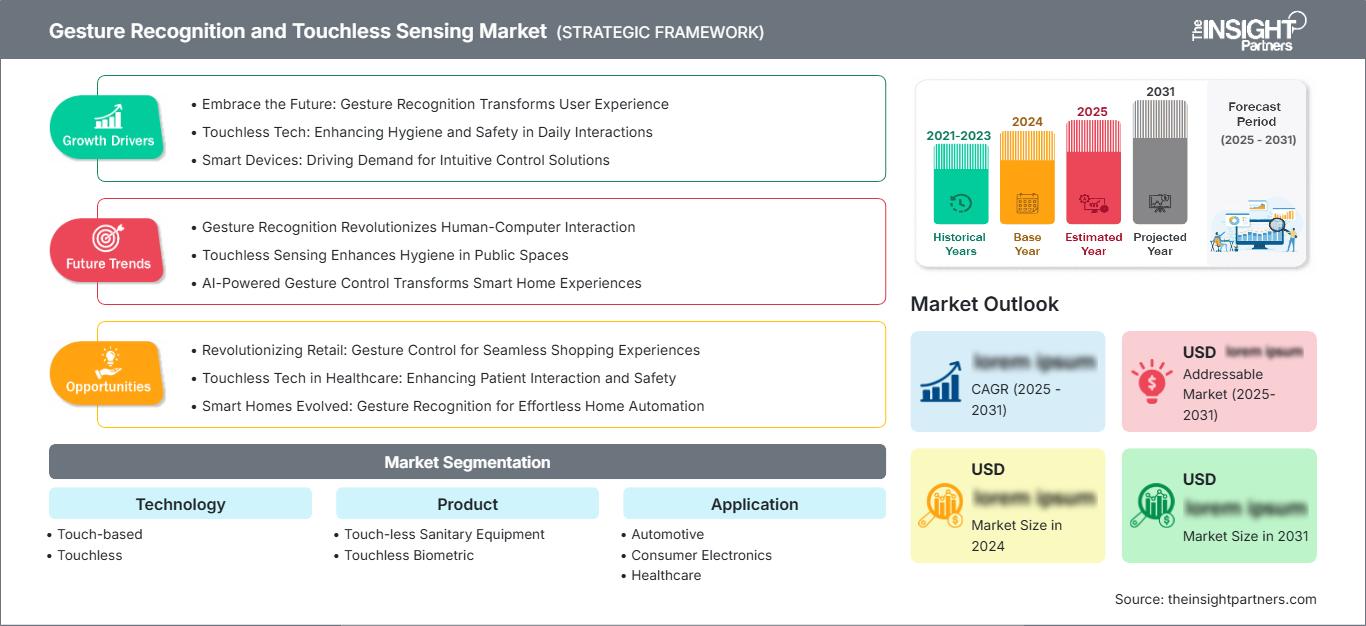
Gesture Recognition and Touchless Sensing Market: Strategic Insights
Regional Insights
North America Gesture Recognition and Touchless Sensing Market
The North America Gesture Recognition and Touchless Sensing Market Share commands a substantial share of approximately 28%–32% of the global market valuation in 2025, growing at an estimated CAGR of 12.8%–13.2% through 2034. Market growth is significantly influenced by the region's strong technology innovation ecosystem, with major technology companies and consumer electronics manufacturers driving development and adoption of gesture control technologies. The presence of leading companies including Apple Inc, Microsoft, and Google, coupled with robust investment in research and development, facilitates continuous innovation and market expansion. The growing emphasis on hygienic interfaces in public and commercial spaces, driven by post-pandemic health awareness, continues to accelerate deployment of touchless sensing solutions across retail, hospitality, and healthcare applications. Market participants are increasingly focusing on developing solutions for emerging applications including automotive gesture control and smart home integration.
U.S. Gesture Recognition and Touchless Sensing Market
The U.S. Market represents the dominant country-level market within North America, accounting for approximately 85%–90% of the regional market share in 2025, growing at a CAGR of 13.0%–13.4% during the forecast period. The extensive technology infrastructure, presence of major consumer electronics companies and innovative startups, and strong consumer demand for intuitive interaction methods support sustained adoption of gesture recognition solutions across diverse applications. The U.S. market benefits from significant investment in AI and computer vision research, with leading technology companies continuously developing advanced gesture recognition capabilities. Major companies including Apple Inc, Microsoft, and Google maintain significant operational presence in the U.S., driving technological advancement and market penetration. The growing focus on automotive HMI innovation and smart home automation is accelerating adoption of gesture control technologies, creating opportunities for innovative solutions addressing consumer demand for seamless, intuitive interaction.
Europe Gesture Recognition and Touchless Sensing Market
The Europe Gesture Recognition and Touchless Sensing Market accounts for approximately 22%–26% of the global market share in 2025, growing at a CAGR of 12.4%–12.8% from 2026 to 2034, with Germany, the UK, France, Italy, and Spain leading regional demand. Germany's strong automotive manufacturing base drives significant demand for gesture control systems in vehicle infotainment, HMI, and interior design. The UK market emphasizes consumer electronics and healthcare applications, contributing to regional growth through innovative technology adoption. France supports automotive, consumer electronics, and healthcare applications; Italy contributes through design and luxury automotive sectors; and Spain is gaining demand from consumer electronics and smart home adoption. Europe is characterized by stringent privacy regulations including GDPR that influence deployment of biometric gesture recognition applications, driving demand for solutions that balance functionality with user privacy protection through on-device processing and data minimization features.
APAC Gesture Recognition and Touchless Sensing Market
The Asia Pacific is the largest regional segment, accounting for approximately 32%–36% of the global market share in 2025, with China, Japan, South Korea, India, and Australia as key contributors. The market is expanding at an estimated CAGR of 14.8%–15.2% during the forecast period, driven by extensive consumer electronics manufacturing, rapid technology adoption, and growing investment in AI and computer vision technologies across the region. China leads regional demand, supported by large consumer electronics manufacturing ecosystem and growing domestic demand for innovative interaction technologies. Japan and South Korea contribute through technological leadership and electronics innovation, while India is emerging as a significant market through IT services, smartphone adoption, and growing technology startup ecosystem. Industrial policy initiatives promoting AI development and digital transformation are shaping market dynamics across the APAC region. The growing emphasis on smart manufacturing, autonomous systems, and mobile interaction continues to create substantial opportunities for gesture recognition solutions, with countries like China and South Korea investing heavily in next-generation interaction technologies.
Middle East & Africa Gesture Recognition and Touchless Sensing Market
The Middle East & Africa represents an emerging regional segment with growing potential, driven by increasing investment in smart city infrastructure, digital transformation initiatives, and technology adoption across commercial and healthcare sectors. Saudi Arabia and the UAE are the leading country markets, with substantial investments in smart city programs and technology adoption creating demand for touchless interfaces and gesture recognition solutions. The market is expected to register a CAGR of 13.6%–14.0% during the forecast period, supported by ongoing investment in healthcare modernization, smart building automation, and commercial technology adoption across the region. South Africa contributes to the African market segment, with established technology adoption in commercial and healthcare applications. The growing emphasis on digital transformation and infrastructure development in the Gulf Cooperation Council countries is creating additional opportunities for gesture recognition technology providers, with applications spanning smart retail, healthcare, and commercial building automation.
Segmentation Analysis
Technology
The Technology segment encompasses Touch-based and Touchless technologies. This segment is expected to register a CAGR of 14.0%–14.4% from 2026 to 2034. The evolution toward touchless interaction reflects growing demand for hygienic, intuitive interfaces that enable natural human-machine communication without physical contact, though touch-based gesture recognition continues to find applications where tactile feedback and precision are required.
- Touch-based: Utilizes touch-sensitive surfaces and interfaces including touchscreens and touchpads for gesture input. Touch-based gesture recognition enables precise, tactile interaction for applications requiring fine control and feedback.
- Touchless: The dominant technology segment with 55%–60% market share in 2025, utilizing sensors including cameras, infrared, and ultrasonic to detect gestures without physical contact. Touchless technology is increasingly adopted for hygienic interfaces and immersive interaction experiences.
Product
The Product segment comprises Touch-less Sanitary Equipment and Touchless Biometric. The segment is projected to grow at a CAGR of 14.8%–15.2% from 2026 to 2034. The expansion of touchless products reflects growing demand for hygienic interfaces and secure authentication solutions, with touchless sanitary equipment addressing hygiene requirements and touchless biometric enabling secure, contactless identity verification.
- Touch-less Sanitary Equipment: Represents a significant product category including touchless faucets, soap dispensers, and toilets utilizing gesture sensors for operation. This segment is driven by growing hygiene awareness and building sanitation requirements.
- Touchless Biometric: Exhibits the highest growth potential with a CAGR of 16.5%–16.9%, encompassing facial recognition, iris recognition, and gesture-based authentication systems. Touchless biometric solutions offer secure, hygienic authentication for access control and identity verification.
Application
The Application segment includes Automotive, Consumer Electronics, Healthcare, Advertisement and Communication, and Defense. This segment is projected to grow at a CAGR of 14.5%–14.9% from 2026 to 2034. Consumer electronics represents the largest application segment driven by widespread adoption in smartphones, gaming, and smart home devices, while automotive and healthcare applications exhibit strong growth potential.
- Automotive: A high-growth application segment for gesture control in vehicle infotainment, climate control, and HMI applications. Automotive gesture recognition enables intuitive, distraction-free interaction for enhanced driver experience and safety.
- Consumer Electronics: The largest application segment, encompassing smartphones, gaming consoles, smart TVs, and wearables. Consumer electronics gesture recognition enables immersive, intuitive interaction for entertainment and device control.
- Healthcare: An emerging segment for touchless interfaces in medical equipment, surgical navigation, and patient monitoring. Healthcare applications demand hygienic, contactless interaction to reduce infection transmission risks.
- Advertisement and Communication: Utilizes gesture recognition for interactive displays, digital signage, and communication applications. This segment enables engaging, immersive experiences for advertising and public communication.
- Defense: Employs gesture recognition for human-machine interface applications in military equipment, training systems, and control systems. Defense applications demand robust, reliable gesture recognition for secure, efficient operation.
Opportunity Snapshot
| Application Segment | Revenue Contribution | Trend Tag | Adoption Stage |
|---|---|---|---|
| Automotive | High | In-Car Gesture | Scaling |
| Consumer Electronics | High | Touchless UX | Mature |
| Healthcare | Medium | Hygiene First | Scaling |
| Advertisement and Communication | Medium | Interactive Signage | Scaling |
| Defense | Medium | Non-contact HMI | Scaling |
Gesture Recognition and Touchless Sensing Market Growth Drivers and Impact Analysis
Growing Demand for Hygienic Touchless Interfaces
The growing demand for hygienic touchless interfaces across public spaces, commercial buildings, and healthcare facilities is a primary driver for the Gesture Recognition and Touchless Sensing Market, as organizations seek to reduce contact surface transmission risks and improve sanitation. Post-pandemic health awareness has accelerated adoption of touchless technologies including gesture-controlled faucets, automatic doors, and contactless access systems. The market impact is evident in increased deployment of gesture recognition solutions across commercial buildings, healthcare facilities, and public spaces where hygiene is paramount. Manufacturers are developing robust, reliable touchless solutions that maintain performance while addressing hygiene requirements, with sensors designed for automatic operation and durable construction for high-traffic environments. The growing emphasis on healthy building design and infection control continues to drive demand for touchless interaction technologies.
Consumer Electronics Innovation and User Experience Enhancement
Continuous consumer electronics innovation and emphasis on user experience enhancement represent a significant driver for the Gesture Recognition and Touchless Sensing Market, as device manufacturers integrate gesture control capabilities to differentiate products and deliver intuitive interaction experiences. Smartphone brands, gaming console manufacturers, and smart TV producers are incorporating gesture recognition for screen navigation, application control, and gaming interaction. The market impact includes increased adoption of gesture control in flagship consumer devices, with manufacturers leveraging advanced sensors and AI algorithms to enable reliable, responsive gesture interaction. Companies such as Apple Inc, Google, and Microsoft are developing integrated gesture recognition capabilities that enhance device usability and create immersive experiences, with feature sets expanding to include multi-touch gestures, proximity sensing, and 3D hand tracking for next-generation consumer products.
Automotive HMI Innovation and Driver Safety Enhancement
Automotive HMI innovation and focus on driver safety enhancement is a significant driver for the Gesture Recognition and Touchless Sensing Market, as automakers increasingly deploy gesture control systems to reduce driver distraction and enable intuitive control of infotainment and vehicle functions. Gesture-based control allows drivers to perform tasks such as volume adjustment, call handling, and navigation without taking eyes off the road. The market impact includes growing integration of gesture recognition in mid-range and luxury vehicles, with automakers developing proprietary gesture vocabularies for intuitive, safe interaction. Companies such as Infineon Technologies and Microchip Technology are developing automotive-grade sensor solutions and processing platforms for gesture recognition, meeting rigorous reliability and safety requirements while enabling innovative HMI capabilities that enhance driver experience and vehicle differentiation.
Gesture Recognition and Touchless Sensing Market Future Trends
Artificial Intelligence and Machine Learning for Advanced Gesture Recognition
The integration of artificial intelligence and machine learning for advanced gesture recognition is emerging as a transformative Gesture Recognition and Touchless Sensing Market Trend, as manufacturers leverage deep learning algorithms to improve recognition accuracy, expand gesture vocabularies, and enable context-aware interaction. AI-powered gesture recognition systems can adapt to user behavior, recognize subtle gestures, and maintain performance across varied environmental conditions. This trend reflects the growing sophistication of computer vision and sensor fusion technologies, with manufacturers developing AI models that can interpret complex gestures and predict user intent. Market participants such as Google and Microsoft are investing in AI-powered gesture recognition platforms that combine advanced sensors with intelligent algorithms, enabling applications including sign language recognition, predictive interaction, and personalized user experiences that adapt to individual behavior patterns.
Integration with Augmented Reality and Spatial Computing
The integration of gesture recognition with augmented reality and spatial computing platforms is transforming the Gesture Recognition and Touchless Sensing Market, as AR developers leverage gesture-based interaction for immersive experiences and natural control of virtual content. Gesture recognition enables users to interact with digital content in AR environments through natural hand movements and gestures. This trend reflects the growing convergence of physical and digital experiences, with AR applications requiring intuitive, contactless interaction methods for manipulation of virtual objects. Market participants are developing gesture recognition solutions optimized for AR applications, including hand tracking for immersive content manipulation, spatial awareness for interaction with virtual elements, and multi-modal interaction combining voice and gesture for comprehensive AR control.
Gesture Recognition and Touchless Sensing Market Opportunities
Healthcare Touchless Interface Solutions
Significant opportunities exist in the Gesture Recognition and Touchless Sensing Market Forecast arising from healthcare applications requiring hygienic, intuitive interfaces for medical equipment, surgical navigation, and patient monitoring systems. The healthcare sector's emphasis on infection control and sterile environments has accelerated adoption of touchless technologies that reduce contact transmission risks. Investment opportunities include developing specialized gesture recognition solutions for medical applications, establishing partnerships with medical device manufacturers and healthcare facilities, and creating integrated touchless interfaces for operating room equipment, patient monitoring, and diagnostic devices. The growing focus on healthcare digitization and patient safety continues to create demand for robust, reliable touchless interfaces that maintain performance in clinical environments while addressing stringent medical device requirements.
Smart Building and Public Infrastructure Applications
The expansion of smart building and public infrastructure applications presents significant opportunities for the Gesture Recognition and Touchless Sensing Market, as building owners and facility managers deploy touchless interfaces for access control, elevator operation, lighting control, and sanitation equipment. The growing emphasis on healthy building design and occupant well-being continues to drive adoption of touchless technologies in commercial and public buildings. Investment opportunities include developing gesture recognition solutions optimized for building automation and infrastructure applications, establishing partnerships with building automation system providers and facility management companies, and creating integrated touchless control systems for smart buildings. The focus on energy efficiency, occupant comfort, and infection control in commercial and public buildings creates favorable conditions for innovative touchless solutions that enhance building operations and user experience.
Recent Developments
- May 2026: Nuvoton Technology launched the NuMaker-GestureAI-M55M1, an edge AI application module designed to simplify the development of intelligent gesture recognition and visual sensing systems. Powered by the NuMicro® M55M1 microcontroller featuring an Arm Cortex-M55 core and Ethos-U55 neural processing unit (NPU), the module enables real-time AI-based gesture recognition, person detection, and touchless control capabilities. The platform supports applications including smart home appliances, industrial human-machine interfaces, security systems, and medical devices, with built-in gesture recognition software and support for TensorFlow Lite Micro-based AI model deployment.
- January 2026: Wearable Devices Ltd. and Rokid announced a strategic collaboration to enable touchless gesture control for AI and AR glasses using Wearable Devices’ Mudra Link neural wristband. The solution combines Rokid’s AI/AR glasses platform with Mudra Link’s neural sensing technology to interpret subtle wrist and finger movements, allowing users to interact with digital content through natural gestures without physical touch.
- November 2025: Neuranics announced the upcoming launch of its MiMiG 8-channel magnetic sensing wristband prototype at CES 2026, featuring advanced magnetomyography (MMG) technology based on tunneling magnetoresistance (TMR) sensors. The wristband captures muscle-generated magnetic signals from hand and wrist movements without requiring electrodes, gels, or restrictive straps, enabling real-time gesture recognition through embedded electronics and AI-based processing. The technology is designed for applications including XR interaction, smart wearables, digital health devices, and machine control systems.
Frequently Asked Questions

- Comprehensive Market Sizing and Forecast Analysis
- Detailed Segmentation Analysis
- In-Depth Market Dynamics Assessment
- Regional and Country-Level Insights
- Competitive Landscape and Company Benchmarking
- Strategic Business Intelligence
Recent Reports
Testimonials

The Insight Partners provided valuable market intelligence that supported our global go-to-market strategy. Their team was professional, responsive, and attentive to our feedback, providing thoughtful analysis and helpful methodological clarifications throughout the project.
Junmo Kim Chief Financial Officer (CFO), Enertech Co., Ltd.
The Insight Partners' SCADA System Market report is comprehensive, with valuable insights on current trends and future forecasts. The team was highly professional, responsive, and supportive throughout. We are very satisfied and highly recommend their services.
RAN KEDEM Partner, Reali Technologies LTDs
I requested a report on a very specific software market and the team produced the report in a few days. The information was very relevant and well presented. I then requested some changes and additions to the report. The team was again very responsive and I got the final report in less than a week.
JEAN-HERVE JENN Chairman, Future Analytica
We worked with The Insight Partners for an important market study and forecast. They gave us clear insights into opportunities and risks, which helped shape our plans. Their research was easy to use and based on solid data. It helped us make smart, confident decisions. We highly recommend them.
PIYUSH NAGPAL Sr. Vice President, High Beam Global
The Insight Partners delivered insightful, well-structured market research with strong domain expertise. Their team was professional and responsive throughout. The user-friendly website made accessing industry reports seamless. We highly recommend them for reliable, high-quality research services
YUKIHIKO ADACHI CEO, Deep Blue, LLC.
This is the first time I have purchased a market report from The Insight Partners.While I was unsure at first, I visited their web site and felt more comfortable to take the risk and purchase a market report.I am completely satisfied with the quality of the report and customer service. I had several questions and comments with the initial report, but after a couple of dialogs over email with their analyst I believe I have a report that I can use as input to our strategic planning process.Thank you so much for taking the extra time and making this a positive experience.I will definitely recommend your service to others and you will be my first call when we need further market data.
JOHN SUZUKI President and Chief Executive Officer, Board Director, BK Technologies
I wish to appreciate your support and the professionalism you displayed in the course of attending to my request for information regarding to infectious disease IVD market in Nigeria. I appreciate your patience, your guidance, and the fact that you were willing to offer a discount, which eventually made it possible for us to close a deal. I look forward to engaging The Insight Partners in the future, all thanks to the impression you have created in me as a result of this first encounter.
DR CHIJIOKE ONYIA MANAGING DIRECTOR, PineCrest Healthcare Ltd.Reason to Buy
- Informed Decision-Making
- Understanding Market Dynamics
- Competitive Analysis
- Identifying Emerging Markets
- Customer Insights
- Market Forecasts
- Risk Mitigation
- Boosting Operational Efficiency
- Strategic Planning
- Investment Justification
- Tracking Industry Innovations
- Aligning with Regulatory Trends





 Get Free Sample for