
Screenless Display Market Size, Share & Demand by 2034
Coverage: by Technology (Holographic Display, Retinal Display, Visual Image Display), Application (Augmented and Virtual Reality, Head-Up and Head-Mounted Displays, Three-Dimensional Visualization), Verticals (Consumer Electronics, Automotive, Aerospace and Defense, Healthcare, Media and Entertainment), and Geography (North America, Europe, Asia Pacific, and South and Central America)
- Status : Data Released
- Report Code : TIPTE100000316
- Category : Electronics and Semiconductor
- No. of Pages : 150
- Available Report Formats :


- Last update date : September 22, 2026


2025 Market Size
US$ 6.37 Bn
Base year value
2034 Forecast
US$ 54.45 Bn
Projected by 2034
CAGR 2026-2034
26.93 %
Growth rate
Addressable Market
US$ 226.75 Bn
(2026-2034)
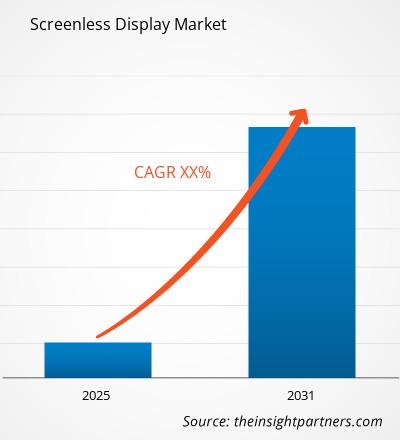
The screenless display market is entering a period of rapid commercialization, supported by advances in optical computing, holography, retinal projection, waveguides, and near-eye visualization. The market was valued at US$ 6.37 Billion in 2025 and is projected to reach US$ 54.45 Billion by 2034, expanding at a CAGR of 26.93% during 2026–2034. Increasing demand for immersive interfaces, hands-free information access, and compact wearable systems is broadening adoption across technology-intensive industries.
North America remains a critical development center because of concentrated investment in augmented reality, defense visualization, spatial computing, and advanced semiconductor technologies. The region is estimated to expand at a 25.8–27.2% CAGR during 2026–2034, supported by strong R&D ecosystems, venture investment, defense modernization, and commercial development of lightweight optical engines and wearable computing platforms, contributing significantly to the Screenless Display Market size.
Screenless Display Market Assessment and Insights
- North America: North America is estimated to hold a 36–40% share in 2025 and grow at a 25.8–27.2% CAGR between 2026–2034, supported by AR development, defense visualization, spatial computing, and strong semiconductor ecosystems.
- US: The US is estimated to represent 78–82% of North America's 2025 share and expand at a 25.5–27.0% CAGR between 2026–2034, driven by technology investment and defense applications.
- Europe: Europe is estimated to account for a 24–28% share in 2025 and grow at a 25.0–26.5% CAGR between 2026–2034, with Germany, the UK, France, and Italy supporting aerospace, automotive, healthcare, and industrial visualization.
- Asia Pacific: Asia Pacific is estimated to command a 25–29% share in 2025 and expand at a 28.0–30.0% CAGR between 2026–2034, led by China, Japan, South Korea, and India through electronics and wearable technology.
- Largest Segment: Holographic display technology is estimated to hold a 38–42% market share in 2025 and grow at a 27.0–29.0% CAGR during 2026–2034, supported by immersive visualization.
- High Growth Segment: Retinal display technology is estimated to hold a 18–22% market share in 2025 and expand at a 29.0–31.0% CAGR during 2026–2034, benefiting from compact wearable architectures.
- Key companies analyzed in detail: Avegant Corporation; Microsoft Corporation; Google LLC; Synaptics Incorporated; BAE Systems plc; Esterline Technologies Corporation; EON Reality, Inc.; MicroVision, Inc.; RealView Imaging Ltd.; Displair, Inc.; Sony Group Corporation; Magic Leap, Inc.
Source: The Insight Partners' analysis based on proprietary research, government publications, company annual reports, investor presentations, industry databases, and expert interviews.
The screenless display market has shifted from experimental optical demonstrations toward application-oriented architectures combining microdisplays, waveguides, holographic optics, laser projection, retinal scanning, and spatial computing. Improvements in optical efficiency, image brightness, field of view, and miniaturization are reducing barriers to wearable deployment. In terms of production processes, there will be a growing trend towards modular light engines, semiconductor integration, optical alignment, and manufacturability in high-volume platforms.
Within the projected timeline, it is expected that investments will shift towards compact designs that will reduce weight, heat generation, and power requirements, as well as improve image quality. Technology leadership will continue to remain in North America, while rapid manufacturing will be possible in the Asia Pacific. Regulatory attention to aviation safety, medical visualization, and human factors will also influence commercialization pathways, as highlighted in the Screenless Display Market report.
Screenless Display Market Report Scope
| Report Attribute | Details |
|---|---|
| Market size in 2025 | US$ 6.37 Billion |
| Market Size by 2034 | US$ 54.45 Billion |
| Global CAGR (2026 - 2034) | 26.93% |
| Historical Data | 2021-2024 |
| Forecast period | 2026-2034 |
Screenless Display Market Analysis
Demand is being generated by the transition from conventional flat interfaces toward spatial, contextual, and hands-free visualization. The screenless display market growth depends on optical performance, computing power, sensor integration, content availability, and device ergonomics. The ecosystem is composed of optical engine manufacturers, semiconductor suppliers, display developers, software vendors, OEMs, systems integrators, and application vendors. Hardware commercialization, then, will involve coordinating across multiple technology stacks.
The supply conditions will be technology-dependent, as the holographic, retinal, projection, and waveguide technologies will demand different types of manufacturing processes. Optical alignment, integration with microLED or LCoS, laser safety issues, and calibration will affect manufacturing economics. Vendors with optical design IP or light engines with economies of scale will enjoy better positions in the market, and contract manufacturing may help in commercialization efforts.
Competitive positioning is increasingly shaped by proprietary optics, light-engine efficiency, software integration, and access to major OEM ecosystems. The screenless display market analysis indicates that Microsoft Corporation and Google LLC benefit from substantial software and spatial-computing capabilities, while Avegant Corporation specializes in compact optical engines. BAE Systems plc brings extensive defense visualization expertise, particularly in head-up and helmet-mounted architectures.
Specialists such as RealView Imaging Ltd., EON Reality, Inc., Displair, Inc., and Synaptics Incorporated address different parts of the visualization ecosystem. Sony Group Corporation and Magic Leap, Inc. broaden competition through advanced spatial and near-eye display capabilities. Investment priorities increasingly favor miniaturization, improved brightness, lower power consumption, and manufacturable optical systems rather than purely experimental demonstrations.
● REPORT CUSTOMIZATION
Tailor This Report To Align With Your Specific Business Requirements
This report can be customized to align precisely with your business objectives, scope, and target markets. Customization options include tailored segmentation, geography, competitive analysis, and strategic insights to support informed decision-making.
Customize This Report →WHAT YOU CAN ADJUST
- ● Segmentations
- ● Geography
- ● Competitive Analysis
- ● Language Preferences
Screenless Display Market: Strategic Insights

Regional Insights
North America screenless display market
North America is estimated to hold a 36–40% share in 2025 and grow at a 25.8–27.2% CAGR through 2034. The US dominates regional activity because of established technology companies, defense programs, venture funding, semiconductor research, and advanced software ecosystems. Canada contributes through photonics, artificial intelligence, and specialized technology research. Demand spans aerospace and defense, healthcare visualization, enterprise AR, automotive interfaces, and consumer wearables.
Regional investment increasingly targets lightweight optics, spatial computing, AI-enabled interfaces, and advanced sensing. Defense programs favor high-brightness displays capable of delivering information without forcing operators to divert attention from their surroundings. Commercial developers are similarly focused on smaller form factors and lower power requirements. Strong university-industry research networks and access to specialized semiconductor manufacturing capabilities should help North America retain a leading innovation position during the forecast period.
U.S. screenless display Market
The US represents 78–82% of North America's 2025 share and is projected to expand at a 25.5–27.0% CAGR through 2034. Some of the organizations operating within the nation’s ecosystem include large technology providers, optical engineers, defense suppliers, semiconductor firms, and health-care technology innovators. Microsoft Corporation, Google LLC, Avegant Corporation, BAE Systems plc, Synaptics Incorporated, and MicroVision, Inc. offer solutions in the areas of spatial computing, optical engineering, sensing, and visualization.
Trends in the applications sector have been moving toward defense and enterprise productivity, industrial maintenance, visualization in healthcare, automotive infotainment, and wearable visualization. The criteria for acquisition include brightness, field of view, latency, eye comfort, thermal properties, and durability. In addition, the US has an active intellectual-property landscape as well as early-stage customers. All of these elements make it possible to move quickly from the prototype stage into platforms.
Europe screenless display Market
Europe is estimated to account for a 24–28% share of the screenless display market in 2025 and grow at a 25.0–26.5% CAGR, with Germany positioned as the leading country. The UK has strong aerospace and defense capabilities, with applications centered on helmet-mounted displays, head-up displays, training, and mission visualization. Germany contributes through automotive engineering, industrial automation, optics, and advanced manufacturing. France supports aerospace, defense, healthcare, and automotive applications, while Italy and Spain contribute through industrial design, mobility, medical technology, and specialized electronics. European development is also influenced by product safety, data protection, human-factor requirements, and sustainability considerations. The region's established automotive and aerospace industries provide commercially demanding test environments where optical reliability, compact form factors, and long operating lifetimes are essential. These conditions support specialized rather than purely volume-driven adoption.
APAC screenless display Market
Asia Pacific is estimated to hold a 25–29% of the screenless display market share in 2025 and expand at a 28.0–30.0% CAGR, making it the fastest-growing major region. China leads, supported by electronics manufacturing and technology investment. Japan and South Korea contribute advanced display expertise, while India and Australia offer opportunities in software, defense, healthcare, and industrial applications. Government-backed technology programs and expanding wearable ecosystems reinforce adoption.
Middle East & Africa screenless display Market
Middle East and Africa screenless display market are expected to expand at a 26.0–28.0% CAGR, supported by defense modernization, healthcare digitization, smart infrastructure, and advanced visualization projects. Saudi Arabia and the UAE provide leading opportunities through technology investment and diversification programs, while South Africa contributes through mining, industrial applications, and specialized technology development. The Rest of MEA offers smaller but emerging opportunities.
Segmentation Analysis
Technology
Technology is projected to expand at a 27.0–28.5% CAGR during 2026–2034. Technology selection is determined by optical efficiency, brightness, image resolution, field of view, power requirements, and device form factor. Holographic systems currently command broad attention, while retinal and projection technologies can gain traction where compactness and direct image formation are priorities, according to the Screenless Display Market forecast.
- Holographic Display: Holographic architectures provide three-dimensional visualization and spatial depth without relying on conventional flat panels. Their strategic importance is strongest in medical imaging, engineering, visualization, education, and advanced spatial-computing applications.
- Retinal Display: Retinal systems project visual information toward the eye rather than relying on a conventional image plane. Their compact architecture supports wearable applications where low weight, controlled focus, and efficient optical paths are important.
- Visual Image Display: Visual image systems generate images through optical projection or related image-forming mechanisms. They support applications requiring flexible viewing formats, portable visualization, and integration into specialized equipment.
Application
Application is expected to grow at a 26.5–28.0% CAGR during 2026–2034. Commercial opportunity depends on whether screenless visualization can deliver measurable improvements over conventional interfaces. Enterprise, defense, medical, automotive, and consumer applications differ substantially in requirements for reliability, latency, brightness, privacy, and ergonomics, reflecting evolving Screenless Display Market trends.
- Augmented and Virtual Reality: Immersive computing applications require lightweight visualization systems that support spatial interaction and contextual information. Demand is driven by training, enterprise collaboration, design, gaming, and remote assistance requirements.
- Head-Up and Head-Mounted Displays: These applications prioritize eyes-out information delivery for aviation, defense, automotive, and industrial environments. High brightness, wide viewing areas, low latency, and stable image positioning remain strategically important.
- Three-Dimensional Visualization: Three-dimensional applications support medical imaging, engineering, education, scientific visualization, and product development. Screenless architectures can improve spatial comprehension where conventional two-dimensional interfaces limit depth perception.
Verticals
Verticals are projected to expand at a 27.5–29.0% CAGR during 2026–2034. Adoption varies according to the economic value of hands-free visualization, regulatory requirements, and tolerance for hardware complexity. Aerospace and defense remain technologically important, while healthcare and automotive applications provide opportunities for broader commercialization.
- Consumer Electronics: Wearable devices, smart glasses, and spatial-computing products can use screenless interfaces to reduce dependence on traditional displays. Miniaturization, comfort, battery life, and manufacturing cost remain central adoption factors.
- Automotive: Automotive applications include head-up visualization and contextual information delivery. Screenless approaches can improve driver access to information while maintaining attention toward the road, particularly when integrated with sensing and navigation systems.
- Aerospace and Defense: Defense users require robust visualization under variable lighting, motion, and environmental conditions. Helmet-mounted and head-up systems can improve situational awareness by presenting mission information within the operator's natural field of view.
- Healthcare: Medical visualization can benefit from three-dimensional and spatial representations of anatomy, imaging data, and procedures. Adoption depends heavily on image accuracy, clinical workflow integration, usability, and regulatory acceptance.
- Media and Entertainment: Entertainment applications use immersive visualization to create differentiated viewing experiences. Adoption is influenced by content availability, device comfort, visual quality, and the ability to provide compelling experiences without conventional screens.
Opportunity Snapshot
| Verticals | Revenue Contribution (High/Medium/Low) | Trend Tag (MAX 2 words) | Adoption Stage (Emerging/Scaling/Mature) |
| Consumer Electronics | High | Smart Glasses | Scaling |
| Automotive | Medium | HUD Integration | Scaling |
| Aerospace and Defense | High | Helmet Displays | Mature |
| Healthcare | Medium | 3D Visualization | Scaling |
| Media and Entertainment | Medium | Spatial Content | Emerging |
Screenless Display Market Growth Drivers and Impact Analysis
Demand for hands-free contextual information
Hands-free computing is opening up an architectural opportunity for optical interfaces that put information in front of the user without the need for a screen. Industrial mechanics, pilots, medical professionals, and outdoor workers may be able to consult instructions, measurements, maps, warnings, or technical data while still focused on their physical work. This makes the value proposition move from visualizing for fun to computing for productivity. When ROI calculations are made, software that cuts down on task switching, training needs, or information gathering can be more compelling commercially. There are effects on software developers as well, since new interfaces will call for a three-dimensional user experience as opposed to typical two-dimensional applications.
Advances in optical miniaturization and light engines
Advances in technology relating to microdisplays, waveguides, laser sources, optical combiners, and light engines will increase the practicality of miniaturized visualization systems. Smaller optical components will lead to smaller headsets and may increase comfort, an issue that has hampered previous wearable adoption. Higher efficiency will also lower demands for batteries and cooling, enabling manufacturers to make lighter products while maintaining runtime. Manufacturing advances in precision are important because proper optical alignment and calibration are necessary for both visual performance and product yield. As component suppliers advance from laboratory samples to mass-producible modules, device manufacturers can leverage new display technologies with fewer internal optics engineers. The impact on the marketplace will be greatest in smart glasses, military wearables, automotive systems, and enterprise wearables, where size, weight, reliability, and energy use directly affect purchasing decisions.
Expansion of spatial computing and immersive interfaces
The concept of spatial computing is expanding the function of the display from showing the information on stationary surfaces to creating a connection between digital content and the surrounding environment. This opens up possibilities for screen-less systems that will enable the use of optical visualization along with cameras, depth sensors, AI, gesture recognition, and even voice commands. Enterprise use cases include the possibility of using spatial interfaces in design reviews, equipment inspection, training, and collaborative working in remote locations. Healthcare users may be able to take advantage of three-dimensional imagery that offers more spatial context than the regular screens. Developers in the automotive and aerospace industries also have a reason to incorporate contextual information in the normal viewing area. With advancements in local processing capabilities of the computing platform, display hardware can become a part of the perception-and-computing solution.
Screenless Display Market Future Trends
AI-native spatial visualization
According to experts, artificial intelligence will enable more contextually rich screenless interfaces through determining what type of information needs to be shown, at what point in time and where. Rather than showing permanent menus or dashboards, AI will enable selective information generation based on computer vision, user intention, environment and task context, which will decrease visual information overload. Edge AI will especially come into play in areas of operation where low latency, privacy and connection constraints prevent using cloud computing. Hence, in the future, display technology will be developed in conjunction with sensing and computing capabilities rather than being separate from them. Gradually, successful technologies will integrate optical effectiveness with information prioritization, making human interaction more natural in industry, automotive, healthcare, military, and consumer spaces.
Convergence of displays, sensing, and spatial mapping
Future devices are likely to combine visualization, depth sensing, eye tracking, environmental mapping, and gesture recognition within increasingly compact architectures. This convergence can improve registration accuracy by allowing digital information to remain anchored to physical objects as users move. Eye tracking can further support foveated rendering and adaptive image quality, potentially reducing processing and power requirements. Spatial mapping will also help systems understand obstacles, surfaces, and user position before presenting visual information. Such integration will make display performance increasingly dependent on the complete device architecture rather than optical hardware alone. Manufacturers that develop interoperable sensing and visualization modules can therefore address more applications with common technology platforms. The trend should accelerate product differentiation based on system-level performance, not simply resolution or brightness.
Screenless Display Market Opportunities
Defense and aerospace visualization platforms
Defense and aerospace provide an attractive commercialization pathway because users place a high value on immediate access to mission information without losing awareness of the surrounding environment. Helmet-mounted displays, head-up systems, training devices, and maintenance applications can justify premium hardware where reliability and situational awareness directly influence operational outcomes. Suppliers can pursue opportunities by combining advanced optics with ruggedized electronics, tracking, night-vision compatibility, and secure connectivity. Partnerships with aerospace integrators can reduce commercialization risk because qualification and platform integration requirements are substantial. The opportunity extends beyond new aircraft because retrofit programs can introduce digital visualization into existing platforms. Companies with established defense relationships can therefore use specialized applications as a route toward technology validation, while subsequent manufacturing improvements can support expansion into industrial and commercial wearable products.
Automotive and enterprise wearable integration
The screenless display market forecasts indicate a significant opportunity in automotive and enterprise applications where information must remain accessible without forcing users to interact continuously with handheld devices. Automotive manufacturers can integrate visual information with navigation, driver assistance, vehicle status, and hazard alerts, while enterprise users can apply wearable displays to maintenance, logistics, training, and remote support. Investment priorities should focus on optical clarity, low latency, eye comfort, reliable tracking, and integration with existing software platforms. Strategic partnerships between display specialists, semiconductor suppliers, automotive OEMs, and enterprise software providers can accelerate commercialization. The strongest opportunities will likely arise where screenless visualization produces measurable workflow benefits rather than merely offering a novel interface. Scalable modules and common software frameworks can further reduce deployment complexity.
Frequently Asked Questions

- Comprehensive Market Sizing and Forecast Analysis
- Detailed Segmentation Analysis
- In-Depth Market Dynamics Assessment
- Regional and Country-Level Insights
- Competitive Landscape and Company Benchmarking
- Strategic Business Intelligence
Recent Reports
Testimonials

The Insight Partners' SCADA System Market report is comprehensive, with valuable insights on current trends and future forecasts. The team was highly professional, responsive, and supportive throughout. We are very satisfied and highly recommend their services.
RAN KEDEM Partner, Reali Technologies LTDs
I requested a report on a very specific software market and the team produced the report in a few days. The information was very relevant and well presented. I then requested some changes and additions to the report. The team was again very responsive and I got the final report in less than a week.
JEAN-HERVE JENN Chairman, Future Analytica
We worked with The Insight Partners for an important market study and forecast. They gave us clear insights into opportunities and risks, which helped shape our plans. Their research was easy to use and based on solid data. It helped us make smart, confident decisions. We highly recommend them.
PIYUSH NAGPAL Sr. Vice President, High Beam Global
The Insight Partners delivered insightful, well-structured market research with strong domain expertise. Their team was professional and responsive throughout. The user-friendly website made accessing industry reports seamless. We highly recommend them for reliable, high-quality research services
YUKIHIKO ADACHI CEO, Deep Blue, LLC.
This is the first time I have purchased a market report from The Insight Partners.While I was unsure at first, I visited their web site and felt more comfortable to take the risk and purchase a market report.I am completely satisfied with the quality of the report and customer service. I had several questions and comments with the initial report, but after a couple of dialogs over email with their analyst I believe I have a report that I can use as input to our strategic planning process.Thank you so much for taking the extra time and making this a positive experience.I will definitely recommend your service to others and you will be my first call when we need further market data.
JOHN SUZUKI President and Chief Executive Officer, Board Director, BK Technologies
I wish to appreciate your support and the professionalism you displayed in the course of attending to my request for information regarding to infectious disease IVD market in Nigeria. I appreciate your patience, your guidance, and the fact that you were willing to offer a discount, which eventually made it possible for us to close a deal. I look forward to engaging The Insight Partners in the future, all thanks to the impression you have created in me as a result of this first encounter.
DR CHIJIOKE ONYIA MANAGING DIRECTOR, PineCrest Healthcare Ltd.Reason to Buy
- Informed Decision-Making
- Understanding Market Dynamics
- Competitive Analysis
- Identifying Emerging Markets
- Customer Insights
- Market Forecasts
- Risk Mitigation
- Boosting Operational Efficiency
- Strategic Planning
- Investment Justification
- Tracking Industry Innovations
- Aligning with Regulatory Trends





 Get Free Sample for