
Smart Stadium Market Demand, Trends & Forecast by 2034
Coverage: by Component (Software, Services), Deployment Mode (On-Premises, Cloud), Platform (Application Management Platform, Device Management Platform, Network Management Platform), and Geography (North America, Europe, Asia Pacific, and South and Central America)
- Status : Data Released
- Report Code : TIPTE100000346
- Category : Electronics and Semiconductor
- No. of Pages : 150
- Available Report Formats :


- Last update date : August 26, 2026


2025 Market Size
US$ 20.39 Bn
Base year value
2034 Forecast
US$ 72.33 Bn
Projected by 2034
CAGR 2026-2034
15.11 %
Growth rate
Addressable Market
US$ 395.83 Bn
(2026-2034)
The global smart stadium market was valued at US$ 20.39 billion in 2025 and is projected to reach US$ 72.33 billion by 2034, registering a compound annual growth rate (CAGR) of 15.11% from 2026 to 2034. This growth trajectory is underpinned by the increasing integration of IoT, AI, and 5G technologies to enhance fan engagement, optimize venue operations, and improve security in sports and entertainment venues.
North America accounted for a substantial portion of the global smart stadium market size in 2025, estimated at 36.25%, and is projected to grow at a CAGR of 13-15% from 2026 to 2034. Structural growth drivers in the region include the high fan expectations for immersive experiences and significant investments in retrofitting existing venues with advanced digital infrastructure, with the U.S. market valued at approximately US$ 2.9 billion in 2025.
Smart Stadium Market Assessment and Insights
- North America: North America is a leading regional market, driven by high fan expectations and strong technological infrastructure. It is estimated to hold a 36.25% share in 2025 and is projected to grow at a CAGR of 13-15% from 2026 to 2034.
- U.S.: The U.S. dominates the North American market, accounting for a significant share of the region's revenue. Its growth is propelled by major league sports and the ongoing modernization of iconic venues. The market is expected to grow at a CAGR of 14-16% from 2026 to 2034.
- Europe: Europe holds an estimated 40-42% share of the global market in 2025, with a projected CAGR of 13-15% from 2026 to 2034. Leading countries include Germany, the UK, and France, driven by early adoption of digital transformation and the presence of technologically advanced stadiums.
- Asia Pacific: APAC is estimated to hold a 16-18% share in 2025 and is projected to grow at the fastest CAGR of 16-18% from 2026 to 2034. China, Japan, and India are key markets, fueled by rapid urbanization, rising investments in sports infrastructure, and government support for smart city initiatives.
- Largest Segment: The software component segment is expected to remain the largest, with a 55-60% share in 2025 and a projected CAGR of 14-16% from 2026 to 2034.
- High Growth Segment: The Services component segment is projected to be the fastest-growing, driven by increasing demand for system integration, consulting, and managed services. It holds a 40-45% share in 2025 and is expected to grow at a CAGR of 16-18% from 2026 to 2034.
- Key companies analyzed in detail: Huawei Technologies Co., Ltd, Intel Corporation, NEC Corporation, Cisco Systems, Inc., IBM Corporation, Fujitsu Ltd., Johnson Controls International, PLC, GP Smart Stadium, Infosys Limited, and Volteo .
Source: The Insight Partners' analysis based on proprietary research, government publications, company annual reports, investor presentations, industry databases, and expert interviews.
The smart stadium market report indicates that globally, the market has seen a dramatic change from stadiums with only limited connection capabilities to stadiums functioning as sophisticated systems of data-driven interaction and operation. The development of the industry was brought about by improvements in IoT sensors, AI analytics, and high-speed connectivity, which resulted in collecting data about crowds, concession transactions, and performance of facilities. The shift in production dynamics consists in creating modular and interoperable software and scalable cloud platforms to cut down the complexity of development and facilitate implementation .
As the smart stadium market develops, the future looks promising with the industry expanding its reach due to numerous international sports events occurring in the emerging markets. Large investments are made in the construction of 5G networks, AI analytics tools, and technologies such as AR/VR to create individualized and seamless experience of attendance for the visitors. Regulatory headwinds such as energy efficiency requirements and public safety standards will play an important role in boosting market growth and innovation globally.
Smart Stadium Market Report Scope
| Report Attribute | Details |
|---|---|
| Market size in 2025 | US$ 20.39 Billion |
| Market Size by 2034 | US$ 72.33 Billion |
| Global CAGR (2026 - 2034) | 15.11% |
| Historical Data | 2021-2024 |
| Forecast period | 2026-2034 |
Smart Stadium Market Analysis
Global smart stadium market growth can be attributed to the rising requirement from sports leagues, stadiums, and events for increased fan engagement, optimization, and safety . By using AI-based crowd analytics, fast 5G connectivity, and sensors, stadium managers can monitor ticket scanning, queue length, and footfalls in real time, making stadiums smarter and full of data . The market ecosystem consists of software developers, hardware companies, connectivity vendors, and system integrators providing comprehensive solutions to stadiums .
Key factors driving supply in the smart stadium market include strategic alliances and acquisitions that help in extending technology portfolios. For example, Cisco Systems, Inc. and Huawei Technologies Co., Ltd are investing in technologies that provide connectivity and security to large venues . Intel Corporation and IBM Corporation use their expertise in AI and analytics to provide crowd management and fan engagement solutions .
Competition within the market includes well-established technology providers and infrastructure specialists such as Johnson Controls International, PLC and GP Smart Stadium . Deployment of technologies used in stadiums suggests significant investment trend towards cloud solutions and software-defined systems .
● REPORT CUSTOMIZATION
Tailor This Report To Align With Your Specific Business Requirements
This report can be customized to align precisely with your business objectives, scope, and target markets. Customization options include tailored segmentation, geography, competitive analysis, and strategic insights to support informed decision-making.
Customize This Report →WHAT YOU CAN ADJUST
- ● Segmentations
- ● Geography
- ● Competitive Analysis
- ● Language Preferences
Smart Stadium Market: Strategic Insights
Regional Insights
North America Smart Stadium Market
North America is a dominant force in the global smart stadium market, holding an estimated 36.25% share in 2025 and projected to grow at a CAGR of 13-15% from 2026 to 2034. The region's growth is underpinned by high fan expectations and a strong technological infrastructure, with significant investment from major leagues like the NFL and NBA in upgrading venues . The U.S. leads the region, driven by a large sports fan base and the continuous modernization of iconic stadiums to offer state-of-the-art fan experiences and operational efficiency .
U.S. Smart Stadium Market
The U.S. accounts for approximately 85-90% of the North American smart stadium market share in 2025. The market is characterized by major investments from league franchises, which are deploying advanced connectivity, high-definition video systems, and AI-driven analytics platforms to enhance the gameday experience . The market is projected to grow at a CAGR of 14-16% from 2026 to 2034, driven by the integration of 5G networks and IoT sensors for real-time crowd management and personalized fan engagement. Major cities like Los Angeles, New York, and Dallas are emerging as key hubs for stadium innovation .
Europe Smart Stadium Market
Europe is estimated to hold a 40-42% share of the global market in 2025, with a projected CAGR of 13-15% from 2026 to 2034. Germany and the UK are leading countries, driven by early adoption of digital transformation in sports infrastructure. France, Italy, and Spain are also significant markets, with demand fueled by investment in tech-enhanced venues for major events . The region's emphasis on sustainability and energy efficiency is accelerating the adoption of green technologies, which is a key adoption factor. Advanced venues like Wembley Stadium and Allianz Arena highlight the region's technological leadership .
APAC Smart Stadium Market
APAC is estimated to hold a 16-18% share of the global market in 2025 and is projected to grow at the fastest CAGR of 16-18% from 2026 to 2034. China, Japan, and India are key markets, driven by rapid urbanization, rising sports culture, and significant government investments in smart city and infrastructure projects . India is expected to witness the highest CAGR in the region due to increasing investments in sports facilities and a growing focus on smart city initiatives . The region's expansion is also supported by major events like the Olympics, driving the construction of modern, tech-enabled stadiums .
Middle East & Africa Smart Stadium Market
The MEA region is estimated to hold a 4-6% share of the global market in 2025, with a projected CAGR of 12-14% from 2026 to 2034. Saudi Arabia and the UAE are key markets, with growth driven by massive investments in digital infrastructure, sports tourism, and the construction of state-of-the-art multi-purpose stadiums for international events . The UAE is a leader in the region, implementing advanced smart technologies in new developments, such as AI-based crowd analytics and cashless payment systems . Energy efficiency and the hosting of mega-events are important contextual factors influencing market growth .
Segmentation Analysis
Component
The component segment is categorized into Software and Services. The Software segment is estimated to be the largest, holding a 55-60% share in 2025, with a projected CAGR of 14-16% from 2026 to 2034 . This dominance is driven by the critical role of software in building automation, crowd management, digital content, and security, enabling the integration of multiple technologies across the venue . The smart stadium scope encompasses a wide range of software and service solutions to meet diverse operational and fan engagement needs.
- Software: The software segment leads the market, encompassing building automation, digital content management, crowd management, and public safety applications. It enables real-time data analytics, personalized fan engagement, and streamlined venue operations. The integration of AI-driven surveillance and data analytics platforms is a key growth driver .
- Services: The services segment is projected to be the fastest-growing, driven by increasing demand for system integration, consulting, and managed services. As venues adopt complex digital ecosystems, the need for professional integration and ongoing maintenance is critical, creating significant opportunities for service providers .
Deployment Mode
The deployment mode segment is divided into On-Premises and Cloud. The On-Premises segment holds the larger market share in 2025, driven by the need for higher data security and control over sensitive operational information . However, the Cloud segment is projected to grow at a higher rate due to its scalability, cost-effectiveness, and ease of integration with IoT devices.
- On-Premises: On-premises deployment provides stadium operators with full control over their data, ensuring higher levels of security and privacy. It allows for extensive customization to meet the specific needs of individual venues and ensures compliance with data protection regulations .
- Cloud: Cloud-based deployment is gaining traction due to its flexibility, scalability, and lower upfront costs. It enables seamless integration with IoT devices and AI-powered analytics, allowing stadiums to adopt advanced technologies without significant infrastructure investments.
Platform
The platform segment includes Application Management Platform, Device Management Platform, and Network Management Platform. These platforms serve as the backbone for managing diverse digital solutions and connected devices, providing centralized control and operational visibility for stadium operators.
- Application Management Platform: This platform manages the various software applications used in the stadium, such as ticketing, fan engagement, and security systems. It ensures seamless integration and performance across the digital ecosystem.
- Device Management Platform: This platform oversees the network of connected devices, including sensors, cameras, and digital signage. It enables remote monitoring, firmware updates, and performance management of these devices.
- Network Management Platform: This platform manages the stadium's connectivity infrastructure, including Wi-Fi, 5G, and wired networks. It ensures high-speed, reliable connectivity for both operational systems and fan-facing applications.
Opportunity Snapshot
| Platform | Revenue Contribution | Trend Tag | Adoption Stage |
|---|---|---|---|
| Application Management Platform | High | App Integration | Scaling |
| Device Management Platform | High | IoT Orchestration | Scaling |
| Network Management Platform | Medium | 5G Connectivity | Scaling |
Smart Stadium Market Growth Drivers and Impact Analysis
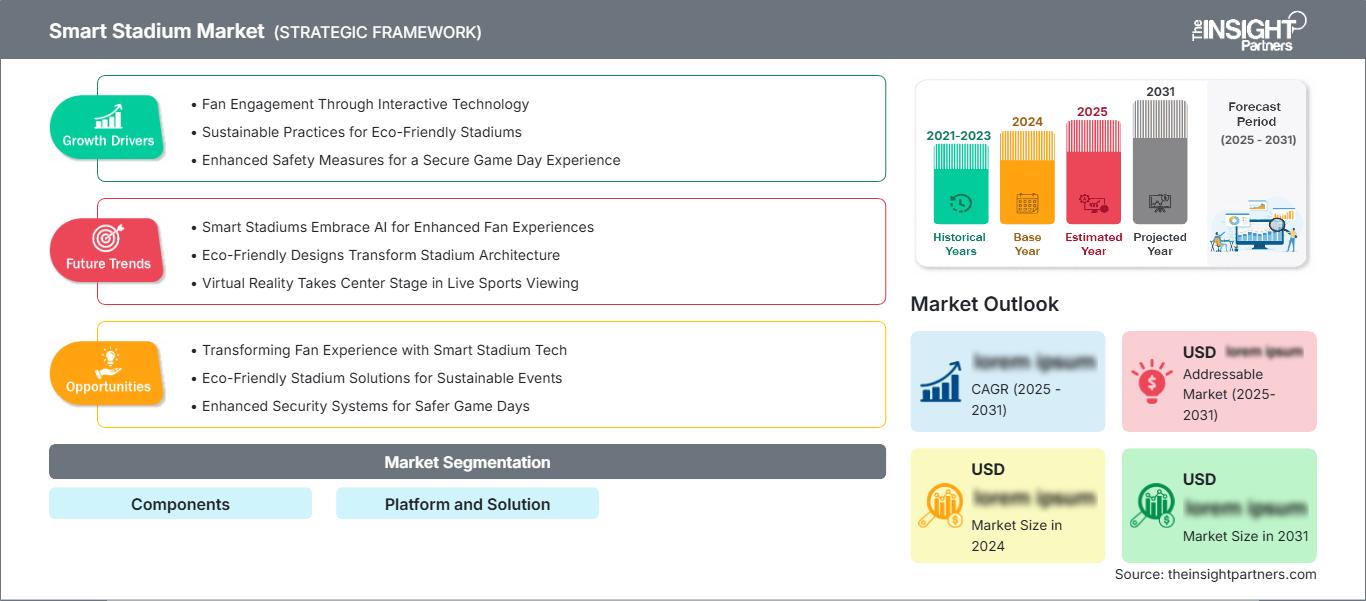
Fan Engagement Through Interactive Technology
A primary driver is the increasing demand for immersive and interactive fan experiences. Sports leagues and venue operators are investing heavily in high-speed 5G connectivity, interactive digital displays, and mobile app integrations that provide real-time statistics, concessions ordering, and AR/VR content . The integration of social media platforms further enhances engagement, creating a more connected and entertaining atmosphere that boosts attendance and revenue .
Enhanced Safety and Security Requirements
The growing need for robust security and safety measures is a significant driver. Smart stadiums deploy sophisticated video surveillance, AI-powered crowd analytics, facial recognition, and advanced access control systems to monitor behavior, detect anomalies, and manage crowd flow . These technologies enable rapid response to incidents and ensure compliance with safety regulations, creating a secure environment for large-scale events .
Growing Demand for Energy Efficiency and Sustainability
The rising focus on sustainability and energy efficiency is catalyzing the adoption of smart stadium solutions. These venues integrate smart building management systems that automate and optimize lighting, HVAC, and energy distribution based on real-time occupancy and weather conditions . The integration of renewable energy sources, such as solar panels, further contributes to reducing operational costs and achieving sustainability goals, which is becoming a key priority for venue operators worldwide .
Smart Stadium Market Future Trends
Integration of AI and Generative AI for Personalization
One of the key Smart Stadium Market trends is the deep integration of AI and generative AI to deliver hyper-personalized fan experiences. AI algorithms will analyze vast amounts of behavioral data to provide tailored notifications, real-time seat upgrades, and customized food and merchandise offers directly via fans' mobile devices . This trend, which is a major part of the smart stadium trends analysis, will elevate the gameday experience and create new monetization opportunities for operators.
Expansion of 5G-Enabled Immersive Technologies
The deployment of 5G networks is enabling the expansion of immersive technologies such as augmented reality (AR) and virtual reality (VR) within stadiums . These technologies will provide fans with enhanced viewing angles, interactive games, and social sharing features without lag, transforming the live entertainment experience. The combination of 5G and AR/VR will be instrumental in attracting younger, digitally-native audiences and competing with at-home viewing experiences.
Smart Stadium Market Opportunities
Untapped Growth in Emerging Markets and Retrofit Solutions
A significant opportunity lies in the modernization of aging stadiums in emerging markets and the growing demand for retrofit solutions . Many venues in regions like Asia Pacific and Latin America are undergoing digital upgrades, creating a substantial market for modular, cost-effective smart technologies . Companies offering scalable solutions that can be integrated into existing infrastructure without high upfront costs are well-positioned to capture this growing segment, as highlighted in smart stadium market forecasts.
Development of Data-Driven Retail Media Networks
A major opportunity exists in the development of data-driven retail media networks within stadiums. By leveraging data collected from IoT sensors and AI analytics, operators can deliver targeted advertising and promotions to fans at the exact moment of purchase decision-making . This creates a new, high-value revenue stream and enables brands to engage with a highly captive audience, transforming the stadium into a personalized media ecosystem.
Recent Developments
- June 2026: Deutsche Telekom IoT uses 2026 World Cup scenario to map the smart stadium IoT stack. Deutsche Telekom IoT is positioning the 2026 FIFA World Cup as a practical reference point for connected stadium operations, spanning parking, logistics, building systems, mobility, safety and fan services. The significance is less a single product launch than a view of how global IoT connectivity, 5G and real-time data may have to work together across complex event environments.
- February 2026: Japan's NTT Docomo Business, Inc. has entered into an exclusive distribution agreement with USA-based facility management SaaS leader 24/7 Software, Inc. to deliver its products in Japan, South Korea and Taiwan. The partnership will bring 24/7 Software's cloud-based platform - which supports smarter operations for stadiums, arenas and commercial facilities - to these markets while also offering integration solutions with existing information and communication technologies (ICT) infrastructure and services.
- January 2026: NTT DOCOMO BUSINESS, Inc. has entered into an exclusive distribution agreement with U.S.-based facility management SaaS leader 24/7 Software, Inc. This partnership will bring 24/7 Software's cloud-based platform, which supports smarter operations for stadiums, arenas and commercial facilities, to these markets. The platform unifies incident management, lost and found, visitor requests and maintenance operations into one mobile-enabled system, giving teams real-time insights to improve efficiency, safety and visitor experiences. Additionally, NTT DOCOMO BUSINESS will propose integrations with existing information and communication technologies (ICT) infrastructure and services to deliver comprehensive solutions.
Frequently Asked Questions

- Comprehensive Market Sizing and Forecast Analysis
- Detailed Segmentation Analysis
- In-Depth Market Dynamics Assessment
- Regional and Country-Level Insights
- Competitive Landscape and Company Benchmarking
- Strategic Business Intelligence
Recent Reports
Testimonials

The Insight Partners' SCADA System Market report is comprehensive, with valuable insights on current trends and future forecasts. The team was highly professional, responsive, and supportive throughout. We are very satisfied and highly recommend their services.
RAN KEDEM Partner, Reali Technologies LTDs
I requested a report on a very specific software market and the team produced the report in a few days. The information was very relevant and well presented. I then requested some changes and additions to the report. The team was again very responsive and I got the final report in less than a week.
JEAN-HERVE JENN Chairman, Future Analytica
We worked with The Insight Partners for an important market study and forecast. They gave us clear insights into opportunities and risks, which helped shape our plans. Their research was easy to use and based on solid data. It helped us make smart, confident decisions. We highly recommend them.
PIYUSH NAGPAL Sr. Vice President, High Beam Global
The Insight Partners delivered insightful, well-structured market research with strong domain expertise. Their team was professional and responsive throughout. The user-friendly website made accessing industry reports seamless. We highly recommend them for reliable, high-quality research services
YUKIHIKO ADACHI CEO, Deep Blue, LLC.
This is the first time I have purchased a market report from The Insight Partners.While I was unsure at first, I visited their web site and felt more comfortable to take the risk and purchase a market report.I am completely satisfied with the quality of the report and customer service. I had several questions and comments with the initial report, but after a couple of dialogs over email with their analyst I believe I have a report that I can use as input to our strategic planning process.Thank you so much for taking the extra time and making this a positive experience.I will definitely recommend your service to others and you will be my first call when we need further market data.
JOHN SUZUKI President and Chief Executive Officer, Board Director, BK Technologies
I wish to appreciate your support and the professionalism you displayed in the course of attending to my request for information regarding to infectious disease IVD market in Nigeria. I appreciate your patience, your guidance, and the fact that you were willing to offer a discount, which eventually made it possible for us to close a deal. I look forward to engaging The Insight Partners in the future, all thanks to the impression you have created in me as a result of this first encounter.
DR CHIJIOKE ONYIA MANAGING DIRECTOR, PineCrest Healthcare Ltd.Reason to Buy
- Informed Decision-Making
- Understanding Market Dynamics
- Competitive Analysis
- Identifying Emerging Markets
- Customer Insights
- Market Forecasts
- Risk Mitigation
- Boosting Operational Efficiency
- Strategic Planning
- Investment Justification
- Tracking Industry Innovations
- Aligning with Regulatory Trends





 Get Free Sample for