
Smart Street Lighting Market Size, Trends & Demand by 2034
Coverage: By Lamp Type (Fluorescent, Incandescent, LED); Component (PLC, RF Controls, Motion Monitor, Astronomical Timer, Ambient Light Sensing, Others); Deployment Site (Highways, Street, Pedestrian and Bike paths, Gardens and Parks) , and Geography (North America, Europe, Asia Pacific, and South and Central America)
- Status : Data Released
- Report Code : TIPTE100000273
- Category : Electronics and Semiconductor
- No. of Pages : 150
- Available Report Formats :


- Last update date : August 27, 2026


2025 Market Size
US$ 24.45 Bn
Base year value
2034 Forecast
US$ 163.98 Bn
Projected by 2034
CAGR 2026-2034
23.55 %
Growth rate
Addressable Market
US$ 732.16 Bn
(2026-2034)
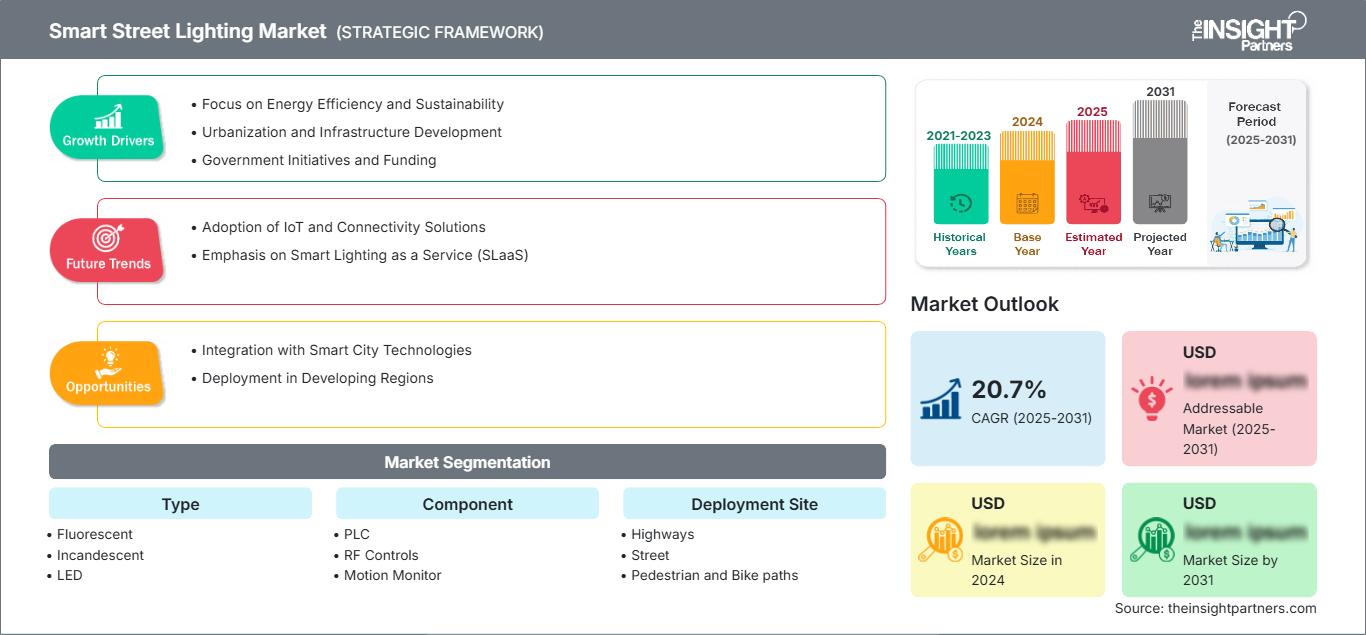
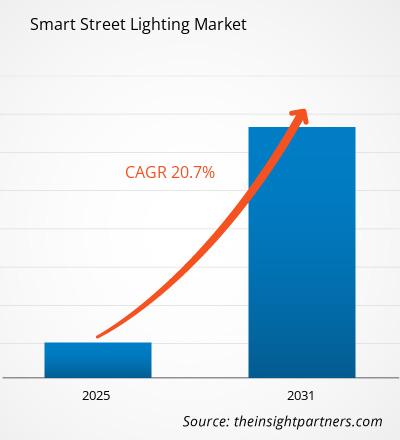
The global smart street lighting market was valued at US$ 24.45 billion in 2025 and is projected to reach US$ 163.98 billion by 2034, registering a compound annual growth rate (CAGR) of 23.55% from 2026 to 2034. This growth trajectory is underpinned by the increasing adoption of energy-efficient LED technology, the integration of IoT-enabled controls, and the rising demand from smart city projects worldwide.
North America accounted for a substantial portion of the global smart street lighting market size in 2025, estimated at 28-32%, and is projected to grow at a CAGR of 22-24% from 2026 to 2034. Structural growth drivers in the region include robust smart city initiatives and the operational benefits of the technology among major utilities. North America accounted for around a third of global shipment volumes in 2024.
Smart Street Lighting Market Assessment and Insights
- North America: North America is the fastest-growing regional market, driven by energy efficiency mandates and utility-led deployments. It is estimated to hold a 28-32% share in 2025 and is projected to grow at a CAGR of 22-24% from 2026 to 2034.
- U.S.: The U.S. dominates the North American market, accounting for 82-86% of the region's share in 2025. Its growth is propelled by significant infrastructure modernization investments and the adoption of adaptive lighting controls. The market is expected to grow at a CAGR of 23-25% from 2026 to 2034.
- Europe: Europe is the leading adopter of smart street lighting, accounting for approximately 35% of the global installed base in 2024. It holds an estimated 30-34% share in 2025 and is projected to grow at a CAGR of 21-23% from 2026 to 2034. Leading countries include Germany, the UK, and France.
- Asia Pacific: APAC is estimated to hold a 24-28% share in 2025 and is projected to grow at a significant CAGR of 24-26% from 2026 to 2034. China, Japan, and India are key markets, fueled by rapid urbanization, government support for smart city development, and the presence of major electronics manufacturers.
- Largest Segment: The LED lighting type segment is estimated to be the largest, holding a 65-70% share in 2025 and projected to grow at a CAGR of 22-24% from 2026 to 2034.
- High Growth Segment: The Cellular connectivity technology segment is projected to be the fastest-growing, driven by its plug-and-play nature and simplicity. It is expected to grow at a CAGR of 25-27% from 2026 to 2034.
- Key companies analyzed in detail: Acuity Brands Lighting Inc., EnGoPlanet Energy Solutions Inc, Bridgelux, Inc., Cree Lighting, Eaton, General Electric, Itron, Inc., Siemens AG, Telensa Ltd, and Signify Holding.
Source: The Insight Partners' analysis based on proprietary research, government publications, company annual reports, investor presentations, industry databases, and expert interviews.
The worldwide smart street lighting sector has experienced a major change from legacy lighting infrastructure to intelligent lighting solutions acting as a platform for various smart city initiatives. This development has been propelled by the combination of energy-saving LED technology, advanced communication technologies, and central software solutions that facilitate monitoring of the lighting infrastructure and its adaptation according to changes. Dynamics of production have moved in the direction of building compatible smart lighting solutions by using open standards, such as D4i and Zhaga.
The smart street lighting market report indicates that the market is expected to see significant development in terms of growth due to the opportunities provided by energy savings, cost reduction, and increased public safety. Significant investment efforts will be concentrated on the implementation of the second wave solutions that include sensors for monitoring of environment and traffic as well as smart parking functionality in street lighting infrastructure.
Smart Street Lighting Market Report Scope
| Report Attribute | Details |
|---|---|
| Market size in 2025 | US$ 24.45 Billion |
| Market Size by 2034 | US$ 163.98 Billion |
| Global CAGR (2026 - 2034) | 23.55% |
| Historical Data | 2021-2024 |
| Forecast period | 2026-2034 |
Smart Street Lighting Market Analysis
The global smart street lighting market is supported by rising awareness about the cost and environmental impacts of conventional street lights as well as the efficiency offered through remote monitoring and control. The use of IoT sensors and analysis provides benefits of preventive maintenance, energy savings, and greater public safety, thus fueling the demand from municipalities and utility companies.
The ecosystem consists of manufacturers of hardware components, providers of connectivity services, software providers, and system integrators who work together in order to provide a holistic solution.
Some of the significant smart street lighting market trends include mergers and acquisitions and collaborations that help in expanding the product portfolio. Some of the prominent players include Signify Holding that gained popularity because of its acquisition of Telensa for providing end-to-end solutions.
The competitors in the market are Itron, a major player in the networking sub-segment and other regional companies like Acuity Brands. It is observed that investment is being made in cloud-based management systems, open architecture systems, and cellular connectivity. There is also emphasis on cybersecurity and data privacy at the design stage.
● REPORT CUSTOMIZATION
Tailor This Report To Align With Your Specific Business Requirements
This report can be customized to align precisely with your business objectives, scope, and target markets. Customization options include tailored segmentation, geography, competitive analysis, and strategic insights to support informed decision-making.
Customize This Report →WHAT YOU CAN ADJUST
- ● Segmentations
- ● Geography
- ● Competitive Analysis
- ● Language Preferences
Smart Street Lighting Market: Strategic Insights
Regional Insights
North America Smart Street Lighting Market
North America is the fastest-growing regional market, driven by energy efficiency mandates and utility-led deployment programs. It is estimated to hold a 28-32% share in 2025 and is projected to grow at a CAGR of 22-24% from 2026 to 2034. The U.S. leads the region, with significant investments from major utilities and municipalities upgrading their infrastructure to meet carbon reduction targets. The region's focus on improving public safety and reducing operational costs is driving the adoption of connected lighting solutions.
U.S. Smart Street Lighting Market
The U.S. accounts for approximately 82-86% of the North American smart street lighting market share in 2025. The market is characterized by robust federal and state-level funding for infrastructure modernization and the adoption of adaptive lighting controls. The market is projected to grow at a CAGR of 23-25% from 2026 to 2034, driven by the integration of IoT sensors and AI-powered analytics for enhanced urban management. Major cities are deploying smart lighting networks that serve as platforms for additional smart city applications, such as traffic optimization and environmental monitoring.
Europe Smart Street Lighting Market
Europe is the leading adopter of smart street lighting technology, accounting for approximately 35% of the global installed base in 2024. It is estimated to hold a 30-34% share in 2025 and is projected to grow at a CAGR of 21-23% from 2026 to 2034. Germany and the UK are leading countries, driven by strong regulatory frameworks and a focus on achieving carbon neutrality. France, Italy, and Spain are also significant markets, with demand fueled by investments in modernizing aging infrastructure. The region's emphasis on open standards and interoperability is accelerating the adoption of D4i and Zhaga-compliant solutions.
APAC Smart Street Lighting Market
APAC is estimated to hold a 24-28% share of the global market in 2025 and is projected to grow at a significant CAGR of 24-26% from 2026 to 2034. China, Japan, and India are key markets, driven by rapid urbanization, rising government support for smart city projects, and the presence of major electronics manufacturers. China holds a substantial share, supported by its strong domestic manufacturing base and aggressive smart city investments. Countries in the region are deploying connected street lighting to improve public safety, reduce energy consumption, and support broader digital transformation initiatives.
Middle East & Africa Smart Street Lighting Market
The MEA region is estimated to hold a 3-5% share of the global smart street lighting market in 2025, with a projected CAGR of 18-20% from 2026 to 2034. Saudi Arabia and the UAE are key markets, with growth driven by massive infrastructure development projects and investments in smart city initiatives as part of economic diversification plans. The UAE is a leader in the region, implementing advanced smart lighting networks in new developments. Energy efficiency, tourism, and hosting international events are important contextual factors influencing market growth.
Segmentation Analysis
Type
The type segment in the smart street lighting market is categorized into Fluorescent, Incandescent, LED, and Others. The LED segment is estimated to be the largest, holding a 65-70% share in 2025, with a projected CAGR of 22-24% from 2026 to 2034. This dominance is driven by the widespread adoption of LED technology due to its superior energy efficiency, longer lifespan, and compatibility with smart controls. The smart street lighting scope encompasses a wide range of lighting types, with LED being the primary choice for new installations and retrofits.
- Fluorescent: Fluorescent lighting is gradually being phased out in favor of more efficient LEDs. Its usage is declining due to lower energy efficiency and shorter lifespan compared to LED alternatives.
- Incandescent: Incandescent lighting is obsolete in modern street lighting applications due to its extremely low energy efficiency and short operational life. These are being replaced aggressively in retrofit projects.
- LED: LED lighting dominates the market, driven by its energy savings, long lifespan, and ability to integrate with smart controls. It is the standard for new smart street lighting projects and retrofits.
- Others: This category includes emerging technologies such as solar-powered lights and high-intensity discharge (HID) lamps, which are used in specific applications.
Component
The component segment includes PLC, RF Controls, Motion Monitor, Ambient Light Sensing, and Others. RF Controls is estimated to be the dominant component segment, leveraging proprietary networking platforms . However, the market is shifting toward increased use of cellular connectivity and PLC for their scalability and simplicity .
- PLC: Power Line Communication uses existing power cables for data transmission, offering a cost-effective and reliable communication method for smart lighting networks.
- RF Controls: Radio Frequency controls are widely deployed, enabling wireless communication between lighting nodes and central management systems. Proprietary RF platforms are currently the most common connectivity type .
- Motion Monitor: Motion sensors are integrated into smart lighting to enable adaptive lighting, reducing energy consumption by dimming lights when areas are unoccupied.
- Ambient Light Sensing: Ambient light sensors automatically adjust lighting levels based on available natural light, optimizing energy usage and maintaining consistent illumination.
Deployment Site
The deployment site segment includes Highways, Street, Pedestrian and Bike paths, and Gardens and Parks. Highways and Streets are the largest deployment sites, driven by the need for public safety and traffic optimization. Pedestrian and bike paths represent a growing segment, with deployments supporting safety and active mobility initiatives.
- Highways: Smart lighting on highways enables traffic optimization, improves safety, and provides real-time monitoring of road conditions.
- Street: Street lighting is the most common deployment site, with cities and municipalities retrofitting traditional street lights with smart LED controls to reduce energy consumption and enhance public safety.
- Pedestrian and Bike paths: Smart lighting on these paths improves safety for pedestrians and cyclists, with motion sensors enabling adaptive dimming to save energy.
- Gardens and Parks: Parks and gardens benefit from smart lighting for ambiance, safety, and energy efficiency, with ambient light sensing and scheduling features.
Opportunity Snapshot
| Deployment Site | Revenue Contribution | Trend Tag | Adoption Stage |
|---|---|---|---|
| Highways | High | Traffic Ops | Scaling |
| Street | High | Urban Safety | Scaling |
| Pedestrian and Bike paths | Medium | Active Mobility | Scaling |
| Gardens and Parks | Medium | Green Spaces | Emerging |
Smart Street Lighting Market Growth Drivers and Impact Analysis
Rising Demand for Energy Efficiency and Cost Reduction
The significant energy consumption and high operational costs associated with traditional street lighting are primary drivers for the adoption in smart street lighting market. Smart street lighting systems enable municipalities and utilities to achieve energy savings of up to 80% through the use of LED technology and adaptive controls. The ability to remotely monitor and manage lighting networks reduces maintenance costs and optimizes operational efficiency.
Technological Advancements in IoT and Connectivity
The market is propelled by continuous innovation in IoT sensors, communication technologies, and centralized management software. The integration of wireless connectivity such as Zigbee, LoRaWAN, and cellular (NB-IoT, LTE-M) enables seamless remote monitoring and control. These advancements improve the functionality of smart lighting systems and enable the integration of additional smart city applications, such as environmental monitoring and traffic management.
Growing Smart City Initiatives and Government Support
Smart street lighting is a foundational component of smart city strategies worldwide. Governments are embedding smart lighting into their urban development plans to achieve sustainability goals, improve public services, and enhance citizen safety. Supportive policies, funding for infrastructure modernization, and energy efficiency mandates are accelerating the adoption of connected lighting solutions.
Smart Street Lighting Market Future Trends
Expansion of IoT-Enabled Lighting Networks and Smart City Platforms
A key future trend in the smart street lighting market is the expansion of IoT-enabled street lighting networks as platforms for broader smart city applications, which is a major part of the trends analysis. Street lighting infrastructure is emerging as a promising platform for the management of additional smart city devices, including environmental sensors, traffic monitors, and digital signage. This evolution will transform lighting networks from standalone systems to multi-functional urban infrastructure hubs.
Increasing Adoption of Cellular Connectivity and Open Standards
The market is shifting toward increased use of cellular communications (NB-IoT, LTE-M) for its simplicity and plug-and-play nature, with cellular expected to be the fastest-growing connectivity technology. Simultaneously, there is growing demand for interoperability, leading to increased adoption of open standards such as D4i and Zhaga . This trend enables multi-vendor ecosystems and future-proofs investments in smart lighting infrastructure.
Smart Street Lighting Market Opportunities
Untapped Growth in Second-Wave Deployments and Retrofit Solutions
A significant opportunity lies in second-wave smart street lighting deployments that go beyond basic controls to integrate advanced sensors and analytics. The market for retrofit solutions is also substantial, allowing existing streetlights to be upgraded to connected LEDs at a lower cost. Companies offering scalable, modular solutions that can be integrated into existing infrastructure are well-positioned to capture this growing segment, as highlighted in smart street lighting market forecasts.
Development of Data-Driven Urban Analytics and Managed Services
A major opportunity exists in the development of data-driven urban analytics and managed services. By leveraging data collected from smart lighting networks, cities can optimize traffic flow, monitor air quality, and improve public safety. The provision of managed services that include analytics, maintenance, and software updates offers recurring revenue streams for technology providers and creates long-term partnerships with municipalities.
Recent Developments
- August 2026: The Energy Efficiency Services Limited (EESL), under the Ministry of Power, is set to launch a Smart LED Street Lighting Project in Andhra Pradesh (A.P.) to accelerate energy efficiency and promote sustainable urban development. The project, to be implemented in partnership with the Municipal Administration and Urban Development (MA&UD) Department, will introduce an Individual Light Monitoring (ILM) network integrated with a centralised control and monitoring system across all Urban Local Bodies (ULBs) in the State, according to an official release.
- August 2026: Bhopal has launched first of its kind public private partnership (PPP) based smart poles and intelligent street lights project in India under the Smart Cities Mission. The project is innovatively structured in such a manner that it delivers bundled smart services to citizens and maximum values for money to the city authority.
- August 2025: As part of its Vision Zero initiative and broader sustainability goals, Washington, D.C. launched a landmark $309 million public–private partnership (P3) to modernize its aging infrastructure by replacing tens of thousands of streetlights with energy-efficient ones such as LEDs. As important, the project addresses the city's needs for advanced control and predictive maintenance capabilities, key enablers for reducing energy consumption, improving public safety and streamlining operations across the city.
Frequently Asked Questions

- Comprehensive Market Sizing and Forecast Analysis
- Detailed Segmentation Analysis
- In-Depth Market Dynamics Assessment
- Regional and Country-Level Insights
- Competitive Landscape and Company Benchmarking
- Strategic Business Intelligence
Recent Reports
Testimonials

The Insight Partners provided valuable market intelligence that supported our global go-to-market strategy. Their team was professional, responsive, and attentive to our feedback, providing thoughtful analysis and helpful methodological clarifications throughout the project.
Junmo Kim Chief Financial Officer (CFO), Enertech Co., Ltd.
The Insight Partners' SCADA System Market report is comprehensive, with valuable insights on current trends and future forecasts. The team was highly professional, responsive, and supportive throughout. We are very satisfied and highly recommend their services.
RAN KEDEM Partner, Reali Technologies LTDs
I requested a report on a very specific software market and the team produced the report in a few days. The information was very relevant and well presented. I then requested some changes and additions to the report. The team was again very responsive and I got the final report in less than a week.
JEAN-HERVE JENN Chairman, Future Analytica
We worked with The Insight Partners for an important market study and forecast. They gave us clear insights into opportunities and risks, which helped shape our plans. Their research was easy to use and based on solid data. It helped us make smart, confident decisions. We highly recommend them.
PIYUSH NAGPAL Sr. Vice President, High Beam Global
The Insight Partners delivered insightful, well-structured market research with strong domain expertise. Their team was professional and responsive throughout. The user-friendly website made accessing industry reports seamless. We highly recommend them for reliable, high-quality research services
YUKIHIKO ADACHI CEO, Deep Blue, LLC.
This is the first time I have purchased a market report from The Insight Partners.While I was unsure at first, I visited their web site and felt more comfortable to take the risk and purchase a market report.I am completely satisfied with the quality of the report and customer service. I had several questions and comments with the initial report, but after a couple of dialogs over email with their analyst I believe I have a report that I can use as input to our strategic planning process.Thank you so much for taking the extra time and making this a positive experience.I will definitely recommend your service to others and you will be my first call when we need further market data.
JOHN SUZUKI President and Chief Executive Officer, Board Director, BK Technologies
I wish to appreciate your support and the professionalism you displayed in the course of attending to my request for information regarding to infectious disease IVD market in Nigeria. I appreciate your patience, your guidance, and the fact that you were willing to offer a discount, which eventually made it possible for us to close a deal. I look forward to engaging The Insight Partners in the future, all thanks to the impression you have created in me as a result of this first encounter.
DR CHIJIOKE ONYIA MANAGING DIRECTOR, PineCrest Healthcare Ltd.Reason to Buy
- Informed Decision-Making
- Understanding Market Dynamics
- Competitive Analysis
- Identifying Emerging Markets
- Customer Insights
- Market Forecasts
- Risk Mitigation
- Boosting Operational Efficiency
- Strategic Planning
- Investment Justification
- Tracking Industry Innovations
- Aligning with Regulatory Trends





 Get Free Sample for