Healthcare is undergoing a remarkable technological transformation, and 3D printing (additive manufacturing) has emerged as one of the most influential innovations reshaping patient care. Once used primarily for rapid prototyping, 3D technologies are now enabling personalized prosthetics, patient-specific implants, surgical planning models, tissue engineering, and even groundbreaking advances in regenerative medicine.
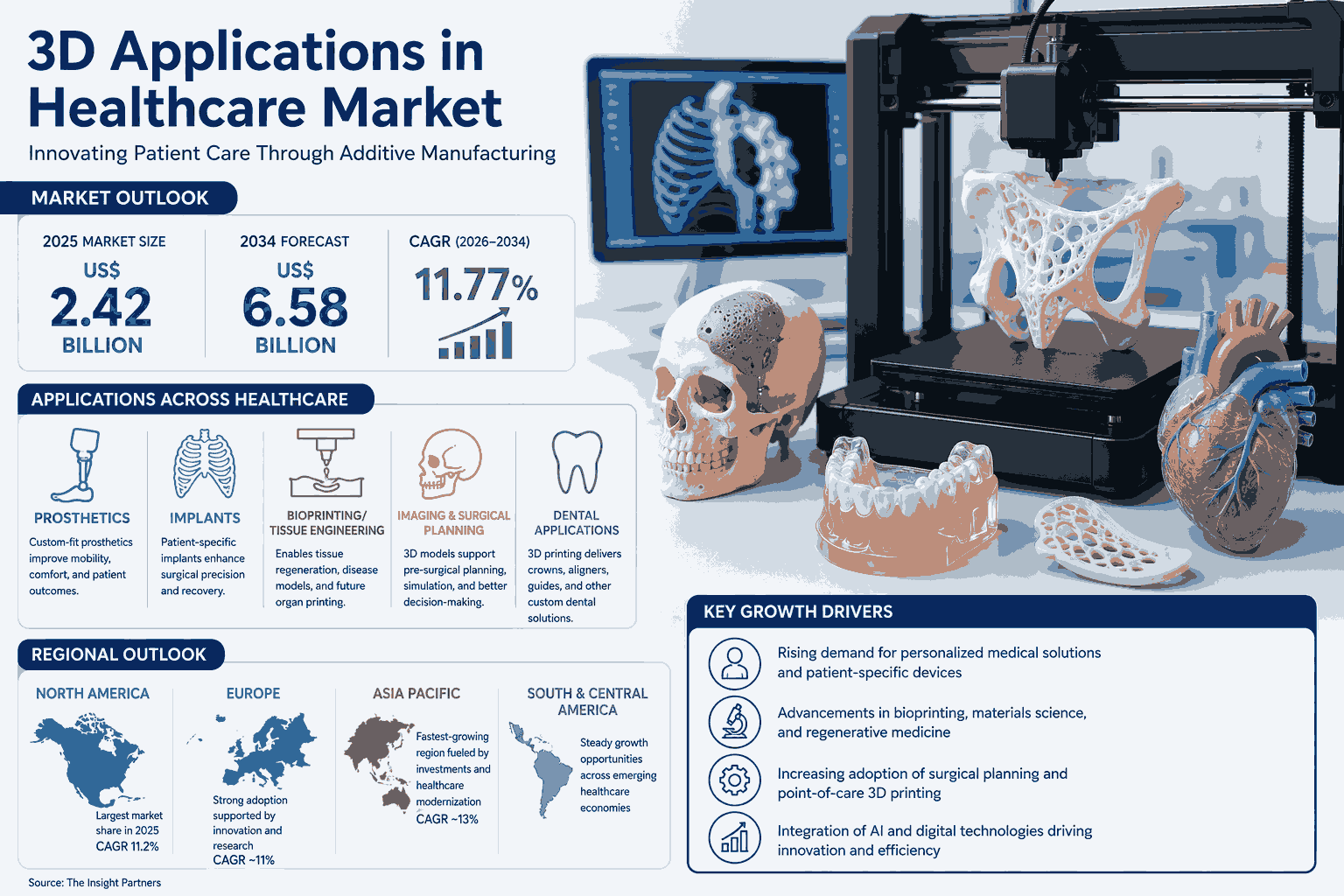
According to The Insight Partners, the 3D Applications in Healthcare Market was valued at US$ 2.42 billion in 2025 and is projected to reach US$ 6.58 billion by 2034, growing at a CAGR of 11.77% during the forecast period. The market's expansion is driven by increasing demand for precision medicine, customized medical devices, and continuous advancements in biomaterials, imaging technologies, and artificial intelligence.
Why 3D Printing Is Becoming Essential in Modern Healthcare
Traditional manufacturing methods often struggle to address the unique anatomical differences among patients. Standardized implants and prosthetics may not always provide the best clinical outcomes, particularly in complex surgeries or reconstructive procedures.
3D printing solves this challenge by enabling healthcare professionals to manufacture patient-specific medical devices based on CT scans, MRI images, and digital modeling software. This level of customization enhances surgical precision, reduces operation time, improves patient recovery, and minimizes complications.
Beyond personalization, hospitals are increasingly using 3D printing for surgical simulation, physician training, and medical education. Surgeons can practice difficult procedures using highly accurate anatomical replicas before entering the operating room, significantly improving procedural confidence and patient safety.
Market Growth Driven by Personalized Healthcare
Personalized medicine continues to redefine healthcare delivery worldwide. As physicians increasingly tailor treatments to individual patients, demand for customized medical products has accelerated rapidly.
The healthcare industry now utilizes 3D printing to manufacture:
- Customized prosthetic limbs
- Patient-specific orthopedic implants
- Cranial and spinal implants
- Dental crowns and aligners
- Surgical guides
- Anatomical models for preoperative planning
These solutions improve patient comfort while reducing manufacturing lead times and minimizing inventory requirements for hospitals and medical device manufacturers.
Healthcare providers also benefit from greater operational efficiency, making additive manufacturing an increasingly attractive investment across developed and emerging healthcare systems.
Bioprinting Is Opening New Possibilities
Perhaps the most exciting development within the healthcare 3D printing ecosystem is bioprinting.
Unlike conventional 3D printing that uses polymers or metals, bioprinting deposits living cells and biomaterials layer by layer to create biological structures. Researchers are making significant progress toward printing tissues, cartilage, skin, blood vessels, and experimental organ models.
Although commercially available fully functional organs remain years away, today's advancements are already supporting:
- Drug discovery and testing
- Disease modeling
- Tissue regeneration research
- Personalized therapeutic development
- Regenerative medicine innovation
Growing investments from biotechnology companies, research institutions, and healthcare organizations continue to accelerate commercialization opportunities in this segment.
Artificial Intelligence Is Enhancing Medical 3D Printing
Artificial Intelligence (AI) is becoming an important component of healthcare-focused additive manufacturing.
AI-powered software can automatically convert medical imaging data into printable anatomical models while optimizing implant designs based on patient anatomy. Automated quality inspection and predictive manufacturing analytics also reduce production errors and improve consistency.
The integration of AI provides several advantages:
- Faster design workflows
- Improved manufacturing accuracy
- Reduced manual intervention
- Enhanced surgical planning
- Better resource utilization
As AI algorithms continue to evolve, healthcare organizations are expected to adopt increasingly automated end-to-end manufacturing workflows that connect diagnostic imaging directly to personalized medical device production.
Point-of-Care Manufacturing Is Reshaping Hospital Operations
Another important trend is the emergence of point-of-care manufacturing.
Rather than depending entirely on centralized manufacturing facilities, hospitals are establishing in-house 3D printing laboratories capable of producing customized medical devices on demand.
Point-of-care manufacturing enables healthcare providers to:
- Produce patient-specific implants faster
- Reduce supply chain delays
- Lower inventory costs
- Improve emergency response capabilities
- Support complex surgical procedures with customized tools
This decentralized production model is particularly valuable for trauma care, orthopedic surgery, craniofacial reconstruction, cardiovascular procedures, and pediatric healthcare.
Regional Outlook
North America Leads Global Adoption
North America continues to dominate the global 3D Applications in Healthcare Market due to its advanced healthcare infrastructure, strong research ecosystem, and high healthcare expenditure.
The United States remains the primary growth engine, supported by:
- Extensive adoption of personalized medicine
- Strong regulatory pathways
- Advanced hospital networks
- Significant investments in medical technology
- Increasing use of surgical planning models and customized implants
Hospitals throughout the region are integrating dedicated 3D printing laboratories into routine clinical workflows.
Asia Pacific Emerges as the Fastest-Growing Region
Asia Pacific is projected to register the highest growth rate through 2034.
Several factors contribute to this rapid expansion:
- Increasing healthcare investments
- Expanding hospital infrastructure
- Government support for healthcare innovation
- Rising adoption of digital healthcare
- Growth of domestic medical device manufacturing
Countries including China, Japan, South Korea, India, and Australia are investing heavily in precision medicine, advanced diagnostics, and personalized healthcare technologies.
Europe Maintains Strong Innovation
Europe remains one of the world's leading centers for healthcare additive manufacturing.
Germany continues to lead regional adoption through its established medical device industry, while France, Italy, Spain, and the United Kingdom are expanding investments in tissue engineering, regenerative medicine, and customized implant manufacturing.
Strong academic research and collaboration between healthcare providers and technology companies continue to support long-term innovation.
Key Market Segments Driving Revenue
Prosthetics
Customized prosthetics represent the largest application segment. Advanced 3D printing enables lightweight, patient-specific devices that improve comfort, mobility, and overall functionality while significantly reducing manufacturing time.
Implants
Patient-specific implants are increasingly replacing conventional standardized devices across orthopedic, cranial, spinal, and maxillofacial procedures. Improved anatomical compatibility enhances long-term clinical outcomes.
Bioprinting and Tissue Engineering
Although still developing commercially, this segment represents one of the industry's most promising long-term growth opportunities.
Imaging and Surgical Planning
Three-dimensional visualization models are helping surgeons better understand complex anatomy before procedures, improving surgical accuracy and reducing operating times.
Competitive Landscape
Competition within the market is increasingly centered on innovation, regulatory expertise, biomaterial development, and software integration.
Leading companies continue to invest in:
- AI-enabled design software
- Advanced biomaterials
- Automated manufacturing platforms
- Regenerative medicine research
- Strategic partnerships with hospitals and universities
Regulatory approvals for patient-specific implants and medical devices are also accelerating commercialization, creating new opportunities across orthopedic, dental, reconstructive, and cardiovascular healthcare applications.
Future Outlook Through 2034
The future of healthcare will increasingly depend on technologies that deliver individualized treatment while improving efficiency and clinical outcomes.
Advancements in bioprinting, AI integration, regenerative medicine, and decentralized manufacturing will continue expanding the scope of healthcare-focused additive manufacturing. As regulatory frameworks mature and material science advances, hospitals and healthcare providers are expected to adopt 3D technologies across a broader range of specialties.
The growing emphasis on precision medicine, value-based healthcare, and patient-centric treatment models positions the 3D Applications in Healthcare Market for sustained long-term growth.
.jpg)
.png)
.png)
.png)
.png)