
Camera Lens Market Size, Trends & Demand by 2034
Coverage: By Type (Built-in Lens, Interchangeable Lenses); Application (Phone Cameras, Computer Cameras, Digital Cameras), and Geography (North America, Europe, Asia Pacific, and South and Central America)
- Status : Data Released
- Report Code : TIPRE00015006
- Category : Electronics and Semiconductor
- No. of Pages : 150
- Available Report Formats :


- Last update date : August 04, 2026


2025 Market Size
US$ 6.02 Bn
Base year value
2034 Forecast
US$ 9.23 Bn
Projected by 2034
CAGR 2026-2034
4.87 %
Growth rate
Addressable Market
US$ 69.24 Bn
(2026-2034)
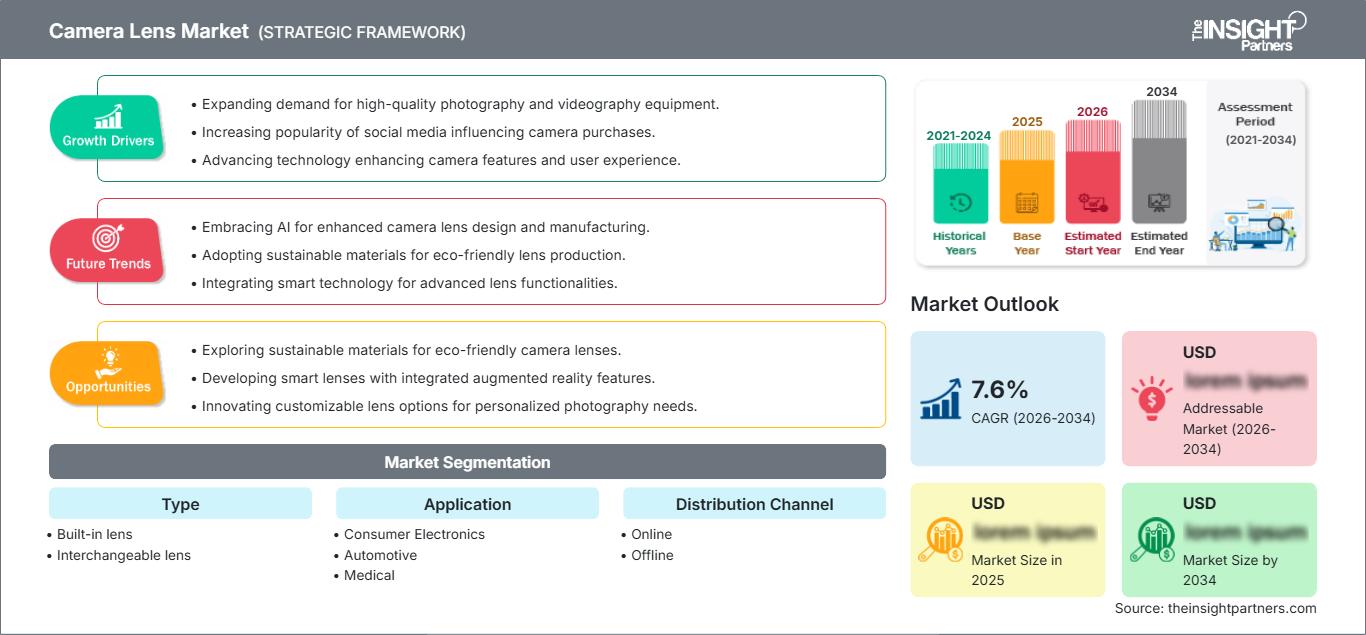
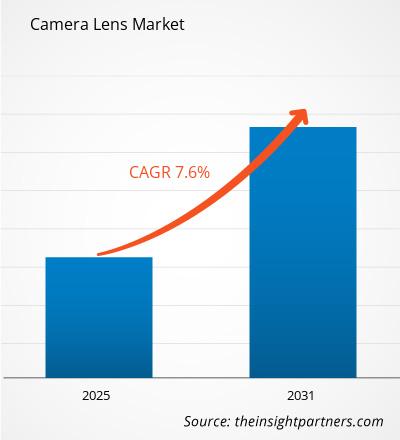
The Camera Lens Market size is expected to reach US$ 9.23 Billion by 2034 from US$ 6.02 Billion in 2025, growing at a CAGR of 4.87% from 2026 to 2034. The demand is driven by the need for high-resolution cameras, multi-camera consumer devices, automobile sensors, and medical visualization systems. The optical performance, small form factor, autofocusing accuracy, and quality of coatings continue to be important purchasing factors in both built-in and interchangeable lenses.
In North America, the Camera Lens Market is driven by upgrades driven by creators, ADAS cameras, and constant demand for premium interchangeable systems. North America is expected to grow at a CAGR of 4.4-4.9% from 2026 to 2034. The U.S. is anticipated to drive the growth due to professional content creation, advanced car electronics, and good penetration of camera accessories online.
Camera Lens Market Assessment and Insights
- North America accounted for 27–29% Camera Lens Market share in 2025 and is projected to grow at a CAGR range of 4.4–4.9% during 2026–2034, supported by creator equipment upgrades, automotive safety imaging, and professional video workflows.
- US represented 76–79% of North America in 2025 and is expected to grow at 4.5–5.0% CAGR, led by media production and ADAS demand.
- Europe held 22–24% share in 2025 and is projected to expand at 4.0–4.5% CAGR, with Germany, the UK, France, Italy, and Spain driving industrial, automotive, and premium camera demand.
- Asia Pacific captured 35–38% share in 2025 and is expected to grow at 5.4–5.9% CAGR, led by China, Japan, South Korea, and India through manufacturing scale and consumer electronics demand.
- Largest Segment Consumer Electronics held 57–60% market share in 2025 and is expected to grow at 4.3–4.8% CAGR as smartphones, mirrorless cameras, and creator devices remain high-volume outlets.
- High Growth Segment Automotive held 17–20% share in 2025 and is projected to grow at 6.0–6.6% CAGR as multi-camera ADAS and in-cabin monitoring scale across vehicles.
- Key companies analyzed in detail: Canon Inc., FUJIFILM Corporation, Genius Electronic Optical Co., Ltd., Haesung Optics Co., Ltd., Largan Precision Co., Ltd., Nikon Corporation, Panasonic Holdings Corporation, Samsung Electronics Co., Ltd., SEKONIX Co., Ltd., Sony Group Corporation
Source: The Insight Partners' analysis based on proprietary research, government publications, company annual reports, investor presentations, industry databases, and expert interviews.
Migration to mirrorless systems, computational imaging, and optical module design have transformed competition in the Camera Lens Market. Assembly lines have been redesigned to produce with higher tolerances, molded glass aspheres, plastic-glass hybrid assemblies, and low-ghost coatings for HDR images. Suppliers are also working in tandem with the roadmap of their sensors especially when designing for smartphone camera modules, automotive surround view cameras, endoscopy devices, and video-first interchangeable camera lenses.
In the coming years, emerging regions will become increasingly important as production, local smartphone brands, and electronics manufacturing capacities expand within Asia and some regions of the Middle East. The regulatory tailwinds related to vehicle safety, need for less invasive medical imaging, and content monetization will encourage investments in lenses with low distortion, stable autofocus, high thermal performance, and ready-to-integrate modules.
Camera Lens Market Report Scope
| Report Attribute | Details |
|---|---|
| Market size in 2025 | US$ 6.02 Billion |
| Market Size by 2034 | US$ 9.23 Billion |
| Global CAGR (2026 - 2034) | 4.87% |
| Historical Data | 2021-2024 |
| Forecast period | 2026-2034 |
Camera Lens Market Analysis
The market growth is supported by increased requirements for image quality in smartphones, professional hybrid cameras, driver assistance applications, and medical visualization. CIPA shipment numbers for interchanging lenses and product roadmaps for mirrorless systems support further development of the market, while automotive imaging industry sources note the increased number of cameras per car due to safety functions becoming standardized.
The supply situation continues to be dependent on precision molding, availability of optical glass, actuator miniaturization, lens sensor alignment, and semiconductor packaging. The lens manufacturers increasingly collaborate with the image sensors manufacturers, module vendors, and the original equipment manufactures to optimize the field of view, minimize distortion, improve low light operation, and facilitate manufacturing.
The analysis of Camera Lens Market indicates that the market exhibits competitive dynamics among the branded camera systems players and high volume mobile or automobile optical players. The competition among brands such as Canon Inc., Nikon Corporation, Sony Group Corporation, and FUJIFILM Corporation comes through mount ecosystems, and companies like Largan Precision Co., Ltd., Genius Electronic Optical Co., Ltd., Haesung Optics Co., Ltd., and SEKONIX Co., Ltd. come through compact module-based offerings.
The investments are directed towards quick autofocus motors, lightweight lens bodies, periscope constructions, wafer level optics, and AI-enabled camera module. The companies like Panasonic Holdings Corporation and Samsung Electronics Co., Ltd. are adding to the strength of the overall imaging ecosystem through consumer electronics devices.
● REPORT CUSTOMIZATION
Tailor This Report To Align With Your Specific Business Requirements
This report can be customized to align precisely with your business objectives, scope, and target markets. Customization options include tailored segmentation, geography, competitive analysis, and strategic insights to support informed decision-making.
Customize This Report →WHAT YOU CAN ADJUST
- ● Segmentations
- ● Geography
- ● Competitive Analysis
- ● Language Preferences
Camera Lens Market: Strategic Insights
Regional Insights
North America Camera Lens Market
North America accounted for 27–29% of 2025 revenues and is estimated to grow with a 4.4–4.9% CAGR over 2026-2034. Market share of the Camera Lens Market in North America is driven by professional photography, live-stream production, sports broadcast, and large presence of interchangeable camera lenses. In addition to that, demand in the region is augmented by automotive electronics owing to widespread use of rear view, surround-view, and driver monitoring cameras.
Structure demand is generated by the use of compact optics by healthcare facilities for endoscopy, telemedicine devices, and surgical imaging. Improved availability of lenses via online retail helps increase after-sales lens sales, whereas specialists continue to play an important role in professional purchases. Suppliers have to focus on weather resistance, stabilization, low light conditions, and video support.
U.S. Camera Lens Market
United States constituted 76–79% share of North America in 2025 and is expected to grow at CAGR of 4.5–5.0%. Demand is based on the need in videography, imaging in e-commerce, defense-related optical expertise, and driver-assistance applications. The professionals are still interested in lenses offering high sharpness, fast autofocus, image stabilization, and minimal focus breathing for hybrid use in still images and video.
Commercial strength in Canon Inc., Nikon Corporation, Sony Group Corporation, FUJIFILM Corporation, and Panasonic Holdings Corporation remains high via their retail distribution, professional service provider network, and cinema/broadcast network. There is room for module manufacturers through the introduction of automotive cameras in various positions in the car including front, rear, surround, and in-cabin position.
Europe Camera Lens Market
The Europe region will have 22–24% market share in 2025 and is projected to register a 4.0–4.5% CAGR till 2034. Germany is the leader in the region due to high safety concerns and machine vision in the country, as well as premium optical engineering. The UK provides its market contribution via films, professional content production, and specialized retail for advanced imaging.
France, Italy, and Spain contribute to the market through broadcasting, tourism-based photography, imaging in the healthcare sector, and the replacement of consumer electronic devices. The regulations regarding the safety of cars and drivers in the region ensure that lenses can be integrated in cars. There is also pressure on manufacturers due to sustainable expectations of the consumers.
APAC Camera Lens Market
APAC region held 35%-38% market share in 2025, with a forecasted CAGR of 5.4%-5.9%. These make APAC region the biggest regional contributor in market development. China, Japan, South Korea, India, and Australia define the dynamics through smartphone modules, mirrorless systems, automotive cameras, and medical applications. Japan is crucial to the supply chain because the biggest manufacturers of cameras and optical technologies are located there.
China and South Korea are dominant regions in high-volume manufacturing of components. India is attractive with the growing electronics industry and automotive market. APAC growth drivers include emerging creator economy, EV platforms with more cameras, and healthcare technology development. Competitors differentiate themselves in terms of volume, yields, miniaturization, and ability to comply with OEM requirements.
Middle East & Africa Camera Lens Market
The Middle East and Africa region is expected to grow at a CAGR of 3.8% to 4.3% between 2024 and 2034, with strong demand from Saudi Arabia and the UAE. Factors contributing to lens use include infrastructure investments, security, surveillance systems in cities, tourism initiatives, and video and film production. In South Africa, retail imaging, medical facilities, and security are driving forces behind lens usage, whereas Rest of MEA shows low willingness to pay and slow upgrading of their surveillance cameras.
Projects related to energy generation and logistics, and also urban surveillance drive the demand for rugged built-in lenses. Premium interchangeable lens market is more limited but is driven by professional events and sports events. Distribution channels include offline for professionals and online for accessories and other consumers' products.
Segmentation Analysis
Type
The type segment is expected to grow at a 4.6–5.1% CAGR during 2026–2034. Camera Lens Market scope across type is shaped by the balance between embedded modules used in smartphones, vehicles, and medical devices and interchangeable systems used by creators and professionals. Built-in lenses dominate unit volumes, while interchangeable lenses preserve higher average selling prices.
- Built-in lens formats remain essential in smartphones, automotive cameras, endoscopy devices, and security systems, where compact size, fixed optical alignment, durability, and high-volume manufacturing yield determine supplier competitiveness.
- Interchangeable lens demand is concentrated among enthusiasts, professionals, broadcasters, and hybrid creators who require focal-length flexibility, superior aperture control, upgrade paths, and compatibility with mirrorless camera ecosystems.
Application
The application segment is projected to grow at a 4.9–5.4% CAGR during 2026–2034. Consumer electronics remains the largest revenue contributor, but automotive is the fastest-rising application as vehicles incorporate more cameras for safety, parking, automation, and cabin monitoring. Medical applications demand clean imaging, miniaturization, and reliability in constrained environments.
- Consumer Electronics leads demand through smartphones, compact cameras, mirrorless systems, action cameras, and creator-focused devices, with buyers prioritizing autofocus speed, stabilization, low-light quality, and portability.
- Automotive is strategically important as ADAS, surround view, parking assistance, and driver monitoring require lenses with wide fields of view, temperature stability, distortion correction, and long operating life.
- Medical applications use compact optics in endoscopy, surgical visualization, diagnostic imaging, and telehealth peripherals, where clarity, sterilization compatibility, and consistent illumination support clinical decision-making.
Distribution Channel
The distribution channel segment is expected to grow at a 4.5–5.0% CAGR during 2026–2034. Online platforms are gaining share because they widen access to compatible lenses, comparison tools, reviews, and promotional bundles. Offline channels remain relevant for high-value purchases, demonstrations, trade-ins, repairs, and professional consultations where fit, handling, and aftersales confidence matter.
- Online channels support faster product discovery, wider inventory visibility, price comparison, and direct-to-consumer launches, particularly for enthusiasts upgrading accessories or buying specialized lenses.
- Offline channels remain critical for professional buyers, rental houses, and institutional customers that require hands-on evaluation, technical advice, servicing support, and assured compatibility.
Opportunity Snapshot
| Application | Revenue Contribution | Trend Tag | Adoption Stage |
| Consumer Electronics | High | Creator Optics | Mature |
| Automotive | Medium | ADAS Vision | Scaling |
| Medical | Medium | Endoscopy Imaging | Scaling |
Camera Lens Market Growth Drivers and Impact Analysis
Rising multi-camera demand across connected devices
As smartphones, tablets, laptops, action cameras, and portable creator devices employ multiple lenses for wide-angle capture, optical zoom, portrait capability, stabilization, and low light, there are benefits in expanding the addressable market away from photography and in focusing lens suppliers on reducing thickness, improving coatings, and increasing yield. The market effects are evident in reduced design cycle time, closer partnership between lens providers and sensor manufacturers, and more differentiation by optical capability than by the hardware itself. For the Camera Lens Market, multi-lens devices will help stabilize volumes since there will be more lens per device regardless of longer replacement cycles.
Automotive safety systems increasing optical content per vehicle
As advanced driver-assist systems make their way from the high-end segment into mass platforms, there is an increased need for front, rear, surround view, side, and in-cabin cameras. These each have distinct FOVs, thermal requirements, anti-glare requirements, and reliability requirements, meaning that the automotive qualification process is now a gating factor. This results in a trend towards longer-term purchasing relationships, increased validation costs, and more visibility into future demand for qualified suppliers. As safety requirements and consumer expectations align, automotive optics emerges as one of the clearest paths for suppliers to diversify away from consumer electronics cycles.
Mirrorless ecosystems sustaining premium interchangeable lenses
Mirrorless camera platforms continue to refresh demand for premium interchangeable lenses because shorter flange distances allow new optical designs, faster communication, and improved autofocus performance. Professional creators, wedding photographers, broadcasters, and hybrid video users are upgrading from legacy DSLR systems to lens families optimized for stabilization, silent focusing, and low focus breathing. This supports higher margins for branded camera makers and third-party specialists. The broader market impact is a more ecosystem-driven purchasing model, where body upgrades, mount compatibility, and lens roadmaps influence customer retention over several product cycles.
Camera Lens Market Future Trends
AI-optimized optical design and calibration
Camera Lens Market trends increasingly point toward optics designed together with software correction, AI autofocus, subject recognition, and computational image pipelines. Future lenses will be evaluated not only by physical sharpness but also by how consistently they feed usable data into device algorithms. This will matter in smartphones, vehicles, medical systems, and industrial inspection, where correction profiles can reduce distortion, stabilize exposure, and support real-time decisions. Suppliers that combine optical engineering with firmware, calibration data, and sensor-level integration will be better positioned to win embedded design slots and premium camera-system upgrades.
Compact high-performance lenses for harsh environments
Future product development will emphasize small lenses that maintain accuracy under heat, vibration, moisture, dust, and repeated cleaning. Automotive cameras, factory vision systems, outdoor surveillance, drones, and medical equipment require optical modules that remain stable over long operating periods. This creates demand for stronger materials, improved sealing, anti-fog coatings, and robust actuator assemblies. The shift favors suppliers with testing depth and cross-industry qualification experience, because failure costs are far higher in vehicles or healthcare equipment than in discretionary consumer imaging products.
Camera Lens Market Opportunities
Localized automotive optics supply for regional platforms
Regional vehicle platforms create attractive Camera Lens Market Forecasts for suppliers able to localize automotive optics near assembly hubs. Automakers are adding cameras for parking, lane support, driver monitoring, and cabin sensing, but they also need validated suppliers that can manage cost, quality, and logistics. Lens manufacturers can invest in regional testing, tooling, and module partnerships to reduce qualification friction. The opportunity is strongest where EV production, safety regulation, and electronics localization overlap, enabling suppliers to secure multi-year programs rather than one-off component sales.
Medical visualization upgrades in outpatient care
Healthcare systems are expanding minimally invasive procedures, teleconsultation tools, and compact diagnostic equipment, creating demand for small, reliable lenses that support clear visualization. Suppliers can target endoscopy, surgical cameras, dental imaging, dermatology devices, and portable diagnostic systems with optics designed for low distortion, illumination efficiency, and cleaning compatibility. The opportunity is investment-oriented because medical devices have longer validation cycles and higher reliability requirements, but approved optical designs can generate durable revenue. Partnerships with medical device OEMs and component sterilization specialists can improve entry prospects.
Recent Developments
- January 2026: Fujifilm launched the FUJIFILM SX400, a lens-integrated long-range camera featuring a bright F2.8 lens and 32x optical zoom (12.5–400mm). Designed for surveillance, inspection, and industrial applications, the compact camera delivers clear imaging even in low-light and nighttime conditions.
- August 2025: Tamron expanded the availability of its 18-300mm F/3.5-6.3 Di III-A VC VXD all-in-one zoom lens to Nikon Z and Canon RF APS-C mirrorless cameras. The lens offers a versatile zoom range with vibration compensation, making it suitable for travel, wildlife, and everyday photography.
- July 2026: Tamron introduced the 12-20mm F2.8 (Model A084) ultra-wide zoom lens for Sony E-mount and Nikon Z full-frame mirrorless cameras. The compact, lightweight lens combines a constant F2.8 aperture with an expansive field of view, targeting landscape, architecture, and astrophotography enthusiasts.
Frequently Asked Questions

- Comprehensive Market Sizing and Forecast Analysis
- Detailed Segmentation Analysis
- In-Depth Market Dynamics Assessment
- Regional and Country-Level Insights
- Competitive Landscape and Company Benchmarking
- Strategic Business Intelligence
Recent Reports
Testimonials

The Insight Partners' SCADA System Market report is comprehensive, with valuable insights on current trends and future forecasts. The team was highly professional, responsive, and supportive throughout. We are very satisfied and highly recommend their services.
RAN KEDEM Partner, Reali Technologies LTDs
I requested a report on a very specific software market and the team produced the report in a few days. The information was very relevant and well presented. I then requested some changes and additions to the report. The team was again very responsive and I got the final report in less than a week.
JEAN-HERVE JENN Chairman, Future Analytica
We worked with The Insight Partners for an important market study and forecast. They gave us clear insights into opportunities and risks, which helped shape our plans. Their research was easy to use and based on solid data. It helped us make smart, confident decisions. We highly recommend them.
PIYUSH NAGPAL Sr. Vice President, High Beam Global
The Insight Partners delivered insightful, well-structured market research with strong domain expertise. Their team was professional and responsive throughout. The user-friendly website made accessing industry reports seamless. We highly recommend them for reliable, high-quality research services
YUKIHIKO ADACHI CEO, Deep Blue, LLC.
This is the first time I have purchased a market report from The Insight Partners.While I was unsure at first, I visited their web site and felt more comfortable to take the risk and purchase a market report.I am completely satisfied with the quality of the report and customer service. I had several questions and comments with the initial report, but after a couple of dialogs over email with their analyst I believe I have a report that I can use as input to our strategic planning process.Thank you so much for taking the extra time and making this a positive experience.I will definitely recommend your service to others and you will be my first call when we need further market data.
JOHN SUZUKI President and Chief Executive Officer, Board Director, BK Technologies
I wish to appreciate your support and the professionalism you displayed in the course of attending to my request for information regarding to infectious disease IVD market in Nigeria. I appreciate your patience, your guidance, and the fact that you were willing to offer a discount, which eventually made it possible for us to close a deal. I look forward to engaging The Insight Partners in the future, all thanks to the impression you have created in me as a result of this first encounter.
DR CHIJIOKE ONYIA MANAGING DIRECTOR, PineCrest Healthcare Ltd.Reason to Buy
- Informed Decision-Making
- Understanding Market Dynamics
- Competitive Analysis
- Identifying Emerging Markets
- Customer Insights
- Market Forecasts
- Risk Mitigation
- Boosting Operational Efficiency
- Strategic Planning
- Investment Justification
- Tracking Industry Innovations
- Aligning with Regulatory Trends





 Get Free Sample for