
3D Imaging Market Demand, Share & Growth by 2034
Coverage: By Offering (Solutions, Hardware, Services); Deployment Mode (Cloud, On-premise); Organization Size (Large Enterprises, SMEs); Vertical (Aerospace and Defense, Automotive and Transportation, Manufacturing, Healthcare and Life Sciences, Architecture and Construction, Media and Entertainment, Retail and Consumer Goods, Others) , and Geography (North America, Europe, Asia Pacific, and South and Central America)
- Status : Data Released
- Report Code : TIPTE100000299
- Category : Electronics and Semiconductor
- No. of Pages : 150
- Available Report Formats :


- Last update date : July 17, 2026


2025 Market Size
US$ 30.61 Bn
Base year value
2034 Forecast
US$ 120.91 Bn
Projected by 2034
CAGR 2026-2034
16.49 %
Growth rate
Addressable Market
US$ 637.90 Bn
(2026-2034)
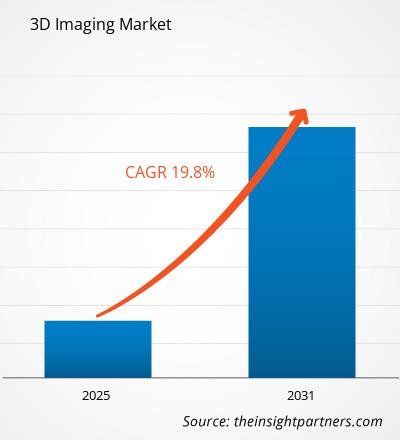
The 3d imaging Market is entering a commercially mature phase as depth-aware visualization, digital reconstruction, and spatial analytics move deeper into industrial operations and clinical workflows. The market is valued at US$ 30.61 Billion in 2025 and is projected to reach US$ 120.91 Billion by 2034, expanding at a CAGR of 16.49% from 2026 to 2034. Adoption is broadening as organizations prioritize precision, simulation, and faster interpretation of complex physical environments.
North America remains a core revenue center for the 3d imaging Market, with an estimated CAGR of 15.2%–15.9% through 2034. Growth is supported by medical imaging modernization, digital construction, defense visualization, and advanced manufacturing inspection. Strong enterprise software integration also helps users connect capture outputs with diagnostics, digital twins, and design-to-production workflows, strengthening regional demand for scalable 3D interpretation.
3D Imaging Market Assessment and Insights
- North America held 36%–39% share in 2025 and is growing at a CAGR of 15.2%–15.9% between 2026 – 2034, supported by healthcare imaging upgrades, reality capture adoption, and advanced defense visualization.
- The US represented 76%–81% of North America in 2025 and is growing at 15.4%–16.1%, led by clinical imaging, software platforms, and industrial inspection.
- Europe accounted for 24%–28% share in 2025 and is growing at 15.6%–16.2%, with Germany, the UK, and France leading engineering, healthcare, and automotive demand.
- Asia Pacific held 27%–32% share in 2025 and is expanding at 17.6%–18.4%, driven by China, Japan, South Korea, India, and Australia across manufacturing and healthcare.
- Largest Segment: Hardware held 45%–49% market share in 2025 and is growing at 14.8%–15.6%, reflecting the essential role of sensors, scanners, cameras, and imaging systems.
- High Growth Segment: Cloud held 23%–27% market share in 2025 and is growing at 18.5%–19.4%, as distributed teams prioritize scalable reconstruction and collaboration.
- Key companies analyzed in detail: Autodesk, Inc.; Dassault Systèmes SE; Esri; FARO Technologies, Inc.; GE HealthCare Technologies Inc.; HP Inc.; Koninklijke Philips N.V.; Panasonic Holdings Corporation; STMicroelectronics N.V.; Trimble Inc.
Source: The Insight Partners' analysis based on proprietary research, government publications, company annual reports, investor presentations, industry databases, and expert interviews.
The 3d imaging market has evolved from specialist visualization into an operational technology spanning industrial inspection, building intelligence, automotive design, surgical planning, and geospatial modeling. Advances in sensors, software processing, and AI-enabled reconstructions are making the 3D data more useful in day-to-day decision-making. Such a change in approach to 3D data will transform the production dynamic to connect capture devices with cloud processing, simulation technology, and enterprise solutions instead of considering 3D data as an end product.
The future demand will be dictated by new geographies, digital infrastructure, clinical modernization, and increased investments in spatial computing. The momentum will pick up in Asia Pacific due to increasing manufacturing automation and access to healthcare services. The Middle East will benefit from imaging technology for its big asset and infrastructure. The importance of traceable documents, patient safety, and accountability in construction will help the industry.
3D Imaging Market Report Scope
| Report Attribute | Details |
|---|---|
| Market size in 2025 | US$ 30.61 Billion |
| Market Size by 2034 | US$ 120.91 Billion |
| Global CAGR (2026 - 2034) | 16.49% |
| Historical Data | 2021-2024 |
| Forecast period | 2026-2034 |
3D Imaging Market Analysis
Demand for 3d imaging is rising because enterprises need dimensional accuracy beyond conventional two-dimensional capture. Healthcare providers use 3D visualization for diagnosis, procedure planning, and image-guided care. Manufacturers apply it to metrology, reverse engineering, and defect detection, while construction teams use reality capture to compare as-built conditions with digital models. The 3d imaging Market size is therefore tied to productivity gains, not only technology replacement.
Value chain components include scanners, cameras, sensors, reconstruction engines, visualization software, cloud, and integration services. The competitive dynamics hinge on the rapidity of turning the acquired data into actionable insights. Autodesk, Inc., Dassault Systèmes SE, Esri, FARO Technologies, Inc., GE HealthCare Technologies Inc., HP Inc., Koninklijke Philips N.V., Panasonic Holdings Corporation, STMicroelectronics N.V., and Trimble Inc. play a role in each of the stages from capturing to simulation and decision-making.
This industry has been segmented into Industrial Imaging, Enterprise Software, Health Care, and Geospatial Intelligence categories. Faro Technologies Inc. and Trimble Inc. are well positioned in reality capture, whereas Autodesk Inc., Dassault Systèmes SE, and Esri dominate in design, simulation, and spatial analysis applications. GE HealthCare Technologies Inc. and Koninklijke Philips N.V. are important market players in the field of clinical application of 3D imaging technologies.
Investment is moving toward platforms that combine hardware precision with recurring software, AI-enabled reconstruction, and cloud-linked collaboration. Strategic positioning increasingly depends on workflow ownership, interoperability, and sector-specific outcomes. Vendors that shorten the interval between capture and decision should gain stronger 3d imaging Market share, especially where users need defensible inspection records, faster clinical interpretation, and reliable digital twin inputs.
● REPORT CUSTOMIZATION
Tailor This Report To Align With Your Specific Business Requirements
This report can be customized to align precisely with your business objectives, scope, and target markets. Customization options include tailored segmentation, geography, competitive analysis, and strategic insights to support informed decision-making.
Customize This Report →WHAT YOU CAN ADJUST
- ● Segmentations
- ● Geography
- ● Competitive Analysis
- ● Language Preferences
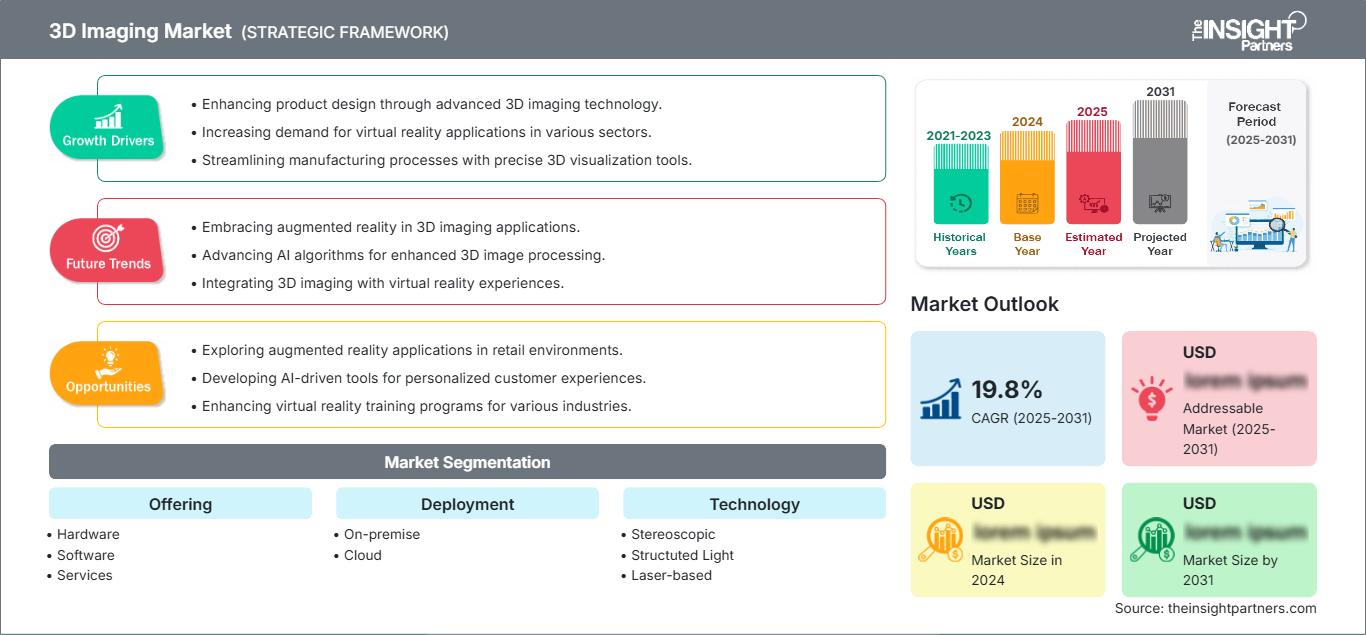
3D Imaging Market: Strategic Insights
Regional Insights
North America 3d imaging Market
North America held 36%–39% share of the 3d imaging Market in 2025 and is projected to grow at 15.2%–15.9%. Demand is supported by strong diagnostic imaging investment, defense visualization, construction reality capture, and factory inspection. The FDA-cleared imaging ecosystem, high hospital technology intensity, and enterprise cloud maturity give the region an advantage in converting 3D data into decisions.
The structural demand gets reinforced through the efforts of software developers, imaging OEMs, and cloud service partners who are involved in the process of capturing, analyzing, and simulating. The dimensional modeling is being used for the aerospace and defense programs for their mission assets, as well as by construction companies to cut down the rework with the help of site scans.
U.S. 3d imaging Market
The U.S. represents roughly 76%–81% of the North American 3d imaging Market and is expected to expand at a CAGR of 15.4%–16.1%. Leadership of the market comes from the concentration of imaging infrastructure within healthcare, visualization needs within defense sector, as well as the advanced design software market. In addition, there is also an improved commercialization process that helps with imaging equipment used in precision medicine, industrial automation, and construction management.
Market presence of companies in the market helps to define the market depth. In particular, Autodesk, Inc., GE Healthcare, Hewlett-Packard Company, ESRI, and Trimble Inc. have high relevance to the industry due to their software solutions for design and imaging informatics and visualization and geospatial platforms. The application demand is most pronounced in hospital imaging, digital construction, manufacturing inspection and vehicle development.
Europe 3d imaging Market
Europe accounts for an estimated 24%–28% share of the global 3d imaging Market and is projected to grow at a CAGR of 15.6%–16.2%. Regional demand is supported by industrial automation, automotive design sophistication, and clinical imaging modernization. Europe also benefits from a strong engineering culture that values metrology, simulation, and digital building processes, all of which raise the practical value of dimensional imaging across enterprise environments.
For the UK, the motivation to adapt stems from the need to improve the quality of the hospitals' imaging systems, digital construction, and geospatial planning technologies. Germany ranks number one amongst all countries in this region due to its background in automotive engineering and the need for inspection, in addition to being industrial in nature. France has taken advantage of its strengths in the healthcare and aerospace industries, which require high-resolution imaging.
Italy and Spain have added value through application of the technology for heritage preservation, construction surveying, and precision manufacturing. Dassault Systèmes adds to software strengths in the region, while healthcare imaging and industrial digitization efforts ensure that demand is not limited to any single vertical. What stands out about Europe’s market is the engineering applications and regulatory environment encouraging traceable digital documentation.
APAC 3d imaging Market
Asia Pacific is the fastest-growing regional 3d imaging Market, with an estimated global share of 27%–32% and a projected CAGR of 17.6%–18.4%. Expansion is being driven by manufacturing scale, healthcare infrastructure upgrades, smart city investments, and policy support for advanced electronics and industrial automation. The region offers a powerful combination of imaging demand and production capability.
The reason why China occupies the position of the leader of the region is explained by the large scale of the country's industry, demands in medical imaging devices, and investments in the development of the digital infrastructure. Japan is still important due to its presence in precision imaging, electronics, and automotive industries. South Korea is extremely relevant in the sphere of sensors, displays, and manufacturing processes.
India and Australia are less significant at the moment, but they still represent the regions that should be considered strategic for the further success of the company. India is becoming more and more important due to the growth of digital healthcare, digital infrastructure, and manufacturing. Australia is growing due to mining and construction surveying activities. The relevance of the companies like Panasonic Corporation and STMicroelectronics is associated with imaging technologies.
Middle East & Africa 3d imaging Market
The Middle East & Africa 3d imaging Market is projected to grow at a CAGR of 14.1%–14.8% from a smaller base, with demand centered on infrastructure, healthcare modernization, and industrial asset management. 3d imaging is particularly relevant where large projects, complex facilities, or difficult operating environments require more accurate visualization than traditional documentation methods can provide.
Leadership in the regional market is attributed to Saudi Arabia because of the presence of many development programs, diversified industries, and increased demand for technologies and tools related to digital planning in such sectors as energy, construction, and infrastructure. Another country with promising trends in this region is the UAE, which boasts smart city programs, advanced healthcare systems, and increasing use of geospatial and built environment technologies to better manage its projects.
In South Africa, as well as the rest of MEA, there are limited opportunities linked to mining, utilities, medical diagnostics, and infrastructure inspection. The use of 3D scanning can be justified by the presence of energy facilities, transport infrastructure, and large construction projects in the country. Growth will rely on cooperation with vendors and training of specialists.
Segmentation Analysis
Offering
The Offering segment is projected to grow at a CAGR of 15.7%–16.5% during 2026–2034 as buyers combine capture devices, visualization platforms, and implementation support into complete workflows. Hardware remains essential for acquisition accuracy, while software and services increasingly determine how quickly imaging outputs become actionable across healthcare, manufacturing, construction, and geospatial operations.
- Hardware remains the largest offering because scanners, sensors, cameras, and imaging systems are essential for accurate depth capture. Demand is strongest where precision, speed, and durability directly affect clinical, industrial, or site-level outcomes.
- Software is becoming more strategic as customers seek reconstruction, segmentation, simulation, and analytics tools that convert raw 3D data into decisions. Interoperability and automation strengthen long-term return on imaging investment.
- Services support deployment, calibration, workflow integration, training, and managed imaging operations. They are important where customers need specialist support to connect 3D outputs with design, diagnostic, or inspection processes.
Deployment
The Deployment segment is expected to grow at a CAGR of 16.6%–17.4% from 2026 to 2034 as organizations balance data control with scalable processing. On-premise models remain relevant for secure and latency-sensitive applications, while cloud adoption is accelerating where distributed teams need shared access, centralized storage, and collaborative visualization.
- On-premise deployment remains important where organizations require low-latency processing, tighter control of sensitive imaging data, or integration with internal engineering and clinical systems in regulated environments.
- Cloud deployment is gaining traction as customers seek scalable reconstruction, collaboration, storage, and remote access. It is attractive for construction, geospatial, and enterprise imaging workflows requiring centralized access.
Technology
The Technology segment is forecast to grow at a CAGR of 16.0%–16.8% during 2026–2034 as users choose imaging methods based on accuracy, range, speed, and operating environment. Stereoscopic systems support visualization and perception, structured light enables precise close-range capture, and laser-based technologies strengthen industrial, construction, and geospatial measurement use cases.
- Stereoscopic technology is used where depth perception and real-time visualization support inspection, navigation, training, and immersive viewing. Its strategic value rises when paired with software that improves interpretation.
- Structuted Light technology supports close-range measurement, product inspection, medical modeling, and object reconstruction. It is valued where high surface detail and repeatable accuracy are more important than long-distance capture.
- Laser-based technology remains critical in construction, geospatial mapping, industrial metrology, and asset documentation. Its demand pattern reflects the need for precise distance measurement across complex physical environments.
End User
The End User segment is projected to grow at a CAGR of 16.2%–17.0% from 2026 to 2034 as 3D imaging becomes embedded in operational decisions rather than isolated visualization tasks. Healthcare, manufacturing, automotive, construction, and aerospace users are adopting the technology to improve planning accuracy, inspection confidence, workflow speed, and lifecycle documentation.
- Aerospace and Defense users apply 3D imaging to mission assets, component validation, simulation, and maintenance documentation. Demand is strongest where dimensional accuracy supports safety, readiness, and design assurance.
- Automotive adoption is shaped by design validation, prototyping, quality inspection, and advanced driver-assistance development. 3D imaging helps teams shorten iteration cycles and validate complex geometries more efficiently.
- Manfacturing users rely on 3D imaging for metrology, reverse engineering, defect detection, and process control. Its strategic importance increases as factories pursue automation and traceable quality documentation.
- Architecture and Construction teams use 3D imaging for site capture, as-built verification, progress tracking, and digital twin inputs. Adoption rises where rework reduction and remote coordination are priorities.
- Healthcare remains a high-value end user because 3D imaging supports diagnosis, surgical planning, image guidance, and patient-specific visualization. Hospitals value tools that improve interpretation and procedural confidence.
Opportunity Snapshot
| End User | Revenue Contribution | Trend Tag | Adoption Stage |
| Aerospace and Defense | Medium | Mission Simulation | Scaling |
| Automotive | High | ADAS Validation | Mature |
| Manfacturing | High | Quality Metrology | Mature |
| Architecture and Construction | High | Reality Capture | Scaling |
| Healthcare | High | Image Guidance | Mature |
| Others | Low | Spatial Analytics | Emerging |
3D Imaging Market Growth Drivers and Impact Analysis
Rising need for precision visualization in healthcare and surgery
A major driver of the 3d imaging market report is the increasing clinical requirement for more precise anatomical visualization across diagnosis, therapy planning, and intervention support. Three-dimensional imaging improves spatial understanding in cardiology, oncology, orthopedics, neurology, and minimally invasive procedures, where clinicians need to interpret relationships between tissues, vessels, and instruments more clearly than conventional two-dimensional formats allow. The technology is also valuable in education, preoperative simulation, and patient communication, which broadens its institutional relevance beyond the radiology department alone.
Its real-world impact is significant because improved 3D visualization can help reduce procedural uncertainty, shorten planning time, and support more confident clinical decisions in complex cases. Companies such as GE Healthcare and Koninklijke Philips N.V. are well positioned where imaging performance, workflow integration, and AI-enhanced interpretation converge. As providers face rising imaging volumes and stronger pressure to improve outcomes, 3d imaging becomes not only a diagnostic enhancement but also an operational tool that supports precision care, efficiency, and technology differentiation across healthcare systems.
Industrial digitization and demand for accurate reality capture
Users in industrial and built environments are increasingly adopting 3d imaging technology for generating accurate digital representations of assets, products, and sites of work. This trend is emerging due to the necessity to minimize reworks, early design validation, and keeping up-to-date with physical conditions. The use of 3d imaging in manufacturing allows improving metrology, reverse engineering, and defect analysis. In construction and architecture, it enables scanning, documentation, and alignment of site conditions with digital models. In aerospace and defense, 3d imaging makes it possible to assess complex geometries and mission critical assets.
The impact of this trend is broad because reality capture turns 3d imaging technology from a measurement process into an enabler of digital twin creation, lifecycle management, and remote collaboration. FARO Technologies, Inc., Autodesk, Inc., ESRI, and Trimble Inc. benefit as the companies involved in capturing, processing, and connecting the data obtained with the help of imaging with planning or operation platforms. As companies start to prioritize traceability of physical intelligence, more money is spent on making spatial information more convenient to capture and utilize.
Advances in sensors, AI reconstruction, and scalable processing
It is also getting a boost from the advancements in sensing components, processing technologies and even the deployment models which help in making 3D imaging quicker, smaller and more cost-effective than before. Time-of-flight sensing capabilities, laser scanning performance, structured light accuracy and the AI-enabled image reconstruction technology have made it much simpler to remove the hurdles which were hindering its adoption till now. This is helped by cloud computing which allows centralization of processing, collaboration and upgrades in software, particularly useful for multi-location companies looking at scalable imaging solutions.
It has an impact on the market since it helps to increase the returns of the investment made by companies and institutions in imaging systems. STMicroelectronics impacts the sensing aspect of imaging by improving time-of-flight sensors while the software-focused firms add value to the system by means of automation and process optimization. With the simplification in usage and interpretation of the technology, the usage of 3D imaging systems goes beyond the specialized users to operators, doctors, engineers and managers.
3D Imaging Market Future Trends
Cloud-native 3d imaging ecosystems will become standard
A defining 3d imaging market trend is the shift from stand-alone image generation toward cloud-native ecosystems that manage capture, reconstruction, annotation, simulation, and collaboration in a connected environment. Customers increasingly want 3d imaging outputs to move directly into enterprise workflows rather than remain trapped in separate devices or local workstations. This is especially relevant in construction, geospatial operations, and healthcare networks where multiple users need synchronized access to current spatial or clinical information.
Forward-looking implications are substantial because cloud-native delivery changes both customer expectations and vendor economics. It supports recurring revenue, remote collaboration, faster updates, and smoother integration with AI services and digital twin applications. GE HealthCare’s move to acquire Intelerad underscores how cloud-enabled enterprise imaging is becoming strategically important for scalable imaging workflows. In industrial contexts, similar logic is shaping demand for platforms that can unify field capture and office-based decision-making rather than simply store three-dimensional files.
AI-guided reconstruction and interpretation will redefine usability
Another major trend is the increasing use of AI to improve the usability of 3d imaging across acquisition, reconstruction, segmentation, registration, and interpretation. As data volumes grow, organizations are no longer satisfied with raw dimensional accuracy alone; they want automated insight that reduces expert workload and shortens the path to action. AI helps remove noise, accelerate reconstruction, identify anomalies, align imagery with plans, and support more intuitive visualization, making 3d imaging practical for broader groups of users.
This trend points toward a market where competitive strength depends as much on interpretation intelligence as on image quality. Philips highlighted intelligent 3d imaging for stroke care in Europe in 2025, while Dassault Systèmes and Esri are advancing AI-linked 3D environments in virtual and reality mapping contexts. Over time, AI-enabled simplification will help 3d imaging move from expert-dependent workflows to more mainstream enterprise adoption.
3D Imaging Market Opportunities
Workflow-specific platforms for construction and infrastructure teams
A major opportunity in the 3d imaging Market lies in delivering workflow-specific platforms for construction, infrastructure, and asset-intensive industries that need more than generic scanning tools. These customers increasingly want 3d imaging systems that integrate directly with project management, digital twin, BIM, and maintenance environments. The opportunity is strongest where imagery can improve coordination, create a verifiable site record, and reduce costly field errors. As-built comparison, remote walkthroughs, and progress tracking are particularly attractive use cases because they tie imaging to measurable operational outcomes.
From an action perspective, vendors should invest in tighter workflow alignment rather than only higher scan specifications. Trimble launched ProjectSight 360 Capture in 2025 to bring AI-powered 3D visualization directly into project management workflows, and FARO Technologies introduced Blink to simplify 3D reality capture for construction and geospatial users. These developments indicate that buyers increasingly reward solutions that reduce adoption friction and connect image data to day-to-day operational decisions.
Advanced 3d imaging in minimally invasive and precision care pathways
Healthcare offers a high-value opportunity as providers seek better intraoperative guidance, improved structural visualization, and more efficient image-enabled care pathways. Three-dimensional imaging is increasingly relevant in neurovascular procedures, cardiac interventions, therapy planning, and advanced diagnostic imaging where spatial interpretation directly influences clinical decisions. The opportunity is especially attractive because these use cases reward clinical utility and workflow improvement rather than pure hardware commoditization, allowing vendors to defend value through software, integration, and procedural intelligence.
For investors and suppliers, the most effective path is to target solutions embedded in precision care pathways instead of broad imaging claims. Philips expanded real-time 3D intracardiac imaging in Europe in 2025, and GE HealthCare showcased a broad wave of AI- and cloud-enabled imaging innovations at RSNA 2025. These moves highlight how clinical demand is shifting toward integrated imaging environments that support better visualization, procedural confidence, and more efficient care delivery rather than isolated modality upgrades.
Recent Developments
- April, 2025: FARO Technologies, Inc. launched Blink, a software-driven 3D reality capture solution designed to simplify data acquisition and automated insight generation for construction, real estate, and geospatial users. The launch is relevant to the market because it reflects a shift toward easier, workflow-ready capture systems that lower adoption barriers and expand the addressable user base beyond specialist scanning professionals.
- June, 2025: Philips announced CE-marking of its latest SmartCT release for intelligent 3d imaging in Europe, designed to support faster stroke care by bringing advanced three-dimensional imaging directly into the angio suite. The development signals how 3d imaging innovation is increasingly focused on time-critical clinical workflows where image access, procedure speed, and decision confidence influence both patient outcomes and hospital efficiency.
- November, 2025: Trimble introduced ProjectSight 360 Capture, adding AI-powered 3D viewer capabilities and native 360-degree capture integration to strengthen progress-to-plan tracking for construction teams. This development is important to the market because it shows how imaging value is increasingly tied to project coordination, cloud collaboration, and operational decision-making rather than image generation alone.
Frequently Asked Questions

- Comprehensive Market Sizing and Forecast Analysis
- Detailed Segmentation Analysis
- In-Depth Market Dynamics Assessment
- Regional and Country-Level Insights
- Competitive Landscape and Company Benchmarking
- Strategic Business Intelligence
Recent Reports
Testimonials

The Insight Partners' SCADA System Market report is comprehensive, with valuable insights on current trends and future forecasts. The team was highly professional, responsive, and supportive throughout. We are very satisfied and highly recommend their services.
RAN KEDEM Partner, Reali Technologies LTDs
I requested a report on a very specific software market and the team produced the report in a few days. The information was very relevant and well presented. I then requested some changes and additions to the report. The team was again very responsive and I got the final report in less than a week.
JEAN-HERVE JENN Chairman, Future Analytica
We worked with The Insight Partners for an important market study and forecast. They gave us clear insights into opportunities and risks, which helped shape our plans. Their research was easy to use and based on solid data. It helped us make smart, confident decisions. We highly recommend them.
PIYUSH NAGPAL Sr. Vice President, High Beam Global
The Insight Partners delivered insightful, well-structured market research with strong domain expertise. Their team was professional and responsive throughout. The user-friendly website made accessing industry reports seamless. We highly recommend them for reliable, high-quality research services
YUKIHIKO ADACHI CEO, Deep Blue, LLC.
This is the first time I have purchased a market report from The Insight Partners.While I was unsure at first, I visited their web site and felt more comfortable to take the risk and purchase a market report.I am completely satisfied with the quality of the report and customer service. I had several questions and comments with the initial report, but after a couple of dialogs over email with their analyst I believe I have a report that I can use as input to our strategic planning process.Thank you so much for taking the extra time and making this a positive experience.I will definitely recommend your service to others and you will be my first call when we need further market data.
JOHN SUZUKI President and Chief Executive Officer, Board Director, BK Technologies
I wish to appreciate your support and the professionalism you displayed in the course of attending to my request for information regarding to infectious disease IVD market in Nigeria. I appreciate your patience, your guidance, and the fact that you were willing to offer a discount, which eventually made it possible for us to close a deal. I look forward to engaging The Insight Partners in the future, all thanks to the impression you have created in me as a result of this first encounter.
DR CHIJIOKE ONYIA MANAGING DIRECTOR, PineCrest Healthcare Ltd.Reason to Buy
- Informed Decision-Making
- Understanding Market Dynamics
- Competitive Analysis
- Identifying Emerging Markets
- Customer Insights
- Market Forecasts
- Risk Mitigation
- Boosting Operational Efficiency
- Strategic Planning
- Investment Justification
- Tracking Industry Innovations
- Aligning with Regulatory Trends





 Get Free Sample for