
3D Motion Capture System Market Growth, Trends & Demand by 2034
3D Motion Capture System Market Size and Forecasts (2020 - 2034), Global and Regional Share, Trends, and Growth Opportunity Analysis by Component (Hardware, Software, Services); by Type (Optical, Non-optical); by End User (Biomechanical Research and Medical, Media and Entertainment, Engineering and Industrial, Education, Others), and by Geography (North America, Europe, Asia Pacific, and South and Central America)
- Status : Data Released
- Report Code : TIPTE100000787
- Category : Electronics and Semiconductor
- No. of Pages : 150
- Available Report Formats :


- Last update date : July 13, 2026


2025 Market Size
US$ 290.22 Mn
Base year value
2034 Forecast
US$ 983.77 Mn
Projected by 2034
CAGR 2026-2034
14.53 %
Growth rate
Addressable Market
US$ 5,468.69 Mn
(2026-2034)
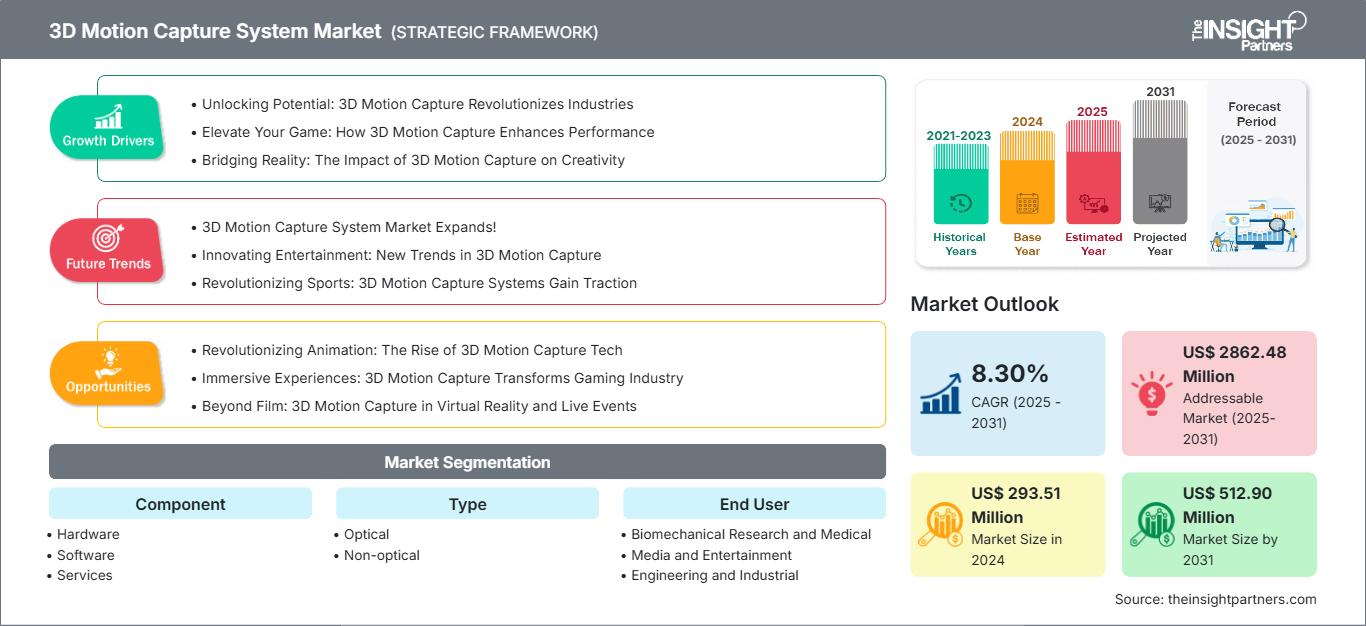
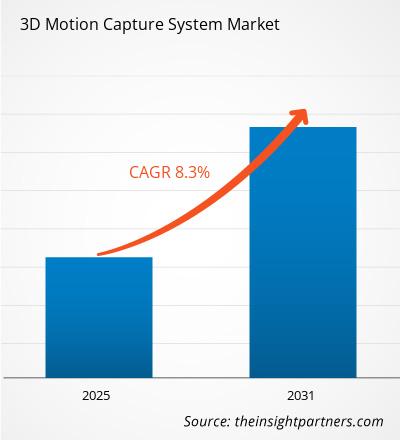
The 3D motion capture system market is valued at US$ 290.22 billion in 2025 and is projected to reach US$ 983.77 billion by 2034, registering a CAGR of 14.53% from 2026 to 2034. The market is expanding across healthcare, media production, industrial engineering, and education as organizations require precise movement data for performance, safety, simulation, and digital content workflows.
North America remains a mature demand center, expanding at an estimated 13.6%–14.2% CAGR as clinical biomechanics laboratories, entertainment studios, defense training centers, and sports science programs increase investment in real-time capture. Structural growth is supported by hospital-based gait assessment, university research funding, virtual production adoption, and vendor service networks that reduce installation, calibration, and workflow-integration barriers.
3D Motion Capture System Market Assessment and Insights
- North America: Share in 2025 is 34%–38%, growing at a 13.6%–14.2% CAGR between 2026–2034 as biomechanics, sports science, virtual production, and industrial human-factors programs sustain premium system adoption.
- US: Share in 2025 is 78%–83% of North America, growing at a 13.8%–14.5% CAGR between 2026–2034, led by studios, research hospitals, and sports laboratories.
- Europe: Share in 2025 is 25%–29%, growing at a 13.9%–14.6% CAGR between 2026–2034; the UK leads, followed by Germany, France, Italy, and Spain.
- Asia Pacific: Share in 2025 is 24%–30%, growing at a 15.8%–16.7% CAGR between 2026–2034; China leads, supported by Japan, South Korea, India, and Australia.
- Largest Segment: Hardware holds 48%–53% market share in 2025 and grows at a 13.8%–14.4% CAGR between 2026–2034 because cameras, sensors, suits, and calibration tools remain core purchases.
- High Growth Segment: Software holds 27%–32% of the 3D motion capture system market share in 2025 and grows at a 16.1%–17.0% CAGR between 2026–2034 as analytics, reporting, retargeting, and AI-assisted processing gain importance.
- Key companies analyzed in detail: AIQ-Synertial Ltd.; Codamotion; mCube Hong Kong Limited; Motion Analysis Corporation; Noraxon U.S.A., Inc.; Northern Digital Inc.; Oxford Metrics plc; PhaseSpace, Inc.; Phoenix Technologies Inc.; Qualisys AB.
Source: The Insight Partners' analysis based on proprietary research, government publications, company annual reports, investor presentations, industry databases, and expert interviews.
The 3D motion capture system market report has moved from specialist studio and laboratory installations toward broader movement-intelligence platforms. Optical systems remain important for validated accuracy, but inertial, wearable, and markerless approaches are improving access where portability and speed matter. Production dynamics are also changing as buyers evaluate complete workflows, including cameras, sensors, software, protocol support, calibration, and integration with force plates, game engines, robotics tools, or clinical reporting systems.
Forward demand will be shaped by emerging geographies, healthcare modernization, virtual production investment, and industrial automation programs. The 3D motion capture system Market growth profile is strongest where motion data improves measurable decisions, such as rehabilitation progress, ergonomic risk reduction, athlete return-to-play assessment, and digital character realism. Regulatory emphasis on safety, clinical evidence, and training quality will further support adoption in professional environments.
3D Motion Capture System Market Report Scope
| Report Attribute | Details |
|---|---|
| Market size in 2025 | US$ 290.22 Million |
| Market Size by 2034 | US$ 983.77 Million |
| Global CAGR (2026 - 2034) | 14.53% |
| Historical Data | 2021-2024 |
| Forecast period | 2026-2034 |
3D Motion Capture System Market Analysis
Demand in the 3D motion capture system market is driven by the need to convert movement into reliable, repeatable, and interpretable data. Clinical teams use systems for gait analysis, rehabilitation, orthopedics, and neurology, while media users rely on motion capture for animation and virtual production. Engineering users apply movement data to robotics validation, ergonomics, product testing, and human-machine interaction design.
The value chain includes optical cameras, inertial measurement units, suits, markers, calibration devices, software platforms, analytics modules, integration services, and training support. Supply dynamics favor vendors that reduce setup time and improve interoperability. The 3D motion capture system scope is widening because customers increasingly seek end-to-end workflows rather than isolated hardware purchases.
The competitive landscape is fragmented by application depth. Oxford Metrics plc, Qualisys AB, Motion Analysis Corporation, PhaseSpace, Inc., and Northern Digital Inc. are associated with high-precision optical environments, while AIQ-Synertial Ltd. and Noraxon U.S.A., Inc. support wearable and biomechanics-oriented workflows. Codamotion, Phoenix Technologies Inc., and mCube Hong Kong Limited contribute to specialized tracking and sensor-enabled use cases.
Investment is shifting toward markerless capture, hybrid optical-inertial systems, automated reporting, and cloud-enabled collaboration. Strategic positioning increasingly depends on software usability and service capability because buyers want shorter calibration, fewer operator dependencies, and validated outputs. The 3D motion capture system analysis indicates that recurring software and analytics revenue will become more influential as installations scale across departments.
● REPORT CUSTOMIZATION
Tailor This Report To Align With Your Specific Business Requirements
This report can be customized to align precisely with your business objectives, scope, and target markets. Customization options include tailored segmentation, geography, competitive analysis, and strategic insights to support informed decision-making.
Customize This Report →WHAT YOU CAN ADJUST
- ● Segmentations
- ● Geography
- ● Competitive Analysis
- ● Language Preferences
3D Motion Capture System Market: Strategic Insights
Regional Insights
North America 3D motion capture system Market
North America accounts for 34%–38% share in 2025 and is projected to expand at a 13.6%–14.2% CAGR. The region benefits from mature gait laboratories, sports performance centers, academic biomechanics programs, and entertainment production infrastructure. Demand is strongest where movement data directly supports clinical decisions, athlete monitoring, digital character creation, or ergonomic validation.
Regionally, adoption will be driven by the presence of reliable vendors, prompt technical support, and budget-conscious customers for expensive optical systems. The 3D motion capture system market share in North America has proven robust, driven by the growing integration of capture systems, force plates, and virtual production engines.
U.S. 3D motion capture system Market
The U.S. represents 78%–83% of the North America 3D motion capture system market size in 2025 and grows at a 13.8%–14.5% CAGR. Adoption is led by film studios, gaming pipelines, rehabilitation networks, collegiate sports science facilities, defense training programs, and medical research hospitals. Application trends favor real-time visualization, markerless previsualization, IMU-based mobility assessment, and validated gait analytics.
Motion Analysis Corporation, Noraxon U.S.A., Inc., PhaseSpace, Inc., Northern Digital Inc., and Oxford Metrics plc enhance the local environment by providing products and process know-how. The United States' buyers generally emphasize precision, compatibility, software, and scalability, and thus are a standard by which other markets judge high-end optical solutions and distributed non-optical setups.
Europe 3D motion capture system Market
Europe holds 25% to 29% market share and records growth at a 13.9% to 14.6% CAGR. The UK dominates due to Oxford Metrics plc, Vicon-linked creative workflows, university biomechanics labs, and game production centers. The demand is supported by clinical gait analysis, sports science, animation, and research projects needing reproducible movement analysis.
Germany has its own strengths in automotive engineering, robotics verification, industrial ergonomics, and human factors testing. Customers frequently value long-lasting systems, control procedures, and engineering integration with software. Germany’s industries require motion capture solutions to optimize work environments and verify the automation of people-related processes.
The third group includes European countries such as France, Italy, and Spain, which host rehabilitation centers, research institutions, educational institutions, and digital content production studios. France has a more active application in medicine and creative industries; Italy has an active presence in biomechanics and industrial design, and Spain has an active presence in sports science and training applications.
APAC 3D motion capture system Market
APAC holds a 24%–30% share of the 3D motion capture system market in 2025 and is growing at a 15.8%–16.7% CAGR, making it the fastest-growing region. China leads in animation production, rehabilitation expansion, sports technology, robotics, and manufacturing modernization. Policy support for smart healthcare and digital manufacturing strengthens trends in 3D motion capture systems among institutional and commercial buyers.
Japan and South Korea continue to be significant players in robotics, gaming, virtual production, and precision engineering. India and Australia are developing via education, clinical rehabilitation, sports performance, and mining or industrial ergonomics. Buyers in the regions like systems that offer a balance between accuracy, cost-effectiveness, portability, and ease of use for new users.
Middle East & Africa 3D motion capture system Market
Middle East & Africa 3D motion capture system market expands at a 12.7%–13.5% CAGR from a smaller installed base. Saudi Arabia leads through sports infrastructure, entertainment investment, healthcare modernization, and industrial diversification. The UAE adds demand from media hubs, immersive experiences, premium clinics, and simulation-led training environments.
Use cases in the energy and infrastructure sectors include ergonomics, worker safety, and training. The case studies for South Africa and the MEA regions are seen in academia, physical therapy, ergonomics in mining, and athletic performance. The development is possible with modular pricing, technical support, and out-of-the-lab-room operation systems.
Segmentation Analysis
Component
Component grows at a 14.0%–14.8% CAGR as buyers combine capture hardware, application software, and service support into integrated deployments. Hardware remains the largest revenue contributor, while software improves workflow value through analytics, visualization, and reporting. Services are strategically important for installation, calibration, validation, and training in clinical, creative, and industrial environments.
- Hardware: Cameras, sensors, markers, suits, and calibration equipment form the core revenue base because capture quality, frame rate, latency, and durability directly influence system selection across laboratories, studios, and industrial sites.
- Software: Software is gaining strategic importance as users need reconstruction, visualization, biomechanical modeling, retargeting, reporting, and real-time feedback tools that convert raw movement data into usable clinical, creative, or engineering outputs.
- Services: Services support installation, calibration, protocol design, training, maintenance, and workflow integration, especially for customers entering motion capture for the first time or scaling systems across multiple departments.
Type
Type grows at a 14.2%–15.1% CAGR as optical and non-optical solutions address different operating needs. Optical systems dominate controlled environments requiring high spatial accuracy, while non-optical systems expand in field, sports, mobile rehabilitation, and ergonomics applications. Hybrid deployment is becoming more common when users need precision and portability.
- Optical: Optical systems remain preferred for high-precision tracking in studios, gait labs, engineering validation, and research environments where spatial accuracy, multi-camera coverage, and validated marker workflows justify higher setup complexity.
- Non-optical: Non-optical systems, including inertial and wearable formats, are expanding where mobility, rapid setup, field deployment, and continuous movement monitoring matter more than fixed-lab capture conditions.
End User
End User grows at a 14.5%–15.4% CAGR as demand broadens beyond entertainment into clinical biomechanics, engineering validation, and education. Medical and research users value objective movement evidence, media teams need faster digital performance capture, industrial buyers seek ergonomic insight, and universities use systems to train future clinicians, animators, and engineers.
- Biomechanical Research and Medical: This segment uses motion capture for gait analysis, rehabilitation, orthopedics, neurology, sports medicine, and clinical research where repeatable movement data supports diagnosis, treatment planning, and recovery monitoring.
- Media and Entertainment: Studios and creators rely on motion capture for animation, virtual production, gaming, immersive content, and previsualization, with markerless workflows improving speed during early creative iteration.
- Engineering and Industrial: Engineering users apply motion capture to ergonomics, robotics validation, product testing, human factors analysis, and worker safety programs where movement data improves design, efficiency, and risk control.
- Education: Universities and training institutions adopt systems for biomechanics teaching, animation programs, engineering labs, and sports science education, often prioritizing flexible setups and software that supports learning outcomes.
Opportunity Snapshot
| End User | Revenue Contribution | Trend Tag | Adoption Stage |
| Biomechanical Research and Medical | High | Gait analytics | Mature |
| Media and Entertainment | High | Virtual production | Scaling |
| Engineering and Industrial | Medium | Ergonomic validation | Scaling |
| Education | Low | Lab training | Emerging |
3D Motion Capture System Market Growth Drivers and Impact Analysis
Rising clinical demand for objective movement assessment
There is an increasing demand for clinical proof regarding gait analysis, postural analysis, joint kinematics, and progress towards recovery. This driver is evident in the 3D Motion Capture System Market, as hospitals, rehabilitation clinics, sports medicine departments, and universities require standard procedures rather than simple observations. The effect of this market driver includes increased demand for systems that utilize sensors and synchronized video, as well as force measurements and reports. Vendors whose technology reduces the complexity of calibration and explains kinematics in the clinicians' vocabulary can address both major laboratories and smaller facilities. There is additional demand for programs for aging patients, neurorehabilitation, orthopedics, and injury prevention for athletes.
Entertainment pipelines shifting toward faster digital performance capture
Motion capture technology is becoming more popular among media and entertainment consumers because it reduces the time between human movement and computer animation. The market effect is evident in virtual production, game creation, episodic video, immersive entertainment, and previs processes, all of which require rapid iteration. Markerless and hybrid technologies reduce the setup effort during the creative process, while optical technologies remain critical for high-fidelity capture. This trend expands the addressable market from big studios to medium-sized companies, colleges, and location-based entertainment organizations. Now, consumers consider the accuracy of capturing data, cleaning, and retargeting speed.
Industrial ergonomics and robotics validation expanding use cases
Adoption in industry and engineering is increasing as motion capture is used to validate robotics, evaluate human-machine interface performance, optimize ergonomics, and reduce workplace hazards. The impact on the market is a shift from research-only applications to operational applications in factory environments, warehouses, vehicle testing facilities, logistics, and infrastructure. Movement data provides insights into repetitive stress, incorrect postures, workflow inefficiencies, and limitations in product design. Non-optical technologies are useful for field deployments, whereas optical technologies are useful for validation in controlled environments.
3D Motion Capture System Market Future Trends
Markerless capture will reshape early-stage workflow economics
The 3D motion capture system market trends will be impacted by markerless motion capture technology, which reduces setup time and enables quick screening, rehearsal, and engagement in the initial stages of creative processes. However, it will not replace high-precision optical systems, as the latter are required wherever established accuracy is required. The competition in the future will rely on transparency about accuracy, ease of calibration, and ease of transmitting movement data to animation, biomechanics, and simulation software. Hybrid environments are likely to become a movement, data-driven operating model.
Motion data platforms will move toward integrated analytics
Motion capture systems are shifting from simple coordinate data to comprehensive analysis, providing role-oriented solutions. Clinicians require measurements of asymmetries, engineers need ergonomic metrics, and artists require rapid re-targeting of the motion. In the future, this development will make software tools more valuable for automating post-processing, cleaning up manually, and providing output that can be easily analyzed or visualized. Future leadership in the market will be driven by workflow solutions tailored to each domain, rather than by sensor capabilities alone. Software modules, cloud computing, and analytics services will contribute a larger share to vendors' business models.
3D Motion Capture System Market Opportunities
Scalable biomechanics solutions for clinics and sports programs
One of the main opportunities would be to create packages to offer biomechanical services to clinics, sports clubs, and universities that require objective information about their patients' movements without high-end lab equipment. It may be possible to attract vendors to develop products that leverage modular equipment, guided assessments, calibration, and reporting to translate kinematics into actionable insights. According to the 3D motion capture system market forecast, the best option to invest in is a product with a predefined workflow that includes gait screening, return-to-sport testing, fall risk assessment, running, and mobility assessment. This is the best option for the companies that would provide equipment, training, and protocol templates.
Hybrid capture for virtual production and industrial simulation
Hybrid capture offers catering to the needs of customers in virtual production and industrial simulation who require precision, mobility, and a single ecosystem. Studios could leverage markerless capture for previsualization, inertial capture for flexible motion capture, and optical capture for high-quality performance capture. In the industrial sector, the same could be leveraged in robotics testing, ergonomics, training simulations, and digital twins. The focus should lie on synchronization, automation of data cleanup, and integration with visualization engines. The best business case would involve selling interoperable capture ecosystems rather than individual pieces of hardware.
Recent Developments
- December 2025: Noraxon U.S.A., Inc. — The company summarized MR4’s 2025 software evolution, including virtual calibration adjustment, intelligent drift stabilization, linear motion analysis, one-to-three sensor mobility assessments, Unity streaming, and MANUS glove integration. The update highlights how inertial motion capture platforms are moving toward higher-confidence analysis and broader clinical, sports, and simulation workflows.
- May 2025: Qualisys, a company based in Gothenburg, has secured an order from CERN for the delivery of a high-precision motion capture system, designed for tracking autonomous robots in radiation environments. The order includes 16 motion capture cameras capable of tracking both position and orientation with high accuracy.
- March 2025: Vicon Markerless, developed by Oxford Metrics plc, launched publicly at the Game Developers Conference (GDC) and achieved general availability on March 19, 2025. The platform equips VFX and previsualization studios to capture human performances seamlessly without bulky suits or physical markers.
Frequently Asked Questions

- Comprehensive Market Sizing and Forecast Analysis
- Detailed Segmentation Analysis
- In-Depth Market Dynamics Assessment
- Regional and Country-Level Insights
- Competitive Landscape and Company Benchmarking
- Strategic Business Intelligence
Recent Reports
Testimonials

The Insight Partners' SCADA System Market report is comprehensive, with valuable insights on current trends and future forecasts. The team was highly professional, responsive, and supportive throughout. We are very satisfied and highly recommend their services.
RAN KEDEM Partner, Reali Technologies LTDs
I requested a report on a very specific software market and the team produced the report in a few days. The information was very relevant and well presented. I then requested some changes and additions to the report. The team was again very responsive and I got the final report in less than a week.
JEAN-HERVE JENN Chairman, Future Analytica
We worked with The Insight Partners for an important market study and forecast. They gave us clear insights into opportunities and risks, which helped shape our plans. Their research was easy to use and based on solid data. It helped us make smart, confident decisions. We highly recommend them.
PIYUSH NAGPAL Sr. Vice President, High Beam Global
The Insight Partners delivered insightful, well-structured market research with strong domain expertise. Their team was professional and responsive throughout. The user-friendly website made accessing industry reports seamless. We highly recommend them for reliable, high-quality research services
YUKIHIKO ADACHI CEO, Deep Blue, LLC.
This is the first time I have purchased a market report from The Insight Partners.While I was unsure at first, I visited their web site and felt more comfortable to take the risk and purchase a market report.I am completely satisfied with the quality of the report and customer service. I had several questions and comments with the initial report, but after a couple of dialogs over email with their analyst I believe I have a report that I can use as input to our strategic planning process.Thank you so much for taking the extra time and making this a positive experience.I will definitely recommend your service to others and you will be my first call when we need further market data.
JOHN SUZUKI President and Chief Executive Officer, Board Director, BK Technologies
I wish to appreciate your support and the professionalism you displayed in the course of attending to my request for information regarding to infectious disease IVD market in Nigeria. I appreciate your patience, your guidance, and the fact that you were willing to offer a discount, which eventually made it possible for us to close a deal. I look forward to engaging The Insight Partners in the future, all thanks to the impression you have created in me as a result of this first encounter.
DR CHIJIOKE ONYIA MANAGING DIRECTOR, PineCrest Healthcare Ltd.Reason to Buy
- Informed Decision-Making
- Understanding Market Dynamics
- Competitive Analysis
- Identifying Emerging Markets
- Customer Insights
- Market Forecasts
- Risk Mitigation
- Boosting Operational Efficiency
- Strategic Planning
- Investment Justification
- Tracking Industry Innovations
- Aligning with Regulatory Trends





 Get Free Sample for