
3D Printer Market Size, Share & Forecast by 2034
Coverage: By Technology (Stereo-Lithography, Digital Light Processing, Fused Deposition Modelling, Selective Laser Sintering, Selective Laser Melting, Electron Beam Melting, Binder Jetting, Material Jetting/Wax Casting, Laminated Object Manufacturing); Application (Manufacturing, Medical, Defense, Education and Research, Others) , and Geography (North America, Europe, Asia Pacific, and South and Central America)
- Status : Data Released
- Report Code : TIPTE100000618
- Category : Electronics and Semiconductor
- No. of Pages : 150
- Available Report Formats :


- Last update date : July 16, 2026


2025 Market Size
US$ 18.92 Bn
Base year value
2034 Forecast
US$ 68.22 Bn
Projected by 2034
CAGR 2026-2034
15.32 %
Growth rate
Addressable Market
US$ 371.28 Bn
(2026-2034)
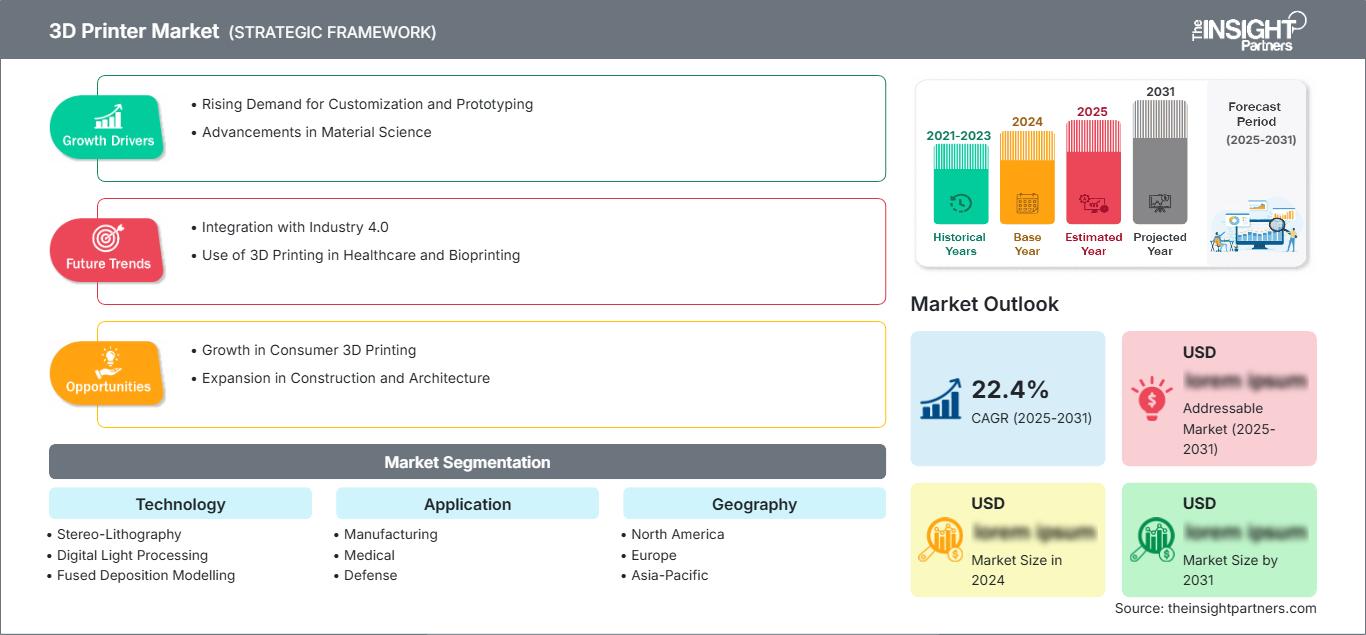
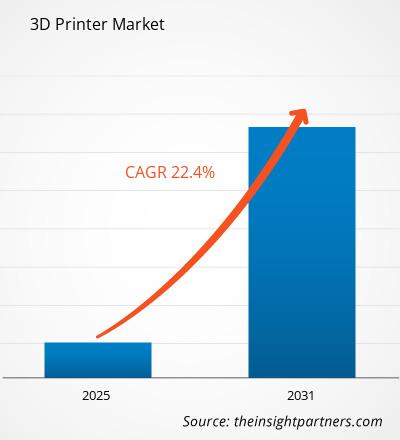
The 3D Printer Market is expected to reach US$ 68.22 Billion by 2034 from US$ 18.92 Billion in 2025, registering a CAGR of 15.32% during 2026–2034. The market reflects rising adoption of additive manufacturing platforms across industrial production, medical modeling, defense supply chains, education, and research environments as organizations move from prototyping toward validated, application-specific part production.
North America market is projected to expand at a CAGR of 13–15% during the forecast period, supported by aerospace qualification programs, healthcare customization, and reshoring of critical manufacturing. Regional demand is reinforced by industrial users adopting certified materials, service bureaus scaling production workflows, and defense agencies using additive systems to shorten lead times for low-volume, high-complexity components.
3D Printer Market Assessment and Insights
- North America: The region is estimated to hold 34–38% share in 2025 and grow at a CAGR of 13–15% during 2026–2034, driven by aerospace, medical, and defense production qualification.
- US: The US accounts for 78–82% of the North America 3D printer market size in 2025 and is expected to grow at a CAGR of 13–15% during 2026–2034, supported by industrial AM investment.
- Europe: Europe represents 24–28% share in 2025 and is projected to grow at a CAGR of 12–14% during 2026–2034, led by Germany, the UK, France, Italy, and Spain.
- Asia Pacific: Asia Pacific holds 28–32% share in 2025 and is forecast to grow at a CAGR of 16–18% during 2026–2034, with China, Japan, South Korea, and India leading adoption.
- Largest Segment: Fused Deposition Modelling holds 36–40% of the market share in 2025 and grows at a CAGR of 13–15% during 2026–2034 due to affordability and broad material access.
- High Growth Segment: Selective Laser Melting holds 10–14% of the 3D printer market share in 2025 and expands at a CAGR of 17–19% during 2026–2034, supported by metal part production.
- Key companies analyzed in detail: Stratasys Ltd., Materialise NV, Nikon SLM Solutions AG, Nano Dimension Ltd., Desktop Metal, Inc., Organovo Holdings, Inc., voxeljet AG, HP Inc., Proto Labs, Inc., and 3D Systems Corporation.
Source: The Insight Partners' analysis based on proprietary research, government publications, company annual reports, investor presentations, industry databases, and expert interviews.
The 3D Printer Market report is evolving from prototype-centered deployment toward qualified production, where repeatability, certified materials, and digital workflow control determine adoption. Industry sources, including ASTM International’s Wohlers Report 2025 cited 9.1% additive manufacturing industry growth to US$ 21.9 billion in 2024, with Asia and China contributing strongly. This shift supports 3D Printer growth across tooling, spare parts, surgical planning, and low-volume manufacturing, while system vendors strengthen software, materials, and service ecosystems.
Forward momentum will be shaped by regional manufacturing policy, healthcare personalization, defense readiness, and industrial demand for resilient supply chains. The 3D Printer scope is widening as users evaluate part economics rather than machine ownership alone. Emerging geographies are investing in technical education, localized production, and additive manufacturing centers, while regulatory pathways in aerospace and medical applications increasingly favor validated digital production records.
3D Printer Market Report Scope
| Report Attribute | Details |
|---|---|
| Market size in 2025 | US$ 18.92 Billion |
| Market Size by 2034 | US$ 68.22 Billion |
| Global CAGR (2026 - 2034) | 15.32% |
| Historical Data | 2021-2024 |
| Forecast period | 2026-2034 |
3D Printer Market Analysis
Demand in the market is anchored in faster product development, lightweight part design, reduced tooling dependence, and localized production. Manufacturing users increasingly combine printers, materials, scanning, simulation, and post-processing into controlled production cells. Supply dynamics are improving as polymer powders, photopolymers, metal powders, and certified filaments become more application-specific, enabling customers to compare 3D Printer size opportunities through part qualification, uptime, and total cost per component.
The competitive landscape includes integrated hardware providers, software-led workflow companies, and service bureaus that translate printer capacity into production outcomes. Stratasys Ltd., 3D Systems Corporation, HP Inc., Materialise NV, Proto Labs, Inc., Nikon SLM Solutions AG, Nano Dimension Ltd., Desktop Metal, Inc., Organovo Holdings, Inc., and voxeljet AG compete through materials breadth, installed base, application engineering, and vertical specialization. Strategic positioning increasingly depends on validated workflows for aerospace, dental, medical, and industrial parts.
● REPORT CUSTOMIZATION
Tailor This Report To Align With Your Specific Business Requirements
This report can be customized to align precisely with your business objectives, scope, and target markets. Customization options include tailored segmentation, geography, competitive analysis, and strategic insights to support informed decision-making.
Customize This Report →WHAT YOU CAN ADJUST
- ● Segmentations
- ● Geography
- ● Competitive Analysis
- ● Language Preferences
3D Printer Market: Strategic Insights
Regional Insights
North America 3D Printer Market
North America 3D Printer Market accounted for 34–38% share in 2025 and is projected to grow at a CAGR of 13–15% during 2026–2034. Aerospace, defense, and medical users are central to regional adoption because they require complex geometries, certified materials, and short-run production. The region benefits from standards work by ASTM International and NIST, which supports qualification confidence.
Service bureaus and industrial manufacturers are expanding polymer and metal capacity to support tooling, replacement parts, dental aligners, surgical guides, and production fixtures. The market share in North America remains supported by installed industrial systems, supplier proximity, and high-value applications where part performance justifies qualification cost. Canada contributes through research networks and advanced manufacturing centers.
U.S. 3D Printer Market
U.S. market represents 78–82% of North America in 2025 and is expected to grow at a CAGR of 13–15% during 2026–2034. The country has strong company presence across Stratasys Ltd., HP Inc., 3D Systems Corporation, Proto Labs, Inc., and Desktop Metal, Inc., supporting industrial, dental, defense, and prototyping workflows.
Trends in applications are moving away from visual models and more towards use in jigs/fixtures, medical models, lightweight aircraft parts, and spare parts distribution. The government’s push for manufacturing excellence and the military’s logistics challenges, coupled with private-sector investment in additively manufactured manufacturing cells, help accelerate the process. The United States is further aided by an extensive ecosystem of universities, materials vendors, certification organizations, and contract manufacturers.
Europe 3D Printer Market
Europe market accounted for 24–28% share in 2025 and is forecast to grow at a CAGR of 12–14% during 2026–2034. Germany is the leading country, supported by automotive engineering, machine tooling, industrial automation, and metal additive manufacturing expertise.
The UK benefits from its capabilities in aerospace, motorsport, medical devices, and research-based commercialization. The French encourage acceptance through aerospace supply chains, innovations in health care, and public-private industrial initiatives, and material qualification is key to production use.
Italy and Spain are creating opportunities for the 3D Printer Market through industrial design, dentistry applications, tooling, and educational manufacturing initiatives. Traceability through software and validated materials plays an important role in purchase decisions made by European clients.
APAC 3D Printer Market
APAC 3D Printer Market holds 28–32% share in 2025 and is projected to grow at a CAGR of 16–18% during 2026–2034. China leads regional growth through domestic machine adoption, electronics manufacturing, automotive tooling, and government-supported advanced manufacturing programs.
Japan and South Korea leverage precision manufacturing, healthcare, electronic equipment, and material innovations in their adoption. India is experiencing an increasing demand for education, service bureaus, and industrial prototyping, whereas Australia is using additive systems for mining, defense, health care, and remote production.
Policy backing, cost-efficient industrial platforms, and supply chain resiliency are improving the region. APAC has become increasingly significant in 3D printer trends owing to the combination of users' expertise in volume manufacturing and the adoption of metal, polymer, and educational printers.
Middle East & Africa 3D Printer Market
Middle East & Africa 3D Printer Market is expected to grow at a CAGR of 11–13% during 2026–2034. Saudi Arabia leads regional adoption through construction technology, energy infrastructure, and industrial diversification linked to localized manufacturing.
The UAE is developing use cases for additive manufacturing in aerospace maintenance, construction components, healthcare, and smart city programs. Contributions from South Africa include repairs of mining equipment, engineering, and university-level research and development.
Projects in energy, infrastructure improvement, and distributed production are driving adoption across the rest of MEA. The development of additive manufacturing will depend on skills, raw material certification, and service models to lower up-front capital barriers.
Segmentation Analysis
Technology
The Technology segment is projected to grow at a CAGR of 14–16% during 2026–2034. Adoption is shaped by material compatibility, part accuracy, production speed, and qualification requirements. Fused deposition remains widely accessible, while powder bed fusion and photopolymerization technologies are gaining relevance in industrial and medical applications where precision, finish, and repeatability influence purchasing decisions.
- Stereolithography provides high-resolution polymer parts for prototypes, dental models, casting patterns, and medical planning where surface finish and dimensional accuracy are critical procurement factors.
- Digital Light Processing supports faster photopolymer curing and detailed small-batch parts, making it important for dental, jewelry, consumer product design, and precision tooling applications.
- Fused Deposition Modelling remains the broadest adoption technology because of accessible machine pricing, engineering-grade filaments, educational use, and growing industrial fixture production.
- Selective Laser Sintering enables durable polymer parts without support structures, supporting service bureaus, functional prototyping, short-run manufacturing, and lightweight component production.
- Selective Laser Melting is strategically important for aerospace, defense, energy, and medical implants because it enables dense metal components with complex internal geometries.
- Electron Beam Melting serves specialized metal applications requiring vacuum processing and high-temperature materials, particularly in orthopedic implants, aerospace parts, and titanium components.
- Binder Jetting supports scalable metal and sand part production, reducing tooling dependence for foundries and enabling faster production of complex industrial components.
- Material Jetting/Wax Casting is used for highly detailed models, investment casting patterns, dental applications, and design validation where multi-material output improves usability.
Application
The Application segment is projected to grow at a CAGR of 15–17% during 2026–2034. Demand is moving beyond prototyping as manufacturers, hospitals, defense organizations, and universities adopt printers for functional parts, simulation models, research experimentation, and distributed production. Application-level adoption depends on part criticality, certification needs, operator skills, and post-processing infrastructure.
- Manufacturing uses printers for tooling, jigs, fixtures, bridge production, and spare parts, reducing lead times while supporting design flexibility and localized production resilience.
- Medical adoption includes surgical guides, anatomical models, dental devices, and patient-specific components, with purchasing decisions shaped by biocompatible materials and workflow validation.
- Defense organizations use additive systems for rapid repair, lightweight components, field-ready logistics, and secure part production where supply-chain responsiveness is operationally valuable.
- Education and Research demand is supported by engineering curricula, materials experimentation, biomedical research, and university-industry programs that develop additive manufacturing skills.
Opportunity Snapshot
| Application | Revenue Contribution | Trend Tag | Adoption Stage |
| Manufacturing | High | Tooling Cells | Mature |
| Medical | High | Patient Models | Scaling |
| Defense | Medium | Field Repair | Scaling |
| Education and Research | Medium | AM Labs | Mature |
| Others | Low | Niche Parts | Emerging |
3D Printer Market Growth Drivers and Impact Analysis
Shift from Prototyping to Qualified Production
The primary market driver for 3D Printers is the shift from model making to validated production. Companies are employing printers to manufacture jigs, fixtures, casting patterns, dental instruments, and small-volume parts where late tooling hinders competitiveness. ASTM International stated that the additive manufacturing industry grew to $21.9 billion in 2024, emphasizing that the value lies as much in materials, services, and software as in machines. These market dynamics favor vendors that provide validated workflow processes, application engineering, and production data management rather than mere machinery. These market dynamics favor vendors that provide validated workflows, application engineering, and traceable production data rather than mere hardware.
Healthcare Customization and Medical Workflow Adoption
Medical practitioners are embracing printers for the benefits they offer in modeling anatomy, surgical tools, restorative dentistry, and custom devices. The digital workflow of hospitals and dental labs enables images or scans to be converted into real-world physical items through printing. This effect is most evident in dental fabrication, orthopedics, maxillofacial surgery, and training centers. WHO-related constraints in medical system capacity also drive interest in technologies that can assist with process planning and minimize avoidable delays. Suppliers with biocompatible materials, regulatory documentation, and secure workflow software are better positioned in this adoption cycle.
Supply Chain Resilience and Distributed Manufacturing
Disruptions to supply chains have prompted procurement professionals to focus on distributed manufacturing and virtual inventory. Users are assessing whether qualified printable files could replace stocked parts, especially for outdated parts, military maintenance parts, and field deployment situations. The practical implications include the ability to reduce reliance on long lead times and foreign shipments for low-volume, expensive parts. The use is deliberate since users need to prove out materials, tolerances, and processing. This factor favors evaluating 3D printers based on economics throughout the lifecycle.
3D Printer Market Future Trends
Software-Controlled Additive Manufacturing Workflows
3D printer market trends are moving towards software-based processes that incorporate design validation, printing preparation, machine supervision, quality control, and post-processing. As organizations adopt printers to produce functional components, customers will demand software traceability, tracking of material lots, build parameters, inspection results, and operator input. It will thus favor platforms that link printer fleets and production management systems. Such developments also benefit service bureaus, as customers can subcontract production while still retaining control through digital means.
Expansion of Metal Additive Manufacturing for Critical Parts
Metal additive manufacturing is expected to gain strategic importance as aerospace, energy, defense, and medical users qualify lightweight, high-performance parts with complex internal channels. Selective Laser Melting, Electron Beam Melting, and Binder Jetting will benefit as material portfolios expand and post-processing becomes more standardized. The trend is forward-looking because production use depends on certification, inspection, and cost reduction rather than printing capability alone. Vendors that combine metal systems, powders, simulation, and finishing partnerships will be better positioned to capture high-value demand.
3D Printer Market Opportunities
Localized Spare Parts and Digital Inventory Models
Investing in localized spare parts is an ideal choice, as many businesses have slow-moving parts that are expensive to keep in stock and difficult to source. The network of printers would be able to turn digitized files into parts, producing them closer to their points of use and saving time, energy, and resources across the mining, transportation, and defense sectors. According to the 3D printer market forecast, enterprises should invest in parts that are seldom needed, have high stock costs, and have an easy certification process. The opportunity supports partnerships among OEMs, service bureaus, and software providers that can secure intellectual property while enabling controlled production.
Application-Specific Medical and Dental Production Centers
Another investment opportunity is medical and dental production centers, where ongoing demand can be met through digital technology. Investment will enable the construction of production centers that serve verified printers, biocompatible materials, and secure data flow, targeted at hospitals, orthodontic practices, and surgical groups. It would be best if such centers could incorporate all steps – scanning, design, printing, finishing, and quality control. This venture differs from the hardware business in that its value derives from efficiency and integration into clinical workflows.
Recent Developments
- April 2026: 3D Systems announced the SLA 825 Dual production stereolithography platform and AddiTrak factory software to support higher-throughput additive manufacturing with improved fleet monitoring, process control, and data collection for industrial production environments.
- November 2025: HP Additive Manufacturing Solutions expanded its portfolio at Formnext 2025, introducing new materials, the HP Additive Manufacturing Network Program, Metal Jet collaborations, and industrial filament printer solutions aimed at lowering cost per part and scaling production.
- June 2026: ExOne, the global leader in binder jet 3D printing of sand and ceramics, today launched the S-Print Pro, a compact industrial sand 3D printer that brings production-grade binder jetting to small and mid-sized foundries, pattern makers, and print service providers.
Frequently Asked Questions

- Comprehensive Market Sizing and Forecast Analysis
- Detailed Segmentation Analysis
- In-Depth Market Dynamics Assessment
- Regional and Country-Level Insights
- Competitive Landscape and Company Benchmarking
- Strategic Business Intelligence
Recent Reports
Testimonials

The Insight Partners' SCADA System Market report is comprehensive, with valuable insights on current trends and future forecasts. The team was highly professional, responsive, and supportive throughout. We are very satisfied and highly recommend their services.
RAN KEDEM Partner, Reali Technologies LTDs
I requested a report on a very specific software market and the team produced the report in a few days. The information was very relevant and well presented. I then requested some changes and additions to the report. The team was again very responsive and I got the final report in less than a week.
JEAN-HERVE JENN Chairman, Future Analytica
We worked with The Insight Partners for an important market study and forecast. They gave us clear insights into opportunities and risks, which helped shape our plans. Their research was easy to use and based on solid data. It helped us make smart, confident decisions. We highly recommend them.
PIYUSH NAGPAL Sr. Vice President, High Beam Global
The Insight Partners delivered insightful, well-structured market research with strong domain expertise. Their team was professional and responsive throughout. The user-friendly website made accessing industry reports seamless. We highly recommend them for reliable, high-quality research services
YUKIHIKO ADACHI CEO, Deep Blue, LLC.
This is the first time I have purchased a market report from The Insight Partners.While I was unsure at first, I visited their web site and felt more comfortable to take the risk and purchase a market report.I am completely satisfied with the quality of the report and customer service. I had several questions and comments with the initial report, but after a couple of dialogs over email with their analyst I believe I have a report that I can use as input to our strategic planning process.Thank you so much for taking the extra time and making this a positive experience.I will definitely recommend your service to others and you will be my first call when we need further market data.
JOHN SUZUKI President and Chief Executive Officer, Board Director, BK Technologies
I wish to appreciate your support and the professionalism you displayed in the course of attending to my request for information regarding to infectious disease IVD market in Nigeria. I appreciate your patience, your guidance, and the fact that you were willing to offer a discount, which eventually made it possible for us to close a deal. I look forward to engaging The Insight Partners in the future, all thanks to the impression you have created in me as a result of this first encounter.
DR CHIJIOKE ONYIA MANAGING DIRECTOR, PineCrest Healthcare Ltd.Reason to Buy
- Informed Decision-Making
- Understanding Market Dynamics
- Competitive Analysis
- Identifying Emerging Markets
- Customer Insights
- Market Forecasts
- Risk Mitigation
- Boosting Operational Efficiency
- Strategic Planning
- Investment Justification
- Tracking Industry Innovations
- Aligning with Regulatory Trends





 Get Free Sample for