
3D Printing Plastics Market Trends, Share & Demand by 2034
Coverage: By Type (Photopolymer, ABS and ASA, Polyamide/Nylon, Polylactic Acid, Others); Form (Filament, Liquid/Ink, Powder); End-Use Industry (Medical, Aerospace and Defense, Automotive, Electrical and Electronics, Others) , and Geography (North America, Europe, Asia Pacific, and South and Central America)
- Status : Data Released
- Report Code : TIPTE100000395
- Category : Chemicals and Materials
- No. of Pages : 150
- Available Report Formats :


- Last update date : July 09, 2026


2025 Market Size
US$ 1.57 Bn
Base year value
2034 Forecast
US$ 10.62 Bn
Projected by 2034
CAGR 2026-2034
23.70 %
Growth rate
Addressable Market
US$ 47.38 Bn
(2026-2034)
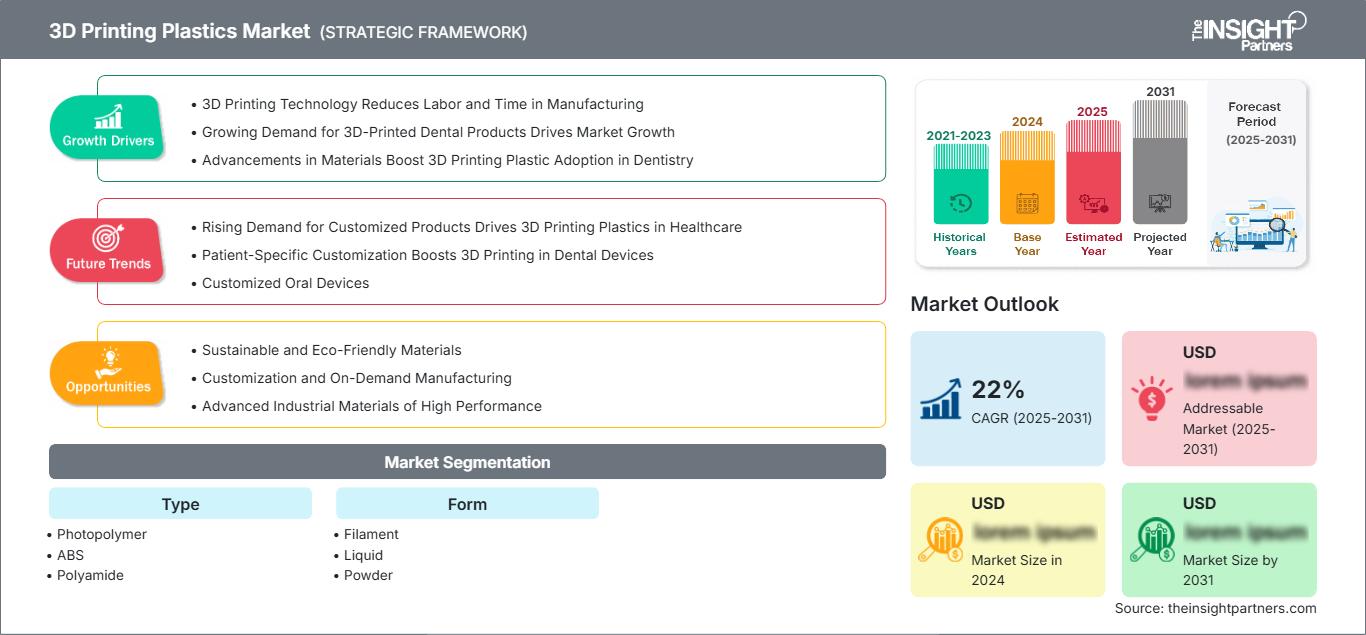
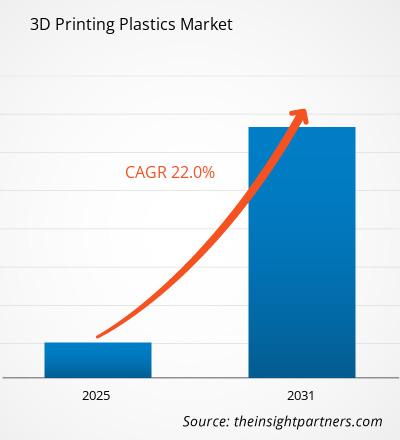
The 3D Printing Plastics Market was valued at US$ 1.57 billion in 2025 and is expected to reach US$ 10.62 billion by 2034, growing at a rate of 23.70% from 2026 to 2034. This market growth is driven by the wider use of additive manufacturing in industrial production, increasing material innovation, and the rising need for lightweight, customized, and cost-effective polymer components in aerospace, automotive, healthcare, consumer products, and industrial manufacturing.
North America is set to remain a leader throughout the forecast period, with regional growth projected to range from 22.5% to 24.5%. Significant investment in industrial additive manufacturing, active research and development, and the early commercialization of new polymer materials support regional demand. The growing use of these technologies in aerospace, medical device manufacturing, and rapid prototyping further supports long-term market growth, according to the 3D Printing Plastics Market report.
3D Printing Plastics Market Assessment and Insights
- North America: North America accounted for 34–38% market share in 2025 and is projected to expand at a CAGR of 22.5%–24.5% during 2026–2034. Growth is driven by increasing adoption of industrial additive manufacturing, expanding aerospace production, healthcare innovation, and ongoing advancements in polymer research.
- U.S.: The U.S. represented 82–86% of the North American market in 2025 and is anticipated to register a CAGR of 22.8%–24.8% during 2026–2034, supported by strong aerospace manufacturing activity, growing investment in advanced manufacturing technologies, and increasing utilization of 3D printing materials across healthcare and industrial applications.
- Europe: Europe held 27–31% market share in 2025 and is expected to grow at a CAGR of 22.0%–24.0% during 2026–2034. Germany, France, and the United Kingdom remain the leading regional markets, supported by advanced manufacturing capabilities, industrial automation adoption, and well-established engineering ecosystems.
- Asia Pacific: Asia Pacific accounted for 26–30% market share in 2025 and is forecast to expand at a CAGR of 25.0%–27.0% during 2026–2034. China, Japan, and South Korea drive regional growth through industrial digitalization, expanding electronics manufacturing activities, and supportive government initiatives for advanced production technologies.
- Largest Segment – Filament: The Filament segment represented the largest market segment, accounting for 44–48% market share in 2025, and is expected to grow at a CAGR of 22.0%–24.0% during 2026–2034, driven by its broad compatibility with both desktop and industrial additive manufacturing systems and sustained commercial adoption across multiple end-use industries.
- High Growth Segment – Photopolymer: The Photopolymer segment is projected to register the fastest growth, accounting for 20–24% market share in 2025 and advancing at a CAGR of 25.5%–27.5% during 2026–2034, supported by increasing demand for precision manufacturing, dental applications, and high-resolution prototyping technologies.
- Key companies analyzed in detail: EOS GmbH Electro Optical Systems; Clariant AG; SABIC; HP Inc.; Avient Corporation; Desktop Metal, Inc.; Stratasys Ltd.; GE Aerospace; Legor Group S.p.A.; and Arkema S.A.
Source: The Insight Partners' analysis based on proprietary research, government publications, company annual reports, investor presentations, industry databases, and expert interviews.
Manufacturing strategies have steadily changed from traditional prototyping to digitally integrated production environments. In these environments, polymer additive manufacturing supports functional components, tools, and custom end-use products. Improvements in printable engineering plastics, better machine productivity, software-driven workflow enhancements, and expanding material qualification programs have increased production consistency, strengthening the 3D Printing Plastics Market share. These advancements allow manufacturers to reduce inventory needs, shorten development cycles, and enhance overall operational flexibility across many industries.
Looking ahead, broader commercialization is expected in emerging manufacturing economies. Investments in localized production capacity, industrial automation, and digital manufacturing infrastructure will drive this growth. New regulations promoting sustainable materials, recycling initiatives, and reduced manufacturing waste are driving innovation in printable polymers. Continued collaboration between material suppliers, printer manufacturers, and industrial end users is expected to accelerate product certification, expand application areas, and support the growth of the 3D Printing Plastics Market size over the forecast period.
3D Printing Plastics Market Report Scope
| Report Attribute | Details |
|---|---|
| Market size in 2025 | US$ 1.57 Billion |
| Market Size by 2034 | US$ 10.62 Billion |
| Global CAGR (2026 - 2034) | 23.70% |
| Historical Data | 2021-2024 |
| Forecast period | 2026-2034 |
3D Printing Plastics Market Analysis
Demand for 3D printing plastics continues to rise as manufacturers prioritize lightweight materials, product customization, shorter production cycles, and decentralized manufacturing. Engineering thermoplastics and specialty polymers are increasingly replacing traditional materials for complex geometries that are expensive to produce using subtractive methods, shaping key 3D Printing Plastics Market trends. The growing use of these materials in aerospace, healthcare, automotive, consumer goods, education, and industrial tooling is diversifying market demand and driving material innovation.
The value chain in this industry includes polymer producers, compound formulators, additive manufacturing equipment makers, software developers, distributors, and industrial end users. Material suppliers are working more closely with printer manufacturers to improve printability, mechanical performance, thermal stability, and certification. Supply chain resilience has become crucial as manufacturers enhance regional production and create recyclable polymer formulations to boost sustainability while cutting reliance on traditional methods.
The competition in the 3D printing plastics market is marked by constant material innovation, strategic partnerships, expanding product lines, and investments in large-scale additive manufacturing solutions. Arkema S.A., SABIC, Clariant AG, and Avient Corporation are broadening their specialty polymer offerings for demanding industrial applications. At the same time, HP Inc. and Stratasys Ltd. are enhancing integrated hardware and material systems to improve printing efficiency and reliability. Material qualification remains a key competitive factor as customers seek certified solutions for regulated industries, supporting a positive 3D Printing Plastics Market forecast.
Investment strategies are increasingly centered on engineering polymers, bio-based materials, high-performance composites, and scalable manufacturing platforms that can support production-grade applications. EOS GmbH Electro Optical Systems is expanding its industrial additive manufacturing capabilities, while Desktop Metal, Inc. is improving polymer manufacturing technologies across broader production solutions. GE Aerospace continues to adopt industrial practices for aerospace qualification initiatives, and Legor Group S.p.A. is developing specialty materials for precision manufacturing needs. These advancements enhance technological competitiveness and create more commercial opportunities in global manufacturing.
● REPORT CUSTOMIZATION
Tailor This Report To Align With Your Specific Business Requirements
This report can be customized to align precisely with your business objectives, scope, and target markets. Customization options include tailored segmentation, geography, competitive analysis, and strategic insights to support informed decision-making.
Customize This Report →WHAT YOU CAN ADJUST
- ● Segmentations
- ● Geography
- ● Competitive Analysis
- ● Language Preferences
3D Printing Plastics Market: Strategic Insights
Regional Insights
North America 3D Printing Plastics Market
North America made up 34 to 38% of the global 3D printing plastics market in 2025. It is expected to grow at a rate of 22.5 to 24.5% from 2026 to 2034. The region has well-established additive manufacturing systems, high research spending, and widespread use of modern manufacturing technologies.
Demand comes from aerospace, healthcare, defense, automotive, and industrial equipment makers who want lightweight, custom polymer parts. Ongoing investments in industrial automation, digital production processes, and material development help maintain long-term market advantage and promote the use of high-performance engineering plastics.
U.S. 3D Printing Plastics Market
The United States accounted for 82 to 86% of the North American market in 2025 and is projected to grow at a rate of 22.8 to 24.8% through 2034. Its strong position is due to widespread industrial use and a solid network of technology developers, material suppliers, and manufacturing innovators.
Key players such as HP Inc., Stratasys Ltd., and GE Aerospace are continuing to expand their additive manufacturing capabilities across aerospace, healthcare, and industrial production. Increasing demand for production-grade polymer parts, customized medical devices, rapid tooling, and distributed manufacturing supports ongoing growth in the domestic 3D Printing Plastics Market.
Europe 3D Printing Plastics Market
Europe captured 27 to 31% of global revenue in 2025 and is expected to see a CAGR of 22.0 to 24.0% over the forecast period. Strong industrial engineering skills and ongoing investments in new manufacturing technologies keep the region competitive. The United Kingdom is enhancing additive manufacturing by promoting collaborative research, expanding medical technology development, and increasing the use of polymer printing in the automotive, healthcare, and education sectors.
Government-backed initiatives support the commercialization of new manufacturing technologies. Germany leads the region due to its well-developed automotive, industrial machinery, and aerospace sectors. Significant industrial digitalization, engineering expertise, and the widespread adoption of Industry 4.0 strategies are driving demand for advanced printable polymers and large-scale additive manufacturing systems, strengthening the 3D Printing Plastics Market.
France, Italy, and Spain together drive substantial market growth by increasing investments in aerospace production, healthcare innovation, luxury goods manufacturing, and industrial design. More small and medium-sized manufacturers are adopting additive manufacturing technologies, further boosting regional usage.
APAC 3D Printing Plastics Market
Asia Pacific represented 26 to 30% of the global market in 2025 and is projected to grow the fastest regionally with a CAGR of 25.0 to 27.0% from 2026 to 2034. Rapid industrial modernization and rising manufacturing investments are speeding up regional demand. China leads in regional consumption thanks to its large-scale manufacturing capacity, growing domestic material production, and supportive industrial modernization policies.
Strong investments in electronics, automotive, healthcare, and industrial equipment are increasing the commercial use of engineering-grade printing plastics. Japan, South Korea, India, and Australia are also boosting regional growth through innovations in precision manufacturing, electronics, medical technologies, and research efforts. Government support for digital manufacturing, advanced materials, and industrial automation offers long-term opportunities across various end-use industries.
Middle East & Africa 3D Printing Plastics Market
The Middle East and Africa market is expected to grow at a rate of 20.5% to 22.5% between 2026 and 2034. Although smaller than other regional markets, it is witnessing increasing adoption of additive manufacturing technologies to support industrial diversification and localized production initiatives, creating new opportunities in the 3D Printing Plastics Market.
Saudi Arabia is driving regional growth through investments that support industrial change, manufacturing improvements, and local strategies. The United Arab Emirates is also encouraging additive manufacturing in construction, healthcare, and aerospace while building innovation-focused industrial networks.
South Africa is slowly adopting these technologies in mining, healthcare, education, and industrial manufacturing. Other parts of the region are benefiting from updated infrastructure, improved engineering skills, and becoming more aware of cost-effective additive manufacturing methods for specialized production needs.
Segmentation Analysis
Type
The Type segment is an important part of the 3D Printing Plastics Market because material choice affects print quality, mechanical strength, thermal stability, chemical resistance, and suitability for various applications. Ongoing innovation in engineering polymers helps manufacturers meet the growing demands of industry. Among the material categories, Photopolymer is expected to see the fastest growth, with a CAGR of 25.5–27.5% from 2026 to 2034, driven by its increasing use in high-precision manufacturing.
- Photopolymer: Its rising use in dental, medical, jewelry, electronics, and precision engineering applications is driving strong demand for materials that offer high dimensional accuracy, smooth surface finishes, and quick curing properties.
- ABS: This material is popular for functional prototypes, automotive parts, industrial tools, and consumer goods due to its good mix of mechanical strength, impact resistance, durability, and cost-effective processing.
- Polyamide: There is strong demand for this material in aerospace, automotive, and industrial machinery because of its excellent wear resistance, mechanical performance, thermal stability, and compatibility with high-performance additive manufacturing.
- Polylactic Acid: The push for sustainability and the growth in educational, consumer, and prototyping applications support its adoption due to its renewable feedstock origins, ease of processing, and lower environmental impact.
Form
Material form has a significant impact on printer compatibility, manufacturing efficiency, production quality, and final part performance in the 3D Printing Plastics Market. Different additive manufacturing technologies require specific material formats that are optimized for deposition, curing, or powder fusion processes.
- Filament: It holds the largest market share due to its wide compatibility with fused filament fabrication systems. It is affordable, readily available, and increasingly used in industrial, educational, research, and professional prototyping settings.
- Liquid: Demand is rising as more industries adopt stereolithography and digital light processing technologies. These methods are used for medical devices, dental models, precision prototypes, and high-resolution manufacturing applications that need superior surface quality.
- Powder: There is growing use in selective laser sintering and industrial manufacturing. This allows for the production of durable, lightweight, and complex components suitable for aerospace, automotive, healthcare, and industrial engineering applications.
Opportunity Snapshot
| Segment Name | Revenue Contribution | Trend Tag | Adoption Stage |
| Aerospace | High | Lightweight Parts | Mature |
| Automotive | High | Tooling Optimization | Scaling |
| Healthcare | High | Patient-Specific | Scaling |
| Consumer Goods | Medium | Mass Customization | Scaling |
| Industrial Manufacturing | High | Digital Factory | Mature |
| Education & Research | Low | Prototype Learning | Mature |
3D Printing Plastics Market Growth Drivers and Impact Analysis
Expansion of Industrial Additive Manufacturing Across Production Environments
Manufacturers are increasingly incorporating additive manufacturing into their production processes rather than limiting its use to prototyping. Polymer-based 3D printing enables rapid production of lightweight components, customized tooling, spare parts, and complex geometries while reducing machining requirements and material waste. Aerospace, automotive, healthcare, and industrial equipment manufacturers are investing in large-scale additive manufacturing to improve operational flexibility and accelerate product development cycles, driving demand in the 3D Printing Plastics Market. As industrial qualification standards improve and production rates increase, the demand for high-quality printable plastics continues to grow. This shift from prototype development to mass production greatly expands business opportunities for suppliers of polymer materials and equipment manufacturers within global manufacturing networks.
Development of High-Performance Engineering Polymer Materials
Ongoing advancements in printable polymer formulations are enhancing the performance of additive manufacturing across challenging industrial uses. Material developers are introducing new polyamides, reinforced composites, flame-retardant polymers, chemically resistant resins, and special thermoplastics that meet strict mechanical and thermal performance standards. These materials enable manufacturers to replace conventionally manufactured components with lighter, customized alternatives without sacrificing structural integrity. Improved material consistency and certification are also increasing confidence in regulated sectors such as aerospace and healthcare. As a result, material innovation remains a key driver of broader industrial adoption and higher-value applications across the 3D Printing Plastics Market during the forecast period.
Growing Demand for Sustainable and Resource-Efficient Manufacturing
Manufacturers are increasingly focusing on production methods that reduce waste, improve material efficiency, and support environmental objectives. Additive manufacturing uses only the required amount of raw material by depositing it precisely where needed, unlike traditional subtractive manufacturing methods. The growing availability of recyclable plastics, bio-based materials, and reusable powder systems further enhances sustainability, creating new opportunities in the 3D Printing Plastics Market. Companies also gain from local production and digital inventory strategies, which lower transportation costs and inventory expenses. These benefits encourage businesses to integrate 3D printing for plastics into their long-term manufacturing plans while backing sustainability goals and enhancing overall production efficiency.
3D Printing Plastics Market Future Trends
Artificial Intelligence Integration Across Additive Manufacturing Workflows
Artificial intelligence is set to play a bigger role in additive manufacturing, stretching from automated design optimization to print parameter selection, predictive maintenance, and quality checks. AI-driven software can lower print failures, enhance material use, and speed up product development by optimizing build orientation and structural strength before production starts. When combined with machine learning and digital simulation, these features help manufacturers boost productivity while cutting operating costs. As digital manufacturing platforms develop, AI-supported workflows will likely become standard in industrial polymer additive manufacturing, offering new advantages for technology providers.
Expansion of Distributed and Localized Manufacturing Networks
Companies are increasingly looking into distributed manufacturing models backed by digital inventories and regional additive manufacturing facilities. Instead of keeping large physical inventories, businesses can maintain validated digital designs and produce parts closer to end users as needed. This method lowers logistics costs, strengthens supply chain resilience, and shortens delivery times. The growth of certified polymer materials, cloud-based manufacturing systems, and standardized production methods will speed up the adoption of distributed manufacturing. This trend is expected to transform spare parts management, custom production, and low-volume manufacturing across various industrial sectors in the coming years.
3D Printing Plastics Market Opportunities
Commercial Expansion in Medical and Personalized Healthcare Manufacturing
Healthcare continues to offer significant investment opportunities as hospitals, medical device manufacturers, and dental laboratories adopt polymer additive manufacturing for specific patient needs. Customized surgical guides, dental aligners, prosthetics, anatomical models, and orthopedic devices all benefit from fast production and precise customization. Ongoing improvements in biocompatible polymers and regulatory compliance further enhance commercial prospects. Companies that invest in specialized medical materials, validated production workflows, and certified manufacturing capabilities are in a strong position to take advantage of increasing healthcare demand. They can also build lasting partnerships with clinical and medical technology organizations.
Investment in Circular Polymer Materials and Recycling Technologies
Growing environmental concerns are creating opportunities for companies specializing in recyclable, reusable, and bio-based 3D printing plastics. Manufacturers are seeking materials that support circular economy objectives without compromising mechanical performance or production reliability. Investments in closed-loop recycling systems, renewable polymer feedstocks, and powder recovery technologies can significantly enhance sustainability while lowering production costs, creating new opportunities in the 3D Printing Plastics Market. Organizations that can provide certified sustainable material solutions are likely to improve their competitive edge as industrial customers more often consider environmental performance in their purchasing decisions and long-term manufacturing plans.
Recent Developments
- April 2026: EOS GmbH Electro Optical Systems acquired Metalpine GmbH, a specialist in high-quality metal powders for additive manufacturing. This move strengthens its materials portfolio and process expertise. While the focus is on metal powders, the acquisition enhances EOS's broader additive manufacturing ecosystem by combining materials, process parameters, and production capabilities. The change is expected to speed up the industrial use of additive manufacturing technologies. It will benefit the overall 3D printing materials market, including plastics, by improving manufacturing workflows, speeding up material qualification, and increasing industrial production capabilities.
- January 2026: EOS GmbH Electro Optical Systems invested US$ 3 million to expand its Texas manufacturing and logistics capabilities. This includes facility upgrades and a new warehouse to boost regional additive manufacturing operations. The expansion will support faster delivery, localized production, and increased capacity for industrial 3D printing solutions. By improving its manufacturing infrastructure and supply chain responsiveness in North America, this development encourages broader use of additive manufacturing technologies and strengthens the ecosystem for advanced materials, particularly polymer-based 3D printing applications.
Frequently Asked Questions

- Comprehensive Market Sizing and Forecast Analysis
- Detailed Segmentation Analysis
- In-Depth Market Dynamics Assessment
- Regional and Country-Level Insights
- Competitive Landscape and Company Benchmarking
- Strategic Business Intelligence
Recent Reports
Testimonials

The Insight Partners provided valuable market intelligence that supported our global go-to-market strategy. Their team was professional, responsive, and attentive to our feedback, providing thoughtful analysis and helpful methodological clarifications throughout the project.
Junmo Kim Chief Financial Officer (CFO), Enertech Co., Ltd.
The Insight Partners' SCADA System Market report is comprehensive, with valuable insights on current trends and future forecasts. The team was highly professional, responsive, and supportive throughout. We are very satisfied and highly recommend their services.
RAN KEDEM Partner, Reali Technologies LTDs
I requested a report on a very specific software market and the team produced the report in a few days. The information was very relevant and well presented. I then requested some changes and additions to the report. The team was again very responsive and I got the final report in less than a week.
JEAN-HERVE JENN Chairman, Future Analytica
We worked with The Insight Partners for an important market study and forecast. They gave us clear insights into opportunities and risks, which helped shape our plans. Their research was easy to use and based on solid data. It helped us make smart, confident decisions. We highly recommend them.
PIYUSH NAGPAL Sr. Vice President, High Beam Global
The Insight Partners delivered insightful, well-structured market research with strong domain expertise. Their team was professional and responsive throughout. The user-friendly website made accessing industry reports seamless. We highly recommend them for reliable, high-quality research services
YUKIHIKO ADACHI CEO, Deep Blue, LLC.
This is the first time I have purchased a market report from The Insight Partners.While I was unsure at first, I visited their web site and felt more comfortable to take the risk and purchase a market report.I am completely satisfied with the quality of the report and customer service. I had several questions and comments with the initial report, but after a couple of dialogs over email with their analyst I believe I have a report that I can use as input to our strategic planning process.Thank you so much for taking the extra time and making this a positive experience.I will definitely recommend your service to others and you will be my first call when we need further market data.
JOHN SUZUKI President and Chief Executive Officer, Board Director, BK Technologies
I wish to appreciate your support and the professionalism you displayed in the course of attending to my request for information regarding to infectious disease IVD market in Nigeria. I appreciate your patience, your guidance, and the fact that you were willing to offer a discount, which eventually made it possible for us to close a deal. I look forward to engaging The Insight Partners in the future, all thanks to the impression you have created in me as a result of this first encounter.
DR CHIJIOKE ONYIA MANAGING DIRECTOR, PineCrest Healthcare Ltd.Reason to Buy
- Informed Decision-Making
- Understanding Market Dynamics
- Competitive Analysis
- Identifying Emerging Markets
- Customer Insights
- Market Forecasts
- Risk Mitigation
- Boosting Operational Efficiency
- Strategic Planning
- Investment Justification
- Tracking Industry Innovations
- Aligning with Regulatory Trends





 Get Free Sample for