
Drill Bit Market Trends, Share & Demand by 2034
Coverage: by Product Type (Fixed Cutter Bits, Roller Cone Cutter Bits); Application (Onshore Drilling, Offshore Drilling) , and Geography (North America, Europe, Asia Pacific, and South and Central America)
- Status : Data Released
- Report Code : TIPRE00010758
- Category : Manufacturing and Construction
- No. of Pages : 150
- Available Report Formats :


- Last update date : July 22, 2026


2025 Market Size
US$ 8.75 Bn
Base year value
2034 Forecast
US$ 13.99 Bn
Projected by 2034
CAGR 2026-2034
5.35 %
Growth rate
Addressable Market
US$ 103.12 Bn
(2026-2034)
The drill bit market was valued at US$ 8.75 Billion in 2025 and is projected to reach US$ 13.99 Billion by 2034, registering a CAGR of 5.35% during 2026–2034. Demand is supported by oil and gas drilling, construction fastening, metalworking, mining, and infrastructure maintenance, where bit durability, penetration rate, and cost per hole remain central procurement criteria for industrial buyers.
North America remains a priority demand center, with the drill bit market size supported by shale activity, construction retrofits, and high replacement intensity in professional tools. The region is expected to expand at a 4.9–5.4% CAGR during 2026–2034, driven by horizontal well designs, infrastructure rehabilitation, and contractor preference for premium carbide, PDC, and application-specific drilling accessories.
Drill Bit Market Assessment and Insights
- North America held 36–39% share in 2025 and is expected to grow at a 4.9–5.4% CAGR between 2026–2034, supported by shale wells, maintenance drilling, and premium bit replacement.
- US represented 78–82% of North America in 2025 and is projected to grow at a 4.8–5.3% CAGR between 2026–2034, led by Permian and Gulf activity.
- Europe accounted for 18–21% share in 2025 and is forecast to grow at a 4.2–4.8% CAGR between 2026–2034, led by Germany, the UK, France, Italy, and Spain.
- Asia Pacific captured 25–28% share in 2025 and is likely to expand at a 6.1–6.8% CAGR between 2026–2034, with China, India, Japan, South Korea, and Australia driving demand.
- Largest Segment Fixed Cutter Bits held 54–58% market share in 2025 and are expected to grow at a 5.6–6.1% CAGR during 2026–2034 due to efficiency advantages.
- High Growth Segment Offshore Drilling held 28–32% market share in 2025 and is projected to grow at a 6.2–6.9% CAGR during 2026–2034 as deepwater projects restart.
- Key companies analyzed in detail: Stanley Black & Decker, Inc., Halliburton Company, Hartner GmbH, Hilti Corporation, IZAR Cutting Tools S.A.L., Makita Corporation, Metabowerke GmbH, Robert Bosch Tool Corporation, RUKO GmbH Präzisionswerkzeuge, SLB, Baker Hughes Company, NOV Inc.
Source: The Insight Partners' analysis based on proprietary research, government publications, company annual reports, investor presentations, industry databases, and expert interviews.
Technology migration is causing changes in the drill bit portfolio in terms of its shifting from high-speed steel type drill bits to the use of carbide tipped, diamond impregnated, fixed cutter, and computer analyzed drill bits for their higher durability and efficiency. Flute design, cutter location, coating materials, and body composition have all been optimized by the manufacturers for increased efficiency in cutting through abrasive materials, reinforced concrete, and high temperature settings. While manufacturing is increasingly becoming international, qualification standards still have a strong local component.
Future demands would be determined by the growth of industries in Asia-Pacific region, investments in the upstream sector in the Middle East, unconventional drilling operations in North America, and infrastructure renewal initiatives in Europe. In addition, with increasing attention to regulations on employee safety, dust management, well integrity, and energy efficiency, the adoption of more efficient drilling products would be encouraged. Consequently, the procurement process would slowly shift from cost-effective consumable products to drilling systems.
Drill Bit Market Report Scope
| Report Attribute | Details |
|---|---|
| Market size in 2025 | US$ 8.75 Billion |
| Market Size by 2034 | US$ 13.99 Billion |
| Global CAGR (2026 - 2034) | 5.35% |
| Historical Data | 2021-2024 |
| Forecast period | 2026-2034 |
Drill Bit Market Analysis
Drill bit industry growth will be further spurred by active rig activity, construction equipment mechanization, mining exploration, and plant maintenance. Active rigs are an early indicator of drilling consumable usage according to Baker Hughes’ rig counts, while the rotary rig activity continues in both onshore and offshore environments according to the Energy Information Administration’s figures.
Steel, tungsten carbide, synthetic diamond, coatings, heat treatment, CNC grinding, field application engineering, and distribution comprise the supply chain. The supply dynamic advantages companies that are able to integrate materials science with the geology of the application or the substrate being worked with. Oilfield clients consider well costs rather than unit costs, whereas construction clients consider speed, hole formation, and available accessories.
Competitive assessment of the drill bit industry exhibits a varied competition between oilfield professionals and industrial tool providers in their respective sales chains. The competition by the likes of Halliburton Company and SLB focuses on well-construction efficiency, while that of Stanley Black & Decker, Inc., Hilti Corporation, Makita Corporation, Metabowerke GmbH, Robert Bosch Tool Corporation, IZAR Cutting Tools S.A.L., Hartner GmbH, and RUKO GmbH Präzisionswerkzeuge is trade-based and involves application versatility and innovative accessories.
Investments are being made in the areas of cutter design, wear detection, drilling feedback automation, carbide technology, and resilience in regional production capacity. Other companies involved in this competitive assessment include Baker Hughes Company and NOV Inc., which compete in the area of oilfield bit systems, and Bosch, Hilti, and Makita, which focus on the cordless ecosystem.
● REPORT CUSTOMIZATION
Tailor This Report To Align With Your Specific Business Requirements
This report can be customized to align precisely with your business objectives, scope, and target markets. Customization options include tailored segmentation, geography, competitive analysis, and strategic insights to support informed decision-making.
Customize This Report →WHAT YOU CAN ADJUST
- ● Segmentations
- ● Geography
- ● Competitive Analysis
- ● Language Preferences
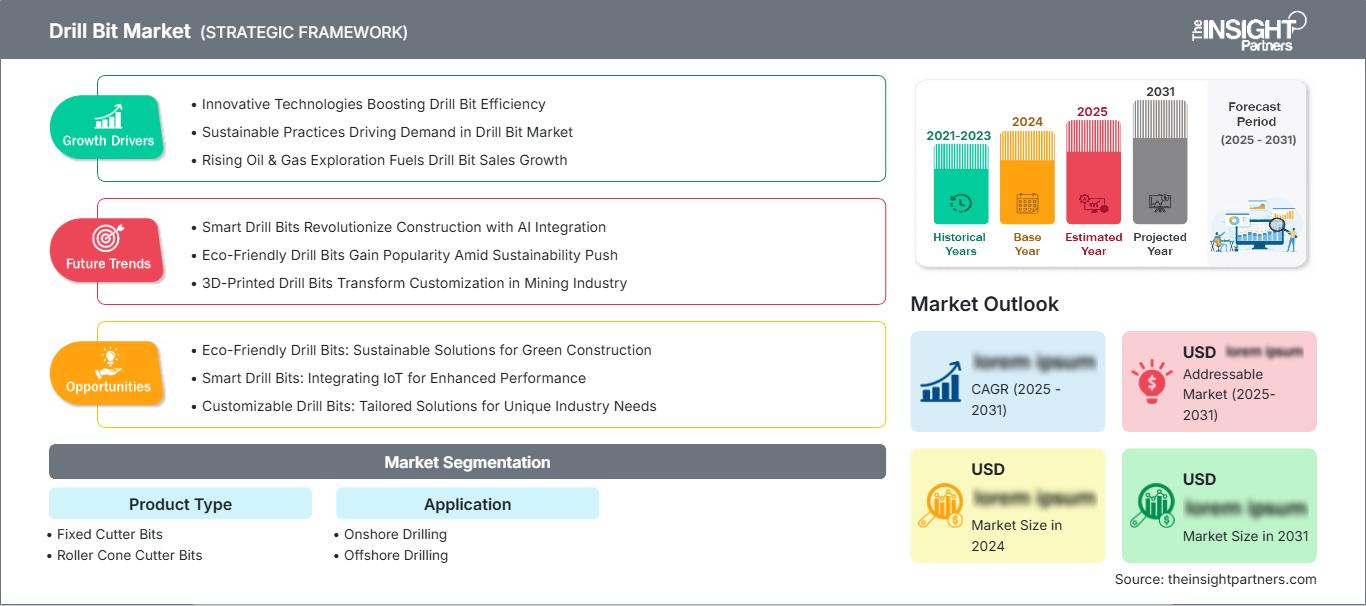
Drill Bit Market: Strategic Insights
Regional Insights
North America Drill Bit Market
North America held 36–39% share in 2025 and is projected to grow at a 4.9–5.4% CAGR during 2026–2034. The drill bit market share reflects shale basin intensity, high contractor replacement rates, and a mature professional tool channel. Baker Hughes reported U.S., Canada, and international rig counts as key drilling barometers, linking active rigs directly with consumable demand.
Onshore drilling remains the regional base, but offshore Gulf of Mexico, Canadian gas, industrial fabrication, and concrete anchoring add resilience. Buyers increasingly prefer bits that reduce tool changes, heat buildup, and hole deviation. Regional growth is therefore less volume-led and more value-led, as premium fixed cutter, carbide, and masonry systems gain share.
U.S. Drill Bit Market
The U.S. represented 78–82% of North America in 2025 and is expected to grow at a 4.8–5.3% CAGR through 2034. EIA annual drilling data recorded 561 rotary rigs in operation in 2025, including 547 onshore and 14 offshore rigs, underscoring persistent well construction demand despite capital discipline. With the current levels of activity in major shale plays, infrastructure repairs, and industrial construction, there is still significant demand for drilling tools and related products. With continued focus on productivity and asset maintenance in a world where commodity prices fluctuate, it is clear that the market remains stable. The market is very wide-ranging, with firms such as Halliburton Company, SLB, Baker Hughes Company, NOV Inc., Stanley Black & Decker, Inc., Hilti Corporation, Makita Corporation, and Robert Bosch Tool Corporation playing significant roles through their services, retail operations, and contracting. Some application areas in this market include horizontal shale laterals, concrete anchors, utility repairs, and metal fabrication, all of which have specific performance specifications and durability requirements, as well as tool designs for productivity.
Europe Drill Bit Market
Europe accounted for 18–21% share in 2025 and is forecast to expand at a 4.2–4.8% CAGR during 2026–2034. Germany is the leading country due to its strong precision manufacturing base, machinery exports, and demand for products from Hartner GmbH, RUKO GmbH Präzisionswerkzeuge, Bosch, and Metabo. Industrial users prioritize tolerance control, tool longevity, coating performance, and repeatable hole quality to support high-precision production environments.
Infrastructural renovation activities, offshore maintenance work, and retrofits of buildings in the UK necessitate the use of a variety of masonry and metal drilling products. The automotive industry in France, construction services in Italy and Spain, aerospace production, and renewables installation projects all add to the requirement. Throughout the area, customers are very quality conscious and emphasize durability, efficiency, and strict adherence to workplace safety regulations. Standards governing dust and vibration control, along with workplace safety regulations, have ensured steady growth in the engineered drill bit systems market.
APAC Drill Bit Market
APAC held 25–28% share in 2025 and is projected to grow at a 6.1–6.8% CAGR during 2026–2034, making it the fastest regional cluster. China dominates in terms of manufacturing volumes and requirements for infrastructure development, while India gains strength through its building works, mining, energy well-drilling, and industrial expansion projects. Investments into manufacturing and infrastructure build-up go on, which continues to contribute to the growth of tools' sales within key application markets.
Japan and South Korea are driven by their metal-cutting, automobile manufacturing, and electronics-related tooling uses, while Australia is a result of mining and energy projects. Policies that focus on manufacturing and transportation infrastructure and energy security stimulate purchases of both high-end and mid-range products. Local distributors are essential as the customers need fast delivery of required sizes, technical support, and replacement services.
Middle East & Africa Drill Bit Market
The Middle East & Africa is expected to grow at a 5.5–6.2% CAGR during 2026–2034, led by Saudi Arabia and the UAE. Energy investment, brownfield redevelopment, and offshore drilling sustain oilfield bit demand, while utility, industrial, and construction megaprojects support the adoption of masonry and metal drilling accessories. Continued infrastructure expansion, mining activity, and economic diversification initiatives are further contributing to market growth across the region. South Africa anchors industrial and mining-related consumption, while the Rest of MEA adds selective demand from infrastructure corridors, resource projects, and upstream exploration activities. Harsh geological conditions, high operating temperatures, and remote project locations encourage the use of durable, high-performance drill bits that reduce replacement frequency, minimize downtime, and improve operational efficiency in demanding field environments. As a result, end users increasingly favor products that offer longer service life, greater drilling accuracy, and lower total operating costs.
Segmentation Analysis
Product Type
Product Type is expected to grow at a 5.2–5.8% CAGR during 2026–2034 as buyers shift toward engineered geometries, better materials, and task-specific performance. The drill bit market scope across this segment includes heavy-duty oilfield bits, construction masonry bits, metalworking bits, and precision industrial tools, with procurement increasingly tied to life-cycle cost rather than purchase price.
- Fixed Cutter Bits lead demand because they deliver high penetration rates, fewer moving parts, and strong performance in directional drilling, abrasive construction substrates, and repetitive industrial drilling tasks.
- Roller Cone Cutter Bits remain strategically important in variable formations, impact-heavy drilling, and applications where crushing action, formation adaptability, and established field familiarity support continued procurement.
Application
Application is projected to grow at a 5.4–6.0% CAGR during 2026–2034. Demand is anchored in onshore drilling because land-based wells, construction sites, mines, and industrial plants generate frequent bit consumption. Offshore drilling, although smaller, requires premium technologies that tolerate vibration, pressure, corrosive fluids, and restricted intervention windows.
- Onshore Drilling dominates usage because shale wells, construction anchoring, quarrying, mining, and plant maintenance require repeated drilling cycles, broad size availability, and reliable supply through distributors.
- Offshore Drilling is strategically premium because deepwater wells demand bits with high durability, directional stability, erosion resistance, and the ability to reduce costly trips.
Opportunity Snapshot
| Application | Revenue Contribution | Trend Tag | Adoption Stage |
| Onshore Drilling | High | Shale Laterals | Mature |
| Offshore Drilling | Medium | Deepwater Bits | Scaling |
Drill Bit Market Growth Drivers and Impact Analysis
Higher Complexity in Well Construction
Directional, horizontal, and extended-reach wells increase mechanical stress on bits and raise the value of designs that improve steerability, cutter durability, and hydraulic cleaning. Operators are willing to pay for tools that reduce trips because rig time can exceed the bit cost by a wide margin. The commercial impact is a shift from standard replacement purchasing toward engineered assemblies, field application support, and performance-based supplier evaluation.
Construction Retrofit and Infrastructure Maintenance
Urban renovation projects, transport network repairs, utility infrastructure upgrades, and commercial building retrofits generate steady demand for masonry, concrete, metal, and multi-material drill bits. Contractors increasingly prioritize accessories that can drill accurately through reinforced materials, reduce dust generation and heat buildup, and maintain compatibility with modern cordless rotary hammers and power tools. This demand driver helps broaden the market beyond cyclical oilfield activity, supporting consistent consumption across construction and maintenance sectors. As a result, brands with strong distribution networks, contractor training programs, and integrated tool ecosystems are well-positioned to strengthen their presence in professional construction channels.
Material Science and Coating Upgrades
Advances in tungsten carbide formulations, PDC cutter technology, diamond-impregnated materials, optimized flute geometries, and integrated wear indicators are improving drill bit performance and service life in abrasive, high-temperature, and demanding operating environments. These innovations enhance cutting efficiency, maintain drilling accuracy, and reduce downtime, helping lower the overall cost per hole and making premium tools more attractive to buyers. As procurement teams increasingly focus on productivity and lifecycle value, suppliers that can demonstrate faster penetration rates, fewer tool failures, and longer replacement intervals are better positioned to protect margins and differentiate their offerings in competitive industrial markets.
Drill Bit Market Future Trends
Digital Bit Selection and Downhole Feedback
The drill bit market will increasingly adopt data-guided selection and performance optimization, where drilling parameters, formation characteristics, vibration data, and wear history are used to recommend the most suitable bit before deployment. In oilfield applications, service providers are already integrating at-bit sensing technologies, automated drilling controls, and performance analytics to improve well construction efficiency and reduce non-productive time. Over time, similar practices are expected to expand into construction and industrial markets through digital application databases, connected tool platforms, and distributor advisory systems. These tools can help users match bit designs to specific substrate conditions, improving drilling accuracy, extending tool life, reducing replacement costs, and enhancing overall jobsite productivity.
Premiumization of Jobsite Accessories
Professional users are increasingly shifting away from basic, general-purpose bit assortments toward task-specific accessories that deliver higher productivity, greater safety, and more consistent results across demanding applications. The growing adoption of cordless tool platforms, the use of stronger concrete formulations, and the rise in mixed-material renovation projects are raising performance expectations for drilling accessories. Contractors are placing greater emphasis on faster drilling speeds, longer tool life, and reduced downtime, particularly in commercial construction and infrastructure maintenance environments. This trend favors manufacturers that offer integrated solutions combining drill bits with rotary hammers, dust extraction systems, anchoring technologies, and user training programs. It also enhances product differentiation in retail and distributor channels, where durability, performance, and efficiency claims play an increasingly important role in purchasing decisions. Suppliers that can demonstrate measurable improvements in productivity, accuracy, and jobsite safety are likely to strengthen their competitive position among professional users.
Drill Bit Market Opportunities
Localized Manufacturing and Basin-Specific Engineering
Suppliers can improve margins by pairing regional manufacturing with application engineering for shale, carbonate, geothermal, mining, and construction substrates. The drill bit market forecasts indicate that buyers will reward shorter lead times, rapid customization, and local technical support. Establishing regional grinding, coating, and repair capabilities can reduce logistics exposure while enabling faster product iteration based on field failure analysis and customer feedback.
Integrated Tool and Consumable Bundles
Power tool manufacturers have an opportunity to bundle drill bits, rotary hammers, dust extraction systems, anchors, batteries, and service plans into trade-specific solutions tailored to the needs of professional users. By offering integrated packages, suppliers can shift purchasing decisions away from the price of individual accessories and toward overall productivity, safety, and regulatory compliance on the jobsite. This approach also helps strengthen customer loyalty and creates additional recurring revenue opportunities through service and replacement programs.
For oilfield suppliers, bundled drilling assemblies, bit optimization software, real-time performance monitoring, and technical support services can enhance value for operators seeking greater drilling efficiency. As operators increasingly focus on reducing trips, minimizing downtime, and improving drilling consistency, integrated solution providers are better positioned to build long-term customer relationships and differentiate themselves in a competitive market.
Recent Developments
- January 2026: Halliburton Company — launched the HyperSteer MX directional drill bit, described as a shankless matrix-body bit designed to improve durability, directional control, erosion resistance, and performance in abrasive, high-flow environments while reducing trips and well construction time.
- May 2025: SLB — received Hart Energy’s 2025 Meritorious Award for Engineering Innovation in Drill Bits for the DualHelix multiformation performance bit, which uses cutter placement geometry to adapt engagement across soft and hard formations and improve cutting efficiency.
- April 2025: Robert Bosch Tool Corporation — introduced the Bulldog Xtreme8 8-cutter SDS-plus concrete drill bit and Blue Xtreme carbide-tipped drill bits, emphasizing rebar-hit durability, carbide strength, centering accuracy, dust removal, and wear indication for concrete drilling applications.
Frequently Asked Questions

- Comprehensive Market Sizing and Forecast Analysis
- Detailed Segmentation Analysis
- In-Depth Market Dynamics Assessment
- Regional and Country-Level Insights
- Competitive Landscape and Company Benchmarking
- Strategic Business Intelligence
Recent Reports
Testimonials

The Insight Partners' SCADA System Market report is comprehensive, with valuable insights on current trends and future forecasts. The team was highly professional, responsive, and supportive throughout. We are very satisfied and highly recommend their services.
RAN KEDEM Partner, Reali Technologies LTDs
I requested a report on a very specific software market and the team produced the report in a few days. The information was very relevant and well presented. I then requested some changes and additions to the report. The team was again very responsive and I got the final report in less than a week.
JEAN-HERVE JENN Chairman, Future Analytica
We worked with The Insight Partners for an important market study and forecast. They gave us clear insights into opportunities and risks, which helped shape our plans. Their research was easy to use and based on solid data. It helped us make smart, confident decisions. We highly recommend them.
PIYUSH NAGPAL Sr. Vice President, High Beam Global
The Insight Partners delivered insightful, well-structured market research with strong domain expertise. Their team was professional and responsive throughout. The user-friendly website made accessing industry reports seamless. We highly recommend them for reliable, high-quality research services
YUKIHIKO ADACHI CEO, Deep Blue, LLC.
This is the first time I have purchased a market report from The Insight Partners.While I was unsure at first, I visited their web site and felt more comfortable to take the risk and purchase a market report.I am completely satisfied with the quality of the report and customer service. I had several questions and comments with the initial report, but after a couple of dialogs over email with their analyst I believe I have a report that I can use as input to our strategic planning process.Thank you so much for taking the extra time and making this a positive experience.I will definitely recommend your service to others and you will be my first call when we need further market data.
JOHN SUZUKI President and Chief Executive Officer, Board Director, BK Technologies
I wish to appreciate your support and the professionalism you displayed in the course of attending to my request for information regarding to infectious disease IVD market in Nigeria. I appreciate your patience, your guidance, and the fact that you were willing to offer a discount, which eventually made it possible for us to close a deal. I look forward to engaging The Insight Partners in the future, all thanks to the impression you have created in me as a result of this first encounter.
DR CHIJIOKE ONYIA MANAGING DIRECTOR, PineCrest Healthcare Ltd.Reason to Buy
- Informed Decision-Making
- Understanding Market Dynamics
- Competitive Analysis
- Identifying Emerging Markets
- Customer Insights
- Market Forecasts
- Risk Mitigation
- Boosting Operational Efficiency
- Strategic Planning
- Investment Justification
- Tracking Industry Innovations
- Aligning with Regulatory Trends





 Get Free Sample for