
Vapor Recovery Units Market Share, Growth & Forecast by 2034
Coverage: By Application (Processing, Storage, Transportation); End-Use Industry (Crude Oil, Liquefied Natural Gas (LNG), Chemicals and Petrochemicals, Others) , and Geography (North America, Europe, Asia Pacific, and South and Central America)
- Status : Data Released
- Report Code : TIPRE00015925
- Category : Manufacturing and Construction
- No. of Pages : 150
- Available Report Formats :


- Last update date : September 17, 2026


2025 Market Size
US$ 1.49 Bn
Base year value
2034 Forecast
US$ 2.27 Bn
Projected by 2034
CAGR 2026-2034
4.78 %
Growth rate
Addressable Market
US$ 17.06 Bn
(2026-2034)
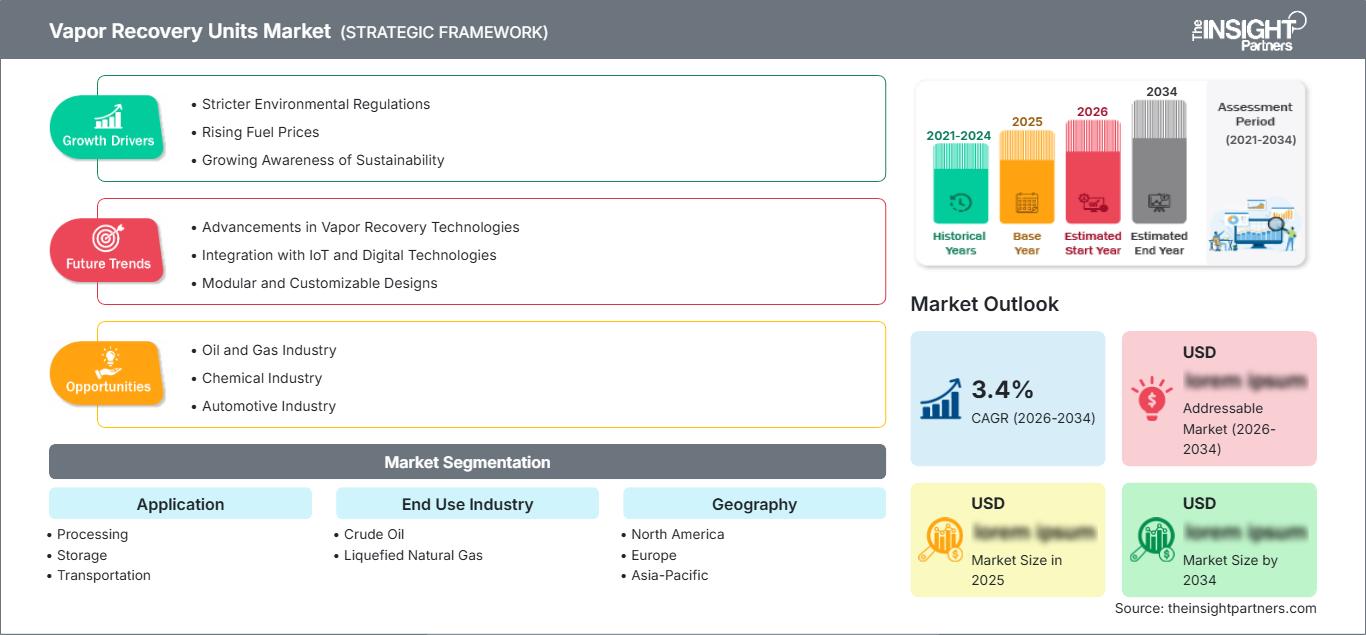
The vapor recovery units market is positioned for steady expansion, increasing from US$ 1.49 Billion in 2025 to US$ 2.27 Billion by 2034, at a CAGR of 4.78% during 2026–2034. Demand is being shaped by tighter emissions controls, hydrocarbon conservation priorities, and modernization of processing, storage, and transportation infrastructure across oil and gas value chains.
North America is expected to remain a major revenue center, supported by mature petroleum infrastructure, stringent volatile organic compound controls, and continued deployment of emissions-management equipment. The vapor recovery units market size is supported by replacement demand, brownfield upgrades, methane-management initiatives, and investments in production assets where recovered hydrocarbons can improve operating economics.
Vapor Recovery Units Market Assessment and Insights
- North America: North America is expected to account for a 38–42% share in 2025, growing at a CAGR of 4.6–5.0% between 2026–2034, supported by established oil infrastructure and increasingly integrated emissions-management programs.
- US: The US is projected to represent 84–88% of North American revenue in 2025 and expand at a CAGR of 4.5–4.9% during 2026–2034, led by upstream and terminal applications.
- Europe: Europe is estimated at a 23–27% share in 2025 and a CAGR of 4.1–4.5% through 2034, with Germany, the UK, France, Italy, and Spain supporting demand through environmental compliance and refinery modernization.
- Asia Pacific: Asia Pacific is estimated to hold a 20–24% share in 2025 and grow at 5.2–5.7% during 2026–2034, with China, India, Japan, South Korea, and Australia driving infrastructure-led adoption.
- Largest Segment: Storage is expected to hold a 40–44% market share in 2025 and expand at a CAGR of 5.2–5.6% during 2026–2034, reflecting widespread terminal and tank applications.
- High Growth Segment: Transportation is estimated at a 26–30% share in 2025 and is projected to grow at 5.2–5.8% during 2026–2034 as loading and transfer emissions controls expand.
- Key companies analyzed in detail: Aereon; BORSIG GmbH; Carbovac; Cool Sorption A/S; Flogistix, LP; Hy-Bon/EDI; John Zink Company, LLC; Symex GmbH & Co. KG; VOCZero Ltd.; Zeeco, Inc.
Source: The Insight Partners' analysis based on proprietary research, government publications, company annual reports, investor presentations, industry databases, and expert interviews.
The vapor recovery units market has evolved from equipment primarily installed for environmental compliance into an integrated hydrocarbon-management solution. Advances in controls, adsorbent technology, condensing capability, instrumentation, and packaged skid systems have increased flexibility in operations. Manufacturers have become more focused in designing systems based on vapor characteristics, pressure changes, recovery objectives, and site limitations than applying standardized systems for all applications.
Future capital expenditure will probably be focused on brownfield upgrades, LNG facilities, export terminals, and environmentally polluting storage facilities. The regulation of methane and volatile organic compound emissions is further fueling capital expenditures in addition to higher environmental standards being applied by developing nations during petroleum facility expansions.
Vapor Recovery Units Market Report Scope
| Report Attribute | Details |
|---|---|
| Market size in 2025 | US$ 1.49 Billion |
| Market Size by 2034 | US$ 2.27 Billion |
| Global CAGR (2026 - 2034) | 4.78% |
| Historical Data | 2021-2024 |
| Forecast period | 2026-2034 |
Vapor Recovery Units Market Analysis
Demand is closely connected to the volume of hydrocarbons handled through production sites, storage tanks, terminals, loading facilities, and transportation networks. The vapor recovery units market growth is therefore influenced by upstream production activity, refinery utilization, terminal throughput, and environmental compliance requirements. Equipment suppliers participate across engineering, compression, separation, controls, installation, commissioning, and aftermarket service.
The ecosystem consists of operators, EPC contractors, equipment makers, compressor suppliers, instrumentation companies, and maintenance service providers. Current trends favor modular packages that minimize installation and retrofit time. Rental and service-based approaches also become relevant when operators require temporary capacities or are looking for operating expenditure rather than capital expenditure, especially in upstream applications with variable flows.
The competition is still fragmented due to substantial differences in terms of project requirements in relation to vapor composition, flow rate, pressure, target recovery level, and jurisdiction. Traditional suppliers differentiate themselves through their engineering competencies, established base of operations, service network, and technical diversity. Specialists highlight the compactness of equipment and application-specific design solutions. Flogistix, LP and Hy-Bon/EDI offer significant relevance to field-related applications. John Zink Company, LLC and Zeeco, Inc. cover general vapor control needs. As highlighted in the Vapor Recovery Units Market report, competitive differentiation increasingly depends on system efficiency, compliance capabilities, lifecycle support, and the ability to address diverse operational and regulatory requirements across end-user industries.
Positioning is becoming more dependent on integration rather than simple equipment supply. The companies Aereon, BORSIG GmbH, Carbovac, Cool Sorption A/S, Symex GmbH & Co. KG, and VOCZero Ltd. each take different approaches in recovery, separation, adsorption, and emission control. This means investment will be shifting toward monitoring systems, packaged equipment, retrofit systems, and technologies linking emission reduction to hydrocarbon recovery economics.
● REPORT CUSTOMIZATION
Tailor This Report To Align With Your Specific Business Requirements
This report can be customized to align precisely with your business objectives, scope, and target markets. Customization options include tailored segmentation, geography, competitive analysis, and strategic insights to support informed decision-making.
Customize This Report →WHAT YOU CAN ADJUST
- ● Segmentations
- ● Geography
- ● Competitive Analysis
- ● Language Preferences
Vapor Recovery Units Market: Strategic Insights
Regional Insights
North America Vapor Recovery Units Market
North America is expected to maintain a 38–42% of the Vapor Recovery Units Market share in 2025 and grow at a CAGR of 4.6–5.0% through 2034. The area has substantial infrastructure for crude oil and natural gas production, existing tank farms, refinery facilities, and terminals. The United States’ environmental regulations and methane management policies ensure that vapor recovery is encouraged, while the Canadian facilities provide replacements.
The United States is still an anchor of the region due to its substantial upstream resources and midstream and terminal infrastructure. Oil and gas companies consider recovering systems based on compliance and economics, with an incentive to do so when recovered oil and gas would offset costs. Rental equipment, remote monitoring, compressors, and skids are especially important in shale-producing areas.
U.S. Vapor Recovery Units Market
The U.S. is projected to represent 84–88% of the North American Vapor Recovery Units Market revenue in 2025 and expand at a CAGR of 4.5–4.9% through 2034. There are numerous opportunities available for production basin, refinery, tank battery, terminal and LNG-related applications. Reliability and emissions testing of equipment is increasingly becoming an important consideration alongside the efficiency of recovery.
The companies have operations in various segments of the business, with Flogistix, LP, Hy-Bon/EDI, John Zink Company, LLC, and Zeeco, Inc. operating in separate areas. The demands of application have changed to include modular, remote diagnostics and retrofit equipment that can be used in conjunction with compressors and controls already in place.
Europe Vapor Recovery Units Market
Europe is expected to account for 23–27% of the global Vapor Recovery Units Market revenue in 2025 and grow at a CAGR of 4.1–4.5% through 2034. Germany is the leader, thanks to its refining and chemical industry infrastructure, while the UK, France, Italy, and Spain help through terminal and fuel distribution infrastructure, and modernizing industry. European market demand is highly influenced by the environment and efficiency considerations.
UK market demand is underpinned by existing fuel terminals, infrastructure, refineries and emissions management regulations. The German market benefits from having a developed industrial base and an engineering eco-system, which makes demands for technically integrated recovery solutions. France, Italy, and Spain offer investment opportunities via refinery and storage infrastructure, ports and fuel distribution facilities.
APAC Vapor Recovery Units Market
APAC is estimated to hold a 20–24% share of the Vapor Recovery Units Market in 2025 and register a CAGR of 5.2–5.7% through 2034, making it one of the fastest-expanding regions. China is forecasted to be the regional leader in terms of revenue generation, followed by Japan, South Korea, India, and Australia. The development of refineries, terminals, LNG facilities, and industry upgrades drives demand for equipment.
China maintains its large refining capacity and continues to invest in environmental solutions, India is developing its petroleum industry and logistics, Japan and South Korea focus on reliable industry systems, while Australia gains from LNG and resource developments. Industrial policy measures that aim to reduce emissions and improve energy efficiency encourage plant owners to implement recovery systems.
Middle East & Africa Vapor Recovery Units Market
The Middle East and Africa Vapor Recovery Units Market is expected to grow at a CAGR of 5.0–5.5% through 2034, supported by petroleum processing, storage, export infrastructure, and industrial diversification. The lead in regional demand is likely to come from Saudi Arabia with other opportunities emerging from UAE and South Africa. The abundance of hydrocarbons results in significant recovery capability.
There is development of downstream infrastructure, terminals, and integrated energy infrastructure on the part of Saudi Arabia and UAE which increases the need for emissions control systems. Fuel storage and industrial infrastructure are the areas where South Africa offers opportunities with other areas of MEA being associated with energy infrastructure projects.
Segmentation Analysis
Application
The application segment is expected to expand at a CAGR of 4.6–5.0% during 2026–2034. Storage remains the principal demand center because tank breathing, working losses, and loading operations create recurring vapor-management requirements. Processing applications require systems designed around variable compositions and process conditions, while transportation applications increasingly require compact and adaptable equipment for transfer points. As outlined in the Vapor Recovery Units Market forecast, demand will continue to be influenced by regulatory compliance requirements, emissions-control objectives, and the need for efficient hydrocarbon recovery across storage, processing, and transportation operations.
- Processing: Processing applications address vapor streams generated during hydrocarbon treatment and separation. Demand favors systems capable of handling changing pressures, compositions, and flow rates while integrating with existing process-control architecture.
- Storage: Storage applications represent the largest demand pool because tanks and terminals continuously generate vapor losses. Operators prioritize reliable capture, low maintenance, and integration with existing tank-management and loading systems.
- Transportation: Transportation applications cover vapor generation during loading and transfer activities. Demand is increasingly tied to terminal modernization, emissions controls, and equipment capable of supporting truck, rail, marine, and pipeline interfaces.
End Use Industry
The application segment is expected to expand at a CAGR of 4.6–5.0% during 2026–2034. Storage remains the principal demand center because tank breathing, working losses, and loading operations create recurring vapor-management requirements. Processing applications require systems designed around variable compositions and process conditions, while transportation applications increasingly require compact and adaptable equipment for transfer points. Vapor Recovery Units Market trends indicate growing demand for efficient emissions-control technologies, modular system designs, and enhanced hydrocarbon recovery solutions across storage, processing, and transportation applications.
- Crude Oil: Crude oil applications dominate installed opportunities across production, gathering, storage, processing, and export facilities. Operators increasingly assess recovery systems through both emissions performance and the value of recovered hydrocarbons.
- Liquefied Natural Gas: LNG applications require specialized vapor-management approaches across liquefaction, storage, transportation, and receiving infrastructure. Demand is supported by expanding LNG trade and the need for reliable handling of boil-off and associated vapor streams.
Opportunity Snapshot
| Application | Revenue Contribution (High/Medium/Low) | Trend Tag | Adoption Stage (Emerging/Scaling/Mature) |
| Processing | Medium | Process Capture | Scaling |
| Storage | High | Tank Vapor | Mature |
| Transportation | Medium | Transfer Control | Scaling |
Vapor Recovery Units Market Growth Drivers and Impact Analysis
Stricter VOC and Methane Control Requirements
The evolution of environmental regulations makes the economic case for vapor recovery stronger. Regulations on VOCs, methane, tank emissions, and flaring will encourage operators to abandon simple physical vapor capture and replace it with recovery systems that are quantifiable. The effect will be especially pronounced at those facilities that have continuous vapor loss or high cycle loading. Regulations will also dictate the type of equipment, instrumentation, monitoring, and maintenance. The suppliers will face an increasing demand for systems that can prove their performance, not just capture vapor physically. Comparison of various recovery technologies is done based on the ability to reduce emissions, downtime, maintenance effort, and the value of recovered products.
Economic Value of Recovered Hydrocarbons
The economic worth of recovered hydrocarbons is emerging as another factor for investment beyond environmental compliance. Vapor systems have the presence of methane along with hydrocarbon compounds, which otherwise would be released, burned, or lost from operating processes. The use of equipment for recovery purposes helps in lowering product losses, along with enhanced emissions performance. The best economics can be achieved when there is a sufficient quantity of vapors present in the system, stable operating conditions, and appropriate infrastructure available to accept the recovered gases. Projects are being evaluated by lifecycle economics rather than the initial cost of equipment only. This is favorable for suppliers who can show good recovery rates, minimal maintenance needs, and easy compression of gases.
Modernization of Storage and Transfer Infrastructure
Older storage tanks, terminals, loading systems, and production plants have resulted in an ongoing need for modernization. This is due to the fact that many systems were built prior to modern expectations for emissions being considered in the capital expenditure process. As a result, many operators are required to improve their vapor management system when it comes time for maintenance or upgrading their infrastructure. Modern VRUs can be installed along with existing tanks, compressors, control systems, and loading systems, thus eliminating the need for replacing all existing infrastructure. In addition, there is more than just revenue from equipment sales involved, as modernization leads to the creation of additional engineering, commissioning, monitoring, and after-sales opportunities.
Vapor Recovery Units Market Future Trends
Intelligent Monitoring and Predictive Maintenance
Future systems are expected to integrate more sensors, remote monitoring, automated control features, and predictive maintenance options. With digital system architecture, data can be collected on pressures, flows, compressor activity, vapor components, operating hours, and alarms nearly in real-time. This data could assist in recognizing when recovery operations are becoming less efficient without causing failure that would generate emissions or cause production stoppages. Predictive maintenance technology is expected to aid in spares management and scheduling technicians who serve geographically dispersed facilities. With connectivity becoming more prevalent, equipment suppliers might begin to compete more on software and services rather than purely on hardware. Integration of data with control systems at the facilities should enhance operational awareness. The commercial opportunity will become broader and cover performance-based service contracts, remote diagnostics, and fleet management.
Modular Recovery Systems for Distributed Assets
The use of modularization will become more prominent when the operators are deploying recovery units at smaller-scale production sites, satellite locations, terminals, and distributed storage units. Standardization of skids will save engineering time, ease transportation, and reduce installation time, as opposed to using custom-designed equipment. The modular system will also allow for compression, absorption, condensation, control, and safety components based on the type of vapor and throughput volume. It will be more important in the case of unconventional production scenarios, where the asset configurations will be changing often. The suppliers who will offer standard platforms with flexible engineering will be able to find a balance between manufacturing and application efficiency.
Vapor Recovery Units Market Opportunities
Expansion of LNG and Export Terminal Infrastructure
LNG infrastructure provides an attractive opportunity because expanding liquefaction, storage, marine transportation, and receiving capacity requires sophisticated vapor-management solutions. New facilities can incorporate recovery equipment during initial engineering, allowing suppliers to optimize system architecture around site-specific vapor characteristics and safety requirements. Existing terminals also present retrofit opportunities as throughput increases or environmental requirements become more demanding. Suppliers can strengthen their position by combining vapor recovery with monitoring, controls, compression, and service capabilities. The opportunity is especially relevant in North America, the Asia Pacific, and the Middle East, where LNG infrastructure investment remains strategically important. Companies that develop specialized solutions for cryogenic and terminal applications can potentially move beyond conventional oil storage opportunities and participate in higher-value infrastructure projects.
Service-Based Models for Remote Oilfield Applications
Remote production sites create opportunities for rental, monitoring, maintenance, and performance-based recovery services. Smaller operators may prefer flexible service arrangements because production volumes can fluctuate and capital budgets may favor operating expenditure. Suppliers can respond with standardized mobile or skid-mounted systems supported by field technicians, remote diagnostics, and scheduled maintenance. Service-based models also create opportunities to optimize equipment utilization across multiple assets rather than leaving units permanently installed at low-volume locations. The model can be particularly effective in shale and other geographically dispersed production regions where equipment demand changes with drilling and completion activity. Over time, integrated rental and service offerings may become an important competitive differentiator, especially where customers value rapid deployment and predictable operating costs.
Frequently Asked Questions

- Comprehensive Market Sizing and Forecast Analysis
- Detailed Segmentation Analysis
- In-Depth Market Dynamics Assessment
- Regional and Country-Level Insights
- Competitive Landscape and Company Benchmarking
- Strategic Business Intelligence
Recent Reports
Testimonials

The Insight Partners' SCADA System Market report is comprehensive, with valuable insights on current trends and future forecasts. The team was highly professional, responsive, and supportive throughout. We are very satisfied and highly recommend their services.
RAN KEDEM Partner, Reali Technologies LTDs
I requested a report on a very specific software market and the team produced the report in a few days. The information was very relevant and well presented. I then requested some changes and additions to the report. The team was again very responsive and I got the final report in less than a week.
JEAN-HERVE JENN Chairman, Future Analytica
We worked with The Insight Partners for an important market study and forecast. They gave us clear insights into opportunities and risks, which helped shape our plans. Their research was easy to use and based on solid data. It helped us make smart, confident decisions. We highly recommend them.
PIYUSH NAGPAL Sr. Vice President, High Beam Global
The Insight Partners delivered insightful, well-structured market research with strong domain expertise. Their team was professional and responsive throughout. The user-friendly website made accessing industry reports seamless. We highly recommend them for reliable, high-quality research services
YUKIHIKO ADACHI CEO, Deep Blue, LLC.
This is the first time I have purchased a market report from The Insight Partners.While I was unsure at first, I visited their web site and felt more comfortable to take the risk and purchase a market report.I am completely satisfied with the quality of the report and customer service. I had several questions and comments with the initial report, but after a couple of dialogs over email with their analyst I believe I have a report that I can use as input to our strategic planning process.Thank you so much for taking the extra time and making this a positive experience.I will definitely recommend your service to others and you will be my first call when we need further market data.
JOHN SUZUKI President and Chief Executive Officer, Board Director, BK Technologies
I wish to appreciate your support and the professionalism you displayed in the course of attending to my request for information regarding to infectious disease IVD market in Nigeria. I appreciate your patience, your guidance, and the fact that you were willing to offer a discount, which eventually made it possible for us to close a deal. I look forward to engaging The Insight Partners in the future, all thanks to the impression you have created in me as a result of this first encounter.
DR CHIJIOKE ONYIA MANAGING DIRECTOR, PineCrest Healthcare Ltd.Reason to Buy
- Informed Decision-Making
- Understanding Market Dynamics
- Competitive Analysis
- Identifying Emerging Markets
- Customer Insights
- Market Forecasts
- Risk Mitigation
- Boosting Operational Efficiency
- Strategic Planning
- Investment Justification
- Tracking Industry Innovations
- Aligning with Regulatory Trends





 Get Free Sample for