
Access Control as a Service Market Size, Growth & Trends by 2034
Coverage: By Service (Hosted, Managed, Hybrid); Deployment Type (Public Cloud, Private Cloud, Hybrid Cloud); End-Use (Commercial, Government, Healthcare, Education, Utilities, Others) , and Geography (North America, Europe, Asia Pacific, and South and Central America)
- Status : Data Released
- Report Code : TIPRE00012004
- Category : Technology, Media and Telecommunications
- No. of Pages : 150
- Available Report Formats :


- Last update date : August 07, 2026


2025 Market Size
US$ 1.66 Bn
Base year value
2034 Forecast
US$ 7.09 Bn
Projected by 2034
CAGR 2026-2034
17.50 %
Growth rate
Addressable Market
US$ 36.44 Bn
(2026-2034)
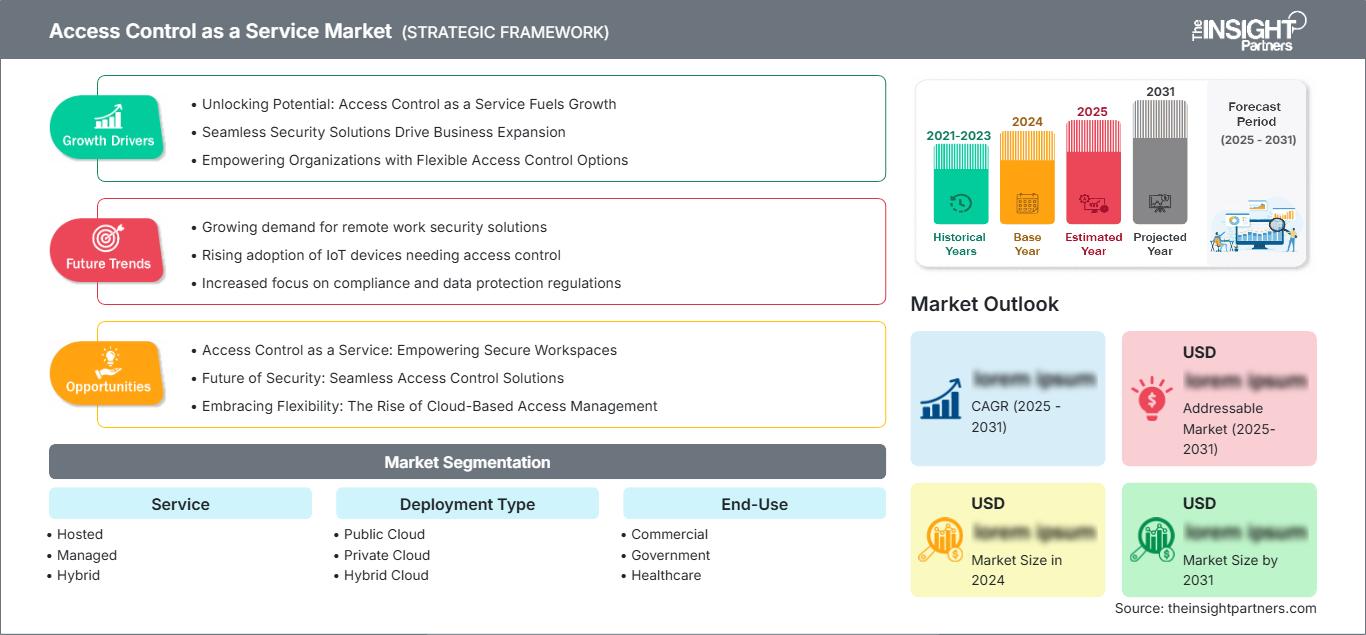
The access control as a service market was valued at US$ 1.66 Billion in 2025 and is projected to reach US$ 7.09 Billion by 2034, expanding at a CAGR of 17.50% during 2026–2034. The market is benefiting from the transition toward cloud-native security architectures, increasing adoption of identity-based access management, and rising demand for remotely managed physical security systems across commercial, institutional, and public-sector facilities. Organizations are increasingly replacing legacy on-premise access systems with subscription-based platforms that support centralized monitoring, scalability, and interoperability.
Across North America, cloud deployment maturity, strong cybersecurity investments, and regulatory emphasis on identity governance continue to accelerate adoption. The access control as a service market size in the region is supported by growing demand for integrated security ecosystems combining access control, video analytics, and visitor management. Commercial real estate modernization, hybrid work environments, and digital transformation initiatives are expected to sustain regional expansion at an estimated CAGR of 15–18% through the forecast period.
Access Control as a Service Market Assessment and Insights
- North America: Accounted for an estimated 36–40% of the access control as a service market share in 2025, supported by advanced cloud security adoption, enterprise digitization, and extensive deployment across commercial and government facilities. The regional market is expected to grow at a 15–18% CAGR during 2026–2034.
- US: Represented approximately 78–82% of North American demand in 2025, driven by enterprise security modernization and smart-building implementation. Growth is projected at a 15–18% CAGR during 2026–2034.
- Europe: Held an estimated 26–30% market share in 2025, led by Germany, the UK, and France. Regulatory emphasis on data security and critical infrastructure protection supports a 16–19% CAGR during 2026–2034.
- Asia Pacific: Accounted for approximately 22–26% share in 2025, with China, Japan, India, and South Korea leading adoption. Rapid digital infrastructure development supports a 19–22% CAGR during 2026–2034.
- Largest Segment: Commercial end-use maintained a 42–46% market share in 2025, reflecting broad deployment across office buildings, retail facilities, and mixed-use properties. The segment is anticipated to expand at a 16–19% CAGR during 2026–2034.
- High Growth Segment: Public Cloud deployment represented approximately 38–42% share in 2025 and is projected to register a 19–22% CAGR during 2026–2034, supported by lower infrastructure costs and simplified management.
- Key companies analyzed in detail: ASSA ABLOY AB, Brivo, Inc., Centrify Corporation, Cisco Systems, Inc., Cloudastructure Inc., Datawatch Systems, Inc., Thales S.A. (Gemalto), Honeywell International Inc., Microsoft Corporation, Johnson Controls International plc (Tyco Integrated Security).
Source: The Insight Partners' analysis based on proprietary research, government publications, company annual reports, investor presentations, industry databases, and expert interviews.
Cloud-based identity management, mobile credential adoption, and software-driven security ecosystems have redefined physical access management during the past decade. Organizations increasingly seek platforms capable of integrating building access, visitor workflows, surveillance, and cybersecurity controls. Improvements in cloud infrastructure reliability and API-driven architecture have enabled access systems to become part of broader enterprise security frameworks while reducing deployment complexity and maintenance requirements.
Looking ahead, adoption is expected to accelerate across emerging economies as governments invest in digital infrastructure and smart-city programs. Expanding regulatory requirements for identity verification, cybersecurity resilience, and critical asset protection are encouraging additional investment in cloud-based access management solutions. Vendor focus on artificial intelligence, predictive analytics, and unified security operations will further strengthen long-term market prospects.
Access Control as a Service Market Report Scope
| Report Attribute | Details |
|---|---|
| Market size in 2025 | US$ 1.66 Billion |
| Market Size by 2034 | US$ 7.09 Billion |
| Global CAGR (2026 - 2034) | 17.50% |
| Historical Data | 2021-2024 |
| Forecast period | 2026-2034 |
Access Control as a Service Market Analysis
The access control as a service market growth trajectory is supported by increasing requirements for centralized access governance and operational efficiency. Enterprises managing multiple facilities increasingly prefer cloud-managed platforms that deliver real-time visibility, software updates, policy enforcement, and remote administration. Growth in smart buildings, distributed workforces, and connected infrastructure is expanding demand for scalable access technologies.
The ecosystem encompasses software providers, cloud infrastructure operators, identity management vendors, hardware manufacturers, system integrators, and managed security providers. Demand is also benefiting from increasing use of mobile credentials and biometric authentication technologies that improve user convenience while strengthening security outcomes. Subscription-based pricing models reduce upfront capital expenditures and encourage adoption among small and medium-sized organizations.
The access control as a service market analysis indicates increasing competition focused on platform consolidation and ecosystem integration. Market participants are emphasizing unified management capabilities that combine access control, surveillance, visitor administration, and analytics. Strategic partnerships have become increasingly important as customers seek interoperable solutions capable of supporting both physical and digital security requirements.
ASSA ABLOY AB continues expanding access technologies through acquisitions and platform development, while Brivo, Inc. strengthens its position in cloud-native security platforms. Honeywell International Inc. and Johnson Controls International plc leverage extensive customer relationships across commercial buildings. Microsoft Corporation contributes cloud infrastructure and identity-management capabilities, while Cisco Systems, Inc. supports secure network integration. These strategic positions are influencing procurement decisions across enterprise and public-sector deployments.
● REPORT CUSTOMIZATION
Tailor This Report To Align With Your Specific Business Requirements
This report can be customized to align precisely with your business objectives, scope, and target markets. Customization options include tailored segmentation, geography, competitive analysis, and strategic insights to support informed decision-making.
Customize This Report →WHAT YOU CAN ADJUST
- ● Segmentations
- ● Geography
- ● Competitive Analysis
- ● Language Preferences
Access Control as a Service Market: Strategic Insights
Regional Insights
North America Access Control as a Service Market
North America represented approximately 36–40% of global access control as a service market revenue in 2025, maintaining its position as the leading regional market. Strong adoption of cloud technologies, high cybersecurity spending, and widespread deployment of enterprise security platforms continue to support market expansion. Organizations across commercial real estate, healthcare, government, and education sectors are accelerating investments in centralized identity and access administration systems.
Regional growth is projected at a CAGR of 15–18% during 2026–2034. Increasing integration between physical and digital security environments remains a major structural driver. Demand for remote credential management, compliance reporting, and smart-building automation is encouraging migration away from traditional on-premise architectures. Continued investment in cloud infrastructure and advanced authentication technologies is expected to strengthen long-term demand.
U.S. Access Control as a Service Market
The United States accounted for approximately 78–82% of North American demand in 2025. The access control as a service market share in the country benefits from widespread enterprise digitalization and a mature ecosystem of software providers, cloud vendors, and security integrators. Adoption remains particularly high across corporate campuses, healthcare facilities, government institutions, and multi-site commercial organizations.
The market is expected to grow at a CAGR of 15–18% through 2034. Strong vendor presence, increasing implementation of mobile credentials, and growing investment in hybrid workplace security solutions are supporting expansion. Demand is also being driven by efforts to unify physical access data with broader cybersecurity and compliance management frameworks, enabling organizations to improve operational visibility and risk governance.
Europe Access Control as a Service Market
Europe accounted for approximately 26–30% of global access control as a service market revenue in 2025 and is projected to expand at a CAGR of 16–19% through 2034. Germany remains the largest regional contributor due to robust industrial infrastructure, advanced manufacturing facilities, and ongoing investments in building modernization. The country's emphasis on operational efficiency and secure facility management is encouraging adoption of cloud-enabled access technologies.
The United Kingdom continues to reap benefits from implementing smart building solutions, upgrading buildings, and integrating security systems. France, Italy, and Spain continue to maintain the consistent implementation of integrated security systems across their transportation, education, health care, and infrastructure sectors. Emphasis on data protection and building security will facilitate the future implementation of integrated security systems.
APAC Access Control as a Service Market
Asia Pacific accounted for approximately 22%-26% of worldwide revenue in 2025 and is projected to grow at the fastest pace among all regions, with a CAGR of 19%-22% through 2034. China is the country with the largest contribution due to numerous smart city installations, the digitization of infrastructure, and construction activities in commercial facilities.
Japan, South Korea, India, and Australia will continue to invest in cloud security solutions. Enterprise mobility, government initiatives to transform digitally, and centralized facility management systems are driving demand for access control services. Growth in data center capacity and intelligent building solutions will continue to drive the market in the long run.
Middle East & Africa Access Control as a Service Market
The Middle East & Africa access control as a service market is projected to expand at a CAGR of 17–20% during 2026–2034. Saudi Arabia and the United Arab Emirates remain leading adopters due to ongoing investments in smart infrastructure, large-scale urban development projects, and advanced facility security initiatives linked to economic diversification programs.
South Africa and other regional markets are benefiting from modernization of commercial facilities, public infrastructure, and industrial assets. Increasing attention to critical infrastructure security, energy-sector protection, and centralized identity management is supporting deployment of cloud-based access platforms. Growing investment in connected buildings is expected to enhance regional market opportunities.
Segmentation Analysis
Service
The Service segment is projected to expand at a CAGR of 17–20% during 2026–2034. The segment continues to benefit from growing preference for subscription-based security management models that reduce internal administrative burdens while improving scalability. The access control as a service market scope continues to widen as organizations adopt flexible service frameworks capable of supporting diverse operational requirements across multiple sites and user groups.
- Hosted – Hosted solutions remain widely adopted among enterprises seeking centralized control without major infrastructure investment. Their ability to support remote administration and software updates enhances operational efficiency and deployment flexibility.
- Managed – Managed offerings provide continuous monitoring, maintenance, and administrative support. Demand is increasing among organizations that prioritize predictable operating costs and limited in-house security management resources.
- Hybrid – Hybrid service models combine local control with cloud-based functionality, supporting organizations that require operational flexibility while maintaining certain data or security workloads on-site.
Deployment Type
The Deployment Type segment will experience a CAGR of 18–21% between 2026–2034. Increasing confidence in the cloud environment, improved network connectivity, and rising integration demands are factors driving deployment modernization. More enterprises are choosing deployment approaches based on their compliance and cybersecurity requirements.
- Public Cloud – Public cloud deployments have gained strong momentum due to lower implementation costs, rapid scalability, and simplified software management. They are particularly attractive for organizations operating distributed facilities across multiple regions.
- Private Cloud – Private cloud environments remain important for entities requiring greater control over data governance, compliance obligations, and customized security configurations across sensitive facilities.
- Hybrid Cloud – Hybrid cloud deployment provides a balanced approach by combining centralized cloud functionality with localized control. Adoption is rising among organizations managing complex regulatory and operational requirements.
End-Use
The End-Use segment access control as a service market is projected to expand at a CAGR of 17–19% during 2026–2034. Increasing focus on physical security modernization, workforce mobility, and identity-based access management continues to support adoption across a broad range of industries. Sector-specific compliance requirements also influence technology selection and deployment priorities.
- Commercial – The largest end-use category benefits from extensive demand across office buildings, retail complexes, hospitality venues, and mixed-use developments. Organizations increasingly prioritize centralized access control and operational visibility.
- Government – Government agencies continue to invest in secure credential management, facility protection, and critical infrastructure resilience. Cloud-based management capabilities support operational consistency across multiple locations.
- Healthcare – Healthcare institutions require strict control of sensitive areas, patient information environments, and staff movements. Integrated access management improves compliance and security performance within complex facilities.
- Education – Educational institutions are adopting advanced access platforms to strengthen campus safety, visitor management, and emergency response capabilities while streamlining administrative operations.
- Utilities – Utility operators increasingly implement centralized access controls to protect mission-critical assets, support regulatory obligations, and enhance security across geographically dispersed infrastructure networks.
Opportunity Snapshot
| End-Use | Revenue Contribution | Trend Tag | Adoption Stage |
| Commercial | High | Smart Buildings | Mature |
| Government | High | Critical Security | Scaling |
| Healthcare | Medium | Digital Identity | Scaling |
| Education | Medium | Campus Safety | Scaling |
| Utilities | Medium | Infrastructure Protection | Emerging |
Access Control as a Service Market Growth Drivers and Impact Analysis
Expansion of Cloud-Based Physical Security Infrastructure
There is an increasing trend among organizations in using cloud-managed platforms for access control, rather than legacy access control hardware. This trend is fueled by digital transformation initiatives in enterprises and the need for remote management functionalities. There are several advantages for multi-location businesses from using cloud-based platforms, such as centralized credential management, automated software updates, and improved scalability. With increasing decentralization of workspaces, cloud-based solutions offer greater flexibility than on-premises solutions. Additionally, there will be improved compatibility between cloud access control systems and cybersecurity, visitor management, and video surveillance platforms.
Growing Convergence of Physical and Cybersecurity Programs
Security professionals have become more aware of the need to incorporate physical access management systems within cybersecurity models. The adoption of identity-based solutions that lower the chances of security breaches is on the rise. Access, authentication, and authorization logs are increasingly critical components of comprehensive risk management plans. Such an approach contributes to improved incident management, enhanced governance practices, and better visibility. With the growing regulatory focus on identity management, organizations are now turning to technologies that facilitate centralized monitoring and enforcement. These integration possibilities are spurring the need for advanced access control services.
Acceleration of Smart Building and Digital Workplace Investments
Smart buildings have brought about significant changes in facility management. More facility managers and businesses now utilize IoT systems to optimize processes, improve performance, and manage resources. The use of access control has become an integral part of the building management ecosystem. In hybrid work environments, where people can either work remotely or be physically present at the workplace, access control systems that meet these requirements are crucial. They can also be integrated into energy management, workplace analytics, and occupancy monitoring systems. This helps ensure continued investments and growth in the market.
Access Control as a Service Market Future Trends
AI-Driven Security Intelligence Platforms
One of the most significant access control as a service market trends involves the integration of artificial intelligence into security management workflows. Future systems will utilize behavioral analysis, anomaly detection, and predictive risk assessment to detect threats before they become actual problems. AI systems will evaluate entry behavior, credential usage, and facility activity levels in real time. As enterprises become more proactive in their approach to security, vendors are expected to devote considerable effort to developing intelligent automation and analytics systems. Machine learning combined with a cloud access management system will transform many operational decisions and approaches to security.
Expansion of Mobile and Biometric Credentials
Mobile devices and biometric systems are expected to be used increasingly in access management frameworks. Companies consider smartphone credentials, facial recognition technology, and biometric systems to be efficient alternatives to conventional access credentials such as cards and keys. In future implementations, ease of use is likely to be prioritized at the expense of maintaining high security standards. Innovations in authentication precision, device compatibility, and cloud integration will fuel this trend. As digital identity systems evolve worldwide, companies will adopt credentialing systems to manage access in both physical and digital spaces.
Access Control as a Service Market Opportunities
Expansion Across Critical Infrastructure Modernization Programs
The access control as a service market Forecasts indicate substantial opportunities arising from infrastructure modernization initiatives across transportation, utilities, healthcare, and public-sector facilities. For governments and infrastructure operators, the centralization of access management, authentication, and operational resilience is increasingly important. In light of the modernization of aging physical security environments, cloud-managed access control platforms are more scalable and visible, but less complex to maintain over their life cycle. Programs involving smart cities, transportation centers, power plants, and government buildings provide good opportunities for deployment. Vendors that can provide an interoperable platform encompassing access management, video surveillance, visitor management, and analytics should do well in these programs, which have long procurement cycles and growing capital pipelines.
Growth Potential in Mid-Sized Enterprise Digital Transformation
The mid-sized organization segment is an important potential market due to the historically limited use of more advanced access control technologies. Many such businesses are currently running on older systems that lack centralization or cloud connectivity. The adoption barrier is being lowered through service-based pricing models that reduce upfront investment costs. Rising interest in cybersecurity, compliance management, and mobility has driven interest in upgrades to security infrastructure in regional organizations. Solution providers that are easy to implement, flexible in pricing models, and offer security features will benefit from rising demand. Due to the need for operational efficiency and centralized identity management, solution adoption will increase across the commercial, educational, healthcare, and industrial domains.
Frequently Asked Questions

- Comprehensive Market Sizing and Forecast Analysis
- Detailed Segmentation Analysis
- In-Depth Market Dynamics Assessment
- Regional and Country-Level Insights
- Competitive Landscape and Company Benchmarking
- Strategic Business Intelligence
Recent Reports
Testimonials

The Insight Partners' SCADA System Market report is comprehensive, with valuable insights on current trends and future forecasts. The team was highly professional, responsive, and supportive throughout. We are very satisfied and highly recommend their services.
RAN KEDEM Partner, Reali Technologies LTDs
I requested a report on a very specific software market and the team produced the report in a few days. The information was very relevant and well presented. I then requested some changes and additions to the report. The team was again very responsive and I got the final report in less than a week.
JEAN-HERVE JENN Chairman, Future Analytica
We worked with The Insight Partners for an important market study and forecast. They gave us clear insights into opportunities and risks, which helped shape our plans. Their research was easy to use and based on solid data. It helped us make smart, confident decisions. We highly recommend them.
PIYUSH NAGPAL Sr. Vice President, High Beam Global
The Insight Partners delivered insightful, well-structured market research with strong domain expertise. Their team was professional and responsive throughout. The user-friendly website made accessing industry reports seamless. We highly recommend them for reliable, high-quality research services
YUKIHIKO ADACHI CEO, Deep Blue, LLC.
This is the first time I have purchased a market report from The Insight Partners.While I was unsure at first, I visited their web site and felt more comfortable to take the risk and purchase a market report.I am completely satisfied with the quality of the report and customer service. I had several questions and comments with the initial report, but after a couple of dialogs over email with their analyst I believe I have a report that I can use as input to our strategic planning process.Thank you so much for taking the extra time and making this a positive experience.I will definitely recommend your service to others and you will be my first call when we need further market data.
JOHN SUZUKI President and Chief Executive Officer, Board Director, BK Technologies
I wish to appreciate your support and the professionalism you displayed in the course of attending to my request for information regarding to infectious disease IVD market in Nigeria. I appreciate your patience, your guidance, and the fact that you were willing to offer a discount, which eventually made it possible for us to close a deal. I look forward to engaging The Insight Partners in the future, all thanks to the impression you have created in me as a result of this first encounter.
DR CHIJIOKE ONYIA MANAGING DIRECTOR, PineCrest Healthcare Ltd.Reason to Buy
- Informed Decision-Making
- Understanding Market Dynamics
- Competitive Analysis
- Identifying Emerging Markets
- Customer Insights
- Market Forecasts
- Risk Mitigation
- Boosting Operational Efficiency
- Strategic Planning
- Investment Justification
- Tracking Industry Innovations
- Aligning with Regulatory Trends





 Get Free Sample for