
Access Control Reader Market Expert Analysis by Size and Share 2034
Coverage: by Reader Type (Biometric Readers, Card-Based Readers, Multi-Technology Readers); End User (Residential, Commercial, BFSI, Healthcare, Government, Transportation, Others) , and Geography (North America, Europe, Asia Pacific, and South and Central America)
- Status : Data Released
- Report Code : TIPRE00006496
- Category : Electronics and Semiconductor
- No. of Pages : 150
- Available Report Formats :


- Last update date : July 10, 2026


2025 Market Size
US$ 3.92 Bn
Base year value
2034 Forecast
US$ 16.88 Bn
Projected by 2034
CAGR 2026-2034
17.61 %
Growth rate
Addressable Market
US$ 86.53 Bn
(2026-2034)
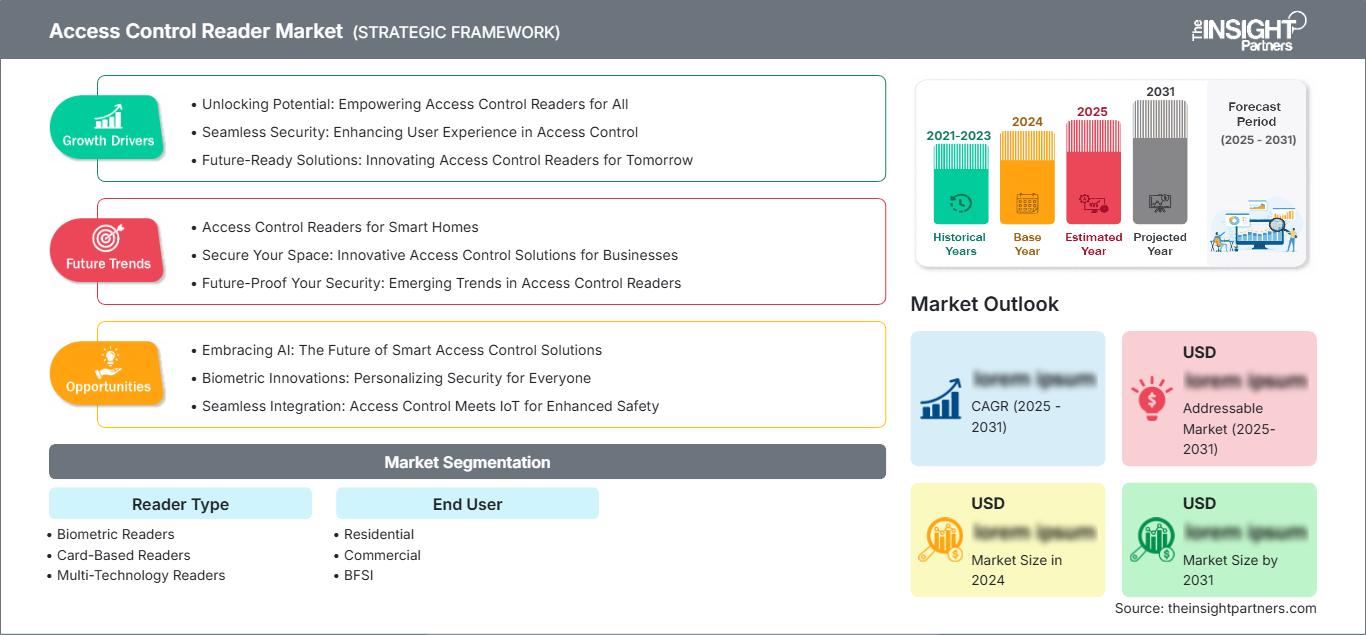
The global Access Control Reader market was valued at US$ 3.92 billion in 2025 and is expected to reach US$ 16.88 billion by 2034; it is estimated to record a CAGR of 17.61% during 2026-2034.
Access Control Reader Market Assessment and Insights
- North America: held 34%–38% share in 2025 and is projected to grow at 9.8%–10.8% CAGR between 2026–2034, supported by commercial retrofits, cloud-managed access control, and healthcare security modernization.
- US: represented 82%–88% of North America in 2025 and is expected to grow at 9.9%–10.7% CAGR, driven by corporate campuses, hospitals, schools, and data centers.
- Europe: accounted for 22%–26% of the share in 2025 and is forecast to grow at 9.0%–10.0% CAGR, led by Germany, the UK, France, Italy, and Spain.
- Asia Pacific: held 28%–33% share in 2025 and is projected to grow at 11.5%–12.8% CAGR, led by China, Japan, South Korea, India, and Australia.
- Largest Segment: Card-Based Readers held 46%–50% market share in 2025 and is expected to grow at 8.8%–9.8% CAGR as RFID and smart-card estates remain widely installed.
- High Growth Segment: Multi-Technology Readers held 24%–28% market share in 2025 and is projected to grow at 12.0%–13.4% CAGR as facilities combine cards, biometrics, mobile credentials, and PINs.
- Key companies analyzed in detail: ASSA ABLOY AB, Motorola Solutions, Inc., AMAG Technology, Inc., Identiv, Inc., Gallagher Group Limited, Thales S.A., Nedap N.V., Johnson Controls International plc, NEC Corporation, Suprema Inc.
Source: The Insight Partners' analysis based on proprietary research, government publications, company annual reports, investor presentations, industry databases, and expert interviews.
The Access Control Reader Market has transitioned from proximity card technology to more sophisticated readers integrating encryption, biometrics, mobile access control, and remote management. The production environment will focus on moving towards secure chipset solutions, power-efficient controllers, edge computing and processing, and open interfaces. The trend will be strengthened by the demands of the aviation sector, health care providers, commercial real estate companies, and public infrastructure agencies, who need better identity assurance without a complete revamp of their access control infrastructure.
Investment is anticipated to occur in the Asia-Pacific and Middle East regions, as well as in areas with high urban density, due to the expansion of technologies related to digital identity, smart cities, upgrades in transport, and facility security, and contribute to the Access Control Reader Market Forecast. The market boundaries are widening due to customers' preference for interoperability, security, and manageability in hardware and credential exchange processes.
Access Control Reader Market Report Scope
| Report Attribute | Details |
|---|---|
| Market size in 2025 | US$ 3.92 Billion |
| Market Size by 2034 | US$ 16.88 Billion |
| Global CAGR (2026 - 2034) | 17.61% |
| Historical Data | 2021-2024 |
| Forecast period | 2026-2034 |
Access Control Reader Market Analysis
Demand is being influenced by the desire to have more entryways but without compromising the user experience. Commercial campuses, hospitals, tall office buildings, airports, and government buildings have started implementing access control not only for the entrances but for elevators, cabinets, laboratories, server rooms, and other secure facilities as well. The ACI World reported that there were 9.4 billion airport passengers in 2024 and forecasted 9.8 billion in 2025.
The ecosystem includes reader manufacturers, semiconductor suppliers, biometric sensor providers, credential issuers, integrators, software platforms, and facility owners, reinforcing the broader Access Control Reader Market Analysis. Vendor preference is biased towards suppliers that can effectively integrate secure hardware, mobile credentials, OSDP transition, edge authentication, and cloud management. Analysis of the market has revealed that, apart from reader cost, factors such as lifecycle cost, card-installed compatibility, and cybersecurity have become equally important.
The competition structure is diversified but moving towards platforms. The companies that are taking advantage of their established building access networks include ASSA ABLOY AB and Johnson Controls International plc. At the same time, Motorola Solutions, Inc. combines building access and video security. AMAG Technology, Inc., Gallagher Group Limited, Identiv, Inc., Nedap N.V., Thales S.A., NEC Corporation, and Suprema Inc. are competing by means of reader offerings and biometric security.
Investment is moving toward readers that protect legacy migration while supporting future credentials, helping vendors strengthen their Access Control Reader Market Share. Strategic positioning favors open architecture, durable outdoor design, encrypted communication, biometric accuracy, and cloud-managed estates. The market share of integrated vendors is expected to rise where buyers consolidate access, video, alarms, visitor management, and identity workflows under fewer operating platforms.
● REPORT CUSTOMIZATION
Tailor This Report To Align With Your Specific Business Requirements
This report can be customized to align precisely with your business objectives, scope, and target markets. Customization options include tailored segmentation, geography, competitive analysis, and strategic insights to support informed decision-making.
Customize This Report →WHAT YOU CAN ADJUST
- ● Segmentations
- ● Geography
- ● Competitive Analysis
- ● Language Preferences
Access Control Reader Market: Strategic Insights
Regional Insights
North America Access Control Reader
North America held 34%–38% share in 2025 and is expected to expand at 9.8%–10.8% CAGR. The growth will be supported by modernization of offices, controls for access to healthcare, programs for the security of schools, smart access for multi-family and security for data centers. The cloud native administration and mobile credentials have accelerated the migration of readers from old Wiegand systems to more secured communication protocol.
Interoperability will be an important feature that will be favored by regional buyers, as the facilities have mixed door hardware, cards and software, which is a result of changing Access Control Reader Market Trends. There is an increased demand for the readers in the U.S. and Canada in the sectors of commercial real estate, hospitals, logistics and public buildings.
U.S. Access Control Reader Market
The U.S. represented 82%–88% of North America in 2025 and is projected to grow at 9.9%–10.7% CAGR. The demand for our products is prevalent in corporate parks, hospitals, residential complexes, airports, data centers, educational institutions, and government facilities. The company has an extensive market coverage with suppliers all over the world providing readers, panels, identity solutions, video integration, and managed access solutions.
Applications focus on mobile access, visitor management, contractor identity, and secure audit logging. According to IATA, an increasing number of travelers like mobile and digital identity solutions. This trend is consistent with airport and transport identity management systems modernization. U.S.-based consumers value card-based readers working alongside Bluetooth, NFC, QR, and biometric readers during phased deployment.
Europe Access Control Reader Market
Europe accounted for 22%–26% share in 2025 and is forecast to grow at 9.0%–10.0% CAGR, with Germany as the leading country. Office refurbishments, educational security, healthcare estate development, and access to residences are the strengths of the UK. Privacy policies enforced under the GDPR affect buyers' awareness of how credentials and biometrics are managed.
Germany takes the lead in industries by way of industrial campuses, logistics centers, local authority buildings, and transportation companies requiring strong readers on their large estates. The demand is driven by manufacturing automation, the need for secure facilities, and the need for reliable lifecycle solutions. Customers favor open standards, secure communications, and long term compatibility
The Access Control Reader Market Size in France, Italy, and Spain contributes to transportation, hospitality, healthcare, and public sector developments, supporting the overall Access Control Reader Market Size in Europe. There are greater contributions from public infrastructure development and corporate demand in France, from industrial and hospitality contributions in Italy, and from smart city, tourism, and residential access contributions in Spain.
APAC Access Control Reader Market
Asia Pacific held 28%–33% share in 2025 and is projected to grow at 11.5%–12.8% CAGR. China is the leading country, supported by smart city infrastructure, transport systems, manufacturing campuses, and large commercial developments. Japan and South Korea add demand through advanced biometrics, mobile access, and enterprise-grade security modernization.
Adoption in India and Australia occurs via offices, airports, hospitals, educational institutions, mining operations, logistics operations, and high-rise residential buildings. Factors that affect policy include digital identity, urban safety, data centers, and critical infrastructure protection. Batteries and wireless-ready readers play a key role in cases where retrofitting buildings must happen quickly or at dispersed access points in industrial settings.
Manufacturing expertise in the region also ensures that products can be localized quickly and more cost-effectively. Organizations involved in such deployments include Suprema Inc., NEC Corporation, ASSA ABLOY AB, Johnson Controls International plc, Identiv, Inc., and Thales S.A.
Middle East & Africa Access Control Reader Market
Middle East & Africa is projected to grow at 10.8%–12.0% CAGR. The UAE leads through airports, hospitality, smart buildings, and public security programs, while Saudi Arabia is expanding access infrastructure across energy, logistics, industrial zones, and large urban projects.
The energy and infrastructure sectors provide good examples, as oil and gas operations, ports, utilities, and construction projects all have dispersed access controls. Robust readers, mobile credentials, and remote monitoring support contractors' movements, control rooms, equipment yards, and valuable resources.
South Africa and other MEA countries show selective demand for corporate offices, healthcare, mining, education, and public utilities. The implementation is feasible given the integrator's capabilities and budget, although wireless and scalable reader architectures lower the entry barriers.
Segmentation Analysis
Reader Type
Reader Type is expected to grow at 10.1%–11.2% CAGR during 2026–2034 as organizations replace single-purpose readers with devices supporting stronger encryption, mobile credentials, biometrics, and open communication protocols. Adoption varies by installed base, security level, and cost tolerance. The Access Control Reader trends across reader types show that migration flexibility is often more important than immediate full credential replacement.
- Biometric Readers: Demand is rising in healthcare, BFSI, airports, and government buildings where identity assurance, auditability, and reduced credential sharing are priorities despite higher sensor and enrollment complexity.
- Card-Based Readers: These readers remain the installed-base leader because RFID and smart-card credentials are familiar, economical, and widely deployed across commercial, residential, education, and public facilities.
- Multi-Technology Readers: Adoption is accelerating as organizations support cards, smartphones, PINs, QR credentials, and biometrics through one reader, reducing migration risk and improving long-term flexibility.
End User
End User demand is projected to grow at 10.4%–11.6% CAGR during 2026–2034, reflecting wider deployment across commercial, regulated, residential, and infrastructure environments. Adoption is strongest where access control improves safety, compliance, tenant experience, or operational accountability. The growth in the Access Control Reader Market across end users is increasingly linked to facility digitization and centralized security operations.
- Residential: Multifamily buildings, gated communities, and rental properties use readers to streamline resident access, visitor entry, deliveries, maintenance permissions, and amenity security.
- Commercial: Offices, campuses, retail sites, and mixed-use assets lead adoption because they need scalable access, mobile credentials, visitor control, and integration with building systems.
- BFSI: Banks and financial institutions prioritize controlled access for branches, vault-adjacent areas, server rooms, ATM service zones, and audit-sensitive operational spaces.
- Healthcare: Hospitals and clinics deploy readers for pharmacies, laboratories, wards, records rooms, and staff-only areas where security, hygiene, and identity accuracy intersect.
- Government: Public buildings, civic infrastructure, law enforcement facilities, and defense-adjacent sites require credential policy enforcement, restricted-zone controls, and reliable event records.
- Transportation: Airports, ports, metro systems, depots, and logistics hubs use readers to secure staff-only routes, equipment rooms, maintenance areas, gates, and contractor movement.
Opportunity Snapshot
| End User | Revenue Contribution | Trend Tag | Adoption Stage |
| Residential | Medium | Smart Locks | Scaling |
| Commercial | High | Mobile Access | Mature |
| BFSI | Medium | Secure Branches | Mature |
| Healthcare | Medium | Restricted Zones | Scaling |
| Government | Medium | Identity Assurance | Scaling |
| Transportation | Low | Gate Security | Emerging |
Access Control Reader Market Growth Drivers and Impact Analysis
Retrofit Demand for Wireless and Low-Disruption Access
Retrofit programs are a major driver because many facilities still depend on mechanical keys, legacy proximity readers, or wiring layouts that limit electronic access expansion. Low-disruption readers allow owners to secure more interior doors, cabinets, apartments, service areas, and remote gates without major construction. The market impact is a larger addressable base, shorter deployment cycles, and stronger business cases for phased modernization, supporting sustained Access Control Reader Market Growth. Commercial landlords, hospitals, and multifamily operators can improve control over previously unmanaged openings while reducing tenant disruption and installation labor.
Shift Toward Mobile, Biometric, and Multi-Credential Access
Credential strategy is shifting from single-card access toward smartphones, biometric verification, QR codes, PINs, and multi-factor workflows. This transition increases demand for readers that support multiple credential types while maintaining secure communication and practical administration. The real-world impact is higher replacement value per door because buyers view readers as migration platforms rather than static peripherals. Multi-technology devices help organizations preserve existing card investments while introducing stronger authentication for sensitive spaces, visitors, contractors, and mobile-first users, enabling suppliers to expand their Access Control Reader Market Share.
Security Compliance Across Critical and Distributed Facilities
Security compliance is becoming more important in healthcare, BFSI, government, transportation, and critical infrastructure. These environments require access logs, restricted-zone enforcement, rapid credential revocation, and role-based permissions. Readers extend control to medicine storage, records rooms, control rooms, utility cabinets, and contractor entry points where manual keys create risk. The market impact is a shift from convenience-led purchases toward risk-led deployments that support investigations, audits, insurance expectations, and incident response across distributed facilities, supporting the long-term Access Control Reader Market Forecast.
Access Control Reader Market Future Trends
Battery-Aware Edge Intelligence in Access Readers
Edge intelligence that accounts for power consumption would become an essential feature as users increasingly rely on local execution of their authentication processes. Future devices will need to perform tasks such as biometric matching, encryption checks, security assessments, wireless communication, and event logging without increasing maintenance overhead. It is the efficiency of the firmware and the ability to sleep when not needed, operate securely offline, and predict device health that will create a competitive advantage. This trend will be especially important for distributed campuses.
Cloud-Managed Reader Fleets and Mobile Credential Ecosystems
Cloud-managed reader fleets are expected to reshape procurement as organizations deal with multiple locations, hybrid work arrangements, tenant changes, and visiting people. A centralized control system will allow teams to create, revoke, and monitor cards without any hassle and reduced physical card management. The future will rely on cybersecurity assurances, openness of integration, ability to operate offline, and synchronization after a disruption in the network. Readers provided by vendors that integrate readers' hardware with identity, video, and building processes are more likely to succeed in the context of Access Control Reader Market Trends.
Access Control Reader Market Opportunities
Multifamily and Smart Residential Access Expansion
Multifamily housing offers a strong opportunity as it meets the important requirement of secure, easy access for all users, including occupants, guests, cleaning crews, and deliveries. One can easily simplify key management across many entry points, such as apartment entrance gates, common areas, parking spaces, mailboxes, and service entrances. Key investments are needed in mobile credential onboarding, occupant administration, integration with property management systems, and device health monitoring.
Secure Access Modernization in Healthcare and BFSI
Healthcare and BFSI are among the key areas for development as they both need restricted access, identity management, and swift handling of credential updates. In hospitals, there is a need for secure access to pharmacies, laboratories, maternity units, document storage facilities, and employees' only zones, while banks ensure secure access to their branches, cash vaults, ATM servicing facilities, and infrastructure. Vendors that demonstrate reliability and compliance support will gain preference, strengthening the long-term Access Control Reader Market Size.
Recent Developments
- In March 2026: ROC launched the ROC Access Face1, its first biometric reader designed for physical access control, marking the company's expansion into the access control market. The AI-powered device combines facial biometric authentication with real-time video analytics for enhanced security. Face1 supports multiple operating modes, watchlist and weapon detection, and integrates with existing access control systems without replacing them.
- In May 2025: Suprema introduced BioStar Air, a cloud-native biometric access control platform built on a smart edge architecture. The solution eliminates the need for on-premise servers and controllers while supporting face recognition, RFID cards, mobile credentials, and QR codes. It enables scalable, secure, and simplified access management for distributed workplaces with biometric processing performed directly at the edge.
- In September 2025: Wavelynx launched the APEX Reader, a next-generation RFID access control reader engineered for long-term durability, adaptability, and future-ready security. The reader supports current and emerging credential technologies, including mobile wallets, and features military-grade encryption and rugged construction. Designed to reduce replacement cycles, it helps organizations modernize access control while protecting long-term infrastructure investments.
Frequently Asked Questions

- Comprehensive Market Sizing and Forecast Analysis
- Detailed Segmentation Analysis
- In-Depth Market Dynamics Assessment
- Regional and Country-Level Insights
- Competitive Landscape and Company Benchmarking
- Strategic Business Intelligence
Recent Reports
Testimonials

The Insight Partners provided valuable market intelligence that supported our global go-to-market strategy. Their team was professional, responsive, and attentive to our feedback, providing thoughtful analysis and helpful methodological clarifications throughout the project.
Junmo Kim Chief Financial Officer (CFO), Enertech Co., Ltd.
The Insight Partners' SCADA System Market report is comprehensive, with valuable insights on current trends and future forecasts. The team was highly professional, responsive, and supportive throughout. We are very satisfied and highly recommend their services.
RAN KEDEM Partner, Reali Technologies LTDs
I requested a report on a very specific software market and the team produced the report in a few days. The information was very relevant and well presented. I then requested some changes and additions to the report. The team was again very responsive and I got the final report in less than a week.
JEAN-HERVE JENN Chairman, Future Analytica
We worked with The Insight Partners for an important market study and forecast. They gave us clear insights into opportunities and risks, which helped shape our plans. Their research was easy to use and based on solid data. It helped us make smart, confident decisions. We highly recommend them.
PIYUSH NAGPAL Sr. Vice President, High Beam Global
The Insight Partners delivered insightful, well-structured market research with strong domain expertise. Their team was professional and responsive throughout. The user-friendly website made accessing industry reports seamless. We highly recommend them for reliable, high-quality research services
YUKIHIKO ADACHI CEO, Deep Blue, LLC.
This is the first time I have purchased a market report from The Insight Partners.While I was unsure at first, I visited their web site and felt more comfortable to take the risk and purchase a market report.I am completely satisfied with the quality of the report and customer service. I had several questions and comments with the initial report, but after a couple of dialogs over email with their analyst I believe I have a report that I can use as input to our strategic planning process.Thank you so much for taking the extra time and making this a positive experience.I will definitely recommend your service to others and you will be my first call when we need further market data.
JOHN SUZUKI President and Chief Executive Officer, Board Director, BK Technologies
I wish to appreciate your support and the professionalism you displayed in the course of attending to my request for information regarding to infectious disease IVD market in Nigeria. I appreciate your patience, your guidance, and the fact that you were willing to offer a discount, which eventually made it possible for us to close a deal. I look forward to engaging The Insight Partners in the future, all thanks to the impression you have created in me as a result of this first encounter.
DR CHIJIOKE ONYIA MANAGING DIRECTOR, PineCrest Healthcare Ltd.Reason to Buy
- Informed Decision-Making
- Understanding Market Dynamics
- Competitive Analysis
- Identifying Emerging Markets
- Customer Insights
- Market Forecasts
- Risk Mitigation
- Boosting Operational Efficiency
- Strategic Planning
- Investment Justification
- Tracking Industry Innovations
- Aligning with Regulatory Trends





 Get Free Sample for