
Account Reconciliation Software Market Share, Growth & Forecast by 2034
Coverage: by Offering (Software, Service); Deployment Model (On-Premise, Cloud); Reconciliation Type (Bank Reconciliation, Customer Reconciliation, Inter-Company Reconciliation, Others); Industry Vertical (BFSI, Manufacturing, Energy and Utilities, Government and Public Sector, Healthcare, IT and Telecom, Retail and E-Commerce, Others) , and Geography (North America, Europe, Asia Pacific, and South and Central America)
- Status : Data Released
- Report Code : TIPRE00012422
- Category : Technology, Media and Telecommunications
- No. of Pages : 150
- Available Report Formats :


- Last update date : August 07, 2026


2025 Market Size
US$ 4.10 Bn
Base year value
2034 Forecast
US$ 9.54 Bn
Projected by 2034
CAGR 2026-2034
9.85 %
Growth rate
Addressable Market
US$ 60.78 Bn
(2026-2034)
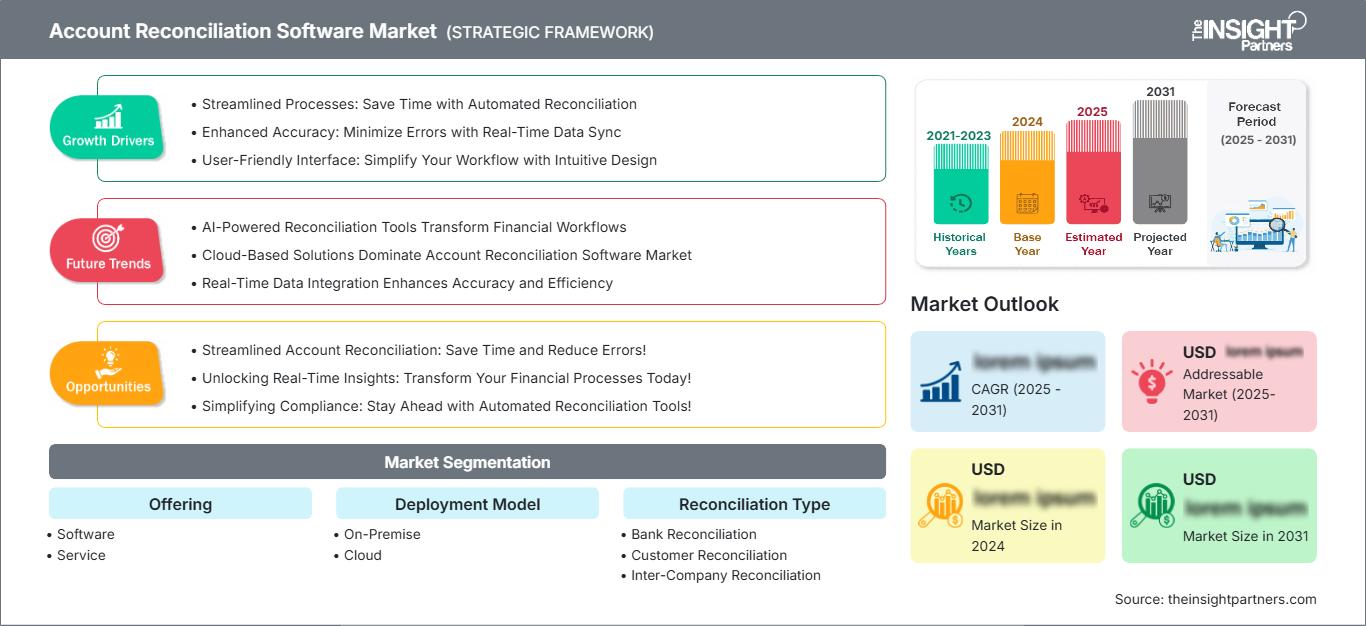
The account reconciliation software market was valued at US$ 4.10 Billion in 2025 and is projected to reach US$ 9.54 Billion by 2034, expanding at a CAGR of 9.85% during 2026–2034. The market is benefiting from rising financial data volumes, stricter compliance obligations, and increasing enterprise demand for automation across accounting functions. Organizations across banking, healthcare, manufacturing, and retail sectors are investing in intelligent reconciliation platforms to improve financial accuracy, accelerate closing cycles, and reduce operational risk associated with manual reconciliations.
Across North America, adoption remains strong as enterprises continue modernizing finance and accounting infrastructure. The account reconciliation software market size in the region is supported by widespread cloud ERP deployments, growing requirements for governance and audit readiness, and increasing usage of AI-enabled financial controls. Large organizations are prioritizing continuous reconciliation frameworks that enhance visibility into transactions, improve exception management, and support regulatory compliance in increasingly complex operating environments.
Account Reconciliation Software Market Assessment and Insights
- North America: Maintains leadership through advanced enterprise software adoption, mature financial services ecosystems, and strong compliance frameworks. Share in 2025: 36–40%; CAGR between 2026–2034: 8.8–9.6%.
- US: Represents the largest regional country market due to extensive deployment among financial institutions and multinational enterprises. Share in 2025: 72–76% of North America; CAGR between 2026–2034: 8.9–9.7%.
- Europe: Strong demand from the UK, Germany, France, Italy, and Spain supports expansion of automated financial governance platforms. Share in 2025: 27–31%; CAGR between 2026–2034: 9.2–10.0%.
- Asia Pacific: Rising digital transformation investments in China, Japan, India, South Korea, and Australia are accelerating implementation. Share in 2025: 22–26%; CAGR between 2026–2034: 11.2–12.0%.
- Largest Segment: Cloud deployment dominates through scalability, rapid implementation, and integration with modern ERP ecosystems. Account reconciliation software market share in 2025: 58–62%; CAGR 2026–2034: 10.5–11.3%.
- High Growth Segment: Customer Reconciliation benefits from expanding digital payment ecosystems and increasing transaction complexity. Market share in 2025: 24–28%; CAGR 2026–2034: 11.8–12.6%.
- Key companies analyzed in detail: AutoRek Limited; BlackLine, Inc.; Broadridge Financial Solutions, Inc.; Fiserv, Inc.; Oracle Corporation; Intuit Inc.; ReconArt, Inc.; SAP SE; The Sage Group plc; Xero Limited.
Source: The Insight Partners' analysis based on proprietary research, government publications, company annual reports, investor presentations, industry databases, and expert interviews.
Account reconciliation software market enterprise finance functions are shifting from periodic reconciliation practices toward continuous, automated monitoring environments. Artificial intelligence, machine learning, robotic process automation, and advanced analytics capabilities are increasingly embedded into reconciliation platforms to reduce manual intervention and identify anomalies more effectively. Cloud-native architectures have also improved accessibility and deployment flexibility, encouraging broader adoption among large enterprises as well as small and medium-sized businesses seeking efficient financial close processes.
Future expansion is expected to be supported by increasing digitization across emerging economies, rising investments in finance transformation initiatives, and stronger regulatory attention toward financial transparency. Financial institutions, healthcare providers, retailers, and government organizations are expected to allocate greater budgets toward automation technologies. As digital transaction volumes increase globally, vendors are expected to focus on intelligent exception handling, predictive reconciliation, and enhanced interoperability with ERP and treasury management platforms.
Account Reconciliation Software Market Report Scope
| Report Attribute | Details |
|---|---|
| Market size in 2025 | US$ 4.10 Billion |
| Market Size by 2034 | US$ 9.54 Billion |
| Global CAGR (2026 - 2034) | 9.85% |
| Historical Data | 2021-2024 |
| Forecast period | 2026-2034 |
Account Reconciliation Software Market Analysis
The account reconciliation software market growth trajectory is supported by increasing complexity in financial operations across organizations of all sizes. Businesses are processing larger transaction volumes through digital banking channels, payment gateways, ERP systems, and e-commerce platforms. Manual matching processes often create delays, increase operating costs, and elevate the risk of errors. Consequently, enterprises are adopting automated reconciliation solutions capable of validating, matching, and reporting financial transactions in near real time.
Rising integration between reconciliation platforms and enterprise financial systems continues to strengthen market expansion. Technology providers are improving interoperability with ERP, treasury management, payment processing, and accounting software ecosystems. Enhanced data visibility, faster month-end close cycles, and improved financial governance have made automated reconciliation increasingly valuable for organizations seeking operational efficiency and risk reduction.
The account reconciliation software market analysis indicates that competition is increasingly centered on automation capability, cloud readiness, artificial intelligence integration, and scalability. Vendors are differentiating solutions through advanced matching engines, workflow automation, predictive analytics, and configurable compliance reporting features. Market participants are also expanding service offerings to include implementation support, integration consulting, and managed reconciliation services.
Leading companies including BlackLine, Inc., Oracle Corporation, SAP SE, Fiserv, Inc., and Broadridge Financial Solutions, Inc. continue investing in intelligent finance automation capabilities. Meanwhile, specialists such as AutoRek Limited and ReconArt, Inc. are focusing on flexible reconciliation frameworks that address industry-specific requirements. Intuit Inc., Xero Limited, and The Sage Group plc continue targeting small and mid-sized enterprises with cloud-based accounting ecosystems that incorporate reconciliation functionality as part of broader financial management suites.
● REPORT CUSTOMIZATION
Tailor This Report To Align With Your Specific Business Requirements
This report can be customized to align precisely with your business objectives, scope, and target markets. Customization options include tailored segmentation, geography, competitive analysis, and strategic insights to support informed decision-making.
Customize This Report →WHAT YOU CAN ADJUST
- ● Segmentations
- ● Geography
- ● Competitive Analysis
- ● Language Preferences
Account Reconciliation Software Market: Strategic Insights
Regional Insights
North America Account Reconciliation Software Market
North America accounted for 36–40% of the global market in 2025 and continues to represent the largest regional revenue contributor. The region benefits from high adoption of finance automation technologies, strong cloud infrastructure penetration, and extensive digitization across banking, insurance, healthcare, and retail industries. Organizations are increasingly deploying automated reconciliation solutions to improve compliance monitoring, reduce manual processing burdens, and accelerate financial close cycles. The region is projected to expand at a CAGR of 8.8–9.6% during 2026–2034.
Large enterprises are integrating reconciliation platforms with enterprise resource planning, treasury management, and payment processing systems to improve financial transparency. Demand also continues to be influenced by audit readiness requirements and internal control initiatives. Financial institutions remain among the largest adopters due to growing transaction volumes and expanding digital payment ecosystems. The account reconciliation software market share remains highest in North America because of its mature software landscape, concentration of solution providers, and sustained investments in intelligent accounting technologies.
U.S. Account Reconciliation Software Market
The United States accounted for approximately 72–76% of North American account reconciliation software market revenue in 2025. Strong enterprise software spending, a large financial services sector, and extensive use of cloud-based financial applications support continued demand. Organizations increasingly require advanced reconciliation capabilities to manage growing volumes of transactions from digital banking, card payments, marketplaces, and omnichannel commerce environments. The U.S. market is anticipated to register a CAGR of 8.9–9.7% through 2034.
Major vendors including BlackLine, Inc., Oracle Corporation, SAP SE, Fiserv, Inc., and Intuit Inc. maintain substantial business operations within the country. Adoption is expanding beyond financial institutions into healthcare providers, government agencies, manufacturers, and technology companies. Furthermore, increasing adoption of artificial intelligence and workflow automation tools is encouraging organizations to modernize reconciliation procedures and strengthen financial governance frameworks.
Europe Account Reconciliation Software Market
Europe represented 27–31% of global market revenue in 2025 and is expected to expand at a CAGR of 9.2–10.0% through the forecast period. The region benefits from rigorous financial reporting regulations, increasing digital finance investments, and widespread adoption of cloud-based enterprise applications. Germany remains the leading country market due to its large industrial base, extensive enterprise software deployment, and ongoing investments in finance modernization initiatives.
The United Kingdom continues to demonstrate strong demand driven by its mature banking ecosystem and concentration of multinational corporations requiring advanced reconciliation capabilities. France, Italy, and Spain are also witnessing increasing implementation across manufacturing, retail, healthcare, and public sector organizations. Growing attention toward operational efficiency, audit compliance, and financial risk management is encouraging businesses throughout the region to replace spreadsheet-based reconciliation processes with automated software platforms.
APAC Account Reconciliation Software Market
The Asia Pacific region contributed 22-26% to the worldwide market in 2025 and is estimated to experience a CAGR of 11.2-12.0%, making it the fastest-growing market. China, Japan, India, South Korea, and Australia have been key drivers, driven by accelerating digital transformation initiatives and increased investment in enterprise software.
Cloud computing and digital payment solutions continue to drive the need for automated financial control systems. China remains the largest market in the region, while India is experiencing rapid adoption among banks, tech companies, and large business process outsourcing organizations seeking scalable reconciliation capabilities.
Middle East & Africa Account Reconciliation Software Market
The Middle East and Africa account reconciliation software market remains smaller than those of North America, Europe, and Asia Pacific, yet the region offers interesting long-term prospects. Companies continue to invest in the automation of accounting processes as part of their digital transformation. The key contributors to this market are Saudi Arabia and the United Arab Emirates, aided by their modernization efforts and growth in enterprise IT spending.
The market in the region is anticipated to expand at a CAGR of 10.0–10.8% during 2027-2034. Yet another vital factor impacting the growth of the market is South Africa, due to its digitization initiatives in the banking industry and usage of enterprise software. Energy, utilities, and government institutions have been increasingly using reconciliation software to improve financial visibility and enhance operational efficiency.
Segmentation Analysis
Offering
The Offering segment is projected to expand at a CAGR of 9.7% to 10.5% from 2026 to 2034. Service providers continue to improve software and expand their consultancy, implementation, and managed services offerings. Companies need more support in deploying and integrating account reconciliation software into existing financial systems. The scope of the account reconciliation software market is widening due to this trend.
- Software: Represents the core revenue contributor, driven by demand for automation, exception management, analytics, and integration capabilities that improve financial close efficiency and strengthen governance frameworks across enterprise environments.
- Service: Growing demand for implementation, support, customization, and managed reconciliation services reflects increasing complexity associated with integrating software into existing ERP and accounting landscapes.
Deployment Model
The Deployment Model segment is anticipated to witness a CAGR of 10.0–10.8% for 2026–2034. Businesses are now analyzing factors such as deployment flexibility, scalability, security, and integration capabilities when choosing reconciliation software. Cloud deployments are still gaining traction due to reduced infrastructure and maintenance costs.
- On-Premise: Maintains relevance among organizations with strict data residency, security, and compliance requirements, particularly within heavily regulated industries and public sector environments.
- Cloud: The largest deployment category, supported by scalability, remote accessibility, lower implementation complexity, and seamless integration with modern enterprise finance systems.
Reconciliation Type
Reconciliation Type segment is expected to grow at a CAGR of 10.4–11.2% up to 2034. The growth in transaction volume, along with the increasing complexity of financial operations, will continue to drive demand for reconciliation workflows. Automation enables organizations to enhance precision while lowering manual efforts.
- Bank Reconciliation: Remains a foundational use case due to its essential role in cash management, financial reporting accuracy, and fraud detection within organizations of all sizes.
- Customer Reconciliation: Benefits from expanding digital commerce activity and increasing transaction frequencies, creating stronger demand for automated matching and dispute resolution capabilities.
- Inter-Company Reconciliation: Increasingly important among multinational enterprises seeking enhanced visibility and control over transactions occurring across business units and subsidiaries.
Industry Vertical
The Industry Vertical segment is anticipated to exhibit a CAGR of 10.3–11.1% over 2026–2034. Increasing demand for improved financial governance, the volume of digital transactions, and efficiencies are driving adoption across varied industry verticals.
- BFSI: The largest industry segment owing to high transaction volumes, strict compliance requirements, and significant investments in finance automation technologies.
- Manufacturing: Adoption is increasing as organizations seek improved visibility into multi-entity financial operations and expanding global supply chain networks.
- Energy and Utilities: Companies increasingly utilize automated reconciliation to improve billing accuracy, payment verification, and financial transparency across complex operating environments.
- Government and Public Sector: Agencies are implementing reconciliation platforms to strengthen accountability, improve reporting accuracy, and support modernization initiatives.
- Healthcare: Growth is supported by increasing payment complexity, reimbursement processing requirements, and regulatory compliance obligations.
- IT and Telecom: High transaction volumes and recurring billing models create demand for automated financial controls and reconciliation workflows.
- Retail and E-Commerce: Digital payments, omnichannel commerce, and marketplace operations are increasing requirements for scalable transaction matching and exception management solutions.
Opportunity Snapshot
| Industry Vertical | Revenue Contribution | Trend Tag | Adoption Stage |
| BFSI | High | Digital Finance | Mature |
| Manufacturing | Medium | Multi-Entity | Scaling |
| Energy and Utilities | Medium | Payment Validation | Scaling |
| Government and Public Sector | Medium | Fiscal Control | Emerging |
| Healthcare | Medium | Revenue Cycle | Scaling |
| IT and Telecom | Medium | Billing Accuracy | Mature |
| Retail and E-Commerce | High | Omnichannel Payments | Scaling |
Account Reconciliation Software Market Growth Drivers and Impact Analysis
Expansion of Digital Transactions Across Enterprise Ecosystems
The rapid rise in digital transactions has led to a strong demand for automated reconciliation solutions. Nowadays, payments are made through multiple channels, including online banking, digital wallets, card networks, ERP systems, and e-commerce. Manual processing of such transactions would increase the likelihood of errors, delays, and non-compliance. The use of automated reconciliation solutions will help companies reconcile large volumes of transactions and improve accuracy and visibility. Financial services, retail, and telecoms are especially affected by the rising complexity of transactions. As more businesses adopt digital technologies, reconciliation solutions become increasingly important.
Increasing Regulatory Compliance and Financial Governance Requirements
There is an increasing need for organizations worldwide to maintain accurate financial records and reporting processes. Given the regulations, audits, and governance requirements, organizations need to update their reconciliation processes. The automation of these processes ensures standardized controls, audit trails, and improved reporting. The BFSI sector, the health care industry, and the government have been particularly keen on greater financial oversight. Modern reconciliation software not only helps reduce operational risk but also provides consistency across departments and subsidiaries. There is an increasing need for organizations to adopt technologies that will help in continuous reconciliation and exception management.
Growing Adoption of Cloud-Based Finance Transformation Programs
Cloud-driven finance transformation initiatives continue to accelerate deployment of reconciliation solutions globally. The implementation of accounting and financial management systems in the cloud requires reconciliation systems that can interface smoothly with ERP, Treasury, and Payment solutions. In addition, cloud deployment provides scalability, reduced infrastructure needs, better accessibility of the solution from remote locations, continuous software updates, and shorter deployment times. Reconciliation automation is becoming an essential component of digital finance transformation initiatives in large corporations and mid-market companies. As the trend towards cloud adoption grows, software providers are adding analytics, AI, and workflow capabilities to their reconciliation solutions.
Account Reconciliation Software Market Future Trends
AI-Enabled Predictive Reconciliation Workflows
The account reconciliation software market trends increasingly point toward predictive and self-learning reconciliation environments. Artificial Intelligence and machine learning models are being integrated into reconciliation systems by vendors to discover patterns, forecast exceptions, and execute corrective actions. Future products are expected to go beyond transaction matching and move toward financial monitoring. This would enable faster issue discovery, greater visibility into cash flow, and reduced workload for people performing manual reconciliation. With the development of AI technology, future reconciliation systems are expected to offer intelligent suggestions, forecast anomalies, and execute workflows automatically.
Convergence of Reconciliation and Financial Close Automation
Financial market participants are now beginning to incorporate reconciliation capabilities into their overall financial close and record-to-report processes. There is now a need for an integrated platform that can handle reconciliation, journal entries, controls, certifications, and reporting. This is intended to provide a better way to enhance transparency and efficiency in the finance department. In the future, there is a need for enterprise vendors to enhance the integration capabilities to avoid silos of information. With companies adopting end-to-end finance transformation programs, demand for connected financial operations platforms will continue increasing. The trend is expected to strengthen software investments among multinational corporations seeking streamlined accounting workflows and enhanced governance structures.
Account Reconciliation Software Market Opportunities
Expansion Opportunities in Emerging Digital Economies
The emerging economies in the Asia-Pacific region, the Middle East, Africa, and Latin America offer many growth opportunities for solution providers. With the increasing adoption of digital payments, broader banking reach, and government digitization initiatives, the market is poised for growth. Companies operating in these regions are upgrading their financial processes and moving away from spreadsheet-driven processes toward automation. Solution providers can capitalize on this opportunity by offering cloud-based solutions that comply with local regulations. The Account Reconciliation Software Market forecast indicates that investments in financial automation will continue to grow.
Industry-Specific Reconciliation Platforms
Opportunities abound for software vendors creating specific solutions that address reconciliation problems unique to particular industries. Complex transaction-matching abilities are needed in the financial industry, whereas the health care industry needs software solutions that validate reimbursements and ensure proper payment. Retailers and e-commerce companies need reconciliation software that can handle multi-channel transactions. Specialized software can offer more value and competitiveness than generic solutions. Software providers that create solutions based on flexible workflows, vertical-specific controls, and compliance capabilities are predicted to gain an advantage in their market position.
Frequently Asked Questions

- Comprehensive Market Sizing and Forecast Analysis
- Detailed Segmentation Analysis
- In-Depth Market Dynamics Assessment
- Regional and Country-Level Insights
- Competitive Landscape and Company Benchmarking
- Strategic Business Intelligence
Recent Reports
Testimonials

The Insight Partners' SCADA System Market report is comprehensive, with valuable insights on current trends and future forecasts. The team was highly professional, responsive, and supportive throughout. We are very satisfied and highly recommend their services.
RAN KEDEM Partner, Reali Technologies LTDs
I requested a report on a very specific software market and the team produced the report in a few days. The information was very relevant and well presented. I then requested some changes and additions to the report. The team was again very responsive and I got the final report in less than a week.
JEAN-HERVE JENN Chairman, Future Analytica
We worked with The Insight Partners for an important market study and forecast. They gave us clear insights into opportunities and risks, which helped shape our plans. Their research was easy to use and based on solid data. It helped us make smart, confident decisions. We highly recommend them.
PIYUSH NAGPAL Sr. Vice President, High Beam Global
The Insight Partners delivered insightful, well-structured market research with strong domain expertise. Their team was professional and responsive throughout. The user-friendly website made accessing industry reports seamless. We highly recommend them for reliable, high-quality research services
YUKIHIKO ADACHI CEO, Deep Blue, LLC.
This is the first time I have purchased a market report from The Insight Partners.While I was unsure at first, I visited their web site and felt more comfortable to take the risk and purchase a market report.I am completely satisfied with the quality of the report and customer service. I had several questions and comments with the initial report, but after a couple of dialogs over email with their analyst I believe I have a report that I can use as input to our strategic planning process.Thank you so much for taking the extra time and making this a positive experience.I will definitely recommend your service to others and you will be my first call when we need further market data.
JOHN SUZUKI President and Chief Executive Officer, Board Director, BK Technologies
I wish to appreciate your support and the professionalism you displayed in the course of attending to my request for information regarding to infectious disease IVD market in Nigeria. I appreciate your patience, your guidance, and the fact that you were willing to offer a discount, which eventually made it possible for us to close a deal. I look forward to engaging The Insight Partners in the future, all thanks to the impression you have created in me as a result of this first encounter.
DR CHIJIOKE ONYIA MANAGING DIRECTOR, PineCrest Healthcare Ltd.Reason to Buy
- Informed Decision-Making
- Understanding Market Dynamics
- Competitive Analysis
- Identifying Emerging Markets
- Customer Insights
- Market Forecasts
- Risk Mitigation
- Boosting Operational Efficiency
- Strategic Planning
- Investment Justification
- Tracking Industry Innovations
- Aligning with Regulatory Trends





 Get Free Sample for