
Accounts Payable Automation Software Market Growth, Demand & Size by 2034
Coverage: By Component (Solution, Services); Deployment Model (Cloud, On premises); Enterprise Size (SMEs, Large Enterprises); End-User Industry (Manufacturing, Hospitality, Consumer Goods and Retail, Energy and Utility, IT and Telecom, BFSI, Others) , and Geography (North America, Europe, Asia Pacific, and South and Central America)
- Status : Data Released
- Report Code : TIPRE00006144
- Category : Technology, Media and Telecommunications
- No. of Pages : 150
- Available Report Formats :


- Last update date : August 06, 2026


2025 Market Size
US$ 7.12 Bn
Base year value
2034 Forecast
US$ 17.47 Bn
Projected by 2034
CAGR 2026-2034
10.49 %
Growth rate
Addressable Market
US$ 109.06 Bn
(2026-2034)
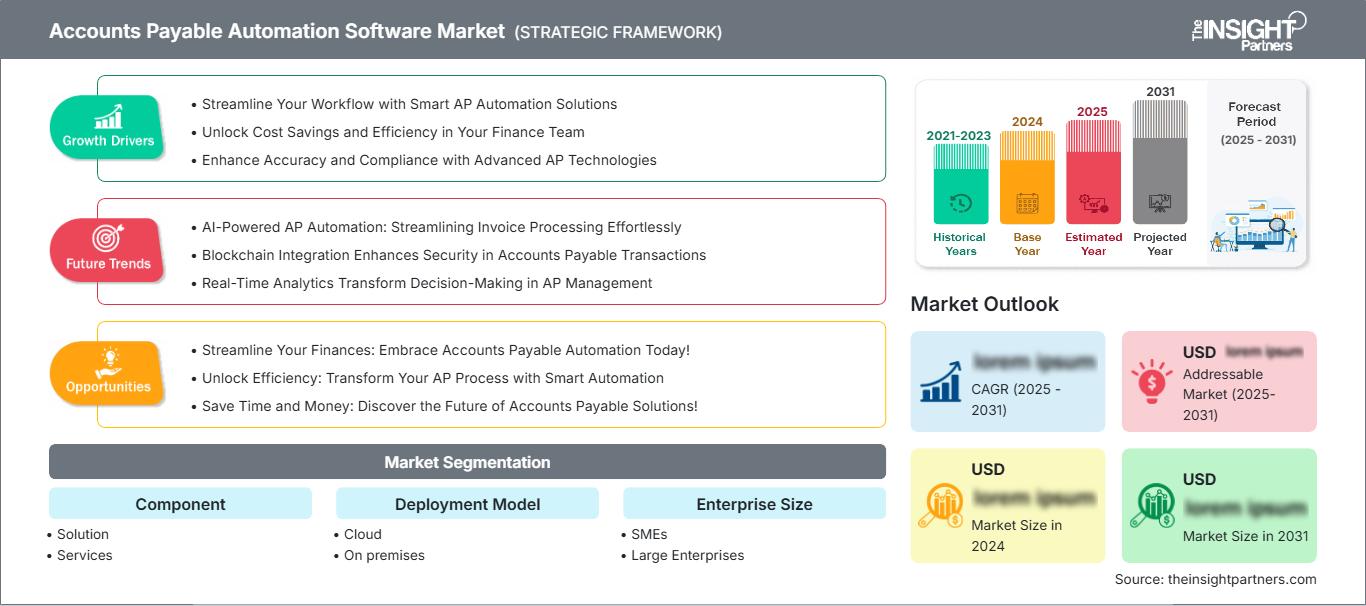
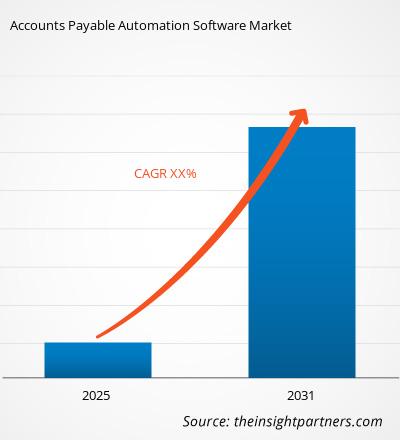
The global Accounts Payable Automation Software market was valued at US$ 7.12 billion in 2025 and is expected to reach US$ 17.47 billion by 2034; it is estimated to record a CAGR of 10.49% during 2026-2034.
Accounts Payable Automation Software Market Assessment and Insights
- North America: Accounted for approximately 36–40% share in 2025 and is expected to expand at a 10.8–12.5% CAGR during 2026–2034. High enterprise software penetration, advanced payment infrastructure, and strong demand for automation continue to support regional leadership.
- US: Represented approximately 74–78% of North American revenue in 2025 and is projected to register a 10.9–12.6% CAGR through 2034. Continued investment in finance transformation and AI-driven workflow optimization sustains demand.
- Europe: Held roughly a 26–30% share in 2025 and is anticipated to grow at a 10.5–12.0% CAGR. Germany, the United Kingdom, and France remain principal adoption centers due to digital compliance frameworks and e-invoicing programs.
- Asia Pacific: Captured approximately 24–28% of the accounts payable automation software market share in 2025 and is forecast to expand at a 13.0–14.8% CAGR. China, India, Japan, South Korea, and Australia are driving growth through cloud adoption and digital finance initiatives.
- Largest Segment: Cloud deployment held approximately 60–64% market share in 2025 and is projected to record a 12.5–14.0% CAGR through 2034 owing to scalability, flexibility, and subscription-based implementation models.
- High Growth Segment: SMEs accounted for nearly 34–38% of the accounts payable automation software market share in 2025 and are anticipated to advance at a 13.5–15.2% CAGR, supported by expanding accessibility of cloud-native financial software solutions.
- Key companies analyzed in detail: AvidXchange, Inc.; Beanworks Solutions Inc.; BILL Holdings, Inc.; MineralTree, Inc.; Nvoicepay, Inc.; Oracle Corporation; The Sage Group plc; SAP SE; Tipalti, Inc.; Xero Limited.
Source: The Insight Partners' analysis based on proprietary research, government publications, company annual reports, investor presentations, industry databases, and expert interviews.
Rapid digital transformation across enterprise finance functions has altered the way organizations manage invoice lifecycle processes, supplier payments, and financial controls. Automation platforms increasingly combine optical character recognition, machine learning, workflow orchestration, analytics, and electronic payments within integrated environments. These developments are reducing invoice processing costs while improving transparency, approval accuracy, and operational responsiveness. As finance departments pursue productivity improvements, technology adoption continues to expand beyond large enterprises into mid-market and emerging business segments.
Future market development is expected to be influenced by cloud-native architectures, regulatory encouragement of electronic invoicing, and growing integration between accounts payable, procurement, treasury, and supplier management systems. Emerging economies are investing in digital business infrastructure and electronic payment ecosystems, creating additional opportunities for software vendors. Increasing emphasis on real-time financial intelligence and compliance automation is expected to strengthen long-term adoption across both developed and developing markets.
Accounts Payable Automation Software Market Report Scope
| Report Attribute | Details |
|---|---|
| Market size in 2025 | US$ 7.12 Billion |
| Market Size by 2034 | US$ 17.47 Billion |
| Global CAGR (2026 - 2034) | 10.49% |
| Historical Data | 2021-2024 |
| Forecast period | 2026-2034 |
Accounts Payable Automation Software Market Analysis
The accounts payable automation software market growth trajectory reflects increasing enterprise efforts to modernize financial operations and eliminate resource-intensive manual invoice processing. Organizations continue to face pressure to reduce operational costs while improving control over supplier payments and cash-management processes. Automated systems help finance teams accelerate invoice approvals, strengthen audit readiness, and enhance payment accuracy. Rising business transaction volumes and growing supplier ecosystems further increase the value proposition of automation technologies.
Throughout the value chain, software developers, ERP vendors, payment processors, cloud infrastructure providers, implementation specialists, and analytics firms collectively contribute to ecosystem expansion. AI-powered invoice recognition and automated exception management capabilities are reducing processing times while improving decision-making quality. As enterprises seek greater visibility into working capital and procurement spending, demand for integrated accounts payable solutions continues to strengthen.
The accounts payable automation software market analysis indicates that competitive dynamics remain centered on platform intelligence, workflow flexibility, integration breadth, and payment enablement. Oracle Corporation and SAP SE benefit from extensive enterprise application ecosystems and established customer bases. Meanwhile, Tipalti, Inc., BILL Holdings, Inc., and AvidXchange, Inc. focus on automation-centric financial operations that streamline invoice processing, supplier onboarding, and payment execution.
Competition is also intensifying among specialized providers such as MineralTree, Inc., Nvoicepay, Inc., Beanworks Solutions Inc., and Xero Limited, which emphasize usability, cloud deployment, and finance automation capabilities for small and mid-sized businesses. Strategic partnerships, product innovation, and acquisitions remain central to vendor expansion strategies. Increasing investment in artificial intelligence, embedded payments, predictive analytics, and treasury integration is expected to further reshape competitive positioning throughout the forecast period.
● REPORT CUSTOMIZATION
Tailor This Report To Align With Your Specific Business Requirements
This report can be customized to align precisely with your business objectives, scope, and target markets. Customization options include tailored segmentation, geography, competitive analysis, and strategic insights to support informed decision-making.
Customize This Report →WHAT YOU CAN ADJUST
- ● Segmentations
- ● Geography
- ● Competitive Analysis
- ● Language Preferences
Accounts Payable Automation Software Market: Strategic Insights
Regional Insights
North America accounts payable automation software market
North America generated approximately 36–40% of global market revenue in 2025 and is expected to expand at a 10.8–12.5% CAGR between 2026 and 2034. Enterprise demand remains supported by mature cloud infrastructure, advanced financial technology ecosystems, and widespread adoption of integrated business management software. Organizations across manufacturing, healthcare, retail, professional services, and financial sectors increasingly implement intelligent automation solutions to improve invoice processing speed and strengthen operational efficiencies.
The region continues to benefit from high digital maturity and substantial software investment budgets. Demand for workflow automation has grown as enterprises seek to reduce processing costs, improve supplier engagement, and enhance financial control frameworks. The regional market also records the highest accounts payable automation software market share globally, supported by strong adoption of artificial intelligence, digital payment technologies, and enterprise-grade analytics solutions. Increasing integration between procurement, treasury, and accounts payable systems remains a significant growth catalyst.
U.S. accounts payable automation software market
The United States accounted for about 74%-78% of North America's accounts payable automation software market revenue in 2025, growing at a CAGR of 10.9%-12.6% from 2025 to 2034. Robust corporate investment in technology, the rising use of digital payments, and an emphasis on automating financial processes have ensured positive demand dynamics. Companies are looking to automation tools to improve workforce efficiency while gaining better visibility into their suppliers' dealings.
Large vendors, including Oracle Corporation, SAP SE, BILL Holdings, Inc., and Tipalti, Inc., have a substantial business presence throughout the nation. On the other hand, AvidXchange, Inc. continues to build on its strength among mid-market firms with specialized requirements for accounts payable automation. There is a trend towards greater adoption of AI-based invoice coding, automated exception management, predictive approval processes, and supplier management. Companies are now aiming for larger-scale finance transformations that integrate accounts payable automation with procurement, treasury, and enterprise resource planning environments.
Europe accounts payable automation software market
Europe accounted for roughly 26–30% of global revenue in 2025 and is anticipated to expand at a 10.5–12.0% CAGR throughout the forecast period. Regulatory initiatives supporting electronic invoicing and digital financial reporting continue to encourage deployment of automation solutions. Germany remains the largest regional market due to extensive manufacturing activities, strong enterprise software investment, and ongoing digital transformation across industrial sectors.
The UK market for accounts payable automation software shows strong deployment across the retail, financial services, professional services, and technology segments. Businesses today are placing greater emphasis on cloud-based software solutions that can boost their efficiency and compliance performance.
France, Italy, and Spain together form an expanding opportunity pool for this market in the region. The adoption of electronic invoice management systems and the digitization of tax and procurement operations are driving this demand. Businesses today are looking to deploy finance software solutions that lower costs and improve transaction visibility.
APAC accounts payable automation software market
Asia Pacific held approximately 24–28% of the accounts payable automation software market share in 2025 and is expected to register the fastest regional expansion at a 13.0–14.8% CAGR through 2034. Rapid enterprise digitization, increasing cloud adoption, and expanding automated payment ecosystems continue to support implementation across the region.
China continues to be the largest contributor to revenue, while India stands out as the fastest-growing market due to rapidly expanding digital business projects. Advanced enterprise software and intelligent workflow solutions have been receiving investments from Japan, South Korea, and Australia. Government-backed digital transformation policies further support long-term adoption.
Middle East & Africa accounts payable automation software market
The Middle East & Africa market is forecast to advance at a 12.0–13.5% CAGR during the study period. Saudi Arabia and the United Arab Emirates lead adoption through ongoing investments in business modernization, financial digitization, and enterprise technology infrastructure.
South Africa is a key country for enterprise software adoption, and regional adoption will be enhanced by increased digital payments and the development of cloud infrastructure. Energy sector upgrades, infrastructure development, and automation projects that emphasize compliance are seen as key drivers of future market growth.
Segmentation Analysis
Component
The Component segment is projected to expand at a 11.5–13.0% CAGR during 2026–2034 of the accounts payable automation software market. Organizations increasingly invest in comprehensive software platforms and associated implementation services to improve invoice processing efficiency and financial governance. Growing demand for workflow standardization, regulatory compliance, and intelligent document management continues to support adoption. As automation initiatives become more sophisticated, solution providers are strengthening service capabilities to support deployment, integration, customization, and optimization across varying enterprise environments.
- Solution: Software platforms remain the primary revenue-generating category, providing invoice capture, approval routing, workflow automation, payment processing, supplier management, and reporting capabilities. Enterprises increasingly value integrated functionality that supports end-to-end finance process transformation.
- Services: Professional and managed services support implementation success through consulting, onboarding, system integration, training, performance optimization, and ongoing technical support. Demand is increasing as organizations seek rapid return on investment and reduced deployment complexity.
Deployment Model
The Deployment Model segment is expected to record a 12.0–13.8% CAGR through the forecast period. Enterprises continue evaluating deployment strategies based on scalability, security requirements, implementation speed, operational flexibility, and infrastructure costs. Cloud-native architectures are becoming increasingly attractive as organizations pursue digital-first finance functions and geographically distributed operations.
- Cloud: The leading deployment approach offers lower upfront investment, faster implementation, automatic software updates, flexible scalability, and seamless integration with ERP and payment ecosystems. Strong accessibility and subscription economics continue to support widespread adoption.
- On-premises: This deployment option remains relevant among organizations managing highly sensitive financial data, strict internal governance policies, or industry-specific compliance obligations requiring enhanced infrastructure control and customization capabilities.
Enterprise Size
The Enterprise Size segment is anticipated to grow at a 12.2–14.0% CAGR between 2026 and 2034 of the accounts payable automation software market. Businesses of all sizes increasingly recognize the operational and financial benefits associated with automated invoice handling, supplier management, and payment visibility. Growing awareness of productivity gains and processing accuracy continues to expand market penetration.
- SMEs: Smaller businesses are increasingly adopting cloud-based automation solutions due to affordable subscription pricing, simplified deployment models, and growing digital accounting maturity. Automation supports resource optimization, error reduction, and improved supplier relationships.
- Large Enterprises: Large organizations continue investing in sophisticated automation platforms to manage high transaction volumes, multiple legal entities, extensive supplier ecosystems, and complex compliance requirements across global operations.
End-User Industry
End-User Industry is anticipated to grow at a 12.4–14.2% CAGR up to 2034. Industry-specific needs and transaction types significantly impact how a solution is adopted. Businesses demand flexible solutions that can help manage unique processes and supplier engagement policies.
- Manufacturing: Large procurement networks and significant invoice volumes make automation essential for supplier coordination, cost management, and financial visibility. Manufacturers increasingly emphasize workflow efficiency and payment accuracy.
- Hospitality: Hotel groups, resorts, and food service operators benefit from centralized processing capabilities that standardize invoice approvals and vendor payments across distributed operating locations.
- Consumer Goods and Retail: Businesses operating across extensive supply chains require automation technologies that improve transaction speed, inventory-related visibility, and working-capital management effectiveness.
- Energy and Utility: Utility providers and energy companies increasingly deploy digital finance systems to improve compliance performance, procurement transparency, and vendor invoice management processes.
- IT and Telecom: Organizations within this sector leverage automated workflows to manage recurring vendor relationships, digital procurement environments, and large transaction volumes efficiently.
- BFSI: Financial institutions prioritize highly auditable workflows, policy compliance, transaction monitoring, and operational accuracy, making automation technology a strategic investment area.
Opportunity Snapshot
| End User Industry | Revenue Contribution | Trend Tag | Adoption Stage |
| Manufacturing | High | Supplier Sync | Mature |
| Hospitality | Medium | Multi-Site AP | Scaling |
| Consumer Goods and Retail | High | Omnichannel Spend | Mature |
| Energy and Utility | Medium | Compliance Billing | Scaling |
| IT and Telecom | Medium | AI Invoicing | Scaling |
| BFSI | High | Risk Controls | Mature |
Accounts Payable Automation Software Market Growth Drivers and Impact Analysis
Artificial Intelligence Enhancing Accounts Payable Productivity
The use of artificial intelligence is increasingly a key driver of transformation in digital finance. Today, automation technologies increasingly rely on machine learning, intelligent document recognition, and predictive capabilities to streamline invoice processing from receipt to payment execution. Finance departments that process thousands of invoices monthly have been reducing manual processing while increasing the efficiency of coding, exception handling, and approvals. These technologies are enabling companies to reduce processing cycles, improve vendor satisfaction, and increase visibility into their working capital activities. With labor shortages and efficiency challenges across several sectors of the economy, firms are investing more in intelligent workflow technologies.
Digital Payment Adoption Supporting Workflow Integration
The rapid growth of payment ecosystems in the digital era is significantly increasing the need for automation systems. Companies have been increasingly looking for automated systems that integrate all their activities, from invoice processing and supplier onboarding to payments, reconciliations, and reporting. Digital payments help companies simplify their processes, reduce delays, and improve transparency. Given that suppliers tend to use digital payment systems, enterprises update their workflows to facilitate a more efficient and reliable payment process. Payment integration helps companies to streamline their cash flow, build better relationships with suppliers, and become more auditable. All these advantages make enterprises across industries such as manufacturing, finance, telecommunications, healthcare, and retail invest in AP automation platforms.
Compliance Requirements Driving Enterprise Automation Investments
The global regulatory environment is increasingly focused on transparency, financial traceability, electronic documents, and auditing readiness. Businesses are becoming more accountable for maintaining accurate records and complying with regulations related to taxes, procurement, and governance. Through the use of automated systems for accounts payable processes, organizations can achieve these objectives through process standardization, document archiving, and an audit trail. The finance team will become better equipped to enforce rules and regulations, confirm invoices, and track transactions. Given that governments are increasingly encouraging companies to adopt e-invoicing and accounting systems, firms are adopting automation software at a much faster pace than before. This trend is particularly evident in highly regulated industries, where financial controls and auditability are critical business requirements.
Accounts Payable Automation Software Market Future Trends
Transition Toward Autonomous Finance Operations
The accounts payable automation software market trends increasingly indicate movement toward autonomous finance environments where intelligent systems perform routine transactional activities with limited human involvement. Future systems will automate activities such as invoice classification, exception management, supplier communication, and payment scheduling using sophisticated analytics and machine learning algorithms. Such features will assist companies in reducing administrative effort and providing operational consistency. Significant investments are being made by vendors in predictive decision-making tools for cash flow predictions, payment prioritization, and spend optimization. With growing confidence in intelligent automation systems, companies are poised to adopt touchless invoice-processing models.
Convergence of Finance, Procurement, and Treasury Platforms
A major industry trend is the merging of distinct financial management technologies into digital ecosystems. Increasingly, companies strive for an ecosystem that can integrate procurement, accounts payable, supplier management, treasury, payments execution, and analytics. Integration will enable greater process transparency, data uniformity, and process control. Software vendors are addressing this need by enhancing their products through acquisitions, partnerships with other vendors, and their own product development. In the long term, an integrated financial environment is expected to promote better interaction between the company's departments and working capital management.
Accounts Payable Automation Software Market Opportunities
Expansion of SME-Focused Cloud Automation Platforms
Small and medium-sized businesses are among the most attractive areas for investment in the business environment. Traditionally, SMEs have used manual invoices, spreadsheets, and other accounting technologies because other options were too expensive and complicated to deploy. Cloud delivery options have significantly reduced adoption barriers today, thanks to subscription pricing models, fast implementation processes, and easy integration. According to the Accounts Payable Automation Software Market Forecasts, the digital transformation of SMEs will drive substantial demand for the software in both developed and emerging economies. Vendors that provide customizable workflow solutions, built-in payment capabilities, supplier self-service features, and AI-driven technology will gain competitive advantages. Growth in mobile finance application usage and accessibility of cloud accounting ecosystems will further enhance their adoption prospects during the forecast period.
Development of Industry-Specific Finance Automation Ecosystems
Another important area of opportunity is the development of specific solutions, which take into account the unique demands of particular industries. Manufacturers, hotels, retail firms, telecommunication companies, utilities, and banks typically need custom workflows, compliance systems, vendor management systems, and reporting capabilities. Standard automation solutions might not be sufficient enough in meeting such complex demands. Vendors could further enhance their market presence by developing industry-specific modules, analytics, and workflow templates. Collaboration with ERP software providers, procurement software vendors, and payments infrastructure firms could facilitate the process of commercialization of such products. Organizations increasingly prioritize solutions that deliver measurable business outcomes rather than standardized functionality, creating favorable conditions for differentiated offerings designed around industry-specific processes and performance objectives.
Frequently Asked Questions

- Comprehensive Market Sizing and Forecast Analysis
- Detailed Segmentation Analysis
- In-Depth Market Dynamics Assessment
- Regional and Country-Level Insights
- Competitive Landscape and Company Benchmarking
- Strategic Business Intelligence
Recent Reports
Testimonials

The Insight Partners' SCADA System Market report is comprehensive, with valuable insights on current trends and future forecasts. The team was highly professional, responsive, and supportive throughout. We are very satisfied and highly recommend their services.
RAN KEDEM Partner, Reali Technologies LTDs
I requested a report on a very specific software market and the team produced the report in a few days. The information was very relevant and well presented. I then requested some changes and additions to the report. The team was again very responsive and I got the final report in less than a week.
JEAN-HERVE JENN Chairman, Future Analytica
We worked with The Insight Partners for an important market study and forecast. They gave us clear insights into opportunities and risks, which helped shape our plans. Their research was easy to use and based on solid data. It helped us make smart, confident decisions. We highly recommend them.
PIYUSH NAGPAL Sr. Vice President, High Beam Global
The Insight Partners delivered insightful, well-structured market research with strong domain expertise. Their team was professional and responsive throughout. The user-friendly website made accessing industry reports seamless. We highly recommend them for reliable, high-quality research services
YUKIHIKO ADACHI CEO, Deep Blue, LLC.
This is the first time I have purchased a market report from The Insight Partners.While I was unsure at first, I visited their web site and felt more comfortable to take the risk and purchase a market report.I am completely satisfied with the quality of the report and customer service. I had several questions and comments with the initial report, but after a couple of dialogs over email with their analyst I believe I have a report that I can use as input to our strategic planning process.Thank you so much for taking the extra time and making this a positive experience.I will definitely recommend your service to others and you will be my first call when we need further market data.
JOHN SUZUKI President and Chief Executive Officer, Board Director, BK Technologies
I wish to appreciate your support and the professionalism you displayed in the course of attending to my request for information regarding to infectious disease IVD market in Nigeria. I appreciate your patience, your guidance, and the fact that you were willing to offer a discount, which eventually made it possible for us to close a deal. I look forward to engaging The Insight Partners in the future, all thanks to the impression you have created in me as a result of this first encounter.
DR CHIJIOKE ONYIA MANAGING DIRECTOR, PineCrest Healthcare Ltd.Reason to Buy
- Informed Decision-Making
- Understanding Market Dynamics
- Competitive Analysis
- Identifying Emerging Markets
- Customer Insights
- Market Forecasts
- Risk Mitigation
- Boosting Operational Efficiency
- Strategic Planning
- Investment Justification
- Tracking Industry Innovations
- Aligning with Regulatory Trends





 Get Free Sample for