
IT Asset Management Market Demand, Share & Growth by 2034
Coverage: By Component (Solutions, Services), Asset Type (Hardware Assets, Software Assets, Cloud Assets, Others), Deployment Mode (Cloud-Based, On-Premise, Hybrid), Enterprise Size (Large Enterprise, SMEs), End User (BFSI, IT and, Telecommunications, Healthcare, Manufacturing, Government and Public Sector, Retail, Others) and Geography (North America, Europe, Asia Pacific, Middle East and Africa, South and Central America)
- Status : Published
- Report Code : TIPRE00005306
- Category : Technology, Media and Telecommunications
- No. of Pages : 554
- Available Report Formats :


- Last update date : September 28, 2026


2025 Market Size
US$ 2.99 Bn
Base year value
2034 Forecast
US$ 4.93 Bn
Projected by 2034
CAGR 2026-2034
5.7 %
Growth rate
Addressable Market
US$ 35.87 Bn
(2026-2034)
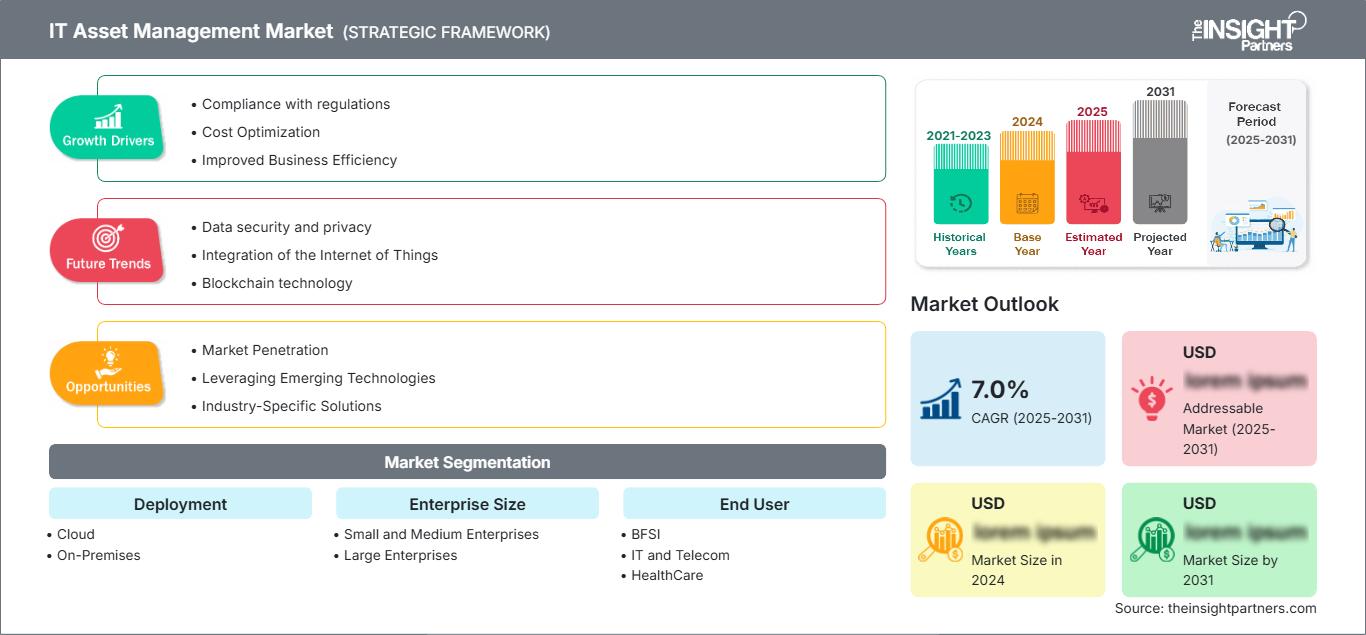
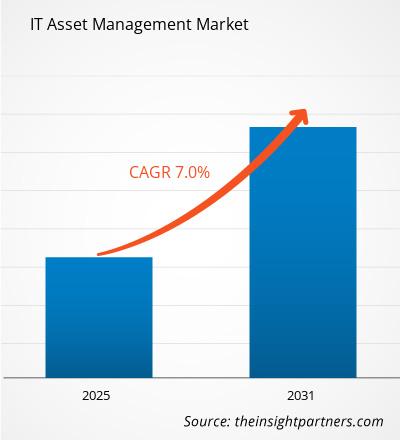
The IT Asset Management Market was valued at US$ 2.99 billion in 2025 and is projected to reach US$ 4.93 billion by 2034, registering a CAGR of 5.7% during 2026–2034. The market reflects growing enterprise requirements for centralized visibility, lifecycle control, compliance management, and cost optimization across hardware, software, cloud infrastructure, and other technology assets.
North America is expected to remain a leading regional market, supported by mature enterprise IT infrastructure, high adoption of cloud technologies, and strong emphasis on technology governance. The region is estimated to account for 39% of global revenue in 2025 and expand at a CAGR of 5.6% through 2034, supported by continued modernization of enterprise IT environments.
IT Asset Management Market Assessment and Insights
- North America: North America is expected to account for 39% share in 2025 and grow at a CAGR of 5.6% during 2026–2034, supported by mature IT infrastructure, cloud adoption, software governance, and enterprise technology modernization.
- US: The US represents 87% of North America's 2025 market and is expected to grow at a 5.9% CAGR through 2034, driven by enterprise cloud adoption and complex technology environments.
- Europe: Europe is estimated to hold 25% share in 2025 and grow at a CAGR of 5.1% during 2026–2034. Germany, the UK, France, and the Netherlands remain important markets due to regulatory requirements, digital transformation, and enterprise IT modernization.
- Asia Pacific: Asia Pacific is estimated to represent 24% share in 2025 and register the fastest regional growth at a 7.2% CAGR during 2026–2034. China, Japan, India, South Korea, and Australia are key markets supported by expanding digital infrastructure.
- Largest Segment: Hardware Assets is the largest asset category, accounting for 33.80% share in 2025 and growing at a CAGR of 5.9%, supported by continued lifecycle tracking and management requirements.
- High Growth Segment: Cloud-Based deployment represents 51% share in 2025 and is projected to grow at a 6.9% CAGR, reflecting demand for scalable and centrally managed IT environments.
- Key companies analyzed in detail: ManageEngine, International Business Machines Corporation, ServiceNow, Inc., Broadcom Inc., Dell Technologies Inc., Ivanti, BMC Software, Inc., HP Inc., Oracle Corporation, Flexera Software LLC, Qualys, Inc., Freshworks Inc., Axonius, Inc., SolarWinds Worldwide, LLC, and Lansweeper NV.
Source: The Insight Partners' analysis based on proprietary research, government publications, company annual reports, investor presentations, industry databases, and expert interviews.
The market has evolved from basic hardware inventory tracking toward integrated lifecycle management covering physical devices, software licenses, cloud resources, subscriptions, and distributed endpoints. Increasing integration with IT service management, configuration management, endpoint management, cybersecurity, and cloud management platforms has improved asset visibility. Automation, discovery tools, analytics, and application programming interfaces are also enabling organizations to connect asset information with operational workflows and financial controls.
Looking ahead, investment is expected to shift toward platforms capable of managing increasingly distributed technology estates. Cloud adoption, hybrid infrastructure, software subscription models, remote work, and expanding cybersecurity requirements will encourage enterprises to consolidate asset information. Regulatory expectations around data governance and software compliance will further support adoption, while artificial intelligence and predictive analytics are expected to improve asset discovery, utilization forecasting, renewal planning, and technology cost management.
IT Asset Management Market Report Scope
| Report Attribute | Details |
|---|---|
| Market size in 2025 | US$ 2.99 Billion |
| Market Size by 2034 | US$ 4.93 Billion |
| Global CAGR (2026 - 2034) | 5.7% |
| Historical Data | 2021-2024 |
| Forecast period | 2026-2034 |
IT Asset Management Market Analysis
As organizations continue to evolve their IT environments through integration of physical infrastructure, SaaS applications, cloud platforms, mobile devices, remote endpoints, and interconnected technologies, there is an increasing demand for accurate discovery, identification of ownership, monitoring of asset usage, licensing of IT assets and managing the lifecycle of those assets. In this context, the IT Asset Management Market is becoming increasingly important due to the need to avoid redundant assets and control spending in technology, compliance issues and better operation visibility.
The ecosystem consists of ITAM software suppliers, IT service management software companies, cybersecurity platforms, cloud management solution providers, system integrators and companies specializing in technology infrastructure. The market demand is driven by companies' interest in unified information about various technology environments. The suppliers are paying increased attention to automation, integration of work flows, analytics, configuration data synchronization and centralization of dashboards. Cloud deployment is particularly relevant in case when quick implementation and scalability across geographically dispersed company is required.
The competitive environment is influenced by the presence of strong enterprise software companies and dedicated ITAM vendors. The companies that provide solutions addressing general requirements of enterprise management include ManageEngine and ServiceNow. The companies with integrated asset management functions in their broader IT operations offerings include International Business Machines Corporation, BMC Software, Inc., Broadcom Inc. and Ivanti. Dell Technologies Inc., HP Inc. and Oracle Corporation have advantages related to long-term enterprise technology partnerships. Flexera Software LLC provides dedicated solutions for software and technology assets management.
Increasing strategic value of integration, discovery, automation and hybrid environment management is recognized. Qualys, Inc., Axonius, Inc., Freshworks Inc., SolarWinds Worldwide, LLC and Lansweeper NV provide differentiated solutions in areas of asset visibility, endpoint management, IT operations and technology discovery. The suppliers are also investing in cloud-native architecture, AI, analytics and work flows automation.
● REPORT CUSTOMIZATION
Tailor This Report To Align With Your Specific Business Requirements
This report can be customized to align precisely with your business objectives, scope, and target markets. Customization options include tailored segmentation, geography, competitive analysis, and strategic insights to support informed decision-making.
Customize This Report →WHAT YOU CAN ADJUST
- ● Segmentations
- ● Geography
- ● Competitive Analysis
- ● Language Preferences
IT Asset Management Market: Strategic Insights
Regional Insights
North America IT Asset Management Market
North America is expected to hold 39% share of the worldwide market in 2025 and is anticipated to grow at a CAGR of 5.6% during 2026 to 2034. North America enjoys advantages such as enterprise IT infrastructure, cloud usage, advanced software portfolio, and need for technology governance. Companies from various sectors including finance, health care, manufacturing, and technology need comprehensive views of their hardware, applications, licenses, and cloud assets due to cost concerns and regulatory reasons.
The United States is the key regional market, powered by presence of many technology-driven firms and fast adoption of hybrid infrastructure. Canada makes its contribution through the digital transformation of governments, financial services, telecoms, and industrial players. Synergy between ITAM, IT Service Management, Cybersecurity, Endpoint Management, and cloud platforms is helping adoption levels. Automating discovery, analytics, and licensing are becoming increasingly important for enterprises as technology landscapes are becoming more complicated to handle manually.
U.S. IT Asset Management Market Market
The US represents 87% of North America's total market in 2025 and is forecasted to experience a CAGR of 5.9% between 2026-2034. The reason behind the growth is high spending on enterprise technology, prevalence of cloud computing, large software suites and more distributed IT architectures. Centralized solutions are being leveraged to gain visibility into assets, manage costs around licensing and create greater governance over the lifecycles of those assets throughout an organization.
The competition consists of global software vendors and IT management vendors with enterprise relationships. The market sees adoption from BFSI, healthcare, telecoms, manufacturing, governments, and retail industries. Increasingly, enterprises are integrating asset discovery with service management, endpoint management, cybersecurity and cloud monitoring. The other driving factors behind the demand include software subscription management and identifying unused or underused technology assets.
Europe IT Asset Management Market Market
Europe is estimated to represent 25% of the global market in 2025 and is expected to grow at a CAGR of 5.1% through 2034. Germany, the UK, France, Italy, and Spain represent important markets, supported by digital transformation, regulatory compliance, cloud adoption, and modernization of enterprise technology estates. The UK maintains strong demand from technology-intensive organizations, while Germany benefits from industrial digitalization. France, Italy, and Spain are expanding adoption as enterprises strengthen governance across distributed IT environments and software portfolios.
APAC IT Asset Management Market Market
Asia Pacific is estimated to hold 24% share in 2025 and is projected to grow at a CAGR of 7.2% during 2026–2034, making it the fastest-growing regional market. China, Japan, South Korea, India, and Australia are key markets, supported by digitalization, cloud infrastructure expansion, enterprise modernization, and increasing technology spending.
India and China provide substantial growth potential as enterprises scale cloud services and distributed digital operations. Japan and South Korea benefit from mature technology ecosystems, while Australia shows demand for governance and lifecycle management across cloud and enterprise environments. Increasing technology complexity is encouraging organizations to adopt automated discovery and centralized asset controls.
Middle East & Africa IT Asset Management Market Market
The Middle East and Africa market is expected to expand at a CAGR of 4.4% during 2026–2034. Saudi Arabia and the UAE are important growth markets due to digital transformation programs, cloud infrastructure investment, smart government initiatives, and modernization of enterprise technology environments. South Africa represents an established market for enterprise IT management across financial services, telecommunications, and industrial sectors.
The regional opportunity is also supported by increasing investments in digital infrastructure and cybersecurity. Organizations are seeking stronger visibility across physical and cloud-based assets as technology estates expand. Demand is expected to remain focused on centralized governance, lifecycle management, software compliance, and cost optimization, particularly among large enterprises and public-sector organizations undertaking digital transformation initiatives.
Segmentation Analysis
Component
The component segment comprises Solutions and Services. The segment is supported by enterprise demand for technology discovery, lifecycle management, implementation, integration, consulting, maintenance, and support. Solutions provide the core functionality for asset visibility and optimization, while services help organizations configure platforms and integrate them with existing IT environments. The component segment is expected to grow at a CAGR range of 5.0–6.2% during 2026–2034.
- Solutions: Solutions form the core technology layer for discovering, tracking, monitoring, and optimizing enterprise assets. Demand is strengthened by automation, analytics, workflow management, license optimization, and integration with broader IT operations platforms.
- Services: Services support implementation, configuration, integration, consulting, maintenance, and technical assistance. Demand is particularly relevant for enterprises requiring customized deployments, legacy-system integration, and ongoing platform optimization.
Asset Type
The asset type segment covers Hardware Assets, Software Assets, Cloud Assets, and Others. Hardware Assets represented the largest category in 2025, with a 33.80% share and a 5.9% CAGR during 2026–2034. Increasingly diverse technology estates are encouraging organizations to combine physical asset tracking with software and cloud resource management.
- Hardware Assets: Hardware assets remain fundamental to lifecycle management because enterprises must track devices, servers, networking equipment, and other infrastructure throughout procurement, deployment, maintenance, reassignment, and retirement.
- Software Assets: Software asset management is increasingly important as organizations manage subscription models, complex licensing structures, application portfolios, and compliance requirements across multiple vendors and business units.
- Cloud Assets: Cloud assets are gaining strategic importance as enterprises expand infrastructure, platform, and application consumption across public, private, hybrid, and multicloud environments, increasing the need for centralized visibility and utilization controls.
Deployment Mode
Deployment mode includes Cloud-Based, On-Premise, and Hybrid models. Cloud-Based deployment held a 51% share in 2025 and is projected to expand at a CAGR of 6.9% during 2026–2034. Its scalability, accessibility, centralized administration, and comparatively flexible implementation model support adoption among organizations managing distributed technology environments.
- Cloud-Based: Cloud-based platforms provide centralized access, scalable infrastructure, and simplified deployment. They are increasingly preferred by organizations seeking rapid implementation and consistent asset visibility across geographically dispersed environments.
- On-Premise: On-premise deployment remains relevant where organizations require greater infrastructure control, specific security arrangements, or alignment with established internal technology architectures and governance policies.
- Hybrid: Hybrid models support enterprises operating combinations of cloud and on-premise infrastructure. They are particularly useful where organizations are transitioning gradually while maintaining selected systems within internal environments.
Enterprise Size
The enterprise size segment comprises Large Enterprise and SMEs. Large organizations continue to represent a substantial demand base because of geographically dispersed infrastructure, extensive software portfolios, and complex governance requirements. SMEs are increasingly evaluating ITAM to control technology costs and improve visibility without adding substantial administrative overhead. The segment is expected to expand at a CAGR range of 5.2–6.1% during 2026–2034.
- Large Enterprise: Large enterprises require comprehensive asset visibility across multiple locations, business units, technology environments, and software portfolios, making centralized lifecycle management strategically important.
- SMEs: SMEs are increasingly adopting scalable platforms to improve inventory accuracy, control technology spending, manage software licenses, and establish structured asset governance as their IT environments expand.
End User
The end-user segment includes BFSI, IT and Telecommunications, Healthcare, Manufacturing, Government and Public Sector, Retail, and Others. Adoption varies according to technology intensity, regulatory requirements, asset complexity, and cloud penetration. The segment is expected to grow at a CAGR range of 5.3–6.4% during 2026–2034, with technology-intensive sectors remaining important users.
- BFSI: Financial institutions require detailed technology inventories, licensing controls, and governance because of extensive digital infrastructure and stringent operational and compliance requirements.
- IT and Telecommunications: Technology providers manage highly distributed infrastructure, applications, endpoints, and network assets, creating strong demand for automated discovery and centralized lifecycle management.
- Healthcare: Healthcare organizations require structured technology inventories across clinical, administrative, and infrastructure environments while balancing operational continuity and governance requirements.
- Manufacturing: Manufacturers increasingly manage connected production systems, enterprise applications, servers, and network infrastructure, creating demand for integrated asset visibility and lifecycle controls.
- Government and Public Sector: Public-sector organizations use asset management to improve accountability, procurement visibility, lifecycle planning, and utilization of technology resources across departments and locations.
- Retail: Retailers manage distributed stores, point-of-sale systems, endpoints, networking equipment, applications, and cloud services, supporting demand for centralized asset oversight.
Opportunity Snapshot
| End User | Revenue Contribution | Trend Tag | Adoption Stage |
|---|---|---|---|
| BFSI | High | Digital Governance | Mature |
| IT and Telecommunications | High | Cloud Expansion | Mature |
| Healthcare | Medium | Connected Care | Scaling |
| Manufacturing | Medium | Smart Manufacturing | Scaling |
| Government and Public Sector | Medium | Digital Government | Scaling |
| Retail | Medium | Store Digitization | Scaling |
| Others | Low | Asset Visibility | Emerging |
IT Asset Management Market Growth Drivers and Impact Analysis
Increasing Complexity of Enterprise Technology Environments
Businesses are managing technology estates with a wider range of technologies, which include not only physical assets but also software applications, cloud services, mobile devices, remote infrastructure, and even subscription services. It becomes very hard to keep track of those assets as they go through the different phases of their life cycles and move from one user to another and from one location to another. Thereby, ITAM systems offer an automated way of discovering the technology estate, maintaining its records, tracking who owns what, how it is used, and helping manage the life cycle of the assets. The effect will be especially noticeable for large companies with many geographically dispersed business units. At the same time, companies also try to use asset intelligence for detecting redundancies and making better purchase decisions.
Growing Need for Software License and Technology Cost Optimization
The use of software subscriptions, cloud computing solutions, and technology contracts has been an important element of enterprise spending. There is now a growing need for organizations to be aware of what is being utilized in terms of applications, where the licensing is being done, what the expiration dates on contracts are, and if the capacity being purchased is what is required. This is where asset management solutions come into play, helping enterprises organize all of that information and assisting in renewal planning, licensing, and identifying any unused capacities. The financial implications grow as enterprises manage larger application portfolios from a variety of vendors and divisions. Increased visibility may assist procurement teams in the renegotiation process and prevent any unnecessary purchases. When integrated with financial and service management processes, the connection between asset management and business strategy becomes even stronger.
Expansion of Hybrid and Multicloud IT Infrastructure
The adoption of hybrid and multi-cloud models results in growing numbers of technology assets that need to be discovered, monitored, and managed by companies. The assets might cover internal data center operations, cloud services, SaaS, remote endpoints, and third-party infrastructure, thereby leading to an incomplete visibility picture in case if isolated solutions are used. ITAM platforms are able to collect information about such assets and get a more uniform picture of their ownership, usage, lifecycle state, and costs. This feature becomes more important with the development of new-generation infrastructure while keeping some legacy solutions in place. The effect on the market goes beyond the scope of simple inventory management due to the possibility of applying asset information for other purposes like cybersecurity, service management, compliance, and financial planning.
IT Asset Management Market Future Trends
AI-Enabled Asset Intelligence and Predictive Management
Asset management will be increasingly affected by artificial intelligence that will provide for asset discovery, classification, detection of anomalies, usage analysis, and life cycle planning. Organizations will no longer rely just on static inventories but will use intelligent analytics to detect unusual behavior of assets, predict the need for refreshing them, spot low utilization rates of some resources, and prioritize remediation actions. Artificial intelligence will be used to improve the quality of data by connecting information provided by endpoint systems, clouds, service desks, procurement, and configuration management databases. In the long term, the above-described capabilities will move asset management from being purely transactional to being predictive in terms of decision making. The vendors will probably compete on the basis of increased automation, natural language processing, intelligent recommendations, and contextual analytics.
Unified Management Across Physical, Software, and Cloud Assets
One significant future trend would be the merging of historically separate asset management functionality into integrated solutions. Firms need a single pane of glass covering physical equipment, software licensing, cloud infrastructure, SaaS subscriptions, and remote endpoints. The merging could help minimize disparate logs and inconsistency across procurement, implementation, maintenance, renewals, and end-of-life processes. Integrating with service management, cybersecurity, endpoint management, cloud management, and financial systems would become critical for organizations. In addition, companies would favor integrated solutions that could help establish consistent asset relationships amidst constant shifts in the infrastructure. This trend would push vendors to enhance API capabilities, integration, and data models. The aim would be to have continuously up-to-date technology inventories, which would allow firms to make better-informed decisions.
IT Asset Management Market Opportunities
Expansion of Cloud-Native Asset Management for Distributed Enterprises
For vendors, cloud-native platforms provide a chance to help businesses whose IT infrastructure is spread across geography, which have remote employees and dynamic IT stacks. By adopting scalable architectures, vendors can simplify the deployment process and facilitate access through centralization within various business units and geographical locations. Vendors can enhance this opportunity by providing capabilities around multicloud discovery, SaaS application management, automatic inventory refreshment, and usage analytics. Additionally, smaller firms may find it easier to use subscription-based services that do not require internal infrastructure and skills. Some differentiated opportunities can be explored by vendors when it comes to modular platforms which would let customers start with discovery and then build upon it with software, cloud, finance, compliance, and analytics functionality.
Integration of Asset Intelligence With Cybersecurity and Financial Controls
Information about assets may become more useful by connecting it to cybersecurity issues and financial decision-making processes. For example, organizations can use proper inventories to detect endpoints not managed by any IT department, to link vulnerabilities to concrete technology assets, and to perform prioritization based on the business significance. The same way, linking asset records to procurement and financial data can help organizations in budgeting of the lifecycle of the asset, management of the contract and cost calculation of the technology assets. Vendors that can provide all of these functions at once can satisfy many needs of enterprises without using separate applications for different functions. There is also an opportunity to create data models that include asset ownership, asset configuration, security, contractual information, usage and costs.
Recent Developments
- July 2026: Dell announced that Lifecycle Hub Suite now supports both Dell and non-Dell devices, enabling organizations to manage mixed hardware environments from a single platform. The service also strengthens responsible end-of-life processes through integrated resale, recycling, and disposal capabilities.
- January 2026: Ivanti announced the introduction of agentic AI capabilities within Ivanti Neurons for ITSM. The new functionality enables organizations to use AI-driven workflows that can assist with service operations, automate complex processes, and improve employee support experiences. Ivanti stated that these capabilities are designed to reduce service desk workload and provide more intelligent interactions through natural-language-based automation.
- March 2026: Oracle announced the launch of its AI Customer Excellence Centre in Sydney to help organisations keep pace with rapid AI advancements. The Oracle AI Customer Excellence Centre (AI CEC) will serve as a hub for innovation and collaboration, bringing together leaders to drive AI adoption and success across Australia and Oceania.
Frequently Asked Questions

- Comprehensive Market Sizing and Forecast Analysis
- Detailed Segmentation Analysis
- In-Depth Market Dynamics Assessment
- Regional and Country-Level Insights
- Competitive Landscape and Company Benchmarking
- Strategic Business Intelligence
Recent Reports
Testimonials

The Insight Partners' SCADA System Market report is comprehensive, with valuable insights on current trends and future forecasts. The team was highly professional, responsive, and supportive throughout. We are very satisfied and highly recommend their services.
RAN KEDEM Partner, Reali Technologies LTDs
I requested a report on a very specific software market and the team produced the report in a few days. The information was very relevant and well presented. I then requested some changes and additions to the report. The team was again very responsive and I got the final report in less than a week.
JEAN-HERVE JENN Chairman, Future Analytica
We worked with The Insight Partners for an important market study and forecast. They gave us clear insights into opportunities and risks, which helped shape our plans. Their research was easy to use and based on solid data. It helped us make smart, confident decisions. We highly recommend them.
PIYUSH NAGPAL Sr. Vice President, High Beam Global
The Insight Partners delivered insightful, well-structured market research with strong domain expertise. Their team was professional and responsive throughout. The user-friendly website made accessing industry reports seamless. We highly recommend them for reliable, high-quality research services
YUKIHIKO ADACHI CEO, Deep Blue, LLC.
This is the first time I have purchased a market report from The Insight Partners.While I was unsure at first, I visited their web site and felt more comfortable to take the risk and purchase a market report.I am completely satisfied with the quality of the report and customer service. I had several questions and comments with the initial report, but after a couple of dialogs over email with their analyst I believe I have a report that I can use as input to our strategic planning process.Thank you so much for taking the extra time and making this a positive experience.I will definitely recommend your service to others and you will be my first call when we need further market data.
JOHN SUZUKI President and Chief Executive Officer, Board Director, BK Technologies
I wish to appreciate your support and the professionalism you displayed in the course of attending to my request for information regarding to infectious disease IVD market in Nigeria. I appreciate your patience, your guidance, and the fact that you were willing to offer a discount, which eventually made it possible for us to close a deal. I look forward to engaging The Insight Partners in the future, all thanks to the impression you have created in me as a result of this first encounter.
DR CHIJIOKE ONYIA MANAGING DIRECTOR, PineCrest Healthcare Ltd.Reason to Buy
- Informed Decision-Making
- Understanding Market Dynamics
- Competitive Analysis
- Identifying Emerging Markets
- Customer Insights
- Market Forecasts
- Risk Mitigation
- Boosting Operational Efficiency
- Strategic Planning
- Investment Justification
- Tracking Industry Innovations
- Aligning with Regulatory Trends





 Get Free Sample for