
Acetabular Prostheses Market Size, Share & Trends by 2034
Coverage: By product Type (Cemented, Cement less); Application (Primary, Revision); End User (Hospitals, Specialty Clinics, Ambulatory Surgical Centers), and Geography (North America, Europe, Asia Pacific, and South and Central America)
- Status : Data Released
- Report Code : TIPRE00027298
- Category : Life Sciences
- No. of Pages : 150
- Available Report Formats :


- Last update date : July 15, 2026


2025 Market Size
US$ 1.6 Bn
Base year value
2034 Forecast
US$ 3.16 Bn
Projected by 2034
CAGR 2026-2034
7.86 %
Growth rate
Addressable Market
US$ 21.42 Bn
(2026-2034)
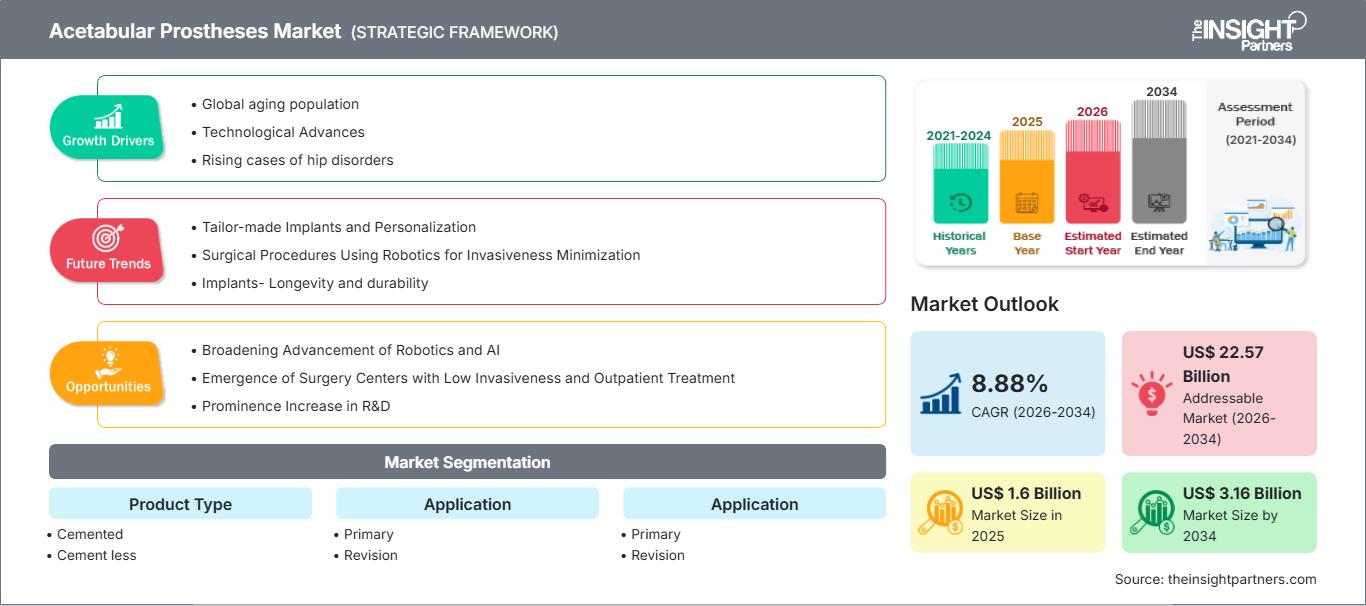
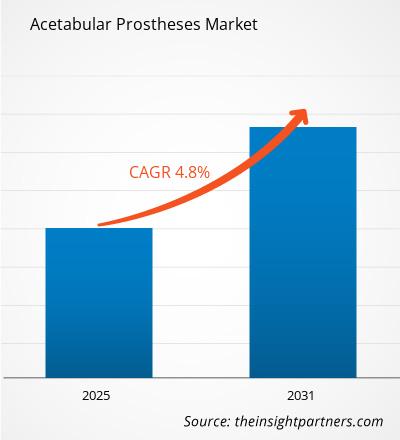
The Acetabular Prostheses market was valued at US$ 1.6 billion in 2025 and is expected to reach US$ 3.16 billion by 2034; it is estimated to record a CAGR of 7.86% during 2026-2034.
Acetabular Prostheses Market Assessment and Insights
- North America held an estimated 36–38% share in 2025 and is expected to grow at a CAGR between 2026–2034 of 8.0–8.6%, supported by advanced orthopedic infrastructure, robotic adoption, and revision procedure intensity.
- US accounted for 84–87% of North America in 2025 and is projected to grow at a CAGR between 2026–2034 of 8.1–8.7%, led by high hip replacement volumes and premium implant uptake.
- Europe represented 28–30% share in 2025 and is forecast to grow at a CAGR between 2026–2034 of 7.3–7.9%, with Germany, the UK, and France leading through registry-based arthroplasty systems.
- Asia Pacific captured 23–25% share in 2025 and is expected to grow at a CAGR between 2026–2034 of 10.1–10.8%, led by China, India, Japan, South Korea, and Australia through expanding surgical capacity.
- Largest Segment Cement less held 66–70% market share in 2025 and is projected to grow at a CAGR range of 9.1–9.7% during 2026–2034 due to biologic fixation preference.
- High Growth Segment Revision held 24–28% market share in 2025 and is projected to grow at a CAGR range of 9.8–10.5% during 2026–2034 as implant aging and bone defects rise.
- Key companies analyzed in detail: Zimmer Biomet Holdings, Inc., Johnson & Johnson Services, Inc., Stryker Corporation, Smith & Nephew plc, Waldemar LINK GmbH & Co. KG, Aesculap, Inc., ARZZT Medical Ltd., Exactech, Inc., MicroPort Orthopedics Inc., Enovis Corporation.
Source: The Insight Partners' analysis based on proprietary research, government publications, company annual reports, investor presentations, industry databases, and expert interviews.
The trend towards acetabular reconstruction surgery has transitioned from traditional cemented cups to more advanced porous-coated, modular and cementless cups, which are made to achieve biologic fixation and modularity during surgery. Additive manufacturing, highly crosslinked polyethylene liners, dual mobility constructs, and customized implantation planning are advancing stability and wear resistance. Factors that also influence the acetabular prosthesis market include production accuracy, sterilization processes, implant tracking and compatibility with robots and navigated systems.
Future growth will depend on the creation of new orthopedic units, growing investments in private hospitals and increased access to hip implants for the aging population. The strongest growth in procedures will be witnessed in the Asia Pacific region, while North America and Europe will concentrate on revision difficulty, registries and clinical outcomes. Quality issues will put pressure on manufacturers with proven clinical experience.
Acetabular Prostheses Market Report Scope
| Report Attribute | Details |
|---|---|
| Market size in 2025 | US$ 1.6 Billion |
| Market Size by 2034 | US$ 3.16 Billion |
| Global CAGR (2026 - 2034) | 7.86% |
| Historical Data | 2021-2024 |
| Forecast period | 2026-2034 |
Acetabular Prostheses Market Analysis
Drivers of the acetabular prosthesis market growth include osteoarthritis, trauma, rheumatoid arthritis, development dysplasia, avascular necrosis, and increased longevity following primary hip replacement. According to the statistics provided by OECD and national joint registries, total hip arthroplasty is one of the most common elective orthopedic surgeries in developed countries. Increasing patient demands for mobility and reduced pain encourage early intervention in active seniors.
Value chain involves titanium and cobalt alloy producers, ceramic and polyethylene component makers, companies involved in additive manufacturing, coating firms, sterilized packing services, instrumentation suppliers, hospitals, orthopedic clinics, and rehabilitation facilities. Consistency in supply relies on precise machining, porous architecture, liner locking, sterilization, and stock of various cup sizes. Hospitals assess the system according to fixation, stability, bearing types, instruments efficiency, surgeon experience, and joint registry data.
Competitive positioning is dominated by large reconstruction firms, and in the analysis of acetabular prosthesis market, platform depth proves to be an absolute advantage. Zimmer Biomet Holdings, Inc., Stryker Corporation, Johnson & Johnson Services, Inc., and Smith & Nephew plc engage in competition based on integrated hip system, education of surgeons, and robotic and digital planning ecosystems.
Waldemar LINK GmbH & Co. KG and Aesculap, Inc. remain highly relevant specialists for European and hospital-driven orthopedic business, while Exactech, Inc., MicroPort Orthopedics Inc., Enovis Corporation, and ARZZT Medical Ltd. respond to specific needs in particular regions and value-added products. Investments are focused on porous metal, dual mobility, revision shell, augment component, and process effectiveness.
● REPORT CUSTOMIZATION
Tailor This Report To Align With Your Specific Business Requirements
This report can be customized to align precisely with your business objectives, scope, and target markets. Customization options include tailored segmentation, geography, competitive analysis, and strategic insights to support informed decision-making.
Customize This Report →WHAT YOU CAN ADJUST
- ● Segmentations
- ● Geography
- ● Competitive Analysis
- ● Language Preferences
Acetabular Prostheses Market: Strategic Insights
Regional Insights
North America acetabular prostheses market
North America accounted for an estimated 36–38% share in 2025 and is expected to grow at a CAGR of 8.0–8.6% during 2026–2034. The region benefits from high diagnosis rates for degenerative hip disease, established arthroplasty specialist networks, and sustained hospital investment in robotic-assisted joint replacement. The acetabular prostheses market share is supported by premium cementless systems and revision surgery demand.
Demand is strongest in primary total hip arthroplasty, complex revision, and instability management using dual mobility or constrained options. Integrated delivery networks increasingly assess implants through survivorship, operating room efficiency, readmission risk, and surgeon workflow. Suppliers with broad liner choices, compatible instruments, and predictable inventory hold an advantage in North American tenders.
U.S. acetabular prostheses market
The U.S. represented 84–87% of North America in 2025 and is projected to grow at a CAGR of 8.1–8.7% during 2026–2034. Demand is supported by high procedural volumes, active orthopedic surgeon adoption of cementless cups, and technology-enabled planning in hospitals and ambulatory surgical centers. Zimmer Biomet Holdings, Inc., Stryker Corporation, Johnson & Johnson Services, Inc., and Exactech, Inc. maintain strong visibility.
Application trends emphasize primary hip replacement for osteoarthritis and revision procedures for loosening, instability, liner wear, and periprosthetic bone loss. U.S. providers increasingly favor acetabular platforms that support multiple bearing surfaces, screw fixation choices, and robotic workflow compatibility. Outpatient hip replacement also increases demand for reproducible instrumentation and reliable early stability.
Europe acetabular prostheses market
Europe held an estimated 28–30% share in 2025 and is expected to expand at a CAGR of 7.3–7.9% during 2026–2034. Germany is the leading country due to high orthopedic specialization, hospital density, and strong implant registry awareness. The UK and France remain important markets where traceability, reimbursement, and long-term outcomes influence procurement.
The UK market is shaped by NHS capacity planning, private elective recovery, and National Joint Registry scrutiny. Germany benefits from advanced revision centers, established cementless adoption, and domestic strength from Waldemar LINK GmbH & Co. KG and Aesculap, Inc. France shows stable demand through public and private hospitals, with clinical preference shaped by surgeon training and implant track records.
Italy and Spain contribute meaningful volume through aging populations, public hospital networks, and gradual elective surgery recovery. Procurement remains cost-sensitive, but premium acetabular systems gain acceptance in complex cases where stability, liner options, and still-compatible revision constructs reduce reoperation risk. Across Europe, registry performance is central to supplier credibility.
APAC acetabular prostheses market
APAC represented 23–25% share in 2025 and is forecast to grow at a CAGR of 10.1–10.8% during 2026–2034. China is the leading country by scale, while India shows rapid procedure expansion through private hospitals and medical tourism. Japan, South Korea, and Australia contribute higher-value demand through mature arthroplasty standards.
Industrial and policy drivers include hospital infrastructure investment, local implant manufacturing incentives, broader insurance coverage, and surgeon training programs. Australia’s joint registry culture supports outcome-based product evaluation, while China and India prioritize access expansion. Suppliers with tiered portfolios and education programs can capture both premium and value-demand channels.
Middle East & Africa acetabular prostheses market
Middle East & Africa is expected to grow at a CAGR of 7.6–8.3% during 2026–2034, led by Saudi Arabia and the UAE. Tertiary hospital expansion, medical tourism, trauma burden, and orthopedic specialty investment support demand for primary and revision hip systems. South Africa remains the most developed sub-Saharan market.
Energy-linked fiscal capacity in Gulf countries supports advanced operating rooms, imported implant access, and surgeon training partnerships. Rest of MEA demand is uneven because reimbursement gaps, distributor availability, and public procurement cycles limit uniform adoption. Suppliers with reliable logistics, procedural education, and tiered implant pricing can improve penetration.
Segmentation Analysis
Product Type
Product Type is expected to grow at a CAGR of 8.6–9.2% during 2026–2034. The acetabular prostheses market scope by product type is defined by fixation philosophy, bone quality, surgeon preference, and hospital implant protocols. Cementless cups dominate because porous surfaces support biologic fixation, while cemented designs remain important for selected elderly patients, poor bone stock, or specific revision circumstances.
- Cemented products retain clinical relevance where immediate fixation, compromised bone quality, or surgeon preference supports cement mantle use in carefully selected primary and revision patients.
- Cement less products dominate modern hip reconstruction because porous-coated shells, screw fixation options, and biologic ingrowth align with long-term stability expectations in active patients.
Application
Application is projected to grow at a CAGR of 8.8–9.5% during 2026–2034. Primary procedures generate the largest installed base because osteoarthritis remains the leading indication for hip replacement. Revision applications are expanding faster as earlier implant cohorts age, complex trauma cases rise, and surgeons address instability, osteolysis, aseptic loosening, infection-related reconstruction, and failed fixation.
- Primary applications represent the main procedural base, driven by osteoarthritis, avascular necrosis, hip fracture sequelae, and patient demand for durable pain relief and mobility restoration.
- Revision applications require advanced shells, augments, cages, liners, and fixation options because surgeons manage bone defects, instability, implant loosening, and complex reconstruction risks.
Opportunity Snapshot
| Segment Name | Revenue Contribution | Trend Tag | Adoption Stage |
| Primary | High | Elective Recovery | Mature |
| Revision | Medium | Bone Loss | Scaling |
Acetabular Prostheses Market Growth Drivers and Impact Analysis
Rising osteoarthritis burden and elective hip replacement demand
Osteoarthritis continues to be the key reason for hip replacement procedures, particularly among older, active people who need pain relief and mobility. Increasing longevity contributes to more patients suffering from joint disease, and improved results of surgery help increase the willingness to consider hip replacement procedure. The practical consequence of this trend is the increased need for cups, liners, screws, and instrument kits. Cementless hip replacement is favored due to the surgeons’ desire to use biological fixation methods for the long-term stability of primary reconstruction.
Expansion of revision arthroplasty and complex reconstruction
The trend of revision hip arthroplasty is rising as aging occurs among the first group of implants and patients live longer than their primary hip implants. Some of the typical causes of revision surgery include aseptic loosening, instability, polyethylene wear, revision due to infection, osteolysis, and periprosthetic fractures. For these conditions, revision techniques of the acetabulum include porosity revision shell, augments, cages, dual mobility liner, and constrained constructs. Revision implants hold high clinical value since they demand highly trained surgeons. Manufacturers that offer comprehensive revision hip products have an opportunity to enhance their business relationship with tertiary institutions and specialized surgeons.
Technology-enabled planning and robotic-assisted implantation
Digital technology for planning, navigation, and robotic-assisted surgery is influencing the process of cup positioning. The precise positioning of the cup is essential for the stability of the joint, the range of motion of the hip, the length of the leg, and wear minimization. The technologies that include planning, imaging, and guidance systems can enhance surgeons' confidence, particularly in difficult patients or during revisions. In terms of market impact, the winners will be the firms that combine acetabular components with the use of planning software, robotic systems, and instruments.
Acetabular Prostheses Market Future Trends
Porous metal and additive manufacturing refinement
Acetabular Prostheses Market trends will increasingly involve the design of porous structures with improved biological fixation properties through a balance between strength, flexibility, and producibility. Additive manufacturing techniques provide the means of controlling the pore architecture, shell design, and customization of revision procedures. Future designs are projected to develop surfaces with enhanced osseointegration potential, precise screw hole placement, and compatibility with modular augmentation. The healthcare institutions and surgeons will demand proof of the relationship between porous design and stable fixation in weak bone structures.
Dual mobility and instability-management adoption
Dual mobility constructs are expected to gain wider use as surgeons focus on reducing dislocation risk in high-risk primary and revision patients. Future acetabular platforms will likely include more seamless compatibility across dual mobility, constrained, ceramic, and polyethylene liner options. This matters for elderly patients, neuromuscular conditions, spine-hip imbalance, and revision instability. Manufacturers that simplify intraoperative liner choice without increasing instrument burden can strengthen adoption. The trend will also influence training programs, as appropriate patient selection and component positioning remain essential to achieving durable instability-management outcomes.
Acetabular Prostheses Market Opportunities
Revision-Focused Implant Systems for Tertiary Centers
Revision arthroplasty offers a clear investment opportunity because procedure complexity and implant value are rising together. The acetabular prostheses market forecast indicate stronger demand for porous revision shells, augments, cages, dual mobility liners, and constrained options. Suppliers can build tertiary-center programs that include complex case planning, surgeon workshops, loaner inventory, and defect-classification support. Commercial success will depend on readiness during unpredictable revision surgeries. Companies with flexible systems, reliable logistics, and education around bone-loss reconstruction can secure preferred status in high-volume orthopedic hospitals.
Emerging-market surgeon training and tiered product access
Emerging markets present a practical opportunity as hip arthroplasty expands beyond major metropolitan hospitals. Companies should combine premium cementless systems with value-tier acetabular cups, durable liners, and pragmatic instrument sets. Surgeon training is critical because implant performance depends on preparation, cup positioning, and fixation technique. China, India, Southeast Asia, Saudi Arabia, and South Africa offer attractive long-term demand through aging populations and hospital investment. Strategic partnerships with teaching hospitals, cadaver labs, and orthopedic societies can accelerate adoption while supporting safe procedural expansion.
Recent Developments
- April 2026: Stryker Corporation launched the Trident II Acetabular System in India for total hip arthroplasty, highlighting Tritanium In-Growth Technology or PureFix HA, Modular Dual Mobility options, X3 polyethylene, and Mako SmartRobotics compatibility. The launch supports India’s rising hip replacement demand and expands access to robotic-compatible acetabular reconstruction technologies.
- February 2026: Zimmer Biomet Holdings, Inc. received U.S. FDA 510(k) clearance for the G7 TM Acetabular System, designed for challenging primary and revision hip replacement surgeries. The system combines Trabecular Metal Technology, an anatomic screw-hole pattern, Rim Fix screws, and compatibility with G7 liners, including dual mobility and constrained options.
- September 2025: Exactech, Inc. announced court confirmation of its restructuring plan and approval of the sale of its assets to an investor group. The development followed a period of operational restructuring and is relevant to orthopedic customers because continued business continuity affects access to Exactech hip, knee, shoulder, and related reconstruction technologies.
Frequently Asked Questions

- Comprehensive Market Sizing and Forecast Analysis
- Detailed Segmentation Analysis
- In-Depth Market Dynamics Assessment
- Regional and Country-Level Insights
- Competitive Landscape and Company Benchmarking
- Strategic Business Intelligence
Recent Reports
Testimonials

The Insight Partners provided valuable market intelligence that supported our global go-to-market strategy. Their team was professional, responsive, and attentive to our feedback, providing thoughtful analysis and helpful methodological clarifications throughout the project.
Junmo Kim Chief Financial Officer (CFO), Enertech Co., Ltd.
The Insight Partners' SCADA System Market report is comprehensive, with valuable insights on current trends and future forecasts. The team was highly professional, responsive, and supportive throughout. We are very satisfied and highly recommend their services.
RAN KEDEM Partner, Reali Technologies LTDs
I requested a report on a very specific software market and the team produced the report in a few days. The information was very relevant and well presented. I then requested some changes and additions to the report. The team was again very responsive and I got the final report in less than a week.
JEAN-HERVE JENN Chairman, Future Analytica
We worked with The Insight Partners for an important market study and forecast. They gave us clear insights into opportunities and risks, which helped shape our plans. Their research was easy to use and based on solid data. It helped us make smart, confident decisions. We highly recommend them.
PIYUSH NAGPAL Sr. Vice President, High Beam Global
The Insight Partners delivered insightful, well-structured market research with strong domain expertise. Their team was professional and responsive throughout. The user-friendly website made accessing industry reports seamless. We highly recommend them for reliable, high-quality research services
YUKIHIKO ADACHI CEO, Deep Blue, LLC.
This is the first time I have purchased a market report from The Insight Partners.While I was unsure at first, I visited their web site and felt more comfortable to take the risk and purchase a market report.I am completely satisfied with the quality of the report and customer service. I had several questions and comments with the initial report, but after a couple of dialogs over email with their analyst I believe I have a report that I can use as input to our strategic planning process.Thank you so much for taking the extra time and making this a positive experience.I will definitely recommend your service to others and you will be my first call when we need further market data.
JOHN SUZUKI President and Chief Executive Officer, Board Director, BK Technologies
I wish to appreciate your support and the professionalism you displayed in the course of attending to my request for information regarding to infectious disease IVD market in Nigeria. I appreciate your patience, your guidance, and the fact that you were willing to offer a discount, which eventually made it possible for us to close a deal. I look forward to engaging The Insight Partners in the future, all thanks to the impression you have created in me as a result of this first encounter.
DR CHIJIOKE ONYIA MANAGING DIRECTOR, PineCrest Healthcare Ltd.Reason to Buy
- Informed Decision-Making
- Understanding Market Dynamics
- Competitive Analysis
- Identifying Emerging Markets
- Customer Insights
- Market Forecasts
- Risk Mitigation
- Boosting Operational Efficiency
- Strategic Planning
- Investment Justification
- Tracking Industry Innovations
- Aligning with Regulatory Trends





 Get Free Sample for