
Adenomyosis Treatment Market Trends, Share & Demand by 2034
Coverage: By Type ( Adenomyoma, Focal, Diffuse, Others ); Diagnosis ( Magnetic Resonance Imaging (MRI), Endometrial Biopsy, Ultrasound ); Treatment ( Anti-Inflammatory Drugs, Hormone Medications, Hysterectomy, Others ); Application ( Hospitals, Clinics, Ambulatory Surgical Centers, Others ), and Geography (North America, Europe, Asia Pacific, and South and Central America)
- Status : Data Released
- Report Code : TIPRE00015968
- Category : Life Sciences
- No. of Pages : 150
- Available Report Formats :


- Last update date : July 09, 2026


2025 Market Size
US$ 1.32 Bn
Base year value
2034 Forecast
US$ 2.9 Bn
Projected by 2034
CAGR 2026-2034
9.18 %
Growth rate
Addressable Market
US$ 18.91 Bn
(2026-2034)
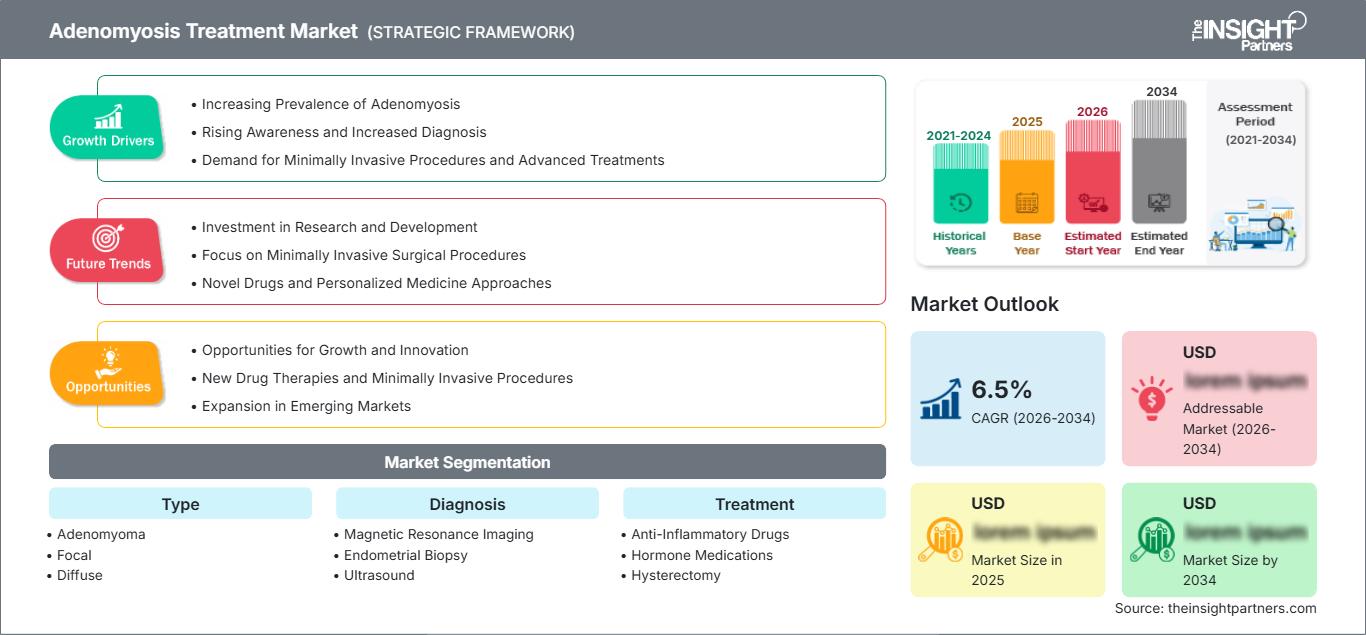
The Adenomyosis Treatment Market size was valued at US$ 1.32 Billion in 2025 and is projected to reach US$ 2.9 Billion by 2034, expanding at a CAGR of 9.18% from 2026 to 2034. Growth is driven by increasing diagnosis rates, improved imaging accuracy, and expanding adoption of hormonal and minimally invasive therapies across developed and emerging healthcare systems. Rising awareness among women regarding chronic pelvic pain management further strengthens demand across hospitals and specialty clinics globally.
North America is expected to remain the leading regional contributor with a steady CAGR of 9.5–10.2%, supported by advanced gynecological care infrastructure and early adoption of MRI-based diagnostics. Increasing healthcare expenditure and strong insurance coverage for women’s health disorders are accelerating treatment uptake. Additionally, pharmaceutical innovation and clinical research initiatives focused on endometriosis-related conditions continue to positively influence regional growth dynamics.
Adenomyosis Treatment Market Assessment and Insights
- North America: Holds 38–42% Adenomyosis Treatment Market share in 2025, growing at 9.5–10.2% CAGR (2026–2034). Strong diagnostic penetration, high hysterectomy rates, and availability of hormonal therapies drive dominance across the region’s advanced healthcare systems.
- U.S.: Accounts for 80–85% of North America’s share in 2025, expanding at 9.6–10.3% CAGR (2026–2034). High patient awareness and reimbursement support reinforce treatment adoption across specialty hospitals and clinics.
- Europe: Represents 25–28% share in 2025, growing at 8.5–9.0% CAGR (2026–2034). Germany, France, the UK, Italy, and Spain lead due to structured women’s health programs and MRI-based diagnostic standardization.
- Asia Pacific: Holds 22–26% share in 2025, expanding at 10.0–11.0% CAGR (2026–2034). China, India, Japan, and South Korea drive growth due to rising gynecological disorder prevalence and expanding healthcare access.
- Largest Segment (Hormone Medications): Contributes 35–40% share in 2025, growing at 9.0–10.0% CAGR (2026–2034) due to strong clinical preference for non-invasive disease management.
- High Growth Segment (Ultrasound Diagnosis): Holds 25–30% share in 2025, growing at 10.5–11.5% CAGR (2026–2034) due to increasing demand for cost-effective and accessible imaging tools.
- Key companies analyzed: Bayer AG, Ferring B.V., Johnson & Johnson Services, Inc., Novartis AG, Merck KGaA, Pfizer Inc., Speciality European Pharma, Contura International A/S, Focused Ultrasound Foundation, Solara Healthcare Solutions.
Source: The Insight Partners' analysis based on proprietary research, government publications, company annual reports, investor presentations, industry databases, and expert interviews.
The adenomyosis treatment market has seen major changes due to improved diagnostic processes and advanced imaging technology in gynecology. Adenomyosis, being a relatively undiagnosed disease, has become increasingly identifiable through techniques such as MRI and ultrasonography at an early stage, thus facilitating timely treatment. Advances in drug-based treatments, including hormone therapy drugs and anti-inflammatory drugs, have revolutionized the treatment scenario.
In the coming years, increased healthcare investments in Asia Pacific and the adoption of minimally invasive treatments in developing nations would positively impact market growth. Approvals of new hormone modulators and FUS therapies would increase access to treatment. Furthermore, the adoption of telemedicine in gynecology and the use of digital diagnostic methods would aid in better disease detection.
Adenomyosis Treatment Market Report Scope
| Report Attribute | Details |
|---|---|
| Market size in 2025 | US$ 1.32 Billion |
| Market Size by 2034 | US$ 2.9 Billion |
| Global CAGR (2026 - 2034) | 9.18% |
| Historical Data | 2021-2024 |
| Forecast period | 2026-2034 |
Adenomyosis Treatment Market Analysis
The analysis of the adenomyosis treatment market is based on an increasingly evolving ecosystem driven by diagnostic advancements and diverse treatment options. Growth in demand is mainly driven by a rise in the prevalence of abnormal uterine bleeding, chronic pelvic pain, and infertility issues related to adenomyosis. Hospitals and specialty clinics remain the main care delivery settings, whereas ambulatory surgical centers are becoming increasingly popular due to the cost-effectiveness of minimally invasive procedures. The value chain involves diagnostic solutions, drug suppliers, and surgeons.
On the supply side, rising clinical trial activity and increasing availability of generic hormones affect market dynamics. Diagnostic solutions provided by makers of MRI machines and ultrasound devices become increasingly important, as they enable early diagnosis of the condition, which in turn affects the treatment start rate. Drug companies spend considerable efforts in the development of GnRH agonists and progestin treatments, improving compliance rates.
The adenomyosis treatment market forecast indicates that the competitive landscape is moderately consolidated, with leading players such as Bayer AG, Pfizer Inc., and Novartis AG focusing on hormonal therapy innovation, while Johnson & Johnson Services, Inc. and Merck KGaA emphasize gynecological surgical solutions. Investment trends highlight increasing venture funding in non-invasive ultrasound-based treatment technologies. Strategic collaborations between biotech firms and diagnostic imaging companies are reshaping market positioning and accelerating commercialization of advanced therapies.
● REPORT CUSTOMIZATION
Tailor This Report To Align With Your Specific Business Requirements
This report can be customized to align precisely with your business objectives, scope, and target markets. Customization options include tailored segmentation, geography, competitive analysis, and strategic insights to support informed decision-making.
Customize This Report →WHAT YOU CAN ADJUST
- ● Segmentations
- ● Geography
- ● Competitive Analysis
- ● Language Preferences
Adenomyosis Treatment Market: Strategic Insights
Regional Insights
North America Adenomyosis Treatment Market
North America dominates the adenomyosis treatment market, owing to factors such as a developed healthcare infrastructure, higher diagnostic rates, and adequate health insurance coverage. The rising incidence of gynecological diseases and the increased use of minimally invasive procedures contribute to market growth. Also, the presence of key pharmaceutical firms and robust clinical research environments further helps in the innovation and development of adenomyosis treatments. The healthcare systems in the US and Canada emphasize timely diagnosis through technologies such as MRI and ultrasound. The growing awareness of the condition and favorable reimbursement policies are increasing the adoption of hormonal and surgical treatments. The sustained investments in women's health care and fertility preservation treatments increase prospects for future growth.
U.S. Adenomyosis Treatment Market
The U.S. commands a roughly 80-85% share of North America by 2025, growing at a 9.6-10.3% CAGR (2026-2034). Well-established clinical infrastructure, advanced imaging technologies, and widespread access to hormonal therapy propel the market position. Growing detection rates and awareness also speed up adoption among specialized gynecological centers. Hospitals and ambulatory surgery centers in the U.S. account for most treatment provision due to the high volume of procedures. Innovation on the part of drug firms contributes to the adoption of hormonal therapy. Research centers contribute to the rise in the adoption of minimally invasive therapies.
Europe Adenomyosis Treatment Market
The region benefits from structured public healthcare systems and standardized diagnostic protocols. Leading countries include Germany, France, the United Kingdom, Italy, and Spain, where gynecological care accessibility is high. MRI-based diagnosis is widely adopted, improving early detection rates. Germany leads in clinical research and pharmaceutical adoption, while France emphasizes women’s reproductive health initiatives. The UK focuses on integrated NHS-based treatment pathways, and Italy and Spain show rising adoption of minimally invasive surgical procedures. Regulatory harmonization across the EU strengthens market stability and encourages cross-border healthcare collaboration.
APAC Adenomyosis Treatment Market
China, India, Japan, South Korea, and Australia are major contributors. The market is growing rapidly owing to increased healthcare expenditure and greater awareness of uterine disorders. Women’s health screening programs launched by governments also play a role in boosting diagnosis rates. According to the adenomyosis treatment market report, China dominates, owing to its large patient population and hospital development, while India experiences robust growth in the diagnosis of the condition. Japan and South Korea are focusing more on imaging and minimally invasive procedures. Australia gets an advantage owing to its developed healthcare system and use of hormone therapy.
Middle East & Africa Adenomyosis Treatment Market
MEA accounts for a smaller but steadily growing share of the adenomyosis treatment market, driven by improving healthcare infrastructure and rising awareness of gynecological conditions. Saudi Arabia and the UAE lead due to advanced hospital networks and increasing investment in women’s health services. South Africa shows gradual improvement in diagnostic accessibility, while other regions remain underpenetrated. The region grows at 7.5–8.5% CAGR (2026–2034) supported by healthcare modernization initiatives. Expansion of private hospitals and medical tourism in Gulf countries contributes significantly to treatment availability. Increasing collaboration with global pharmaceutical companies enhances access to hormonal therapies and diagnostic imaging technologies.
Segmentation Analysis
Type
The Type segment, including adenomyoma, focal, and diffuse forms, plays a crucial role in treatment stratification. The segment grows steadily at a 9.0–9.5% CAGR due to improved diagnostic precision and increasing disease classification accuracy. Early identification of focal and diffuse adenomyosis through MRI has improved treatment personalization and clinical outcomes. Rising awareness among gynecologists is enhancing early-stage intervention adoption across hospitals and specialty clinics.
- Adenomyoma: Represents a clinically complex subtype requiring combined hormonal and surgical management, often diagnosed in advanced disease stages with higher symptom severity and fertility implications.
- Focal: Characterized by localized uterine lesions, often treated with conservative hormonal therapy or targeted minimally invasive procedures aimed at preserving fertility and reducing uterine damage.
- Diffuse: The most widespread form, associated with severe symptoms and higher likelihood of hysterectomy, requiring integrated long-term management strategies across multidisciplinary healthcare teams.
Diagnosis
The diagnosis segment in the adenomyosis treatment market is driven by imaging advancements and improved clinical awareness, expanding at a 9.5–10.5% CAGR. MRI remains the gold standard, while ultrasound adoption is rising due to cost efficiency. Improved imaging resolution enhances early detection and reduces misdiagnosis rates, significantly impacting treatment initiation timelines.
- Magnetic Resonance Imaging: Preferred for high-accuracy visualization of uterine tissue changes, enabling detailed assessment of lesion depth and extent for advanced clinical decision-making.
- Endometrial Biopsy: Used to rule out overlapping conditions, offering supportive diagnostic validation in complex gynecological cases requiring histopathological confirmation.
- Ultrasound: Widely used first-line imaging tool due to accessibility and affordability, increasingly enhanced with high-resolution and transvaginal imaging technologies.
Treatment
Treatment segment remains central to market expansion, growing at **9.2–10.0% CAGR (2026–2034)** due to increasing adoption of hormonal therapies and minimally invasive procedures. Pharmaceutical innovation and surgical advancements continue to improve patient outcomes and reduce recurrence rates.
- Anti-Inflammatory Drugs: Used for symptomatic relief, particularly in early-stage cases, helping manage pain and inflammation associated with uterine tissue abnormalities.
- Hormone Medications: Dominant treatment approach targeting estrogen regulation, widely used for long-term symptom control and fertility preservation strategies.
- Hysterectomy: Considered definitive treatment in severe cases, especially among patients with diffuse adenomyosis unresponsive to conservative therapies.
Application
Application segment includes hospitals, clinics, and ambulatory surgical centers, expanding at 9.0–9.8% CAGR. Growth is driven by increasing patient inflow and expansion of outpatient surgical services.
- Hospitals: Serve as primary treatment hubs with advanced diagnostic and surgical capabilities for complex adenomyosis cases.
- Clinics: Provide outpatient diagnosis and hormone therapy management, focusing on early-stage disease intervention and follow-up care.
- Ambulatory Surgical Centers: Growing rapidly due to cost efficiency and rising demand for minimally invasive gynecological procedures.
Opportunity Snapshot
| Segment Name | Revenue Contribution (High/Medium/Low) | Trend Tag | Adoption Stage |
| Hospitals | High | Integrated Care | Mature |
| Clinics | Medium | Outpatient Growth | Scaling |
| Ambulatory Surgical Centers | Medium | Minimally Invasive | Scaling |
Adenomyosis Treatment Market Growth Drivers and Impact Analysis
Rising prevalence of adenomyosis and diagnostic awareness expansion
Adenomyosis has increased in prevalence globally, specifically in women aged between 30 and 50 years, thereby boosting market growth. Due to improved awareness among doctors and patients, underdiagnosis has decreased, making it possible to provide timely treatment. The use of advanced imaging technologies, such as MRI and high-resolution ultrasound, has improved diagnostic accuracy for adenomyosis. Adenomyosis treatment market trends indicate that more patients are being diagnosed to undergo treatments, which has positively impacted the demand for hormonal and minimally invasive procedures.
Advancements in hormone-based and non-invasive therapies
Advanced hormone modulation therapies that include the use of GnRH analogs and progestins have revolutionized the clinical approach to the disease. The use of hormone modulation techniques provides better symptom management while maintaining fertility, and hence they are considered superior to surgical methods. Furthermore, focused ultrasound has become an innovative technique for the non-invasive treatment of adenomyosis. This has been accompanied by shorter hospital stays and quicker recovery times. Many studies have been conducted by pharmaceutical companies to improve the effectiveness of drugs.
Expansion of healthcare infrastructure and reimbursement coverage
The increased development of healthcare infrastructure, especially in the Asia-Pacific region and North America, has been one of the most important factors driving market growth. Growing government expenditure on women’s health and improved insurance coverage structures are increasing access to diagnostic and treatment procedures. Hospitals are also upgrading their gynecology departments with imaging and surgical technologies. There is also increased investment from the private healthcare sector, leading to the establishment of specialty clinics.
Adenomyosis Treatment Market Future Trends
Integration of AI-enabled imaging in gynecological diagnostics
The use of artificial intelligence in diagnostic imaging for adenomyosis will greatly enhance the accuracy and efficiency of its detection. AI-enabled MRI and ultrasound analysis systems help detect minor changes in the uterus that might not be observed in routine diagnoses. The use of AI in diagnostics has become common in hospitals and is projected to play an important role in improving predictive analytics in healthcare systems worldwide.
Shift toward fertility-preserving and minimally invasive treatments
The increasing clinical favor for fertility-sparing treatments has changed the way adenomyosis is managed. The patient population tends to choose hormonal therapy and non-hysterectomizing surgeries as opposed to hysterectomy. There is an emerging trend toward minimally invasive approaches, such as laparoscopy and focused ultrasound, owing to shorter recovery times and greater satisfaction. Research and development in the pharmaceutical sector have also continued to support symptom management and fertility preservation.
Adenomyosis Treatment Market Opportunities
Expansion of personalized medicine in gynecological care
Personalized medicine offers an important opportunity for the treatment of adenomyosis by tailoring therapies to patients' hormonal profiles, symptoms, and genetic makeup. Diagnostic technologies and biomarker research are providing physicians with information to develop targeted therapies. There are new developments in the drug development industry where pharmaceutical firms are working to improve the effectiveness of hormone therapy treatments and minimize the side effects.
Growth of outpatient and ambulatory surgical ecosystems
The emergence of ambulatory care services and ambulatory surgery centers provides many opportunities for affordable delivery of adenomyosis treatment. It entails minimal invasiveness and shortened periods of recuperation without placing much pressure on hospitals. Growing trends toward healthcare decentralization are increasing access to gynecologic services in urban and semi-urban areas. The introduction of mobile diagnostic imaging and surgical equipment further speeds up this process. With such trends towards efficiency and convenience in healthcare provision, ambulatory care approaches have a strong chance of becoming popular worldwide.
Recent Developments
- March 2026: Bayer AG announced expanded clinical evaluation of next-generation hormone therapy targeting uterine disorders, focusing on improved safety and reduced systemic side effects, strengthening its women’s health portfolio across global markets.
- November 2025: Pfizer Inc. advanced its gynecological therapeutics pipeline with updated phase trials for hormone-regulating compounds aimed at reducing adenomyosis-associated pain and bleeding symptoms in premenopausal women.
- June 2025: Novartis AG reported progress in non-invasive treatment research collaborations involving focused ultrasound systems for uterine disease management, enhancing its strategic positioning in women’s health innovation.
Frequently Asked Questions

- Comprehensive Market Sizing and Forecast Analysis
- Detailed Segmentation Analysis
- In-Depth Market Dynamics Assessment
- Regional and Country-Level Insights
- Competitive Landscape and Company Benchmarking
- Strategic Business Intelligence
Recent Reports
Testimonials

The Insight Partners' SCADA System Market report is comprehensive, with valuable insights on current trends and future forecasts. The team was highly professional, responsive, and supportive throughout. We are very satisfied and highly recommend their services.
RAN KEDEM Partner, Reali Technologies LTDs
I requested a report on a very specific software market and the team produced the report in a few days. The information was very relevant and well presented. I then requested some changes and additions to the report. The team was again very responsive and I got the final report in less than a week.
JEAN-HERVE JENN Chairman, Future Analytica
We worked with The Insight Partners for an important market study and forecast. They gave us clear insights into opportunities and risks, which helped shape our plans. Their research was easy to use and based on solid data. It helped us make smart, confident decisions. We highly recommend them.
PIYUSH NAGPAL Sr. Vice President, High Beam Global
The Insight Partners delivered insightful, well-structured market research with strong domain expertise. Their team was professional and responsive throughout. The user-friendly website made accessing industry reports seamless. We highly recommend them for reliable, high-quality research services
YUKIHIKO ADACHI CEO, Deep Blue, LLC.
This is the first time I have purchased a market report from The Insight Partners.While I was unsure at first, I visited their web site and felt more comfortable to take the risk and purchase a market report.I am completely satisfied with the quality of the report and customer service. I had several questions and comments with the initial report, but after a couple of dialogs over email with their analyst I believe I have a report that I can use as input to our strategic planning process.Thank you so much for taking the extra time and making this a positive experience.I will definitely recommend your service to others and you will be my first call when we need further market data.
JOHN SUZUKI President and Chief Executive Officer, Board Director, BK Technologies
I wish to appreciate your support and the professionalism you displayed in the course of attending to my request for information regarding to infectious disease IVD market in Nigeria. I appreciate your patience, your guidance, and the fact that you were willing to offer a discount, which eventually made it possible for us to close a deal. I look forward to engaging The Insight Partners in the future, all thanks to the impression you have created in me as a result of this first encounter.
DR CHIJIOKE ONYIA MANAGING DIRECTOR, PineCrest Healthcare Ltd.Reason to Buy
- Informed Decision-Making
- Understanding Market Dynamics
- Competitive Analysis
- Identifying Emerging Markets
- Customer Insights
- Market Forecasts
- Risk Mitigation
- Boosting Operational Efficiency
- Strategic Planning
- Investment Justification
- Tracking Industry Innovations
- Aligning with Regulatory Trends





 Get Free Sample for