
Advanced HD Television Sets Market Demand, Share & Growth by 2034
Coverage: By Display Type (LED Display, OLED Display, QLED Display); Resolution (4K, 8K) , and Geography (North America, Europe, Asia Pacific, and South and Central America)
- Status : Data Released
- Report Code : TIPRE00006517
- Category : Electronics and Semiconductor
- No. of Pages : 150
- Available Report Formats :


- Last update date : July 14, 2026


2025 Market Size
US$ 19.41 Bn
Base year value
2034 Forecast
US$ 29.18 Bn
Projected by 2034
CAGR 2026-2034
4.63 %
Growth rate
Addressable Market
US$ 220.55 Bn
(2026-2034)
The Advanced HD Television Sets Market was valued at US$ 19.41 Billion in 2025 and is projected to reach US$ 29.18 Billion by 2034; it is expected to register a CAGR of 4.63% during 2026–2034. Advanced HD television sets combine high-resolution panels, smart operating systems, upgraded video processors, and premium display technologies to support home entertainment, gaming, streaming, and commercial viewing applications.
North America is expected to grow at a CAGR range of 4.1–4.5% during 2026–2034, supported by ultra-large screen upgrades, mature streaming consumption, and premium OLED and QLED replacement cycles. Retailers are also promoting AI picture processing, gaming refresh rates, and smart platform integration, widening the Advanced HD Television Sets Market scope across households, hospitality spaces, and commercial display environments.
Advanced HD Television Sets Market Assessment and Insights
- North America: 25–29% share in 2025 and CAGR between 2026–2034 of 4.1–4.5%; replacement demand, streaming households, and large-screen premiumization support steady adoption.
- US: 79–83% share in North America in 2025 and CAGR between 2026–2034 of 4.2–4.6%; OLED, QLED, and gaming-ready 4K models remain key demand anchors.
- Europe: 20–24% share in 2025 and CAGR between 2026–2034 of 3.7–4.1%; the UK, Germany, France, Italy, and Spain lead through retail upgrades and connected-TV penetration.
- Asia Pacific: 38–42% share in 2025 and CAGR between 2026–2034 of 5.0–5.4%; China, Japan, South Korea, India, and Australia benefit from manufacturing scale and urban replacement demand.
- Largest Segment: LED Display held 58–62% market share in 2025, CAGR range 3.9–4.3%, supported by affordability, retail reach, and broad 4K availability.
- High Growth Segment: 8K held 8–12% market share in 2025, CAGR range 6.3–6.7%, driven by premium product roadmaps and ultra-large screen positioning.
- Key companies analyzed in detail: Sichuan Changhong Electric Co., Ltd.; Hisense Group Co., Ltd.; Skyworth Group Limited; Konka Group Co., Ltd.; LG Electronics Inc.; Samsung Electronics Co., Ltd.; Sony Group Corporation; Sharp Corporation; TVS REGZA Corporation; Super Plastronics Pvt. Ltd.; TCL Technology Group Corporation; Panasonic Holdings Corporation.
Source: The Insight Partners' analysis based on proprietary research, government publications, company annual reports, investor presentations, industry databases, and expert interviews.
The advanced HD television sets market report has evolved from resolution-led upgrades into integrated display platforms combining panel engineering, software ecosystems, audio enhancement, and AI-assisted image processing. Production dynamics reflect rising use of Mini LED backlighting, OLED efficiency improvements, quantum-dot color systems, and larger mother-glass utilization. Brands are balancing premium differentiation with cost discipline as panel pricing, logistics, tariffs, and retail promotions influence the Advanced HD Television Sets Market analysis.
Forward demand will be shaped by Asia Pacific scale, North American premium screen upgrades, and European energy-efficiency priorities. Broadband expansion, connected-TV advertising, gaming consoles, and streaming services support refresh cycles, while policymakers increasingly monitor product energy consumption and e-waste. Investment is expected to favor localized assembly, advanced backlighting, software monetization, and efficient panel architectures that improve Advanced HD Television Sets growth without relying only on replacement volume.
Advanced HD Television Sets Market Report Scope
| Report Attribute | Details |
|---|---|
| Market size in 2025 | US$ 19.41 Billion |
| Market Size by 2034 | US$ 29.18 Billion |
| Global CAGR (2026 - 2034) | 4.63% |
| Historical Data | 2021-2024 |
| Forecast period | 2026-2034 |
Advanced HD Television Sets Market Analysis
Demand is driven by households replacing older HD and full-HD models with 4K sets that offer better brightness, sharper upscaling, and native streaming interfaces. Omdia reported global TV shipments of 47.5 million units in 1Q25, up 2.4% year on year, indicating that resilient entertainment demand can offset macro pressure in selected quarters.
The ecosystem includes panel makers, chipset suppliers, operating-system providers, contract assemblers, brand owners, retailers, content platforms, and aftersales networks. Supply dynamics depend on LCD capacity discipline, OLED yield, memory pricing, logistics costs, and regional assembly footprints. Advanced HD Television Sets market size expands as brands bundle screen quality with smart-home control, cloud gaming, and advertising-supported streaming access.
The competitive landscape involves integrating Korean premium, Chinese manufacturing, Japanese image-processing technology, and an Indian value proposition. Companies competing in the market include Samsung Electronics Co., Ltd., LG Electronics Inc., Sony Group Corporation, Hisense Group Co., Ltd., TCL Technology Group Corporation, Skyworth Group Limited, Konka Group Co., Ltd., and Sichuan Changhong Electric Co., Ltd., which compete based on display technology, screen size, gaming technology, distribution, and software.
Themes of investment include mini-LED, QD-OLED, increased refresh rates, an artificial-intelligence picture engine, and large-screen production. The companies involved are Sharp Corporation, TVS REGZA Corporation, Panasonic Holdings Corporation, and Super Plastronics Pvt. Ltd. They strengthen their regional presence through brand licensing and distribution. Strategic positioning in the industry involves premium pricing and service revenues from smart-TV platforms, supported by affordable 4 K production.
● REPORT CUSTOMIZATION
Tailor This Report To Align With Your Specific Business Requirements
This report can be customized to align precisely with your business objectives, scope, and target markets. Customization options include tailored segmentation, geography, competitive analysis, and strategic insights to support informed decision-making.
Customize This Report →WHAT YOU CAN ADJUST
- ● Segmentations
- ● Geography
- ● Competitive Analysis
- ● Language Preferences
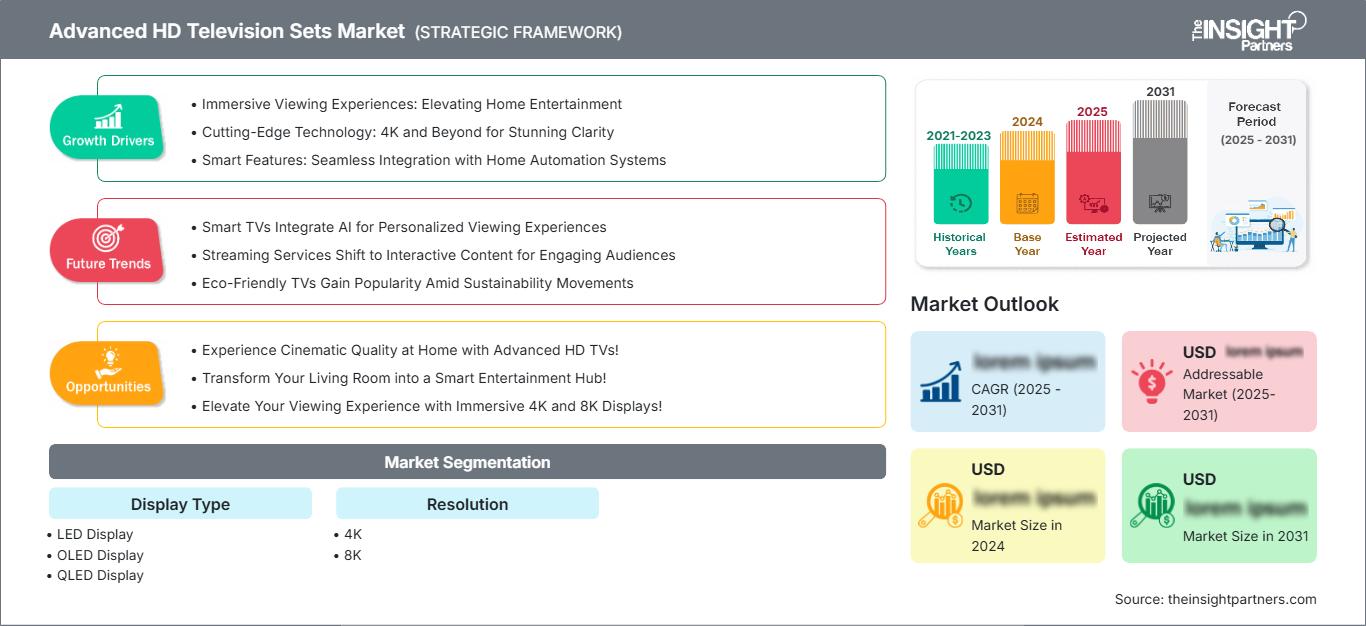
Advanced HD Television Sets Market: Strategic Insights
Regional Insights
North America Advanced HD Television Sets Market
North America accounted for 25–29% of the market share in 2025, and the compound annual growth rate will be 4.1–4.5% in 2026–2034. The major structural driver is the transition to larger screen sizes, with 80-inch or larger models gaining shelf space in warehouse clubs and electronics stores. Upgrades to OLED and QLED are helped by sports, gaming, and streaming households that require good HDR capability.
Although regional sales depend on promotion, tariffs, and logistics management, the presence of connected TVs helps the decision to replace old models. Branding leverages Mexico assembly, retail financing, and a software ecosystem to maintain high margins. North America's advanced HD Television Sets Market share depends on the price of ultra-large LCD sets, OLED luminance improvement, and 4K gaming capabilities.
U.S. Advanced HD Television Sets Market
The U.S. accounted for 79-83% of North America's share in 2025 and is projected to grow at a CAGR of 4.2-4.6% through 2034. Market demand is driven by streaming-first homes, sporting events, console gaming, and retailer promotions. Samsung Electronics Co., Ltd., LG Electronics Inc., Sony Group Corporation, Hisense Group Co., Ltd., TCL Technology Group Corporation, and Sharp Corporation have prominent channel presence.
Trends in applications include 65-inch, 75-inch, and larger 4K televisions, while 8K televisions are limited to the premium showcase segment. AI upscaling, anti-glare screen, integrated audio, and gaming refresh rate have been prioritized in the retail segment. The Advanced HD Television Sets market also benefits from the connected-TV advertising model, which helps retain users after purchase.
Europe Advanced HD Television Sets Market
Europe held 20–24% share in 2025 and is forecast to grow at a CAGR of 3.7–4.1% during 2026–2034. The UK leads premium replacement because pay-TV, streaming, sports broadcasting, and dense retail channels encourage OLED and QLED adoption. Energy-label awareness makes efficient backlighting and standby performance important purchase considerations.
Advantages of Germany include household purchasing power, organized electronics retail, and the demand for high-quality big screens. Advantages of France include stabilized demand through connected-TV technology, improvements in public broadcasting, and increased home entertainment expenditure. Italy and Spain are still highly influenced by promotions, but smart TV replacement and football watching drive sales of 4K televisions across mid-range LED and top-end OLED models.
Competitiveness among European suppliers and distributors includes energy efficiency, warranties, software updates, and retail exclusivity. The target customers for Samsung Electronics Co., Ltd., LG Electronics Inc., Sony Group Corporation, Panasonic Holdings Corporation, Hisense Group Co., Ltd., and TCL Technology Group Corporation are differentiated by tier. Advanced HD Television Sets market trends in Europe favor practical 4K upgrades over general 8K adoption.
APAC Advanced HD Television Sets Market
APAC accounted for 38–42% share in 2025 and is expected to grow at a CAGR of 5.0–5.4% through 2034. China leads through manufacturing depth, domestic stimulus cycles, and large-scale retail competition.
Japan and South Korea prioritize premium OLED, processors, and broadcast-based upgrades. The Indian strategy involves urbanization, e-commerce, sports streaming, and localized assembly, whereas the Australian strategy includes large screen upgrades with high margins.
Industrial policy, the panel value chain, and export-oriented manufacturing make APAC the fastest-growing region. Chinese and Korean brands adopt a scale-based, price-based, and tiering approach to expand penetration in the Advanced HD Television Sets Market.
Middle East & Africa Advanced HD Television Sets Market
Middle East & Africa is projected to grow at a CAGR of 4.6–5.0% during 2026–2034. Saudi Arabia leads through premium retail, hospitality investment, and smart-city entertainment infrastructure.
The UAE supports demand through affluent households, tourism, aviation lounges, and electronics retail hubs, while South Africa contributes pay-TV, sports viewing, and middle-income replacement demand.
Energy diversification, commercial real estate, and broadband investment help premium models gain visibility, though affordability constraints keep many purchases concentrated in LED Display models and promotion-led channels.
Segmentation Analysis
Display Type
The display type segment is projected to grow at a CAGR of 4.2–4.6% during 2026–2034. LED Display remains the volume base because it offers competitive pricing, broad screen-size coverage, and reliable retail availability. OLED Display supports premium home cinema and gaming, while QLED Display strengthens bright-room performance and large-screen positioning through quantum-dot color and Mini LED backlighting.
- LED Display maintains the widest installed base because affordability, 4K availability, and mature supply chains make it the default choice for mainstream households and commercial replacement programs.
- OLED Display serves premium buyers seeking deep contrast, fast response, and cinematic viewing, with adoption supported by brighter panels, gaming features, and stronger retail education.
- QLED Display addresses bright-room viewing and larger screen formats, offering color volume, high brightness, and competitive pricing that help brands bridge mainstream and premium portfolios.
Resolution
The resolution segment is expected to grow at a CAGR of 4.7–5.1% during 2026–2034. 4K dominates because it aligns with streaming libraries, gaming consoles, sports broadcasts, and mainstream price points. 8K remains smaller but strategically important for premium branding, ultra-large screens, and AI upscaling, particularly where consumers prioritize future-ready display capability.
- 4K represents the commercial core of the market, supported by broad content availability, affordable panel supply, and strong adoption across living rooms, gaming setups, and hospitality spaces.
- 8K serves flagship portfolios and ultra-large display categories, helping brands demonstrate processing capability, premium design, and long-term differentiation despite limited native 8K content availability.
Opportunity Snapshot
| Resolution | Revenue Contribution | Trend Tag | Adoption Stage |
| 4K | High | Streaming Core | Mature |
| 8K | Low | Upscaling Flagship | Emerging |
Advanced HD Television Sets Market Growth Drivers and Impact Analysis
Large-Screen Replacement Cycles Lift Premium Demand
Households are increasingly upgrading from 40-inch to 55-inch TVs, with 65-inch, 75-inch, and larger TVs owing to lower panel prices and a rise in living-room entertainment involving screens. According to a recent report by Omdia, sales of 80-inch and larger TVs in North America rose by 24.5% year on year in the fourth quarter of 2024, illustrating the effect of affordability in making oversized display screens more available in the retail market. The market impact is a higher average selling value for premium models, stronger demand for Mini LED and QLED backlighting, and greater emphasis on installation, delivery, and warranty services.
Streaming and Gaming Raise Performance Expectations
Streaming media, cloud gaming, and improved consoles have transformed television buying decisions from just about resolution to a complete experience. People consider HDR type, refresh rate, latency, app availability, Wi-Fi capabilities, and voice commands when buying a television. It helps boost the Advanced HD Television Sets market by enabling companies to differentiate across various levels by leveraging the processor, operating system, and gaming options rather than panels alone. The retailers benefit from attachments such as sound bars, mounts, subscription programs, and protection packages.
Panel Innovation Improves Value Across Price Tiers
Innovation within display technology has been shifting from headline resolution to brightness management, color accuracy, anti-glare features, and efficiency. The development of OLED displays is delivering higher full-panel brightness, while Mini LED and QLED offer better contrast even in brightly lit environments. This development broadens the definition of Advanced HD Television Sets by enabling manufacturers to market their products to segments such as home cinema, sports, gaming, hospitality, and digital signage using unique feature offerings.
Advanced HD Television Sets Market Future Trends
AI Picture Processing Becomes a Core Differentiator
Product road maps for the future would position the use of AI picture processing technology at the core of premium branding, particularly with 4K being prevalent and 8K requiring good upscaling technologies. The development of processors would focus more on optimizing processing for sports action, compressed video streams, gaming latency, ambient lighting, and real-time speech recognition. Such a trend would result in competition driven by semiconductor capabilities, training data sets, and software updates.
Smart-TV Platforms Expand Post-Sale Monetization
TV profitability is set to become more software-focused after hardware sales are complete. There will be increasing reliance on software for such things as advertising, content discovery, games, home automation control, and subscription management. With hardware margins decreasing, the ability of firms with strong operating systems to capitalize on viewing behavior, software installation, and advertising will be a key factor in retaining customers.
Advanced HD Television Sets Market Opportunities
Localized Assembly and Channel-Specific Portfolios
Tariff vulnerability, shorter replenishment times, and improved retailer responses are achievable through localized model design and assembly. It is worth noting that Mexico, India, Vietnam, and certain parts of Eastern Europe are relevant to the strategy, as they support regional supply, cost-effective labor, and policy coordination. It is important to note that portfolio designs tailored to specific channels also help secure margins by offering customization of screen size, warranty, operating system, and promotional packages for warehouse clubs, Internet portals, specialty stores, and telecom companies that connect demand sensing with flexible production.
Premium Hospitality and Commercial Display Refresh
Hotels, serviced apartments, sports bars, airports, educational venues, and executive offices are replacing screens to support streaming, casting, signage, and hybrid meetings. Suppliers of advanced HD television sets can design commercial versions of their products by incorporating features such as easy device management, hospitality mode, extended warranty, and a secure app ecosystem. The Advanced HD Television Sets market forecast opportunity will lie at the confluence of investments in tourism, corporate real estate, and digital signage. Vendors that bundle installation, content management, and lifecycle support can convert one-time hardware sales into repeatable institutional refresh programs.
Recent Developments
- January 2026: Samsung Electronics hosted a Visual Display (VD) Deep Dive session at CES 2026. Led by SW Yong, President of VD Business at Samsung Electronics, the session was held at The Wynn Las Vegas and highlighted how Samsung is building on two decades of market leadership to redefine the role of the TV in the connected home. As the global TV market enters a new phase defined by premium demand, larger screens and intelligent experiences, Samsung outlined its strategy for the future of television.
- July 2025: LG Electronics India Ltd. announced the launch of its 2025 OLEDevo and QNEDevo TV line-up in India. These new televisions are powered by LG’s latest Alpha AI Processor Gen2, delivering personalized experiences and improved picture, sound, and interactivity. With the introduction of next-level AI capabilities and award-winning picture technology, the 2025 range builds on LG’s legacy of innovation, elevating smart TV experiences to a new standard.
- January 2025: During its CES 2025 press conference, Hisense, a global leader in consumer electronics and display innovation, introduced the 116-inch TriChroma LED TV (116UX), a groundbreaking achievement in home entertainment as the only consumer model to use RGB Local Dimming Technology. This cutting-edge development offers unparalleled color precision, vibrancy, and efficiency, not only setting a new benchmark for big-screen TVs but also leading the MiniLED into a new era.
Frequently Asked Questions

- Comprehensive Market Sizing and Forecast Analysis
- Detailed Segmentation Analysis
- In-Depth Market Dynamics Assessment
- Regional and Country-Level Insights
- Competitive Landscape and Company Benchmarking
- Strategic Business Intelligence
Recent Reports
Testimonials

The Insight Partners provided valuable market intelligence that supported our global go-to-market strategy. Their team was professional, responsive, and attentive to our feedback, providing thoughtful analysis and helpful methodological clarifications throughout the project.
Junmo Kim Chief Financial Officer (CFO), Enertech Co., Ltd.
The Insight Partners' SCADA System Market report is comprehensive, with valuable insights on current trends and future forecasts. The team was highly professional, responsive, and supportive throughout. We are very satisfied and highly recommend their services.
RAN KEDEM Partner, Reali Technologies LTDs
I requested a report on a very specific software market and the team produced the report in a few days. The information was very relevant and well presented. I then requested some changes and additions to the report. The team was again very responsive and I got the final report in less than a week.
JEAN-HERVE JENN Chairman, Future Analytica
We worked with The Insight Partners for an important market study and forecast. They gave us clear insights into opportunities and risks, which helped shape our plans. Their research was easy to use and based on solid data. It helped us make smart, confident decisions. We highly recommend them.
PIYUSH NAGPAL Sr. Vice President, High Beam Global
The Insight Partners delivered insightful, well-structured market research with strong domain expertise. Their team was professional and responsive throughout. The user-friendly website made accessing industry reports seamless. We highly recommend them for reliable, high-quality research services
YUKIHIKO ADACHI CEO, Deep Blue, LLC.
This is the first time I have purchased a market report from The Insight Partners.While I was unsure at first, I visited their web site and felt more comfortable to take the risk and purchase a market report.I am completely satisfied with the quality of the report and customer service. I had several questions and comments with the initial report, but after a couple of dialogs over email with their analyst I believe I have a report that I can use as input to our strategic planning process.Thank you so much for taking the extra time and making this a positive experience.I will definitely recommend your service to others and you will be my first call when we need further market data.
JOHN SUZUKI President and Chief Executive Officer, Board Director, BK Technologies
I wish to appreciate your support and the professionalism you displayed in the course of attending to my request for information regarding to infectious disease IVD market in Nigeria. I appreciate your patience, your guidance, and the fact that you were willing to offer a discount, which eventually made it possible for us to close a deal. I look forward to engaging The Insight Partners in the future, all thanks to the impression you have created in me as a result of this first encounter.
DR CHIJIOKE ONYIA MANAGING DIRECTOR, PineCrest Healthcare Ltd.Reason to Buy
- Informed Decision-Making
- Understanding Market Dynamics
- Competitive Analysis
- Identifying Emerging Markets
- Customer Insights
- Market Forecasts
- Risk Mitigation
- Boosting Operational Efficiency
- Strategic Planning
- Investment Justification
- Tracking Industry Innovations
- Aligning with Regulatory Trends





 Get Free Sample for