
Aerospace Material Market Demand, Share & Growth by 2034
Coverage: by Type (Aluminum Alloys, Steel Alloys, Titanium Alloys, Super Alloys, Composite Materials, Others); Aircraft Type (Military Aircraft, Commercial Aircraft, Helicopters, Business and General Aviation, Others) , and Geography (North America, Europe, Asia Pacific, and South and Central America)
- Status : Data Released
- Report Code : TIPRE00010506
- Category : Chemicals and Materials
- No. of Pages : 150
- Available Report Formats :


- Last update date : July 21, 2026


2025 Market Size
US$ 11.52 Bn
Base year value
2034 Forecast
US$ 13.43 Bn
Projected by 2034
CAGR 2026-2034
1.72 %
Growth rate
Addressable Market
US$ 113.02 Bn
(2026-2034)
The aerospace material market size is projected to grow from US$ 11.52 Billion in 2025 to US$ 13.43 Billion by 2034, registering a CAGR of 1.72% during 2026–2034. It is noteworthy that the market continues to be critical for commercial and defense aviation since there has been a growing trend among manufacturers towards using lightweight, durable, corrosion-resistant and stronger materials. The continuous modernization and replacement of aircraft contribute to stable demand on the global aerospace materials manufacturing market.
In North America, aircraft production capabilities, defense modernization plans, and an existing aerospace supply chain will contribute to material demand. The size of the aerospace materials market in North America is driven by investments into advanced commercial aircraft and military aviation, as well as the production of composite materials. Growing adoption of lightweight carbon fiber and titanium-based materials, together with maintenance, repair, and overhaul operations, will drive a CAGR of 1.8–2.2% in North America until 2034.
Aerospace Material Market Assessment and Insights
- North America: North America accounted for 38–42% of the Aerospace Material Market share in 2025 and is anticipated to expand at a CAGR of 1.8–2.2% during 2026–2034. Strong OEM presence, defense procurement programs, advanced composite manufacturing, and extensive MRO infrastructure continue supporting regional demand for aerospace-grade metals and composites.
- US: The US represented 77–81% of the North American market in 2025 and is projected to record a CAGR of 1.9–2.3% through 2034, supported by commercial aircraft production, military modernization programs, and sustained investments in advanced aerospace manufacturing technologies.
- Europe: Europe held 26–30% share in 2025 and is forecast to grow at a CAGR of 1.5–1.9% during 2026–2034. Germany, France, the UK, Spain, and Italy continue driving regional demand through commercial aircraft manufacturing, aerospace component production, and defense procurement activities.
- Asia Pacific: Asia Pacific captured 22–26% share in 2025 and is expected to register the fastest regional CAGR of 2.1–2.5% through 2034. China, Japan, India, South Korea, and Australia continue expanding aerospace manufacturing capabilities and indigenous aircraft development programs.
- Largest Segment: Aluminum Alloys represented the largest segment with 34–38% market share in 2025 and are expected to grow at a CAGR of 1.5–1.9% owing to their favorable strength-to-weight ratio, corrosion resistance, and widespread use in commercial aircraft structures.
- High Growth Segment: Composite Materials accounted for 18–22% market share in 2025 and are projected to expand at a CAGR of 2.5–2.9%, supported by increasing adoption in lightweight aircraft structures, fuel-efficient designs, and next-generation commercial aircraft platforms.
- Key companies analyzed in detail: Alcoa Corporation, Aleris Corporation, AMG Advanced Metallurgical Group N.V., ATI Inc., Constellium SE, DuPont de Nemours, Inc., Hexcel Corporation, Koninklijke Ten Cate B.V., Teijin Limited, Toray Industries, Inc.
Source: The Insight Partners' analysis based on proprietary research, government publications, company annual reports, investor presentations, industry databases, and expert interviews.
The manufacturing of aircraft involves an incremental shift towards advanced materials, which boost energy efficiency, durability and performance during their lifespan. Even though aluminum alloys remain the major construction materials for most types of aircrafts, composites and titanium alloys have been increasingly applied to the manufacture of fuselages, wings, engines and cabin structures. At the same time, manufacturers of the mentioned materials are continuously developing solutions in terms of recyclability, cost-efficiency, durability and corrosion-resistance to cope with new requirements imposed on their products.
Future growth of the industry will be conditioned by the continuity of aircraft delivery, the upgrade of national defense forces and investment in local aerospace manufacturing infrastructure. Governments are continuously supporting domestic supply chains of the industry through various industrial policies and financing programs, whereas aircraft manufacturers are more likely to cooperate with material producers in order to develop innovative alloys and composites. Continuous focus on lightweight constructions and lower costs of life-cycle are expected to ensure further market growth at the moderate pace.
Aerospace Material Market Report Scope
| Report Attribute | Details |
|---|---|
| Market size in 2025 | US$ 11.52 Billion |
| Market Size by 2034 | US$ 13.43 Billion |
| Global CAGR (2026 - 2034) | 1.72% |
| Historical Data | 2021-2024 |
| Forecast period | 2026-2034 |
Aerospace Material Market Analysis
Increased deliveries of commercial aircraft, fleet renewal programs, and defense procurements continue driving aerospace materials markets around the world. Material demands will continue centering on lightweight aluminum alloys, titanium alloys, composites, and superalloys that help to make airplanes more efficient and profitable to operate. Material suppliers cooperate with aircraft OEMs, engine manufacturers, and Tier 1 suppliers to provide materials that can meet the needs of aerospace applications in terms of their mechanical, thermal, and corrosion-resistant properties.
The value chain consists of raw material suppliers, specialty alloys producers, composite producers, aerospace components manufacturers, OEMs of aircraft, and maintenance, repair, and overhaul services. Manufacturers try to build more resilient supply chains by diversifying their sources and producing materials closer to their own regions. Investments into recycling technology, automated composite production, and additive manufacturing help to boost efficiency of material production and assure better access to materials in the future.
The competitive dynamics of the aerospace material market report is seen through innovations, partnerships, and expansions among the major material producers. Such firms as Alcoa Corporation, ATI Inc., Hexcel Corporation, Toray Industries, Inc., Teijin Limited, Constellium SE, and DuPont de Nemours, Inc. keep developing new alloys, carbon fibers composites, and high-performance resins for manufacturing the new generation aircraft in line with sustainability and manufacturing process optimization goals.
Investments into such initiatives are being oriented now toward localized manufacturing of materials, aerospace recycling processes, and the development of multifunctional materials with increased strength, reduced weight, and enhanced fatigue resistance. The players in the market are increasing their long-term deals with aerospace companies and defense industry organizations while enlarging their production plants to cater to increasing demands in different regions.
● REPORT CUSTOMIZATION
Tailor This Report To Align With Your Specific Business Requirements
This report can be customized to align precisely with your business objectives, scope, and target markets. Customization options include tailored segmentation, geography, competitive analysis, and strategic insights to support informed decision-making.
Customize This Report →WHAT YOU CAN ADJUST
- ● Segmentations
- ● Geography
- ● Competitive Analysis
- ● Language Preferences
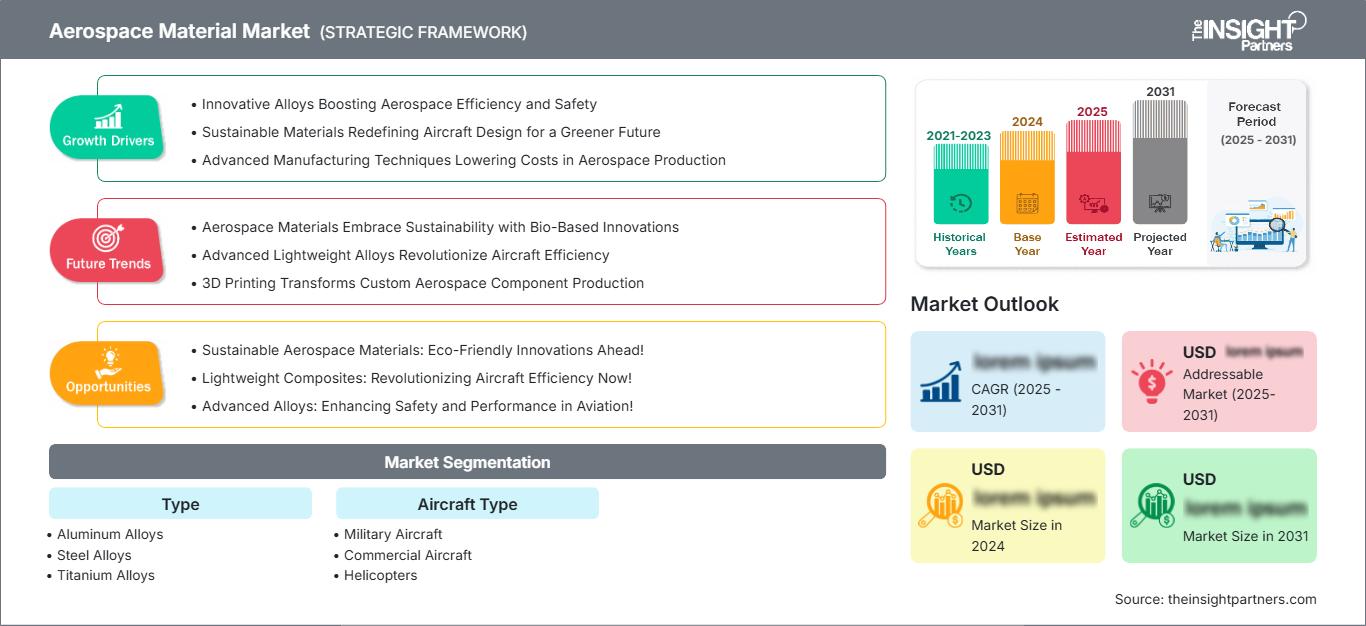
Aerospace Material Market: Strategic Insights
Regional Insights
North America Aerospace Material Market
North America remained the largest regional market, accounting for 38–42% of the aerospace material market share in 2025, and is projected to expand at a CAGR of 1.8–2.2% during 2026–2034. There are advantages arising from the presence of major manufacturers of aircraft, sophisticated defense industries, and aerospace materials. Constant production of commercial airplanes, military fleet modernizations, and R&D investments will continue to create a demand for aluminum alloys, titanium alloys, and composite materials.
Investments by the U.S. and Canada in next-generation aerospace manufacturing technologies such as automatic composites manufacturing and additive manufacturing will increase the demand for aerospace materials. Another area of demand for the aerospace-grade materials will be created through the maintenance, repair, and overhaul industry, the replacement of older aircrafts, and production of lightweight aircraft parts. The defense budget and the procurement programs will also be steady demand sources for aerospace materials.
U.S. Aerospace Material Market
The United States represented 77–81% of the North American market in 2025 and is expected to register a CAGR of 1.9–2.3% during the forecast period. Commercial aircraft manufacture, manufacture of defense aircraft, and consistent research in aerospace engineering have ensured that the country is the largest consumer of high-end materials and advanced composites. The capability to manufacture locally also ensures that there is demand for the materials in aircraft structures, aircraft engines, landing gears, and interiors of aircraft.
Material producers, aircraft OEMs, and Tier 1 suppliers will keep on investing more in alloys, carbon fiber composites, and advanced manufacturing processes in order to enhance the efficiency of aircraft and minimize the costs involved. Defense modernization projects sponsored by the government, manufacture of military aircraft, and delivery of commercial aircraft keep ensuring continued material consumption.
Europe Aerospace Material Market
Europe accounted for 26–30% of the global market in 2025 and is anticipated to grow at a CAGR of 1.5–1.9% through 2034. Germany remains the regional leader due to its advanced aerospace manufacturing capabilities and strong industrial materials sector. France benefits from extensive commercial aircraft production, while the United Kingdom continues contributing through aerospace engineering, defense manufacturing, and high-value composite material technologies.
Germany continues investing in advanced aluminum processing, titanium manufacturing, and composite research to strengthen domestic aerospace competitiveness. France maintains significant demand through commercial aircraft assembly, aerospace systems integration, and engine manufacturing. Meanwhile, the United Kingdom, Italy, and Spain collectively support regional growth through specialized aerospace component manufacturing, composite technology development, military aircraft programs, and participation in multinational European aerospace projects.
APAC Aerospace Material Market
Asia Pacific represented 22–26% of the market in 2025 and is forecast to register the fastest regional CAGR of 2.1–2.5% through 2034. China continues leading regional aircraft manufacturing expansion, while Japan, India, South Korea, and Australia strengthen aerospace production capabilities through public and private investments.
Government initiatives supporting indigenous aircraft development, expanding aerospace supply chains, and increasing defense procurement continue stimulating regional demand for lightweight alloys, advanced composites, and high-temperature materials. Rapid industrialization and growing aviation markets further reinforce long-term consumption across commercial and military aircraft manufacturing.
Middle East & Africa Aerospace Material Market
The Middle East & Africa market is expected to expand at a CAGR of 1.4–1.8% during 2026–2034. Saudi Arabia and the UAE continue investing in aerospace manufacturing capabilities, while South Africa maintains an established aerospace engineering and maintenance industry supporting regional material demand.
National diversification strategies, increasing defense procurement, and investments in aviation infrastructure continue supporting gradual aerospace industry development across the region. Although manufacturing volumes remain comparatively smaller than mature markets, expanding maintenance facilities and strategic aerospace partnerships are expected to generate steady demand for certified aerospace materials.
Segmentation Analysis
Type
The Type segment forms the technological foundation of the aerospace material market and reflects the industry's continuous transition toward lightweight, high-strength, and corrosion-resistant materials. The aerospace material market scope continues expanding as manufacturers optimize material selection to improve aircraft efficiency, reduce lifecycle costs, and satisfy increasingly stringent certification requirements. This segment is projected to grow at a CAGR of 1.8–2.2% during 2026–2034.
- Aluminum Alloys: Continue serving as the dominant structural material because of their excellent strength-to-weight ratio, corrosion resistance, cost-effectiveness, and extensive use across fuselage structures, wings, and airframes.
- Steel Alloys: Maintain strategic importance in landing gear, fasteners, engine components, and highly stressed structural applications where exceptional mechanical strength and fatigue resistance remain critical.
- Titanium Alloys: Experience growing adoption owing to superior corrosion resistance, high-temperature performance, and compatibility with advanced aircraft engines and lightweight structural assemblies.
- Super Alloys: Primarily utilized in turbine engines and high-temperature aerospace applications where exceptional thermal stability, oxidation resistance, and long-term mechanical performance are essential.
- Composite Materials: Continue gaining market acceptance through carbon fiber-reinforced structures that significantly reduce aircraft weight while improving fuel efficiency, structural durability, and maintenance performance.
Aircraft Type
Aircraft type significantly influences aerospace material demand as structural requirements, operating environments, and certification standards vary across aviation platforms. Commercial aviation remains the largest consumer, while military modernization programs continue increasing demand for advanced alloys and composites. The segment is expected to register a CAGR of 1.7–2.1% during the forecast period.
- Military Aircraft: Demand advanced titanium alloys, superalloys, and high-performance composites capable of withstanding demanding operational conditions, extreme temperatures, and extended service life requirements.
- Commercial Aircraft: Represent the largest material-consuming category because of high production volumes, continuous fleet expansion, and increasing adoption of lightweight structural materials to improve operational efficiency.
- Helicopters: Require specialized lightweight metals and composite materials that improve rotorcraft performance, corrosion resistance, vibration control, and operational reliability across civilian and defense applications.
- Business and General Aviation: Continue adopting advanced composite structures and lightweight alloys to improve aircraft performance, reduce operating costs, and enhance passenger comfort while supporting customized aircraft designs.
Opportunity Snapshot
| Aircraft Type | Revenue Contribution | Trend Tag | Adoption Stage |
| Commercial Aircraft | High | Fleet Renewal | Mature |
| Military Aircraft | High | Defense Upgrade | Scaling |
| Helicopters | Medium | Lightweight Rotorcraft | Mature |
| Business and General Aviation | Medium | Premium Aircraft | Scaling |
Aerospace Material Market Growth Drivers and Impact Analysis
Increasing Commercial Aircraft Production and Fleet Modernization
The continued revival of air transport across the world, as well as the continued expansion of the long-term programs for aircraft replacement, are expected to continue boosting the demand for aerospace materials. There has been an increase in the production of fuel-efficient aircraft, which are constructed using light aluminum and titanium alloys, as well as advanced composite materials. The construction of new-generation aircraft requires much more carbon fiber composite and advanced alloy material than before. In addition, fleet modernization efforts by countries both in the developed and developing world have increased the need for replacement of aerospace materials during the process of maintenance, repairs, and overhaul of aircraft fleets.
Rising Defense Expenditure Supporting Advanced Material Adoption
With increasing uncertainties in geopolitics and defense modernization efforts, governments have started making investments in fighter aircraft, transport aircraft, helicopters, and unmanned aerial systems. The defense equipment needs materials which are able to provide better strength, fatigue resistance, heat resistance, and anti-corrosion capabilities in tough operational conditions. Titanium alloys, superalloys, and high-end composites have become increasingly important since they enhance the mission effectiveness and reduce structural weight. The procurement process and defense manufacturing efforts are helping in achieving localized production of aerospace materials as well. With the growth of defense spending in North America, Europe, and Asia Pacific regions, it is anticipated that there will be stable demand for aerospace materials.
Growing Adoption of Lightweight Composite Structures
Aircraft makers have been consistently replacing traditional metallic parts with new-age composite materials that help improve fuel economy, cargo load factors, and maintenance savings. Composites reinforced by carbon fibers provide outstanding mechanical properties in terms of strength-to-weight ratio, corrosion protection, and design freedom, and thus can be used for constructing the fuselage body, wings, tail sections, and cabin interior. The development of resins, automation of fiber placement, and composite manufacturing technologies will make composites even more widespread in the future. Recycling composites and environmentally friendly manufacturing processes will also be considered in order to comply with the environmental criteria.
Aerospace Material Market Future Trends
Expansion of Sustainable Material Development and Circular Manufacturing
Aircraft manufacturers and material suppliers are increasingly prioritizing sustainability through recyclable alloys, lower-carbon aluminum production, bio-based composite resins, and closed-loop manufacturing systems. The aerospace material market trends indicate that environmental performance will become an increasingly important purchasing criterion alongside mechanical strength and durability. Investments in material recycling, energy-efficient production technologies, and lifecycle optimization are expected to accelerate as aerospace companies pursue carbon reduction objectives while maintaining compliance with stringent safety and certification standards.
Greater Integration of Additive Manufacturing for Aerospace Components
Additive manufacturing is increasingly complementing conventional aerospace material processing by enabling lightweight component production, optimized geometries, and reduced material waste. Aircraft manufacturers continue expanding the use of metal powders, titanium alloys, and specialized aerospace materials for producing complex structural and engine components. As qualification standards mature and production scalability improves, additive manufacturing is expected to reduce manufacturing lead times while enhancing supply chain flexibility across commercial and defense aerospace industries.
Aerospace Material Market Opportunities
Increasing Localization of Aerospace Material Supply Chains
Governments and aerospace manufacturers continue investing in regional production capabilities to improve supply chain resilience and reduce dependence on imported aerospace materials. The aerospace material market forecasts suggest that localized alloy production, composite manufacturing facilities, and aerospace-grade recycling capabilities will attract substantial investments across Asia Pacific and the Middle East. Companies establishing regional manufacturing partnerships, technical centers, and certification capabilities are expected to strengthen their competitive position while supporting expanding domestic aerospace industries.
Growing Demand for Next-Generation Composite Materials
The transition toward lightweight aircraft creates significant opportunities for manufacturers developing advanced composite materials with enhanced fatigue resistance, improved impact performance, and higher manufacturing efficiency. Continued research into thermoplastic composites, automated composite processing, and recyclable carbon fiber technologies is expected to broaden aerospace applications beyond primary structures. Strategic collaborations between aircraft manufacturers, research institutions, and specialty material suppliers will accelerate commercialization while supporting future aircraft platforms requiring higher structural performance and improved sustainability.
Recent Developments
- July 9, 2026: Zotefoams plc expanded high-performance foam manufacturing capacity in Kentucky, USA, through the commissioning of a second low-pressure expansion autoclave. The investment doubled North American low-pressure capacity and strengthened supply capabilities for advanced foam applications requiring lightweight performance, durability, and specialized material characteristics. The expansion supports growing demand across transportation and aerospace-related applications where engineered foam solutions are increasingly adopted for weight reduction and performance optimization.
- February 25, 2026: Rogers Corporation announced the launch of PORON ReSource30 polyurethane foam, a material incorporating post-industrial recycled and renewable bio-based content. The development aligns with increasing demand for sustainable lightweight materials with reliable performance characteristics. The product expansion supports aerospace-related material innovation trends where manufacturers are seeking lower-impact solutions without compromising durability and long-term application performance.
Frequently Asked Questions

- Comprehensive Market Sizing and Forecast Analysis
- Detailed Segmentation Analysis
- In-Depth Market Dynamics Assessment
- Regional and Country-Level Insights
- Competitive Landscape and Company Benchmarking
- Strategic Business Intelligence
Recent Reports
Testimonials

The Insight Partners' SCADA System Market report is comprehensive, with valuable insights on current trends and future forecasts. The team was highly professional, responsive, and supportive throughout. We are very satisfied and highly recommend their services.
RAN KEDEM Partner, Reali Technologies LTDs
I requested a report on a very specific software market and the team produced the report in a few days. The information was very relevant and well presented. I then requested some changes and additions to the report. The team was again very responsive and I got the final report in less than a week.
JEAN-HERVE JENN Chairman, Future Analytica
We worked with The Insight Partners for an important market study and forecast. They gave us clear insights into opportunities and risks, which helped shape our plans. Their research was easy to use and based on solid data. It helped us make smart, confident decisions. We highly recommend them.
PIYUSH NAGPAL Sr. Vice President, High Beam Global
The Insight Partners delivered insightful, well-structured market research with strong domain expertise. Their team was professional and responsive throughout. The user-friendly website made accessing industry reports seamless. We highly recommend them for reliable, high-quality research services
YUKIHIKO ADACHI CEO, Deep Blue, LLC.
This is the first time I have purchased a market report from The Insight Partners.While I was unsure at first, I visited their web site and felt more comfortable to take the risk and purchase a market report.I am completely satisfied with the quality of the report and customer service. I had several questions and comments with the initial report, but after a couple of dialogs over email with their analyst I believe I have a report that I can use as input to our strategic planning process.Thank you so much for taking the extra time and making this a positive experience.I will definitely recommend your service to others and you will be my first call when we need further market data.
JOHN SUZUKI President and Chief Executive Officer, Board Director, BK Technologies
I wish to appreciate your support and the professionalism you displayed in the course of attending to my request for information regarding to infectious disease IVD market in Nigeria. I appreciate your patience, your guidance, and the fact that you were willing to offer a discount, which eventually made it possible for us to close a deal. I look forward to engaging The Insight Partners in the future, all thanks to the impression you have created in me as a result of this first encounter.
DR CHIJIOKE ONYIA MANAGING DIRECTOR, PineCrest Healthcare Ltd.Reason to Buy
- Informed Decision-Making
- Understanding Market Dynamics
- Competitive Analysis
- Identifying Emerging Markets
- Customer Insights
- Market Forecasts
- Risk Mitigation
- Boosting Operational Efficiency
- Strategic Planning
- Investment Justification
- Tracking Industry Innovations
- Aligning with Regulatory Trends





 Get Free Sample for