
Agricultural Lubricant Market Size, Share & Demand by 2034
Agricultural Lubricant Market Size and Forecasts (2021–2034), Global and Regional Share, Trends, and Growth Opportunity Analysis Report Coverage : by Product Type (Engine Oil, UTTO, Coolant, Grease); Category (Mineral Oil-Based Lubricants, Synthetic Oil-Based Lubricants, Bio-Based); Sales Channel (Oems And Aftermarket); and Geography (North America, Europe, Asia Pacific, and South and Central America)
- Status : Data Released
- Report Code : TIPRE00040212
- Category : Chemicals and Materials
- No. of Pages : 150
- Available Report Formats :


- Last update date : July 27, 2026


2025 Market Size
US$ 5.3 Bn
Base year value
2034 Forecast
US$ 7.24 Bn
Projected by 2034
CAGR 2026-2034
3.98 %
Growth rate
Addressable Market
US$ 58.27 Bn
(2026-2034)
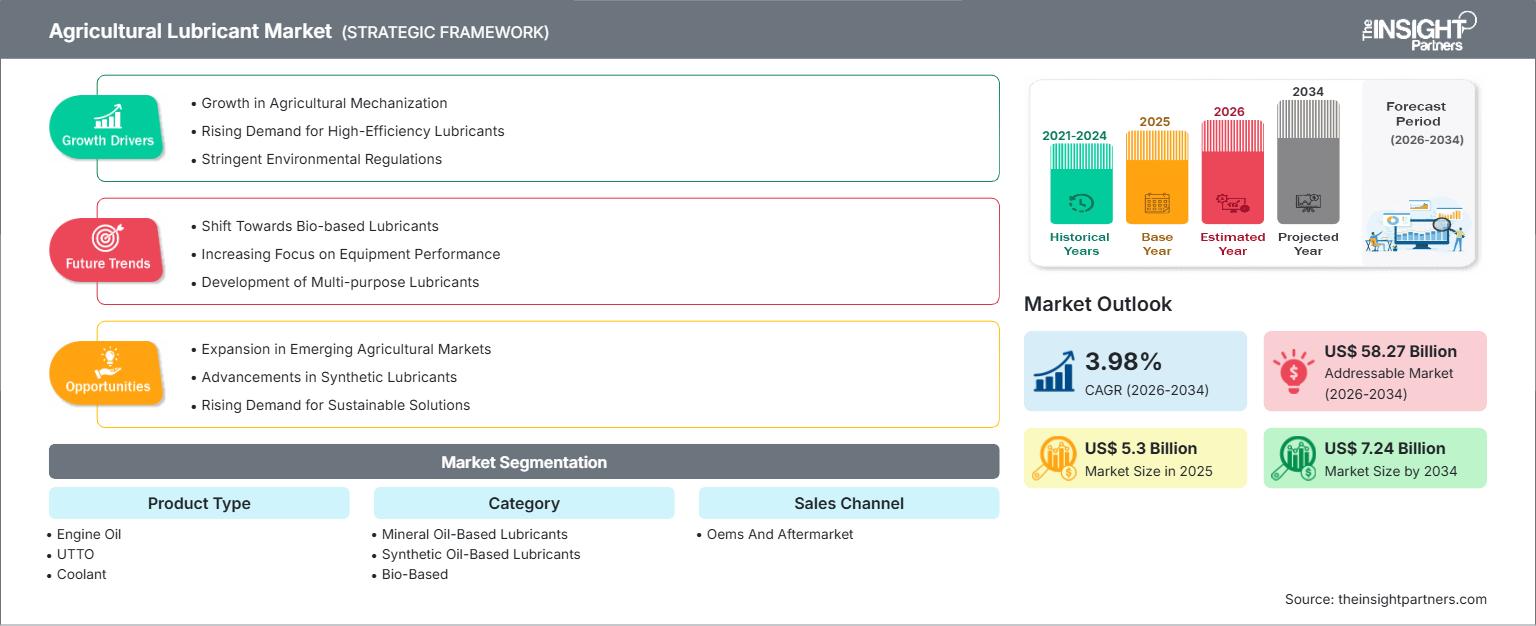
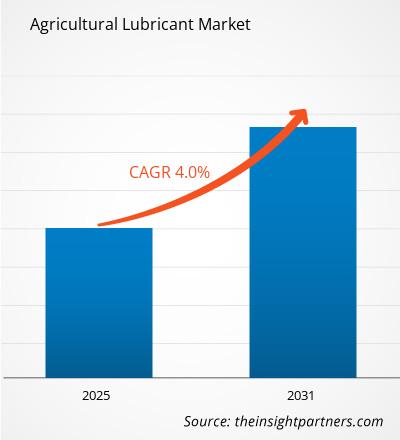
The agricultural lubricant market was valued at US$ 5.3 Billion in 2025 and is projected to reach US$ 7.24 Billion by 2034, registering a CAGR of 3.98% during 2026–2034. Agricultural lubricants are extremely important for keeping tractors, harvesters, irrigation systems, and other farm equipment reliable, efficient, and durable. Increased levels of farm mechanization, growing demand for performance-oriented lubricants, and constant evolution of agricultural lubricants are driving growth in the industry worldwide.
In North America, growing demand is driven by high levels of mechanization, growing replacement demand for better lubricants, and rising use of superior quality synthetic lubricants. The region is expected to expand at a CAGR of 3.6–4.2% during 2026–2034, supported by the modernization of agricultural equipment fleets and growing emphasis on preventive maintenance. The agricultural lubricant market size continues to benefit from technological advancements in heavy-duty farm machinery and increasing demand for environmentally responsible lubricant formulations.
Agricultural Lubricant Market Assessment and Insights
- North America: Accounted for 31–35% share in 2025 and is projected to grow at a CAGR of 3.6–4.2% during 2026–2034. High mechanization levels, replacement demand, and increasing adoption of synthetic lubricants continue supporting steady regional market expansion.
- US: Represented 76–80% of the North American market in 2025 and is anticipated to register a CAGR of 3.7–4.3% during 2026–2034, driven by extensive commercial farming, large agricultural machinery fleets, and established aftermarket service networks.
- Europe: Held 24–28% share in 2025 and is expected to expand at a CAGR of 3.5–4.1% during 2026–2034. Germany, France, Italy, and the UK remain leading markets due to advanced agricultural mechanization and stringent equipment maintenance standards.
- Asia Pacific: Captured 29–33% share in 2025 and is forecast to record a CAGR of 4.6–5.2% during 2026–2034. China, India, Japan, and Australia continue investing in agricultural modernization, supporting growing lubricant consumption across farming equipment.
- Largest Segment: Engine Oil accounted for 41–45% market share in 2025 and is anticipated to grow at a CAGR of 3.9–4.4% during 2026–2034, reflecting its essential role in protecting engines operating under demanding agricultural conditions.
- High Growth Segment: Bio-Based lubricants represented 11–15% share in 2025 and are projected to witness a CAGR of 6.2–6.8% during 2026–2034, supported by environmental regulations and increasing adoption of sustainable agricultural practices.
- Key companies analyzed in detail: Shell plc, Exxon Mobil Corporation, TotalEnergies SE, BP p.l.c., Chevron Corporation, Phillips 66, FUCHS SE, Sinopec Lubricant Company, PETRONAS Lubricants International Sdn. Bhd., Valvoline Global Operations.
Source: The Insight Partners' analysis based on proprietary research, government publications, company annual reports, investor presentations, industry databases, and expert interviews.
There has been significant development in the equipment itself, which requires higher levels of wear protection, thermal stability, oxidation resistance, and longer oil change intervals. Development of additives as well as synthetic base oils has greatly improved the efficiency of lubricants in terms of engines, hydraulics, transmission, and greasing. Manufacturers are also working on products that will work with new engine standards and will provide reliable operation of equipment.
Future growth of the market is expected to occur due to increasing mechanical efficiency of agriculture in emerging countries, increased use of precision farming technology, and greater investments in sustainable lubricants. Legislative measures in favor of environmentally acceptable lubricants, along with the development of new technologies in bio-lubricant production, have led manufacturers to develop more diversified product lines. Expansion of dealer network and aftermarket services will also increase accessibility of products in emerging agricultural markets.
Agricultural Lubricant Market Report Scope
| Report Attribute | Details |
|---|---|
| Market size in 2025 | US$ 5.3 Billion |
| Market Size by 2034 | US$ 7.24 Billion |
| Global CAGR (2026 - 2034) | 3.98% |
| Historical Data | 2021-2024 |
| Forecast period | 2026-2034 |
Agricultural Lubricant Market Analysis
Growing agricultural mechanization and increasing utilization of high-horsepower farming equipment continue to stimulate lubricant demand across global agriculture. Modern tractors, combines, sprayers, harvesters, and irrigation systems require specialized lubricants that ensure operational reliability under severe working environments. The agricultural lubricant market growth is further supported by rising awareness regarding preventive equipment maintenance, increasing replacement intervals for premium lubricants, and expanding commercial farming operations requiring efficient fleet management.
Market Value Chain consists of crude oil processors, base oil producers, additive producers, lubricant formulators, machinery manufacturers, authorized dealers, aftermarket suppliers, and agricultural consumers. Technological advancements in synthetic base oils, multifunctional additives, and environmentally friendly formulations are enhancing the performance of the lubricants while complying with emission regulations and machinery requirements. Supply chain management and regional blending units are enabling the manufacturers to enhance their marketability and cost effectiveness.
The agricultural lubricant market analysis highlights competition centered on product performance, technical service capabilities, sustainability initiatives, and extensive distribution networks. Leading participants include Shell plc, Exxon Mobil Corporation, TotalEnergies SE, Chevron Corporation, FUCHS SE, Phillips 66, BP p.l.c., and PETRONAS Lubricants International Sdn. Bhd. continue investing in advanced lubricant technologies, digital condition monitoring services, and OEM collaborations to strengthen customer relationships and expand market presence.
Strategic investments have started centering on the expansion of capacity for blending lubricants, the development of the distribution network, and the creation of bio-based and synthetic lubricant lines. Equipment manufacturers and lubricant companies have started working together to create lubricants that will be used in the latest generation of agricultural equipment. At the same time, the companies have kept on improving their technical support, oil analysis, and predictive maintenance services.
● REPORT CUSTOMIZATION
Tailor This Report To Align With Your Specific Business Requirements
This report can be customized to align precisely with your business objectives, scope, and target markets. Customization options include tailored segmentation, geography, competitive analysis, and strategic insights to support informed decision-making.
Customize This Report →WHAT YOU CAN ADJUST
- ● Segmentations
- ● Geography
- ● Competitive Analysis
- ● Language Preferences
Agricultural Lubricant Market: Strategic Insights
Regional Insights
North America Agricultural Lubricant Market
North America accounted for 31–35% of the agricultural lubricant market share in 2025 and is projected to expand at a CAGR of 3.6–4.2% during 2026–2034. The region benefits from one of the world's highest levels of agricultural mechanization, extensive use of tractors, combines, self-propelled sprayers, and precision farming equipment. Farmers increasingly adopt premium engine oils, universal tractor transmission oils (UTTO), and synthetic greases to improve equipment reliability, reduce maintenance frequency, and extend machinery operating life under intensive seasonal workloads.
A replacement market segment constitutes a considerable share of the lubricant consumption, due to the emphasis on prevention in commercial farms to avoid equipment downtime during the periods when farming activities take place. Continuous investments in agricultural equipment that work autonomously, as well as the usage of machinery controlled by GPS and fuel-efficient diesel engines, result in growing demand for improved lubricants with better oxidation stability, heat resistance and anti-wear properties. Another area attracting growing interest is that of biodegradable lubricants.
U.S. Agricultural Lubricant Market
The US represented 76–80% of the North American market in 2025 and is anticipated to register a CAGR of 3.7–4.3% during 2026–2034. Large-scale commercial farming, widespread ownership of high-powered agricultural equipment, and an extensive aftermarket service network continue driving lubricant consumption. Corn, soybean, wheat, cotton, and specialty crop production require reliable machinery performance, increasing demand for premium engine oils, transmission fluids, hydraulic lubricants, and greases capable of operating under demanding field conditions.
The country also benefits from the presence of major lubricant manufacturers, agricultural equipment OEMs, and well-established dealer networks that facilitate product availability and technical support. Increasing adoption of precision agriculture, telematics-enabled machinery, and predictive maintenance programs encourages farmers to utilize higher-quality lubricants that maximize equipment efficiency while reducing maintenance costs and extending service intervals throughout annual operating cycles.
Europe Agricultural Lubricant Market
Europe held 24–28% share in 2025 and is forecast to grow at a CAGR of 3.5–4.1% during 2026–2034. The region's mature agricultural sector, advanced mechanization, and stringent environmental regulations encourage the adoption of premium and environmentally responsible lubricant solutions. Germany remains the leading market because of its strong agricultural machinery manufacturing base, while France, Italy, Spain, and the UK continue contributing significant demand through highly mechanized farming operations and established aftermarket distribution channels.
Stable lubricant demand in the country is sustained by modern methods of cereal cultivation and livestock production, alongside the growing use of precision farming techniques. Demand is slowly moving towards synthetics and multifunctional lubricants, which increase machine performance and minimize operational costs.
Consumption in Germany is led by its highly developed sector of agricultural machinery production, presence of numerous companies offering lubricant technology solutions, and advanced maintenance procedures. Ongoing process of equipment upgrades creates demand for advanced engine oils and UTTO formulations.
A large regional market is formed by France, Italy, and Spain, which is created by diverse agricultural product range, vineyards and orchards, cereal cultivation, and horticulture. Seasonal use of equipment and ongoing mechanization sustains demand for engine oils, greases, and hydraulic oils.
APAC Agricultural Lubricant Market
Asia Pacific captured 29–33% share in 2025 and is expected to register the fastest regional expansion with a CAGR of 4.6–5.2% during 2026–2034. China leads regional consumption due to rapid agricultural mechanization and expanding domestic machinery manufacturing, while India continues investing in farm equipment modernization supported by government mechanization initiatives.
Japan and South Korea emphasize premium lubricant technologies for advanced agricultural equipment, whereas Australia benefits from large-scale commercial farming and extensive machinery utilization. Continued investment in agricultural productivity and rural mechanization supports sustained regional lubricant demand.
Middle East & Africa Agricultural Lubricant Market
The Middle East & Africa market is projected to expand at a CAGR of 4.0–4.6% during 2026–2034, supported by increasing agricultural mechanization, irrigation development, and government initiatives promoting food security. The Kingdom of Saudi Arabia and the UAE are continuously upgrading themselves with the help of advanced farming equipment, which requires efficient lubricants that can perform well in high temperatures.
The country of South Africa still represents the biggest market for farm machinery in the region and provides a continuous demand for engine oils, greases, and transmission lubricants. The rest of the Middle East & Africa region is slowly but surely stepping up its investments in the mechanization of agriculture.
Segmentation Analysis
Product Type
The product type segment represents the foundation of lubricant demand across agricultural machinery, as each formulation is designed to protect critical equipment components operating under varying load, temperature, and environmental conditions. The segment is projected to register a CAGR of 3.9–4.3% during 2026–2034. Continuous improvements in additive chemistry, oxidation stability, and extended-drain formulations are enabling manufacturers to deliver longer equipment life, reduced maintenance costs, and improved fuel efficiency. The agricultural lubricant market scope continues to expand as farmers increasingly adopt high-performance lubricants compatible with modern emission-compliant engines and advanced transmission systems.
- Engine Oil: Engine oil remains the largest product category because it protects diesel engines from wear, oxidation, sludge formation, and thermal degradation. Premium formulations are increasingly preferred to extend service intervals and improve engine efficiency under demanding agricultural operating conditions.
- UTTO: Universal Tractor Transmission Oil (UTTO) is extensively used in agricultural machinery to lubricate transmissions, hydraulic systems, wet brakes, and final drives. Multifunctional performance and compatibility with modern tractor systems continue supporting strong market demand.
- Coolant: Agricultural equipment increasingly utilizes advanced coolants to maintain engine temperature stability, prevent corrosion, and improve overall equipment reliability. Modern coolant formulations also contribute to longer maintenance intervals and enhanced engine durability.
- Grease: Greases provide essential lubrication for bearings, joints, pins, bushings, and heavily loaded mechanical components exposed to dust, moisture, and shock loads. High-performance greases help reduce equipment wear while improving operational reliability throughout seasonal farming activities.
Category
Category reflects the evolution of lubricant technology as agricultural operators balance equipment performance, operating costs, and environmental considerations. The segment is expected to grow at a CAGR of 4.0–4.5% during 2026–2034. Increasing demand for premium synthetic lubricants and environmentally acceptable bio-based alternatives is gradually reshaping purchasing preferences, although mineral oil-based products continue to dominate due to their broad compatibility and cost effectiveness across conventional agricultural machinery.
- Mineral Oil-Based Lubricants: Mineral oil-based lubricants continue to account for the largest share because they provide dependable performance, competitive pricing, and compatibility with a wide range of agricultural machinery used across developed and emerging farming markets.
- Synthetic Oil-Based Lubricants: Synthetic lubricants offer superior oxidation resistance, thermal stability, low-temperature performance, and extended drain intervals. Their adoption continues increasing among operators seeking improved fuel efficiency and reduced maintenance costs for advanced farming equipment.
- Bio-Based: Bio-based lubricants are gaining traction as environmental regulations and sustainability initiatives encourage the use of renewable, biodegradable products. They are particularly suitable for environmentally sensitive agricultural operations where minimizing ecological impact is a priority.
Sales Channel
Sales channels play a significant role in product availability, technical support, and long-term customer relationships throughout the agricultural lubricant market. This segment is anticipated to register a CAGR of 3.8–4.2% during 2026–2034. Original equipment manufacturers continue strengthening factory-fill and recommended lubricant programs, while the aftermarket remains the dominant source of recurring lubricant demand owing to routine maintenance requirements across agricultural machinery fleets.
- OEMs: Original equipment manufacturers recommend specialized lubricant formulations that meet equipment warranty requirements and performance specifications. OEM partnerships also encourage adoption of premium lubricants engineered specifically for modern agricultural machinery platforms.
- Aftermarket: The aftermarket remains the primary distribution channel because agricultural equipment requires periodic oil changes, grease replacement, coolant replenishment, and transmission fluid servicing throughout its operational lifecycle. Extensive dealer networks and independent distributors continue supporting recurring product demand.
Opportunity Snapshot
| Sales Channel | Revenue Contribution | Trend Tag | Adoption Stage |
|---|---|---|---|
| OEMs | Medium | Factory Fill | Scaling |
| Aftermarket | High | Predictive Service | Mature |
Agricultural Lubricant Market Growth Drivers and Impact Analysis
Increasing mechanization of agricultural operations
The increasing use of mechanical farming practices is playing a major role in shaping the demand for lubricants, as farmers are becoming more reliant on tractors, harvesters, sprayers, and irrigation machines in order to become more productive. Emerging nations are purchasing machinery to decrease their reliance on manual labor and produce more crops, while mature markets are continuously modernizing their fleets with new technologies. Such changes increase the need for better lubricants that will be able to handle heavier engine loads, longer operation times, and greater efficiency of equipment. With the increasing use of machinery, lubricant companies can look forward to higher sales of engine oils, transmission fluids, coolants, and greases.
Rising focus on agricultural equipment lifecycle optimization
Preventive maintenance is becoming one of the key concerns for farm operators in order to minimize machine breakdowns and lower operation costs. The proper use of lubricants helps in the reduction of wear and tear, efficient thermal transfer, and the overall prolongation of the lifespan of costly farming equipment. With the cost of machinery increasing, commercial farmers have started opting for planned maintenance practices, condition-based monitoring of oils, and high-quality lubricants in order to make optimum use of their assets. This development is motivating manufacturers to manufacture new lubricants that last longer and provide better resistance against contaminants. Service providers are providing support services for the selection of lubricants as well.
Growth of sustainable and environmentally acceptable lubricant solutions
As a result of environmental policies and sustainability goals, renewable and biodegradable lubricant systems are being developed and embraced for agriculture. Bio-lubricants have a number of benefits in environmentally sensitive situations, such as streams, forests, and other farming environments that require a lubricant that does not pose an environmental hazard when a spillage occurs. Lubricant producers are focusing on developing innovative base oils and additives in order to optimize the performance of their sustainable lubricants while ensuring that they are compatible with agricultural equipment. As awareness among farmers increases regarding environmental protection, acceptance of alternative lubricant systems is rising.
Agricultural Lubricant Market Future Trends
Integration of digital maintenance technologies with lubricant management
The future of equipment maintenance will increasingly involve digital monitoring systems that track lubricant condition, operating hours, temperature variations, and component performance. The agricultural lubricant market trends indicate growing integration between lubricant suppliers, machinery manufacturers, and digital agriculture platforms to enable predictive maintenance strategies. The sensor technology, as well as the technologies used by the connected devices, will be able to provide real-time analysis of how the lubricants are degrading, making it easier for the farmers to plan for their replacements when the need arises. This development will increase the demand for more sophisticated lubricants that are backed up by a maintenance schedule based on the data collected.
Development of advanced formulations for next-generation machinery
The current trend in agricultural machinery design involves increasing the power of the engine, the use of hybrids and automatic control systems, better standards of emission control, etc. The development of new lubricants should be directed at developing new products that will provide for better performance of equipment according to higher standards while providing high efficiency and high thermal and component stability. Manufacturers are expected to create special lubricants for automatic tractors, precision farming equipment, and highly effective hydraulic systems. The development of synthetic base oil, additives, and low-viscosity formulation will contribute to further product innovation. With the development of more complicated platforms by manufacturers of machinery, collaboration with OEMs will become crucial.
Agricultural Lubricant Market Opportunities
Expansion into emerging agricultural mechanization markets
Emerging economies present significant opportunities as governments and agricultural organizations promote mechanization to improve productivity and strengthen food security. The agricultural lubricant market Forecasts indicate increasing investment potential across countries where tractor ownership, irrigation infrastructure, and commercial farming operations are expanding. These opportunities could be leveraged through the creation of localized distribution channels, improving relationships with machinery dealerships, and offering economical lubricants that suit the needs of regional agriculture. The growing use of technologically advanced machinery in APAC, LATAM, and Africa will raise the need for maintenance products. Businesses that can create good technical support and supply chain systems will be able to make good use of these growth opportunities.
Increasing demand for premium synthetic and specialty lubricants
Increasing use of high-performance agricultural machines presents an avenue for the development of superior lubricant products aimed at increasing efficiency and reducing the need for maintenance. The new products include synthetic lubricants, advanced greases, and special transmission oils that provide enhanced protection even in extreme temperature and load conditions. Farming businesses are becoming increasingly willing to pay more for such products that reduce downtime and increase efficiency. Lubricant producers can further establish themselves in the market by producing application-specific lubricants and partnering with machine manufacturers in developing new products geared towards optimizing performance. The increased technologization of agricultural business makes it likely that more professional farmers will prefer premium lubricant products.
Recent Developments
- June 24, 2025: Castrol introduced Castrol Intelligent Lubrication Solutions, integrating predictive analytics, sensor-based monitoring, and digital platforms with lubricant services. The initiative supports equipment operators in reducing downtime, optimizing lubricant consumption, and extending asset life, reflecting the growing shift toward condition-based maintenance in heavy-duty equipment sectors, including agriculture.
- May 2, 2025: PETRONAS Lubricants International announced strategic collaborations to expand its high-performance lubricant and fluid solutions portfolio across industrial markets. The company continues strengthening its global lubricant capabilities through partnerships, technology development, and regional expansion, supporting broader adoption of advanced lubrication solutions for machinery-intensive sectors.
Frequently Asked Questions

- Comprehensive Market Sizing and Forecast Analysis
- Detailed Segmentation Analysis
- In-Depth Market Dynamics Assessment
- Regional and Country-Level Insights
- Competitive Landscape and Company Benchmarking
- Strategic Business Intelligence
Recent Reports
Testimonials

The Insight Partners' SCADA System Market report is comprehensive, with valuable insights on current trends and future forecasts. The team was highly professional, responsive, and supportive throughout. We are very satisfied and highly recommend their services.
RAN KEDEM Partner, Reali Technologies LTDs
I requested a report on a very specific software market and the team produced the report in a few days. The information was very relevant and well presented. I then requested some changes and additions to the report. The team was again very responsive and I got the final report in less than a week.
JEAN-HERVE JENN Chairman, Future Analytica
We worked with The Insight Partners for an important market study and forecast. They gave us clear insights into opportunities and risks, which helped shape our plans. Their research was easy to use and based on solid data. It helped us make smart, confident decisions. We highly recommend them.
PIYUSH NAGPAL Sr. Vice President, High Beam Global
The Insight Partners delivered insightful, well-structured market research with strong domain expertise. Their team was professional and responsive throughout. The user-friendly website made accessing industry reports seamless. We highly recommend them for reliable, high-quality research services
YUKIHIKO ADACHI CEO, Deep Blue, LLC.
This is the first time I have purchased a market report from The Insight Partners.While I was unsure at first, I visited their web site and felt more comfortable to take the risk and purchase a market report.I am completely satisfied with the quality of the report and customer service. I had several questions and comments with the initial report, but after a couple of dialogs over email with their analyst I believe I have a report that I can use as input to our strategic planning process.Thank you so much for taking the extra time and making this a positive experience.I will definitely recommend your service to others and you will be my first call when we need further market data.
JOHN SUZUKI President and Chief Executive Officer, Board Director, BK Technologies
I wish to appreciate your support and the professionalism you displayed in the course of attending to my request for information regarding to infectious disease IVD market in Nigeria. I appreciate your patience, your guidance, and the fact that you were willing to offer a discount, which eventually made it possible for us to close a deal. I look forward to engaging The Insight Partners in the future, all thanks to the impression you have created in me as a result of this first encounter.
DR CHIJIOKE ONYIA MANAGING DIRECTOR, PineCrest Healthcare Ltd.Reason to Buy
- Informed Decision-Making
- Understanding Market Dynamics
- Competitive Analysis
- Identifying Emerging Markets
- Customer Insights
- Market Forecasts
- Risk Mitigation
- Boosting Operational Efficiency
- Strategic Planning
- Investment Justification
- Tracking Industry Innovations
- Aligning with Regulatory Trends





 Get Free Sample for