
AI-Based Fever Detection Camera Market Growth, Size & Forecast by 2034
Coverage: By Type (Turret/Bullet Cameras, Handheld Cameras); End-User (Airport, Hospitals, Public Places, Enterprises/Factories, Banks, Others) , and Geography (North America, Europe, Asia Pacific, and South and Central America)
- Status : Data Released
- Report Code : TIPRE00020409
- Category : Electronics and Semiconductor
- No. of Pages : 150
- Available Report Formats :


- Last update date : July 10, 2026


2025 Market Size
US$ 1,508.89 Mn
Base year value
2034 Forecast
US$ 4,416.06 Mn
Projected by 2034
CAGR 2026-2034
12.67 %
Growth rate
Addressable Market
US$ 25,843.19 Mn
(2026-2034)
The AI-Based Fever Detection Camera Market was valued at US$ 1,508.89 Million in 2025 and is projected to reach US$ 4,416.06 Million by 2034, registering a CAGR of 12.67% from 2026 to 2034. The market covers AI-enabled thermal imaging systems used to identify elevated body temperature across controlled and high-footfall environments.
North America is expected to expand at a 11.8–12.4% CAGR through 2034, supported by airport modernization, hospital infection-prevention budgets, and enterprise security upgrades. The region’s adoption is reinforced by integrated surveillance platforms, established thermal imaging suppliers, and regulatory attention to workplace safety, although privacy review and procurement cycles continue to shape deployment timing. The AI-Based Fever Detection Camera Market share in North America is supported by these factors, along with continued investments in public safety and health-monitoring infrastructure.
AI-Based Fever Detection Camera Market Assessment and Insights
- North America accounted for 31–34% share in 2025 and is expected to grow at a CAGR of 11.8–12.4% between 2026–2034, driven by healthcare screening, aviation security, and smart-building integration.
- The US represented 78–82% of North America in 2025 and is projected to grow at 11.9–12.5% CAGR through 2034, supported by hospitals, airports, and enterprise campuses.
- Europe held 22–25% share in 2025 and is expected to register an 11.0–11.7% CAGR, with the UK, Germany, France, Italy, and Spain leading institutional deployments.
- Asia Pacific captured 29–32% share in 2025 and is forecast to grow at 13.5–14.3% CAGR, led by China, Japan, South Korea, India, and Australia.
- Turret/Bullet Cameras were the largest segment, with 67–71% market share in 2025 and a 12.1–12.8% CAGR, owing to fixed-site monitoring needs.
- Handheld Cameras formed the high-growth segment, with 29–33% share in 2025 and 13.4–14.2% CAGR, supported by mobile screening and emergency workflows.
- Key companies analyzed in detail: Altoros Americas LLC, AnyConnect Private Limited, Athena Security, Inc., Teledyne FLIR LLC, Honeywell International Inc., Johnson Controls International plc, Mantra Softech India Private Limited, Nippon Avionics Co., Ltd., Platinum CCTV, Vantage Security.
Source: The Insight Partners' analysis based on proprietary research, government publications, company annual reports, investor presentations, industry databases, and expert interviews.
The market has moved from temporary pandemic-response procurement toward integrated safety, access-control, and operations platforms. Turret and bullet systems now combine infrared sensors, face localization, environmental calibration, and edge analytics to reduce manual checks. The AI-Based Fever Detection Camera Market size is also being influenced by shifting production dynamics, as camera manufacturers integrate AI modules, firmware updates, and cybersecurity features into standard surveillance hardware rather than selling fever screening as a standalone emergency product.
Future adoption will depend on resilient infrastructure spending, aviation passenger growth, hospital triage modernization, and public venue risk management. Emerging geographies are prioritizing airport and metro security, while mature markets are upgrading legacy thermal devices with analytics-enabled platforms. Policy attention to infectious disease preparedness, workplace continuity, and non-contact screening should keep the AI-Based Fever Detection Camera Market aligned with broader health-security investment cycles.
AI-Based Fever Detection Camera Market Report Scope
| Report Attribute | Details |
|---|---|
| Market size in 2025 | US$ 1,508.89 Million |
| Market Size by 2034 | US$ 4,416.06 Million |
| Global CAGR (2026 - 2034) | 12.67% |
| Historical Data | 2021-2024 |
| Forecast period | 2026-2034 |
AI-Based Fever Detection Camera Market Analysis
Demands arise from an environment that has fast flow, minimal interaction, and quick processing of exceptions. Airport terminals, hospitals, banks, manufacturing plants, and open facilities demand solutions where many individuals must be screened without interfering with the flow of traffic. The AI-Based Fever Detection Camera size is determined by factors such as the availability of thermal sensors, AI precision, installation procedures, and connection to the video management system.
The value chain includes infrared detector suppliers, optical module makers, AI software developers, device assemblers, system integrators, and facility operators. Supply dynamics favor companies that can combine calibrated thermal measurement, privacy-aware analytics, and dependable after-sales support. The AI-Based Fever Detection Camera Market report also reflects procurement preference for platforms that support broader security use cases beyond fever detection.
The competitive landscape is fragmented between thermal imaging specialists, security automation vendors, and AI-enabled access-control firms. Teledyne FLIR LLC and Nippon Avionics Co., Ltd. bring thermal imaging depth, while Honeywell International Inc. and Johnson Controls International plc benefit from building systems integration. Athena Security, Inc., Mantra Softech India Private Limited, and Platinum CCTV compete on application-specific deployment models. The AI-Based Fever Detection Camera Market remains characterized by competition based on thermal accuracy, AI capabilities, integration flexibility, and deployment expertise across healthcare, transportation, and commercial environments.
Investment is moving toward edge AI, cloud dashboards, and unified entrance-screening solutions. Strategic positioning increasingly depends on accuracy validation, device interoperability, and the ability to serve healthcare, transportation, and enterprise buyers with different compliance expectations. The AI-Based Fever Detection Camera Market forecast indicates that these factors will continue to support market growth while separating durable suppliers from opportunistic hardware resellers.
● REPORT CUSTOMIZATION
Tailor This Report To Align With Your Specific Business Requirements
This report can be customized to align precisely with your business objectives, scope, and target markets. Customization options include tailored segmentation, geography, competitive analysis, and strategic insights to support informed decision-making.
Customize This Report →WHAT YOU CAN ADJUST
- ● Segmentations
- ● Geography
- ● Competitive Analysis
- ● Language Preferences
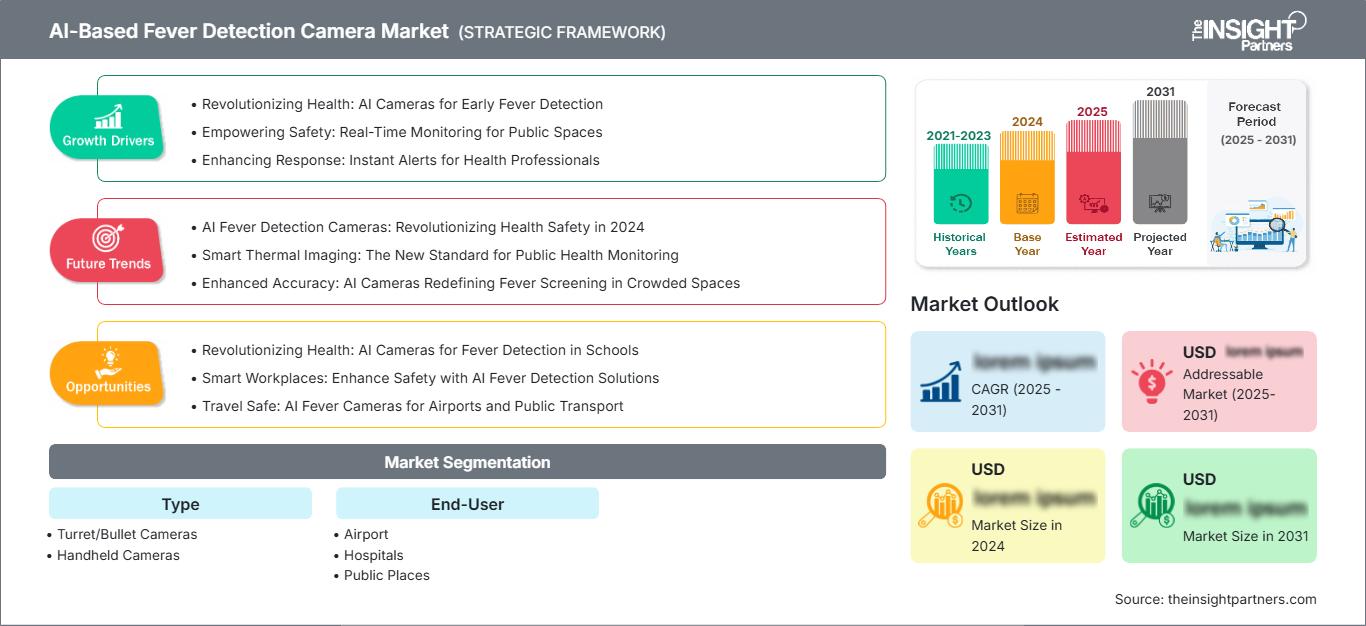
AI-Based Fever Detection Camera Market: Strategic Insights
Regional Insights
North America AI-Based Fever Detection Camera Market
North America held 31–34% share in 2025 and is expected to record an 11.8–12.4% CAGR. Demand is supported by airport passenger recovery, hospital emergency-department triage, and enterprise safety investments. IATA’s traffic recovery outlook has encouraged airports to balance throughput with health screening, creating demand for non-contact thermal systems. AI-Based Fever Detection Camera Market trends are increasingly focused on integrated screening solutions, edge analytics, and contactless monitoring technologies that enhance operational efficiency and public safety.
The regional AI-Based Fever Detection Camera Market share also depends on the use of smart buildings. More and more facility managers want to purchase fever detection cameras that are compatible with access control, visitor management, and security control centers. Buyers are selective since they need proof of the camera's performance, privacy protection, and low false alarm rate.
U.S. AI-Based Fever Detection Camera Market
The US accounted for 78–82% of North American revenue in 2025 and is expected to grow at an 11.9–12.5% CAGR. Hospitals, airports, factories, and corporate campuses represent the largest use cases, with adoption driven by infection-control readiness, facility automation, and integrated security modernization. The AI-Based Fever Detection Camera Market is benefiting from these trends as organizations increasingly deploy non-contact screening technologies within broader safety and access-control frameworks.
Presence of companies boosts the United States market. Honeywell International Inc., Johnson Controls International plc, Athena Security, Inc., Platinum CCTV, and Vantage Security contribute to domestic sourcing by using building automation, security integration, and specialized screening solutions. Trends in applications include fever screening with visitor analysis, access processes, and alerts, rather than separate temperature checks.
Europe AI-Based Fever Detection Camera Market
Europe represented 22–25% share in 2025 and is expected to expand at an 11.0–11.7% CAGR. The UK leads adoption across airports, hospitals, and public venues where security modernization and operational resilience remain procurement priorities. Buyers emphasize compliance, transparent data handling, and integration with existing CCTV estates. The AI-Based Fever Detection Camera Market is benefiting from these requirements as organizations seek reliable, compliant, and interoperable screening solutions.
Germany comes next as a major adopter of industry and healthcare. Factories, distribution centers, and hospitals make use of thermal imaging technology to ensure continuity of labor and proper access control. Germany’s conservative procurement practices value validated precision, reliability, and seamless connectivity with building management systems.
Other European nations contributing to adoption are France, Italy, and Spain. These countries contribute with their transit points, tourist spots, and healthcare facilities. The stable demand for public infrastructure exists in France, hospitals and airports need to be resilient in Italy, and Spain enjoys high tourist traffic.
APAC AI-Based Fever Detection Camera Market
APAC accounted for 29–32% share in 2025 and is expected to grow at a 13.5–14.3% CAGR. China is the leading country, supported by dense urban transit, airport screening, and domestic electronics supply chains. Japan and South Korea add demand through healthcare quality standards and smart infrastructure. The AI Based Fever Detection Camera Market is benefiting from these factors as governments and organizations invest in advanced screening, monitoring, and public safety technologies across transportation, healthcare, and smart city environments.
India is increasing the use of technology in airport terminals, hospital facilities, commercial firms, and banking institutions by strengthening entrance screening and monitoring systems. Australia plays its part in the form of deployment of this system in the transportation, healthcare, and public places sectors, where risk management and business continuity continue to be the top buying criteria.
Industrial policies, production in the country itself, and the smart city initiative drive the trends of AI-based fever detection cameras in the region. Scaling capabilities, along with edge computing and integration with biometric or access control systems, become essential buying factors.
Middle East & Africa AI-Based Fever Detection Camera Market
Middle East & Africa will be growing at a CAGR of 11.4–12.1%. Saudi Arabia will be the dominant country due to airport modernization, security for giga projects, modernization of healthcare, and monitoring of public places with heavy foot traffic. Thermal cameras are also used for the security of energy installations. All of this will positively impact the AI-Based Fever Detection Camera Market.
UAE is showing great demand from airports, hospitality, banking, and smart buildings. In South Africa, the market is getting demand from healthcare, mining, and enterprises, where thermal screening helps in occupational safety and the management of visitors in big establishments.
In the rest of the MEA region, demand will be project-based, linked to infrastructure, government offices, and private hospitals. Growth will be limited due to budget cycles, but integration of security solutions will help in durable deployment.
Segmentation Analysis
Type
The Type segment is expected to grow at a 12.4–13.1% CAGR from 2026 to 2034. Adoption is shaped by facility layout, screening volume, mobility requirements, and integration with existing surveillance systems. Fixed devices dominate permanent checkpoints, while portable devices support flexible response needs in hospitals, factories, banks, and temporary public venues.
- Turret/Bullet Cameras hold the strongest market position because they suit entrances, corridors, airport gates, hospital lobbies, and factory access points requiring continuous monitoring and integration with control rooms.
- Handheld Cameras address mobile inspection, emergency triage, temporary events, and facilities without permanent screening lanes, making them strategically important for flexible and distributed operations.
End-User
The End-User segment is expected to grow at a 12.6–13.3% CAGR from 2026 to 2034. Demand varies by throughput, health-risk exposure, and security integration needs. Airports and hospitals lead structured deployments, while public places, enterprises, factories, and banks adopt systems when continuity, crowd management, or controlled visitor access becomes a priority.
- The airport demand is driven by passenger movement management, border-health readiness, and integration with security checks, where contactless screenings should not cause queuing problems.
- The hospital system uses systems for patient sorting, staff screening, an emergency entry point, and infection control processes, where rapid temperature assessment helps to route patients more safely.
- Public Places use systems for transit terminals, sports and entertainment venues, governmental organizations' buildings, and shopping malls, where heavy traffic demands health screening infrastructure to be visible and scalable.
- Enterprises/Factories use systems for ensuring operational continuity, workplace safety, shift check-in, and visitor screening for manufacturing companies, logistics facilities, and corporate campuses.
- Banks use fever detection systems selectively in their headquarters, branches, cash-processing facilities, and secure premises where client access, employee safety, and business continuity coincide.
Opportunity Snapshot
| Segment Name | Revenue Contribution | Trend Tag | Adoption Stage |
| Airport | High | Passenger Flow | Mature |
| Hospitals | High | Triage Safety | Scaling |
| Public Places | Medium | Crowd Screening | Scaling |
| Enterprises/Factories | Medium | Workforce Entry | Scaling |
| Banks | Low | Secure Access | Emerging |
AI-Based Fever Detection Camera Market Growth Drivers and Impact Analysis
Rising Need for Non-Contact Health Screening
Footfall-heavy sites remain committed to investing in technologies that minimize physical contact, reduce waiting times, and safeguard personnel amid outbreaks of infectious diseases. The guidelines set by the WHO regarding outbreaks involving the respiratory system have reiterated the importance of early detection and isolation of affected people in readiness for such scenarios. Although thermal imaging does not diagnose any condition, it acts as an initial filter when used in conjunction with operating procedures. This is a major driver of the global AI-Based Fever Detection Camera Market in various places like airports, hospitals, and other sites where regular thermometers take time.
Integration with Smart Building and Security Platforms
Fever detectors for facilities are increasingly being considered as an integral element of a wider system of security and automation. Cameras integrated with access control, visitor management, alarms, and video analytics can avoid duplication of hardware and enhance coordination of responses. This will make the business case better since the same infrastructure can be used for health screenings, occupancy tracking, and security checks. The leading players in this space are Honeywell International Inc. and Johnson Controls International plc on the building systems side and camera vendors for endpoint intelligence.
Airport and Healthcare Infrastructure Modernization
The airports and hospitals are renovating their entrance points and checkpoints to process more people without affecting the level of safety. According to IATA, passenger processing will still be challenging due to continued aviation growth. In addition, the hospitals have made investments in preventing infections and increasing the speed at which they conduct triage. The AI-driven thermal system allows the organization to detect any exceptions, redirect people for secondary screening, and ensure continuity during the season when there is an outbreak of illnesses. The effect is significant as the sites determine the procurement standards for other organizations.
AI-Based Fever Detection Camera Market Future Trends
Edge AI Calibration and Lower False Alerts
Systems in the future will make use of edge AI more extensively to make necessary adjustments in terms of distance, ambient temperature, face positioning, and crowd movements without making use of cloud-based processing alone. This is important in light of the fact that false positives can affect the queue lines, whereas false negatives lower the confidence in screening systems. Improvements in the algorithms are expected from vendors through the use of bigger thermal datasets, sensor fusion, and automatic black body calibration. Ultimately, system differentiation will be defined by reliability and not just thermal resolution alone.
Multifunctional Entrance Screening Platforms
The industry is headed toward entrance solutions that incorporate thermal fever sensing, visitor validation, weapon scanning, access control, and incident management. This trend is a reflection of customers' preference for fewer solutions, simplified operations, and integrated dashboards. In hospitals, the platform strategy will enable triage and security services; in factories, it will tie health screening into shift entrance; at airports, it will coexist alongside biometrics and luggage security processes. As buyers become more lifecycle-minded in their purchasing decisions, vendors who are able to bundle hardware, software, analytics, and support services will fare better.
AI-Based Fever Detection Camera Market Opportunities
Healthcare Network Standardization Programs
The potential of hospitals and clinic networks is considerable, since many have a fragmented approach to screening at their entrance points, covering not only ERs and outpatient clinics but also admin buildings. Vendors will be able to add value through the provision of standard solutions for camera setup, management dashboards, training, and SLAs at various locations. The case for investment is further strengthened when data from screening is used for auditing infection control procedures, staffing, and planning emergency preparedness activities. Companies that prove reliability in the medical environment without overpromising on diagnostics will win long-term contracts.
Industrial and Enterprise Campus Upgrades
Manufacturers, logistics operators, corporate campuses, and banks are reassessing entrance security as part of business-continuity planning. AI-based fever detection can be bundled with access control, attendance systems, visitor management, and occupational safety reporting. The opportunity is strongest where employers operate multiple shifts, large contractor populations, or critical processes that cannot tolerate workforce disruption. Vendors should focus on modular deployments that can start at the main gates and expand to secondary entrances. Clear privacy policies, local data storage options, and integration with existing security platforms will influence buying decisions.
Recent Developments
- November 2025: The Institut national de la recherche scientifique (INRS) has developed an innovative infrared technology aimed at improving fever detection. The system could enhance the accuracy and reliability of fever screening in public settings by addressing limitations of traditional thermal cameras, which can be affected by factors such as airflow, sweat, or face coverings when measuring temperature on the forehead or cheeks.
- May 2025: FLIR Systems, Inc. (NASDAQ: FLIR) announced the FLIR A400/A700 Thermal Smart Sensor and Thermal Image Streaming fixed camera solutions for monitoring equipment, production lines, critical infrastructure, and screening for elevated skin temperatures. These highly configurable smart camera systems provide accurate, non-contact temperature monitoring across a wide range of disciplines: manufacturing process control, product development, emissions monitoring, waste management, facilities maintenance, and Environmental, Health, and Safety (EHS) improvements.
Frequently Asked Questions

- Comprehensive Market Sizing and Forecast Analysis
- Detailed Segmentation Analysis
- In-Depth Market Dynamics Assessment
- Regional and Country-Level Insights
- Competitive Landscape and Company Benchmarking
- Strategic Business Intelligence
Recent Reports
Testimonials

The Insight Partners' SCADA System Market report is comprehensive, with valuable insights on current trends and future forecasts. The team was highly professional, responsive, and supportive throughout. We are very satisfied and highly recommend their services.
RAN KEDEM Partner, Reali Technologies LTDs
I requested a report on a very specific software market and the team produced the report in a few days. The information was very relevant and well presented. I then requested some changes and additions to the report. The team was again very responsive and I got the final report in less than a week.
JEAN-HERVE JENN Chairman, Future Analytica
We worked with The Insight Partners for an important market study and forecast. They gave us clear insights into opportunities and risks, which helped shape our plans. Their research was easy to use and based on solid data. It helped us make smart, confident decisions. We highly recommend them.
PIYUSH NAGPAL Sr. Vice President, High Beam Global
The Insight Partners delivered insightful, well-structured market research with strong domain expertise. Their team was professional and responsive throughout. The user-friendly website made accessing industry reports seamless. We highly recommend them for reliable, high-quality research services
YUKIHIKO ADACHI CEO, Deep Blue, LLC.
This is the first time I have purchased a market report from The Insight Partners.While I was unsure at first, I visited their web site and felt more comfortable to take the risk and purchase a market report.I am completely satisfied with the quality of the report and customer service. I had several questions and comments with the initial report, but after a couple of dialogs over email with their analyst I believe I have a report that I can use as input to our strategic planning process.Thank you so much for taking the extra time and making this a positive experience.I will definitely recommend your service to others and you will be my first call when we need further market data.
JOHN SUZUKI President and Chief Executive Officer, Board Director, BK Technologies
I wish to appreciate your support and the professionalism you displayed in the course of attending to my request for information regarding to infectious disease IVD market in Nigeria. I appreciate your patience, your guidance, and the fact that you were willing to offer a discount, which eventually made it possible for us to close a deal. I look forward to engaging The Insight Partners in the future, all thanks to the impression you have created in me as a result of this first encounter.
DR CHIJIOKE ONYIA MANAGING DIRECTOR, PineCrest Healthcare Ltd.Reason to Buy
- Informed Decision-Making
- Understanding Market Dynamics
- Competitive Analysis
- Identifying Emerging Markets
- Customer Insights
- Market Forecasts
- Risk Mitigation
- Boosting Operational Efficiency
- Strategic Planning
- Investment Justification
- Tracking Industry Innovations
- Aligning with Regulatory Trends





 Get Free Sample for