
AI Camera Market Size, Share & Forecast by 2034
Coverage: By Type (Smartphone Cameras, Surveillance Cameras, DSLRs, Others); Technology (Image/Face Recognition, Speech/Voice Recognition, Computer Vision, Others), and Geography (North America, Europe, Asia Pacific, and South and Central America)
- Status : Data Released
- Report Code : TIPRE00017716
- Category : Electronics and Semiconductor
- No. of Pages : 150
- Available Report Formats :


- Last update date : July 10, 2026


2025 Market Size
US$ 17.76 Bn
Base year value
2034 Forecast
US$ 103.76 Bn
Projected by 2034
CAGR 2026-2034
21.67 %
Growth rate
Addressable Market
US$ 482.95 Bn
(2026-2034)
The AI Camera Market was valued at US$ 17.76 Billion in 2025 and is projected to reach US$ 103.76 Billion by 2034, expanding at a CAGR of 21.67% from 2026 to 2034. Adoption is accelerating as imaging hardware integrates edge AI, computer vision, image and face recognition, and voice interaction across smartphones, surveillance systems, professional cameras, enterprise video analytics, and smart infrastructure.
North America is expected to grow at an estimated 20.6%–22.0% CAGR, supported by enterprise video analytics, cloud-connected security upgrades, AI-enabled smartphones, and public safety modernization. The region benefits from advanced semiconductor availability, hyperscale cloud ecosystems, privacy-led procurement standards, and strong deployment across retail, transportation, commercial buildings, logistics, and smart city programs that require real-time visual intelligence. The AI Camera Market report highlights these factors as key drivers supporting adoption and innovation across the North American market.
AI Camera Market Assessment and Insights
- North America: The region accounted for 33%–37% share in 2025 and is growing at a 20.6%–22.0% CAGR between 2026–2034, supported by security modernization, AI smartphones, edge analytics, and commercial video intelligence.
- US: The U.S. represented 68%–73% of North America in 2025 and is growing at a 20.8%–22.2% CAGR between 2026–2034, led by enterprise surveillance, consumer electronics, and connected infrastructure.
- Europe: Europe held 22%–26% share in 2025 and is growing at a 19.0%–20.4% CAGR between 2026–2034, led by Germany, the UK, France, Italy, and Spain.
- Asia Pacific: Asia Pacific held 29%–33% share in 2025 and is growing at a 23.0%–24.6% CAGR between 2026–2034, led by China, South Korea, Japan, India, and Australia.
- Largest Segment: Surveillance Cameras held 35%–39% market share in 2025 and is growing at a 21.2%–22.8% CAGR between 2026–2034 as public safety, retail, logistics, and building security deployments scale.
- High Growth Segment: Computer Vision held 28%–32% market share in 2025 and is growing at a 24.0%–25.6% CAGR between 2026–2034 as cameras shift from recording devices to automated decision systems.
- Key companies analyzed in detail: Samsung Electronics Co., Ltd., Canon Inc., Fujitsu Limited, Hangzhou Hikvision Digital Technology Co., Ltd., Honeywell International Inc., Huawei Technologies Co., Ltd., Huddly AS, LG Electronics Inc., Nikon Corporation, Xiaomi Corporation.
Source: The Insight Partners' analysis based on proprietary research, government publications, company annual reports, investor presentations, industry databases, and expert interviews.
The AI Camera Market has transformed itself from mere image-capturing hardware to becoming intelligence perception platforms with integration of sensors, neural processors, optics, embedded software, and cloud-based analytics. The production factors now focus on edge AI chips, low-light imaging, security, efficiency, and the ability to update models. For smartphone manufacturers, computational photography is used as a way to set their products apart, while surveillance companies incorporate behavioral analytics and object recognition into their cameras.
Forward demand will be shaped by smart city investment, enterprise automation, privacy regulation, transport safety, and the need for real-time operational intelligence. Asia Pacific is likely to add volume through smartphone manufacturing and urban surveillance, while North America and Europe will prioritize compliant analytics, data governance, and edge processing. The AI Camera Market share is expanding across retail loss prevention, meeting room automation, industrial inspection, healthcare workflows, and intelligent mobility systems.
AI Camera Market Report Scope
| Report Attribute | Details |
|---|---|
| Market size in 2025 | US$ 17.76 Billion |
| Market Size by 2034 | US$ 103.76 Billion |
| Global CAGR (2026 - 2034) | 21.67% |
| Historical Data | 2021-2024 |
| Forecast period | 2026-2034 |
AI Camera Market Analysis
Demand is driven by public safety needs, smartphone differentiation, enterprise productivity, traffic management, and automated visual inspection. AI Camera Market demand is strongest where video data must be interpreted instantly instead of reviewed later. Cameras now identify objects, faces, gestures, license plates, anomalies, and scene context, reducing manual monitoring and enabling faster responses in security, retail, manufacturing, healthcare, education, and transportation environments.
The value chain includes image sensors, lenses, AI processors, memory, firmware, edge devices, video management systems, analytics software, cybersecurity layers, cloud platforms, installers, and system integrators. Supply dynamics favor vendors that combine optics quality with deployable AI models and secure updates. Semiconductor capacity, thermal design, inference efficiency, privacy compliance, and interoperability with existing camera networks remain decisive for enterprise-scale adoption. The AI Camera Market size is influenced by these factors as organizations scale intelligent imaging deployments across security, industrial, commercial, and smart infrastructure applications.
The competitive landscape combines consumer electronics leaders, professional imaging brands, surveillance specialists, communications technology providers, and enterprise automation suppliers. Samsung Electronics Co., Ltd., Canon Inc., Fujitsu Limited, Hangzhou Hikvision Digital Technology Co., Ltd., Honeywell International Inc., Huawei Technologies Co., Ltd., Huddly AS, LG Electronics Inc., Nikon Corporation, and Xiaomi Corporation compete through sensor design, embedded AI, software ecosystems, channel reach, and vertical solutions. The AI Camera Market forecast indicates continued growth driven by advances in edge AI processing, intelligent video analytics, and expanding adoption across security, industrial automation, consumer electronics, and smart city applications.
Investment trends favor edge AI cameras, generative video search, cloud-managed surveillance, AI-enhanced smartphone imaging, conference room cameras, and industrial inspection systems. ONVIF lists more than 32,000 conformant security products globally, indicating the scale of interoperable camera infrastructure. Public safety, smart buildings, and retail analytics are increasing AI Camera growth because buyers seek measurable reductions in false alerts, investigation time, shrinkage, and operating risk.
● REPORT CUSTOMIZATION
Tailor This Report To Align With Your Specific Business Requirements
This report can be customized to align precisely with your business objectives, scope, and target markets. Customization options include tailored segmentation, geography, competitive analysis, and strategic insights to support informed decision-making.
Customize This Report →WHAT YOU CAN ADJUST
- ● Segmentations
- ● Geography
- ● Competitive Analysis
- ● Language Preferences
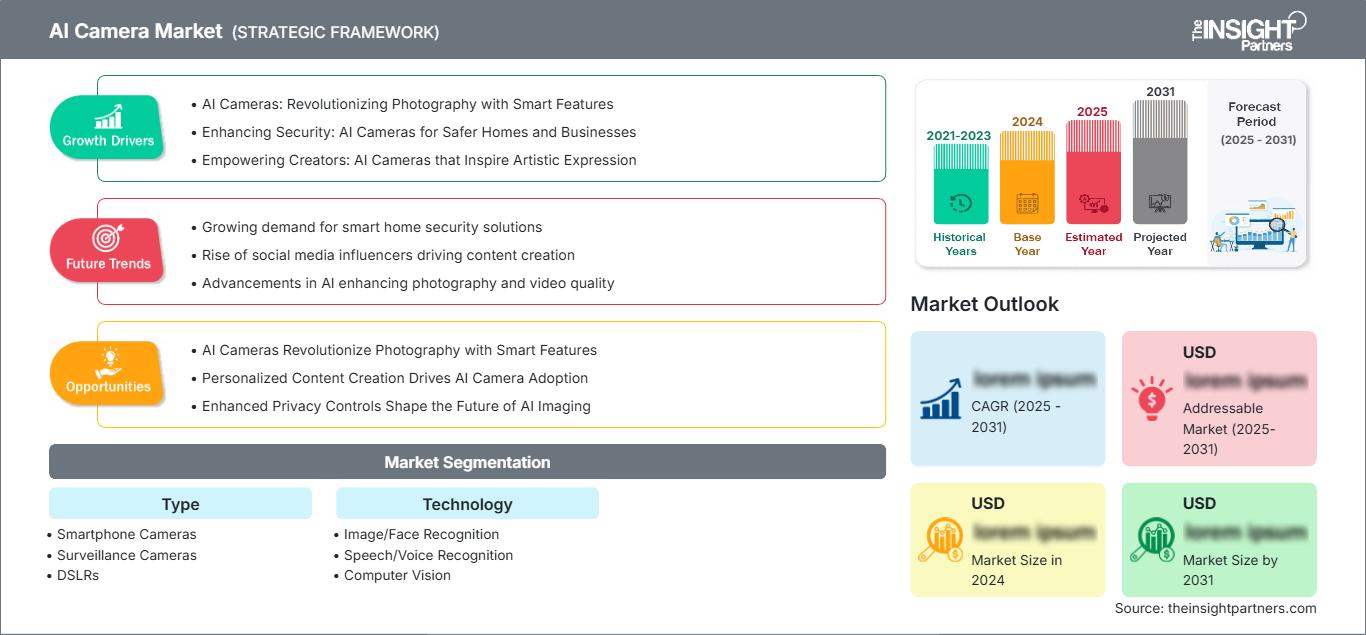
AI Camera Market: Strategic Insights
Regional Insights
North America AI Camera Market
North America held 33%–37% share in 2025 and is growing at a 20.6%–22.0% CAGR between 2026–2034. Adoption is supported by AI-enabled commercial surveillance, smartphone refresh cycles, smart buildings, transportation networks, and cloud video management. The AI Camera Market trends in the region are reinforced by mature security channels and enterprise willingness to pay for analytics that improve incident response.
The structural factors behind this growth include high costs of labor in the monitoring centers, solid infrastructure in hyperscale clouds, campus safety, the need for privacy-aware processing at the edge, and other factors. The share of AI Cameras in North America is supported by Honeywell International Inc., Canon Inc., Samsung Electronics Co., Ltd., Huddly AS, as well as systems integrators.
U.S. AI Camera Market
The United States accounted for 68%-73% of North America in 2025, and the country has a CAGR of 20.8%-22.2% for 2026-2034. The demand for AI cameras is high among commercial buildings, airports, schools, retail stores, logistics, hospitals, and consumer electronics. Consumers' preference for cameras with metadata, alerting, privacy masking, and connection to security operations centers is increasing. The AI Camera Market stands to benefit from these demands as organizations adopt smart imaging technologies for security and operational purposes.
The geographical presence of companies is spread out across imaging, conferencing, building automation, and mobile devices. Honeywell International Inc. has a presence in the areas of connected buildings and security, Canon Inc. for professional imaging and network cameras, Samsung Electronics Co., Ltd. and LG Electronics Inc. for consumer and displays, and Huddly AS in intelligent collaboration room. The applications trend is on threat detection, queue analysis, hybrid work video, and loss prevention.
Europe AI Camera Market
Europe held 22%–26% share in 2025 and is growing at a 19.0%–20.4% CAGR between 2026–2034. Germany is the leading country in industrial automation, transport infrastructure, automotive testing, and privacy-by-design procurement support advanced camera deployments. Demand is strongest where image analytics improve safety, process control, and compliance documentation. The AI Camera Market is benefiting from these applications as organizations increasingly deploy intelligent imaging solutions to enhance operational efficiency, regulatory compliance, and real-time monitoring capabilities.
The UK market is influenced by improvements in retail security, transport monitoring, safety in public venues, and hybrid workplaces. Germany gains from quality control in manufacturing, logistics automation, and automotive camera testing, thereby generating a need for high-resolution cameras, fast inferencing capability, and video management systems capable of working under the umbrella of strong data governance.
Smart city initiatives in France, Italy, and Spain further add to the demand for AI Cameras. While France focuses on compliance in the public sector, Italy and Spain benefit from manufacturing, luxury retail monitoring, transport, and urban safety investment. The regional AI Camera trends continue to be strongly associated with GDPR-compliant analytics and explainable AI implementation.
APAC AI Camera Market
Asia Pacific held 29%–33% share in 2025 and is growing at a 23.0%–24.6% CAGR between 2026–2034. China is the leading country, supported by smartphone manufacturing, urban surveillance, electronics supply chains, and large-scale AI deployment. The AI Camera Market is benefiting from these strengths as demand increases for intelligent imaging solutions across consumer electronics, smart cities, industrial automation, and security applications.
Japan and South Korea focus on advanced imaging, automotive vision, robotics, and consumer electronics. India and Australia provide impetus through smart city security, transport systems, retail analysis, and mobile phone usage.
Key industrial trends comprise semiconductor packaging, camera module assembly, 5G technology, e-commerce operations, and the digital infrastructure of the government. Policies that favor safer cities and intelligent transport systems give the AI Camera Market growth prospects.
Middle East & Africa AI Camera Market
The Middle East & Africa region will have a compound annual growth rate (CAGR) of 18.4% to 20.0% during 2026-2034. Saudi Arabia is the dominant country with smart cities, airport security, energy sites, and large infrastructure construction projects, with the need for intelligent surveillance. The growth of the AI Camera Market can be seen with the increase in the spending of governments and companies on intelligent surveillance and automation solutions.
In Saudi Arabia and the UAE, there is the use of AI cameras in transportation routes, hospitality, commercial properties, industrial areas, and critical infrastructure. The energy and infrastructure investments contribute to ruggedized camera systems, perimeter analytics, and command centers.
In South Africa and the other countries in MEA, the adoption is gradual in retail, mining, logistics, public safety, and education sectors. Growth relies on connectivity, finance, installers' skills, data privacy regulations, and operational value demonstration.
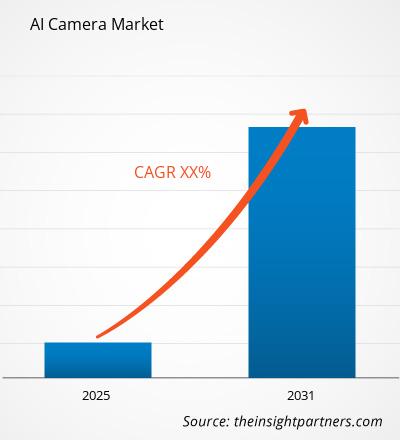
Segmentation Analysis
Type
The Type segment is growing at a 21.4%–22.9% CAGR between 2026–2034. Surveillance cameras lead because organizations require automated threat detection, behavior analytics, and searchable video. Smartphone cameras expand high-volume adoption through computational photography and on-device AI. At the same time, DSLRs remain relevant for professional imaging workflows that need intelligent autofocus, subject recognition, and low-light optimization. The AI Camera Market continues to benefit from adoption across these diverse camera categories as AI capabilities become integral to imaging performance and user experience.
- Smartphone Cameras: The use of AI in smartphone cameras denotes an extensive adoption, as the technology enables the development of portrait, nighttime, stabilization, scene detection, video, and individual image processing capabilities for the consumer.
- Surveillance Cameras: Surveillance cameras have an outstanding revenue position, as AI analytics enable intrusion detection, object detection, facial matching, and efficient investigations by enterprise organizations, municipalities, campuses, and retail locations.
- DSLR Cameras: DSLR cameras and professional cameras still carry strategic importance due to the need for advanced autofocus, subject tracking, image correction, and optical performance.
Technology
The Technology segment is growing at a 22.0%–23.6% CAGR between 2026–2034. Image and face recognition remain central for identity, access, personalization, and search. Speech and voice recognition adds multimodal interaction in smart devices and collaboration systems. Computer vision is the fastest-growing technology because it enables object classification, anomaly detection, visual inspection, and autonomous scene understanding. The AI Camera Market is being driven by these technological advancements as organizations increasingly deploy intelligent imaging solutions for security, automation, analytics, and user engagement applications.
- Image/Face Recognition: This feature enables authentication, access control, people counting, customer experience, and security workflow applications that rely on fast and accurate identification and visual matching capabilities.
- Speech/Voice Recognition: This technology helps add hands-free control, automation, smart home interactions, and accessibility features to improve camera usability both at home and at work.
- Computer Vision: Computer vision transforms visual feeds into decisions through object detection, defect inspection, gesture detection, movement pattern analysis, and security risks.
Opportunity Snapshot
| Type | Revenue Contribution | Trend Tag | Adoption Stage |
| Smartphone Cameras | High | Computational Imaging | Mature |
| Surveillance Cameras | High | Edge Analytics | Scaling |
| DSLRs | Medium | Smart Autofocus | Scaling |
AI Camera Market Growth Drivers and Impact Analysis
Edge AI Turning Cameras into Real-Time Decision Devices
Edge AI will be a key contributor as it enables the processing of the visual information within the camera or in its proximity, and not just through cloud analysis. This results in lower latency, reduced usage of the bandwidth, better privacy protection, and real-time alerts for security breaches, road accidents, quality checks, and consumer events. The effect is more pronounced in places such as hospitals, airports, university campuses, factories, and logistics centers since any delays in analyzing videos may result in losses from a safety or operational perspective. With the advancement in AI processors, customers will be able to improve existing systems.
Public Safety and Enterprise Security Modernization
Modernization of security is happening at a rapid pace as businesses shift from mere documentation to threat detection. AI cameras can identify humans, vehicles, parcels, weapon-like objects, loitering, crowds, and unauthorized movement in restricted areas, enabling security personnel to concentrate on potential threats. Airlines, educational institutions, businesses, transport providers, and retail stores are spending money on the technology owing to lower false alarms and shorter response times provided by AI analytics. Over one billion surveillance cameras are believed to be deployed globally, resulting in an existing platform of equipment suitable for analytics improvement.
Computational Photography and Smart Device Differentiation
Manufacturers of smartphones and consumer electronics apply AI cameras to distinguish their products since hardware specifications are not distinct enough on their own. Artificial Intelligence is used to improve image capture performance in low light conditions, face segmentation, stabilization, magnification, scene optimization, and video enhancement in real time. Companies such as Samsung Electronics Co., Ltd., Xiaomi Corporation, Huawei Technologies Co., Ltd., and LG Electronics Inc. have made image processing technology part of their criteria for buying decisions for smartphones. The effect of the factor under analysis on the market is significant due to the fast renewal rate of smartphones, which creates demand for imaging technology.
AI Camera Market Future Trends
Generative Video Search and Natural Language Investigation
Future AI camera systems will increasingly let users search video with natural language prompts rather than manually reviewing footage. Security teams may ask for a red vehicle entering a restricted gate, a missing package, or a person moving against traffic flow. This trend will require multimodal AI models, metadata indexing, privacy controls, and strong audit trails. Vendors that combine cameras, video management software, and compliant AI search will capture higher recurring revenue. The shift will also expand AI Camera trends from detection alone toward investigation productivity, case management, and operational intelligence.
Privacy-Preserving Vision at the Edge
Privacy requirements will push more AI inference to the edge, where cameras can extract events, blur faces, anonymize people counts, and transmit metadata instead of continuous identifiable video. This approach is important in Europe, healthcare, education, offices, and public venues where compliance and trust influence procurement. Future products will compete on explainability, configurable retention, encryption, and role-based access. The trend supports premium pricing because buyers need analytics without expanding privacy risk. It also improves AI Camera Market resilience by aligning innovation with stricter governance rather than treating regulation as a deployment barrier.
AI Camera Market Opportunities
Vertical AI Analytics for Retail, Logistics, and Manufacturing
Vertical analytics creates an investment opportunity because buyers increasingly want cameras trained for specific workflows rather than generic detection. Retailers need shelf monitoring, queue measurement, theft indicators, and heat mapping; logistics firms need dock visibility, pallet tracking, and safety alerts; manufacturers need defect detection, PPE monitoring, and process verification. Suppliers can package cameras with software, installation, model tuning, and managed services to generate recurring revenue. This opportunity is attractive because it links AI Camera analysis directly to operational KPIs such as shrink reduction, throughput, downtime, safety incidents, and inspection accuracy.
AI Collaboration Cameras for Hybrid Workplaces
Hybrid work creates a distinct opportunity for intelligent cameras that frame speakers, track participants, suppress visual distractions, and integrate with meeting platforms. Huddly AS and other collaboration-focused vendors show that AI cameras are moving beyond security into productivity infrastructure. Enterprises replacing conference room equipment can justify investment through better meeting equity, reduced setup friction, and improved utilization analytics. The opportunity extends to education, telehealth, government, and professional services where video quality affects communication outcomes. Vendors should prioritize compatibility, privacy indicators, firmware updates, and simple deployment across large room fleets.
Recent Developments
- July 2026: New solar-powered agricultural robots are being deployed to autonomously remove weeds with up to 8 mm GPS precision while operating around the clock. The technology allows farmers to significantly reduce herbicide usage through targeted weed control rather than blanket chemical application. Powered entirely by solar energy, the robots eliminate fuel consumption and lower carbon emissions. The solution supports sustainable farming by combining autonomous navigation, precision agriculture, and reduced input costs.
- July 2025: DJI Agriculture launched its next-generation Agras drone lineup, including the Agras T100, T70P, and T25P, designed to improve precision farming operations. The drones support spraying, spreading, and lifting applications with higher payload capacities and improved operational efficiency. Advanced safety technologies such as LiDAR, millimeter-wave radar, and intelligent automation enhance reliability and reduce labor requirements. DJI stated that its agricultural drones are now used in over 100 countries across 300 crop types.
- March 2025: Kubota announced the “Type: V” and “Type: S” versatile platform robots for future agricultural operations at Expo 2025 Osaka. The autonomous robots are designed to perform farming tasks such as tilling, weeding, pest control, harvesting, and material transport with minimal human intervention. Using data-driven precision farming and coordinated autonomous operation, the robots aim to address labor shortages and improve agricultural sustainability. Kubota highlighted the technology as part of its vision for “planetary-conscious” agriculture that balances productivity with environmental protection.
Frequently Asked Questions

- Comprehensive Market Sizing and Forecast Analysis
- Detailed Segmentation Analysis
- In-Depth Market Dynamics Assessment
- Regional and Country-Level Insights
- Competitive Landscape and Company Benchmarking
- Strategic Business Intelligence
Recent Reports
Testimonials

The Insight Partners provided valuable market intelligence that supported our global go-to-market strategy. Their team was professional, responsive, and attentive to our feedback, providing thoughtful analysis and helpful methodological clarifications throughout the project.
Junmo Kim Chief Financial Officer (CFO), Enertech Co., Ltd.
The Insight Partners' SCADA System Market report is comprehensive, with valuable insights on current trends and future forecasts. The team was highly professional, responsive, and supportive throughout. We are very satisfied and highly recommend their services.
RAN KEDEM Partner, Reali Technologies LTDs
I requested a report on a very specific software market and the team produced the report in a few days. The information was very relevant and well presented. I then requested some changes and additions to the report. The team was again very responsive and I got the final report in less than a week.
JEAN-HERVE JENN Chairman, Future Analytica
We worked with The Insight Partners for an important market study and forecast. They gave us clear insights into opportunities and risks, which helped shape our plans. Their research was easy to use and based on solid data. It helped us make smart, confident decisions. We highly recommend them.
PIYUSH NAGPAL Sr. Vice President, High Beam Global
The Insight Partners delivered insightful, well-structured market research with strong domain expertise. Their team was professional and responsive throughout. The user-friendly website made accessing industry reports seamless. We highly recommend them for reliable, high-quality research services
YUKIHIKO ADACHI CEO, Deep Blue, LLC.
This is the first time I have purchased a market report from The Insight Partners.While I was unsure at first, I visited their web site and felt more comfortable to take the risk and purchase a market report.I am completely satisfied with the quality of the report and customer service. I had several questions and comments with the initial report, but after a couple of dialogs over email with their analyst I believe I have a report that I can use as input to our strategic planning process.Thank you so much for taking the extra time and making this a positive experience.I will definitely recommend your service to others and you will be my first call when we need further market data.
JOHN SUZUKI President and Chief Executive Officer, Board Director, BK Technologies
I wish to appreciate your support and the professionalism you displayed in the course of attending to my request for information regarding to infectious disease IVD market in Nigeria. I appreciate your patience, your guidance, and the fact that you were willing to offer a discount, which eventually made it possible for us to close a deal. I look forward to engaging The Insight Partners in the future, all thanks to the impression you have created in me as a result of this first encounter.
DR CHIJIOKE ONYIA MANAGING DIRECTOR, PineCrest Healthcare Ltd.Reason to Buy
- Informed Decision-Making
- Understanding Market Dynamics
- Competitive Analysis
- Identifying Emerging Markets
- Customer Insights
- Market Forecasts
- Risk Mitigation
- Boosting Operational Efficiency
- Strategic Planning
- Investment Justification
- Tracking Industry Innovations
- Aligning with Regulatory Trends





 Get Free Sample for