
AI in Asset Management Market Size, Share & Growth by 2034
Coverage: By Deployment (Cloud, On-premises); Application (Portfolio Optimization, Conversational Platform, Risk and Compliance, Data Analysis, Process Automation, Others); Vertical (BFSI, Healthcare, Retail and E-commerce, Media and Entertainment, Automotive, Others), and Geography (North America, Europe, Asia Pacific, and South and Central America)
- Status : Data Released
- Report Code : TIPRE00013837
- Category : Technology, Media and Telecommunications
- No. of Pages : 150
- Available Report Formats :


- Last update date : August 12, 2026


2025 Market Size
US$ 5.99 Bn
Base year value
2034 Forecast
US$ 39.52 Bn
Projected by 2034
CAGR 2026-2034
23.31 %
Growth rate
Addressable Market
US$ 177.18 Bn
(2026-2034)
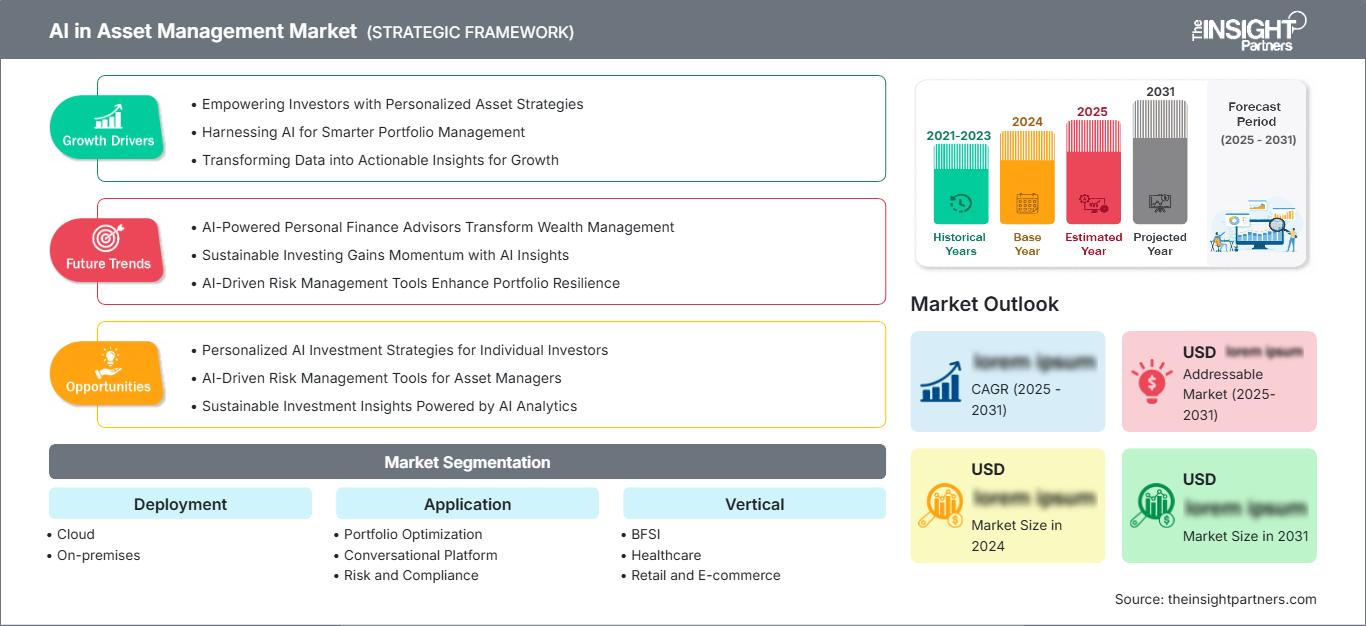
The AI in asset management market was valued at US$ 5.99 Billion in 2025 and is projected to reach US$ 39.52 Billion by 2034, expanding at a CAGR of 23.31% during 2026–2034. Growth is being supported by increasing use of machine learning in portfolio construction, rising adoption of predictive analytics across investment firms, and broader deployment of generative AI tools for research automation, compliance monitoring, and client engagement across institutional and retail investment ecosystems.
Across North America, adoption continues to accelerate as asset managers modernize legacy investment platforms and increase spending on data-driven decision support. The AI in asset management market size in the region benefits from strong cloud infrastructure, mature capital markets, and expanding availability of alternative data sources. Regional growth is estimated in the 21.5–24.5% CAGR range through 2034, supported by regulatory technology investments and enterprise AI integration.
AI in Asset Management Market Assessment and Insights
- North America: Largest regional market with a 37–41% Share in 2025 and expected CAGR of 21.5–24.5% during 2026–2034. Growth is supported by institutional asset managers, fintech ecosystems, and high AI investment intensity.
- US: Accounts for 72–76% of North America in 2025 and is projected to expand at 22–25% CAGR during 2026–2034, driven by advanced investment analytics adoption.
- Europe: Represents 25–29% Share in 2025 and grows at 20–23% CAGR during 2026–2034. Germany, the UK, and France lead deployment of AI-enabled investment management platforms.
- Asia Pacific: Holds 22–26% Share in 2025 and records 25–28% CAGR during 2026–2034, led by China, Japan, India, and South Korea.
- Largest Segment: Application – Portfolio Optimization with 28–32% market share in 2025 and 22–25% CAGR during 2026–2034 due to demand for real-time allocation and alpha generation.
- High Growth Segment: Application – Conversational Platform with 12–16% market share in 2025 and 27–30% CAGR during 2026–2034 as firms deploy AI assistants for advisors and investors.
- Key companies analyzed in detail: Genpact Limited, Infosys Limited, International Business Machines Corporation, Squirro AG, SymphonyAI Summit, Brainalyzed Finance GmbH, Liquidnet Holdings, Inc., XAI Asset Management Ltd, Castle Ridge Asset Management Limited, Intel Corporation.
Source: The Insight Partners' analysis based on proprietary research, government publications, company annual reports, investor presentations, industry databases, and expert interviews.
Advanced computational power, increased availability of structured and unstructured financial data, and advances in large language models are transforming how investments are made. The use of artificial intelligence among asset managers for risk management, securities selection, and operations is becoming increasingly common. The implementation of AI technology has advanced from being experimental to generating revenue through incorporating it into processes such as research, trading, compliance, and customer support.
Growth will be driven by an increase in implementation in new financial centers of the future located in Asia Pacific and the Middle East regions. Policies related to artificial intelligence governance, model explainability, and responsible use will make the pathway for adoption easier. There will also be growth due to greater institutional investment in data infrastructure and personalized portfolios.
AI in Asset Management Market Report Scope
| Report Attribute | Details |
|---|---|
| Market size in 2025 | US$ 5.99 Billion |
| Market Size by 2034 | US$ 39.52 Billion |
| Global CAGR (2026 - 2034) | 23.31% |
| Historical Data | 2021-2024 |
| Forecast period | 2026-2034 |
AI in Asset Management Market Analysis
The AI in asset management market growth trajectory is being shaped by increasing asset complexity and the need for rapid interpretation of market signals across equities, fixed income, alternatives, and digital assets. Increasing amounts of data have been produced through transactions, macroeconomic factors, news feeds, and others. AI helps process the increased amount of data and improves forecast precision, as well as helps in making investments more quickly.
In the environment, data providers, cloud service providers, software developers, quantitative analysts, and financial organizations become a connected chain. The need for developing predictive models that could recognize risk and opportunities in a volatile environment is increasing.
The AI in asset management market analysis indicates that competition is intensifying as established technology firms and specialist financial AI providers expand capabilities. International Business Machines Corporation is further improving its solutions in enterprise AI governance, while Infosys Limited and Genpact Limited are concentrating on AI-driven business transformation services for banks. Squirro AG and SymphonyAI Summit are paying attention to intelligent platforms that include both structured and unstructured data in investment processes.
All investments are aimed at generative AI, explainable AI, and agent-based systems, which can help with research and investment management tasks. Positioning strategies become dependent on such factors as data quality, model governance, cybersecurity, and flexibility of integration. Suppliers that provide advanced analytics with compliance features will keep a competitive edge.
● REPORT CUSTOMIZATION
Tailor This Report To Align With Your Specific Business Requirements
This report can be customized to align precisely with your business objectives, scope, and target markets. Customization options include tailored segmentation, geography, competitive analysis, and strategic insights to support informed decision-making.
Customize This Report →WHAT YOU CAN ADJUST
- ● Segmentations
- ● Geography
- ● Competitive Analysis
- ● Language Preferences
AI in Asset Management Market: Strategic Insights
Regional Insights
North America AI in asset management market
North America accounted for approximately 37–41% market share in 2025 and is expected to expand at a 21.5–24.5% CAGR through 2034. The region benefits from sophisticated institutional investors, broad cloud adoption, and significant spending on financial innovation. Large asset managers increasingly deploy AI for portfolio construction, risk monitoring, and automated research workflows.
The region's leadership is also supported by strong technology ecosystems and favorable capital availability. The AI in the asset management market share remains concentrated among major financial centers where demand for scalable investment intelligence platforms continues to rise. Regulatory emphasis on transparency and governance is accelerating enterprise-grade AI deployment across investment organizations.
U.S. AI in asset management market
The United States represents 72–76% of the North American market in 2025 and is forecast to grow at 22–25% CAGR through 2034. Asset managers across the country increasingly use AI-driven analytics to improve portfolio performance, automate reporting, and enhance customer engagement capabilities.
The presence of major technology suppliers and financial institutions creates a favorable innovation environment. Companies including International Business Machines Corporation, Intel Corporation, Genpact Limited, and Infosys Limited actively support AI-enabled transformation initiatives. Rising implementation of conversational investment tools, predictive analytics, and compliance automation continues to strengthen market demand.
Europe AI in asset management market
Europe accounted for 25–29% market share in 2025 and is expected to register a 20–23% CAGR during the forecast period. Regulatory focus on responsible AI adoption and sustainable finance is encouraging the deployment of explainable analytics solutions across the investment sector.
The United Kingdom remains the leading market due to high concentrations of asset management firms and fintech innovation. Germany benefits from advanced digital transformation programs and institutional investment modernization initiatives. France, Italy, and Spain are witnessing increasing demand for AI applications supporting portfolio analytics, compliance management, and client engagement activities, contributing to sustained regional expansion.
APAC AI in asset management market
Asia Pacific held 22–26% market share in 2025 and is projected to grow at a 25–28% CAGR through 2034. China and Japan lead regional adoption, supported by advanced financial technology ecosystems and increasing integration of AI into investment management processes. India and South Korea are emerging rapidly through financial digitization initiatives and expanding adoption of data-driven investment solutions.
Government support for artificial intelligence, expanding digital wealth management platforms, and rising institutional investment activity are enhancing deployment levels across the region. Australia also contributes through wealth management modernization programs, strong regulatory frameworks, and growing demand for advanced portfolio analytics. Increasing digital adoption among investors, coupled with continued investments in financial infrastructure, is expected to create significant growth opportunities for AI-powered asset management solutions throughout the Asia Pacific market.
Middle East & Africa AI in asset management market
The Middle East and Africa market is smaller but developing steadily, supported by financial diversification strategies, growing fintech adoption, and ongoing digital transformation investments. The region is expected to expand at a 22–24% CAGR through 2034. Saudi Arabia and the UAE lead adoption through smart finance initiatives, investment technology programs, and increasing deployment of AI-driven asset management solutions. South Africa remains an important financial center, while expanding digital infrastructure and cloud investments support wider AI implementation across regional financial services organizations. Rising demand for data-driven investment decisions, operational efficiency, and enhanced portfolio management capabilities is further contributing to market growth across the region.
Segmentation Analysis
Deployment
The deployment segment is expected to grow at a 22–25% CAGR during 2026–2034. The AI in asset management market scope within deployment continues expanding as organizations balance scalability, security, and regulatory requirements while implementing advanced analytics across investment operations.
- Cloud: Preferred by organizations seeking scalability, faster deployment, and access to advanced computing resources for portfolio analytics, model development, and investment decision support.
- On-premises: Maintains relevance among institutions requiring heightened data control, customized infrastructure, and adherence to strict governance and regulatory requirements.
Application
Application remains the most influential segment and is projected to grow at a 24–27% CAGR through 2034. Demand is supported by increasing use of AI across investment research, portfolio construction, customer interaction, and operational optimization processes.
- Portfolio Optimization: Widely adopted for risk-adjusted allocation, scenario analysis, and predictive decision making that supports investment performance improvement.
- Conversational Platform: Increasingly used for advisor support, investor engagement, and natural-language interaction with financial information systems.
- Risk and Compliance: Supports continuous monitoring, anomaly detection, reporting automation, and governance requirements across investment operations.
- Data Analysis: Enables the extraction of actionable insights from structured, unstructured, and alternative datasets used in investment strategies.
- Process Automation: Reduces manual effort in reconciliation, documentation, reporting, and operational workflows.
Vertical
The vertical segment is forecast to expand at a 23–26% CAGR during the study period. Adoption continues spreading beyond financial institutions as organizations seek data-driven asset optimization capabilities.
- BFSI: The dominant user group due to extensive portfolio management, wealth management, and investment advisory applications.
- Healthcare: Uses AI for financial planning, institutional investment oversight, and treasury management activities.
- Retail and E-commerce: Deploys AI-driven investment and treasury optimization tools supporting capital allocation decisions.
- Media and Entertainment: Increasingly leverages predictive analytics for investment planning and financial risk management.
- Automotive: Utilizes AI-based portfolio and capital allocation frameworks to improve financial strategy and investment oversight.
Opportunity Snapshot
| Application | Revenue Contribution | Trend Tag | Adoption Stage |
| Portfolio Optimization | High | Quant Alpha | Mature |
| Conversational Platform | Medium | Advisor AI | Scaling |
| Risk and Compliance | High | RegTech AI | Scaling |
| Data Analysis | High | Alt Data | Mature |
| Process Automation | Medium | Workflow AI | Scaling |
AI in Asset Management Market Growth Drivers and Impact Analysis
Expansion of alternative data utilization
In today’s world, asset managers also leverage satellite imagery, transaction data, social sentiments, market intelligence and other alternative data sets together with the traditional financial data. With the help of artificial intelligence, it becomes easier to handle these huge and diverse data sets and find connections between them and come up with investment ideas. With the help of faster analysis and processing of these big data sets, it becomes possible for the investment firms to find such opportunities which would have remained unnoticed in the absence of AI-powered solutions. In order to achieve a competitive edge in rapidly changing financial markets, organizations need advanced analytics platforms.
Growing focus on operational efficiency
Cost considerations have made it necessary for asset managers to automate repetitive tasks like reporting, reconciliation, compliance tracking, and customer communication. Automation through AI enables increased operational efficiency through accuracy, reduced need for human involvement, and speed of processing. Such characteristics make it possible for companies to cut costs, reduce errors, and adapt to new requirements in the markets and regulations. Through the use of intelligent automation in important operational tasks, asset managers will be able to focus on their main tasks of investments and portfolio management.
Increasing regulatory complexity
Investment management organizations must operate in a dynamic regulatory environment that demands constant surveillance, reporting, and documentation. AI assists in detecting any irregularities, automating control activities, and enabling audit preparedness through improved data analysis and surveillance capabilities. Better governance capabilities increase transparency and enhance risk oversight while mitigating compliance burdens. With the regulatory framework governing investments and artificial intelligence becoming increasingly complex, there will be a greater need for accountable, transparent, and properly governed AI. The ability to provide transparent decision-making and model outputs will give an organization a great advantage.
AI in Asset Management Market Future Trends
Generative AI embedded across investment workflows
The most important AI in asset management market trends include broader implementation of generative AI tools supporting research synthesis, investment memos, market monitoring, and client communication. Organizations are increasingly integrating large language models with proprietary datasets to create domain-specific intelligence systems. Future solutions are expected to deliver higher explainability, stronger governance controls, and deeper integration with portfolio management platforms, enabling investment professionals to focus on strategic decision-making rather than information gathering.
Rise of autonomous investment support agents
Agent-based architecture is set to be more prevalent in investment institution environments in the future. These systems will be responsible for collecting information, assessing risks, conducting scenario analysis, and reporting within a certain governance structure. Agent-based system adoption will increase efficiency, improve response time, and enhance consistency within investment activities. Besides, agent-based systems may help in integrating data, enable monitoring of market changes in real time, ensure auditability by leaving clear trails of decision-making, and help in collaborating between investment teams.
AI in Asset Management Market Opportunities
Expansion in emerging wealth management markets
The AI in asset management market Forecasts suggest strong opportunities across rapidly developing wealth management ecosystems in Asia, the Middle East, and selected Latin American countries. Increasing investment participation, rising digital engagement, and the modernization of financial services create favorable conditions for AI-powered advisory and portfolio management solutions. Technology vendors able to offer localized, compliant, and scalable platforms are expected to capture significant long-term value. Furthermore, supportive regulatory innovation, expanding cloud infrastructure, and growing demand for personalized investment experiences are accelerating adoption. Financial institutions are increasingly seeking advanced analytics, predictive modeling, and automated client servicing capabilities to enhance competitiveness. These trends position AI as a key enabler of sustainable growth, operational efficiency, and improved customer engagement.
Development of explainable AI solutions
Growing demand for transparency is creating significant opportunities for providers specializing in explainable and auditable analytics frameworks. Asset managers increasingly require greater visibility into decision-making processes, model assumptions, and risk outcomes to meet both internal governance and regulatory requirements. As AI adoption expands across investment operations, trust and accountability have become critical considerations. Vendors that successfully combine strong predictive performance with clear model interpretability and regulatory confidence may achieve stronger adoption among institutional investors, wealth managers, and other regulated financial organizations. These capabilities can support more informed investment decisions while improving compliance, risk management, and stakeholder confidence.
Frequently Asked Questions

- Comprehensive Market Sizing and Forecast Analysis
- Detailed Segmentation Analysis
- In-Depth Market Dynamics Assessment
- Regional and Country-Level Insights
- Competitive Landscape and Company Benchmarking
- Strategic Business Intelligence
Recent Reports
Testimonials

The Insight Partners' SCADA System Market report is comprehensive, with valuable insights on current trends and future forecasts. The team was highly professional, responsive, and supportive throughout. We are very satisfied and highly recommend their services.
RAN KEDEM Partner, Reali Technologies LTDs
I requested a report on a very specific software market and the team produced the report in a few days. The information was very relevant and well presented. I then requested some changes and additions to the report. The team was again very responsive and I got the final report in less than a week.
JEAN-HERVE JENN Chairman, Future Analytica
We worked with The Insight Partners for an important market study and forecast. They gave us clear insights into opportunities and risks, which helped shape our plans. Their research was easy to use and based on solid data. It helped us make smart, confident decisions. We highly recommend them.
PIYUSH NAGPAL Sr. Vice President, High Beam Global
The Insight Partners delivered insightful, well-structured market research with strong domain expertise. Their team was professional and responsive throughout. The user-friendly website made accessing industry reports seamless. We highly recommend them for reliable, high-quality research services
YUKIHIKO ADACHI CEO, Deep Blue, LLC.
This is the first time I have purchased a market report from The Insight Partners.While I was unsure at first, I visited their web site and felt more comfortable to take the risk and purchase a market report.I am completely satisfied with the quality of the report and customer service. I had several questions and comments with the initial report, but after a couple of dialogs over email with their analyst I believe I have a report that I can use as input to our strategic planning process.Thank you so much for taking the extra time and making this a positive experience.I will definitely recommend your service to others and you will be my first call when we need further market data.
JOHN SUZUKI President and Chief Executive Officer, Board Director, BK Technologies
I wish to appreciate your support and the professionalism you displayed in the course of attending to my request for information regarding to infectious disease IVD market in Nigeria. I appreciate your patience, your guidance, and the fact that you were willing to offer a discount, which eventually made it possible for us to close a deal. I look forward to engaging The Insight Partners in the future, all thanks to the impression you have created in me as a result of this first encounter.
DR CHIJIOKE ONYIA MANAGING DIRECTOR, PineCrest Healthcare Ltd.Reason to Buy
- Informed Decision-Making
- Understanding Market Dynamics
- Competitive Analysis
- Identifying Emerging Markets
- Customer Insights
- Market Forecasts
- Risk Mitigation
- Boosting Operational Efficiency
- Strategic Planning
- Investment Justification
- Tracking Industry Innovations
- Aligning with Regulatory Trends





 Get Free Sample for