
AI in Oil & Gas Market Size, Growth & Demand by 2034
Coverage: by Component (Hardware, Software, and Service); Application (Predictive Maintenance, Material Movement, Field Services, Production Planning, and Quality Control); Sector (Upstream, Midstream, & Downstream), and Geography (North America, Europe, Asia Pacific, and South and Central America)
- Status : Data Released
- Report Code : TIPRE00003187
- Category : Technology, Media and Telecommunications
- No. of Pages : 150
- Available Report Formats :


- Last update date : August 11, 2026


2025 Market Size
US$ 6.82 Bn
Base year value
2034 Forecast
US$ 41.08 Bn
Projected by 2034
CAGR 2026-2034
22.09 %
Growth rate
Addressable Market
US$ 189.50 Bn
(2026-2034)
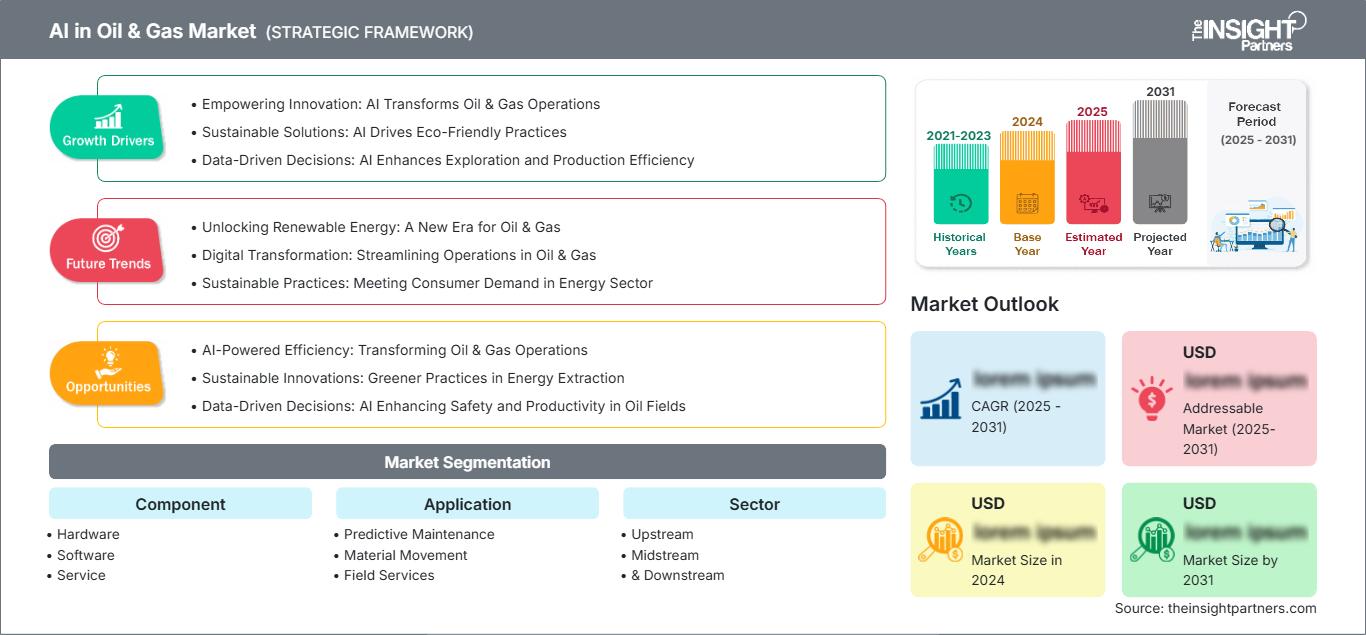
The AI in oil & gas market is projected to grow from US$ 6.82 Billion in 2025 to US$ 41.08 Billion by 2034, registering a CAGR of 22.09% during 2026–2034. Adoption is advancing as operators apply machine learning, computer vision, digital twins, and generative AI across drilling optimization, predictive maintenance, production planning, field services, material movement, and quality control workflows.
North America remains a priority region for AI in oil & gas market size expansion as shale operators, offshore producers, refiners, and pipeline companies increase investments in cloud-edge analytics. The region is expected to hold a 36–39% share in 2025 and grow at a CAGR of 20–23% through 2034, supported by mature digital infrastructure, high automation intensity, and strong hyperscaler participation.
AI in Oil & Gas Market Assessment and Insights
- North America: The region is expected to account for 36–39% share in 2025 and grow at a CAGR of 20–23% during 2026–2034, supported by shale analytics, offshore automation, and predictive maintenance programs.
- US: The US is projected to represent 72–76% of North America share in 2025 and grow at a CAGR of 20–22%, led by cloud AI, digital oilfields, and refinery optimization.
- Europe: Europe is estimated to hold 21–24% share in 2025 and grow at a CAGR of 18–21%, with the UK, Norway, Germany, and France leading digital energy initiatives.
- Asia Pacific: Asia Pacific is expected to hold 25–28% share in 2025 and grow at a CAGR of 24–27%, led by China, India, Japan, South Korea, and Australia.
- Largest Segment: Software is expected to hold 48–52% market share in 2025 and grow at a CAGR of 22–25%, driven by analytics platforms, digital twins, and AI model deployment.
- High Growth Segment: Services are projected to hold 28–32% share in 2025 and grow at a CAGR of 24–27%, supported by integration, consulting, managed analytics, and deployment support.
- Key companies analyzed in detail: Accenture plc, Cisco Systems, Inc., FuGenX Technologies Pvt Ltd, Google LLC, Cloudera, Inc., IBM Corporation, Intel Corporation, Microsoft Corporation, NVIDIA Corporation, and Oracle Corporation.
Source: The Insight Partners' analysis based on proprietary research, government publications, company annual reports, investor presentations, industry databases, and expert interviews.
Oil and gas companies have moved from isolated analytics pilots to enterprise-wide AI programs that connect subsurface data, drilling parameters, production telemetry, maintenance records, logistics systems, and refinery controls. The AI in oil & gas market growth is increasingly shaped by edge computing, governed data platforms, domain-specific models, and operational copilots that improve decision quality while keeping safety constraints and human approvals in place.
Forward momentum is strongest where operators can link AI to measurable uptime, recovery, emissions, and workforce productivity outcomes. Emerging demand from Middle East national oil companies, Asia Pacific refiners, and European offshore operators is widening the AI in oil & gas market analysis beyond North American digital oilfields. Regulatory pressure on methane monitoring and energy efficiency also reinforces adoption.
AI in Oil & Gas Market Report Scope
| Report Attribute | Details |
|---|---|
| Market size in 2025 | US$ 6.82 Billion |
| Market Size by 2034 | US$ 41.08 Billion |
| Global CAGR (2026 - 2034) | 22.09% |
| Historical Data | 2021-2024 |
| Forecast period | 2026-2034 |
AI in Oil & Gas Market Analysis
Demand is being driven by the need to lower unplanned downtime, improve drilling productivity, accelerate seismic interpretation, and optimize production in mature reservoirs. Predictive maintenance remains one of the most commercially visible use cases because it converts equipment sensor data into failure-risk alerts for pumps, compressors, turbines, rigs, and refinery assets.
The value chain is shifting toward integrated data ecosystems where cloud providers, semiconductor companies, automation vendors, oilfield service firms, and software specialists collaborate. The AI in Oil & Gas Market report increasingly reflects hybrid deployment models, with sensitive operational data processed at the edge and larger model training handled in secure cloud environments.
Positioning will be determined by platform depth, domain knowledge, integrability, and model governance. Microsoft Corporation, Google LLC, Oracle Corporation, IBM Corporation, NVIDIA Corporation, Intel Corporation, Cisco Systems, Inc., Accenture plc, Cloudera, Inc., and FuGenX Technologies Pvt Ltd contribute to various components of the technology stack, such as computing, connectivity, enterprise AI, analytics, and implementation.
Money is flowing into production-ready AI solutions rather than just pilot projects. Operators are focused on scalability, cybersecurity, explainability, and workflow integration since oil and gas decisions have consequences for safety, environmental performance, asset integrity, and capital efficiency. This opens opportunities for vendors offering combinations of sophisticated models and reliable operations.
● REPORT CUSTOMIZATION
Tailor This Report To Align With Your Specific Business Requirements
This report can be customized to align precisely with your business objectives, scope, and target markets. Customization options include tailored segmentation, geography, competitive analysis, and strategic insights to support informed decision-making.
Customize This Report →WHAT YOU CAN ADJUST
- ● Segmentations
- ● Geography
- ● Competitive Analysis
- ● Language Preferences
AI in Oil & Gas Market: Strategic Insights
Regional Insights
North America AI in oil & gas market
North America is expected to account for 36–39% share in 2025 and grow at a CAGR of 20–23% during 2026–2034. The region benefits from high sensor density, mature shale operations, extensive pipeline networks, and strong adoption of cloud-based analytics across upstream, midstream, and downstream assets.
The AI in oil & gas market share in North America is also supported by hyperscaler partnerships, advanced cybersecurity practices, and operator focus on emissions monitoring. Predictive maintenance, drilling automation, and production optimization are the most scalable applications because they can be measured through downtime reduction, recovery improvement, and operating cost savings.
U.S. AI in oil & gas Market
The US is projected to represent 72–76% of North America share in 2025 and grow at a CAGR of 20–22% during 2026–2034. Adoption is concentrated in shale basins, offshore Gulf of Mexico assets, LNG infrastructure, pipeline monitoring, and refinery optimization programs.
Company presence is strong because major technology providers, cloud platforms, chip vendors, and consulting firms maintain large energy practices in the country. Operators use AI for well planning, artificial lift optimization, compressor health monitoring, refinery scheduling, and safety analytics, creating a broad deployment base across the value chain.
Europe AI in oil & gas Market
Europe is estimated to hold 21–24% share in 2025 and grow at a CAGR of 18–21% during 2026–2034. The UK and Norway lead offshore adoption, while Germany and France contribute through industrial automation, energy software, and sustainability-oriented analytics.
European deployment is shaped by asset integrity, emissions compliance, offshore safety, and refinery efficiency. Operators use AI to extend field life, improve inspection planning, monitor methane risk, and optimize energy use. The region’s slower hydrocarbon expansion is offset by strong digital governance and high-value brownfield optimization needs.
APAC AI in oil & gas Market
Asia Pacific is expected to account for 25–28% share in 2025 and grow at a CAGR of 24–27% during 2026–2034. China leads adoption through refinery digitalization, pipeline monitoring, and industrial AI investment, while India, Japan, South Korea, and Australia expand use cases across LNG, offshore, and petrochemical assets.
Policy support for energy security and domestic production is strengthening the AI in oil & gas market trends in the region. Refiners are investing in planning systems, quality control, and maintenance analytics, while upstream operators use AI to reduce drilling uncertainty and improve recovery from complex reservoirs.
Middle East & Africa AI in oil & gas Market
The Middle East & Africa is projected to grow at a CAGR of 21–24% during 2026–2034. Saudi Arabia and the UAE lead regional adoption through national energy digitalization programs, while South Africa and other markets focus on asset reliability, logistics visibility, and infrastructure monitoring.
The region’s opportunity is tied to large-scale upstream assets, integrated refining complexes, and long-distance pipeline systems. AI supports drilling optimization, reservoir management, corrosion monitoring, and emissions reduction. National oil companies are increasingly using digital platforms to improve production efficiency and support long-term energy transition strategies.
Segmentation Analysis
Component
Component is expected to grow at a CAGR of 22–25% during 2026–2034 as operators combine hardware, software, and services to create deployable AI ecosystems. The AI in oil & gas market scope is broadening because customers need sensors, edge devices, cloud platforms, analytics models, cybersecurity, and integration support working together.
- Hardware: Hardware includes sensors, edge servers, GPUs, industrial gateways, cameras, and networking systems that capture and process operational data near rigs, pipelines, refineries, and remote production assets.
- Software: Software leads adoption because operators rely on analytics platforms, digital twins, visualization tools, model management systems, and workflow applications to convert complex data into operational decisions.
- Service: Services are expanding quickly as oil and gas companies require consulting, data engineering, integration, model training, cybersecurity alignment, and managed support for production-grade deployments.
Application
Application is projected to grow at a CAGR of 21–24% during 2026–2034 as AI moves across maintenance, logistics, planning, field execution, and quality processes. Operators prioritize use cases where performance can be tied to uptime, throughput, safety, and cost control.
- Predictive Maintenance: Predictive maintenance uses equipment data to detect anomalies, forecast failures, schedule interventions, and reduce unplanned downtime across pumps, compressors, turbines, drilling assets, and refinery systems.
- Material Movement: Material movement applications optimize inventory, routing, storage, and transport decisions for chemicals, spares, crude, refined products, and field equipment across complex supply networks.
- Field Services: Field services benefit from AI-assisted dispatch, technician guidance, remote collaboration, work-order prioritization, and safety monitoring for dispersed assets and harsh operating environments.
- Production Planning: Production planning tools use AI to balance reservoir constraints, facility capacity, maintenance windows, demand signals, and price volatility across upstream and downstream operations.
- Quality Control: Quality control applications use computer vision, sensor analytics, and process models to improve inspection accuracy, refinery consistency, emissions compliance, and product specification management.
Sector
The sector is expected to grow at a CAGR of 22–24% during 2026–2034, with upstream retaining the largest adoption base. Midstream and downstream use cases are also scaling as pipeline operators, LNG terminals, and refineries invest in reliability, planning, safety, and optimization.
- Upstream: Upstream adoption centers on seismic interpretation, reservoir modeling, drilling optimization, production surveillance, artificial lift management, and emissions monitoring across onshore and offshore fields.
- Midstream: Midstream applications focus on pipeline integrity, compressor performance, leak detection, scheduling, storage optimization, and logistics visibility across long-distance transportation networks.
- Downstream: Downstream users apply AI to refinery scheduling, process optimization, quality control, energy efficiency, predictive maintenance, and demand forecasting to improve margins and operational stability.
Opportunity Snapshot
| Application | Revenue Contribution | Trend Tag | Adoption Stage |
| Predictive Maintenance | High | Asset Uptime | Mature |
| Material Movement | Medium | Smart Logistics | Scaling |
| Field Services | Medium | Remote Ops | Scaling |
| Production Planning | High | Dynamic Planning | Scaling |
| Quality Control | Medium | Vision QC | Emerging |
AI in Oil & Gas Market Growth Drivers and Impact Analysis
Predictive Maintenance Reduces Asset Downtime
Predictive maintenance is one of the key factors since the assets in the oil and gas industry are working in expensive areas, and any malfunctioning might disrupt production, safety, and logistics processes. AI-based models use vibration, pressure, temperature, flow, acoustic data, and maintenance history analysis to identify the early warning signs. The effect is highly felt in the case of compressors, pumps, turbines, drilling rigs, and refinery equipment since these assets affect production volume and margins directly.
Digital Oilfields Improve Production Decisions
Increasing adoption of digital oilfield technology is creating demand for AI by integrating the subsurface models, well performance, facility considerations, and field operations into a more cohesive decision-making framework. In such an integrated environment, AI technology can help engineers analyze the various factors like drilling parameters, artificial lift optimization, workover priority, and production anomalies. It will help enhance recovery and minimize the uncertainty associated with operating mature and complex reservoirs. Such a factor becomes very important for those companies that operate with larger portfolios.
Emissions Monitoring Strengthens Compliance Use Cases
AI use has also been enabled by methane detection and flare reduction, energy efficiency, and other initiatives. Computer vision, satellites, drones, sensors, and analytics are now being deployed by operators to find the source of the emission and take corrective action. This has elevated AI from being an efficiency aid to becoming an essential for compliance and sustainability. Its commercial value is increasing since environmental performance affects permit issuance, financing, relationships with customers, and investor demands.
AI in Oil & Gas Market Future Trends
Agentic AI for Field Operations
One of the most important AI in oil & gas market trends is the movement toward agentic AI systems that coordinate multi-step workflows across drilling, production, inspection, maintenance, and logistics. These solutions will not only provide insight but will also give recommendations, approve actions, fetch relevant documents, and update plans while working within the confines of their governance. Their adoption will depend upon security, explainability, and human control. Field operations are expected to be the first to realize benefits as they require faster access to context-relevant guidance.
Domain-Specific Energy Models
Future deployments are likely to utilize more domain-focused energy models based on seismic data, well log data, process data, inspection data, and engineering documents. AI tools without domain expertise have no worth because they will not know the oil industry workflows, equipment behavior, safety considerations, and uncertainties of the reservoirs. The domain models could enhance speed in interpretation, maintenance accuracy, and efficiency in production planning. Companies with the ability to deploy energy datasets in simulations will do better as their clients look for practical results from AI experiments.
AI in Oil & Gas Market Opportunities
AI-Enabled Brownfield Optimization
The largest practical opportunity is brownfield optimization, where operators can apply AI to existing assets without waiting for new field development. Mature wells, aging pipelines, and complex refineries generate extensive historical and real-time data that can support production uplift, downtime reduction, corrosion monitoring, and energy efficiency improvements. The opportunity is attractive because capital intensity is lower than greenfield expansion and returns can be tied to measurable operational indicators. AI in oil & gas market forecasts, therefore, remain closely linked to asset life-extension strategies.
Integrated Cloud-Edge Deployment Services
There is an opportunity for vendors to capitalize on cloud-edge deployment services because of the need by the operators for a secure architecture that functions in remote locations, offshore facilities, pipelines, and refineries. There are many organizations in the oil and gas industry with excellent data assets but fragmented technology, poor metadata, and poor AI engineering capabilities. The service providers can create value through integration, model governance, cybersecurity, change management, and operations management.
Frequently Asked Questions

- Comprehensive Market Sizing and Forecast Analysis
- Detailed Segmentation Analysis
- In-Depth Market Dynamics Assessment
- Regional and Country-Level Insights
- Competitive Landscape and Company Benchmarking
- Strategic Business Intelligence
Recent Reports
Testimonials

The Insight Partners' SCADA System Market report is comprehensive, with valuable insights on current trends and future forecasts. The team was highly professional, responsive, and supportive throughout. We are very satisfied and highly recommend their services.
RAN KEDEM Partner, Reali Technologies LTDs
I requested a report on a very specific software market and the team produced the report in a few days. The information was very relevant and well presented. I then requested some changes and additions to the report. The team was again very responsive and I got the final report in less than a week.
JEAN-HERVE JENN Chairman, Future Analytica
We worked with The Insight Partners for an important market study and forecast. They gave us clear insights into opportunities and risks, which helped shape our plans. Their research was easy to use and based on solid data. It helped us make smart, confident decisions. We highly recommend them.
PIYUSH NAGPAL Sr. Vice President, High Beam Global
The Insight Partners delivered insightful, well-structured market research with strong domain expertise. Their team was professional and responsive throughout. The user-friendly website made accessing industry reports seamless. We highly recommend them for reliable, high-quality research services
YUKIHIKO ADACHI CEO, Deep Blue, LLC.
This is the first time I have purchased a market report from The Insight Partners.While I was unsure at first, I visited their web site and felt more comfortable to take the risk and purchase a market report.I am completely satisfied with the quality of the report and customer service. I had several questions and comments with the initial report, but after a couple of dialogs over email with their analyst I believe I have a report that I can use as input to our strategic planning process.Thank you so much for taking the extra time and making this a positive experience.I will definitely recommend your service to others and you will be my first call when we need further market data.
JOHN SUZUKI President and Chief Executive Officer, Board Director, BK Technologies
I wish to appreciate your support and the professionalism you displayed in the course of attending to my request for information regarding to infectious disease IVD market in Nigeria. I appreciate your patience, your guidance, and the fact that you were willing to offer a discount, which eventually made it possible for us to close a deal. I look forward to engaging The Insight Partners in the future, all thanks to the impression you have created in me as a result of this first encounter.
DR CHIJIOKE ONYIA MANAGING DIRECTOR, PineCrest Healthcare Ltd.Reason to Buy
- Informed Decision-Making
- Understanding Market Dynamics
- Competitive Analysis
- Identifying Emerging Markets
- Customer Insights
- Market Forecasts
- Risk Mitigation
- Boosting Operational Efficiency
- Strategic Planning
- Investment Justification
- Tracking Industry Innovations
- Aligning with Regulatory Trends





 Get Free Sample for