
AI Infrastructure Market Size, Trends & Growth by 2034
Coverage: By Component (Hardware, Software); Deployment Model (On-Premise, Cloud, Hybrid); End User (Government Organizations, Enterprises, Cloud Service Providers (CSPs)) , and Geography (North America, Europe, Asia Pacific, and South and Central America)
- Status : Data Released
- Report Code : TIPRE00006145
- Category : Technology, Media and Telecommunications
- No. of Pages : 150
- Available Report Formats :


- Last update date : August 12, 2026


2025 Market Size
US$ 62.12 Bn
Base year value
2034 Forecast
US$ 509.96 Bn
Projected by 2034
CAGR 2026-2034
26.35 %
Growth rate
Addressable Market
US$ 2,146.71 Bn
(2026-2034)
The AI infrastructure market size is projected to grow from US$ 62.12 Billion in 2025 to US$ 509.96 Billion by 2034, registering a CAGR of 26.35% during 2026–2034. Growth is being shaped by accelerated compute demand, enterprise AI deployment, cloud platform expansion, and rising government investment in sovereign AI capacity. Hardware, software, cloud, hybrid, on-premise, enterprise, government, and cloud service provider adoption define the market’s commercial structure.
North America remains the largest regional base for AI infrastructure market size because hyperscale cloud investment, GPU server procurement, and AI data center expansion are concentrated in the US. The region is expected to account for 36–38% share in 2025 and grow at a CAGR of 25–27% during 2026–2034, supported by cloud modernization, enterprise generative AI adoption, and public-sector compute programs.
AI Infrastructure Market Assessment and Insights
- North America is expected to hold 36–38% share in 2025 and grow at a CAGR of 25–27% during 2026–2034, driven by hyperscaler capital expenditure, GPU-rich data centers, and enterprise AI workloads.
- US is projected to represent 86–89% of North America in 2025, growing at a CAGR of 25–27% as cloud providers expand accelerated computing capacity.
- Europe is estimated to hold 20–22% share in 2025 and grow at a CAGR of 23–25%, led by the UK, Germany, France, Italy, and Spain.
- Asia Pacific is expected to account for 27–29% share in 2025 and grow at a CAGR of 28–30%, supported by China, Japan, South Korea, India, and Australia.
- Largest Segment Hardware is expected to hold 61–64% market share in 2025 and grow at a CAGR of 25–27%, reflecting strong demand for GPUs, accelerators, memory, networking, and servers.
- High Growth Segment Cloud is projected to hold 42–45% share in 2025 and grow at a CAGR of 28–30% as enterprises shift model training and inference workloads to scalable platforms.
- Key companies analyzed in detail: Amazon Web Services, Inc.; Dell Technologies Inc.; Google LLC; Intel Corporation; International Business Machines Corporation; Microsoft Corporation; Micron Technology, Inc.; NVIDIA Corporation; Samsung Electronics Co., Ltd.; Advanced Micro Devices, Inc.; and Xilinx Inc.
Source: The Insight Partners' analysis based on proprietary research, government publications, company annual reports, investor presentations, industry databases, and expert interviews.
While the market was previously focused on pilots of AI, it is now moving towards an infrastructure cycle which includes accelerators, high bandwidth memory, networking, storage, software orchestration, and cooling. While demand used to be concentrated around training models, demand is now moving towards production inference as well, making the addressable workload base broader. Growth in the AI infrastructure is also affected by enterprise governance considerations, data residency constraints, and the economics of lowering the cost of token processing.
There will be further investments in regions outside of the US as governments and cloud providers develop regional compute capability. Data sovereignty is important for Europe while semiconductor and cloud ecosystem are being scaled in Asia Pacific while the Middle East is supporting national AI initiatives.
AI Infrastructure Market Report Scope
| Report Attribute | Details |
|---|---|
| Market size in 2025 | US$ 62.12 Billion |
| Market Size by 2034 | US$ 509.96 Billion |
| Global CAGR (2026 - 2034) | 26.35% |
| Historical Data | 2021-2024 |
| Forecast period | 2026-2034 |
AI Infrastructure Market Analysis
Demand is rising as enterprises move from experimentation to scaled deployment of generative AI, predictive analytics, computer vision, and automation. The AI infrastructure market report shows that accelerated compute is the primary value pool, but storage, networking, software management, and cooling are becoming equally important because AI workloads require synchronized throughput across the full data center stack.
Supply challenges are still impacted by GPU availability, packaging, memory bandwidth, and power consumption. Cloud providers are trying to secure chip supply, while enterprises are trying to find a balance between having control locally and being flexible. Infrastructure providers, semiconductor firms, and systems integrators are providing rack-scale solutions and liquid-cooling options tailored to certain use cases.
Competitive advantages can be derived from platform capabilities, access to chips, software ecosystems, and the size of the data center. Amazon Web Services, Microsoft Corporation, Google LLC, and International Business Machines Corporation compete in cloud AI services, and NVIDIA Corporation, Intel Corporation, Advanced Micro Devices, Inc., Micron Technology, Inc., and Samsung Electronics Co., Ltd. are competing in the silicon and memory layers.
Dell Technologies Inc. is positioned based on enterprise deployments, private AI and integrated systems. There are several market tailwinds in the AI infrastructure including customers’ pursuit of cheaper inference costs, greater utilization, and shorter deployment time. Collaboration is becoming increasingly important in terms of securing large enterprise demand.
● REPORT CUSTOMIZATION
Tailor This Report To Align With Your Specific Business Requirements
This report can be customized to align precisely with your business objectives, scope, and target markets. Customization options include tailored segmentation, geography, competitive analysis, and strategic insights to support informed decision-making.
Customize This Report →WHAT YOU CAN ADJUST
- ● Segmentations
- ● Geography
- ● Competitive Analysis
- ● Language Preferences
AI Infrastructure Market: Strategic Insights
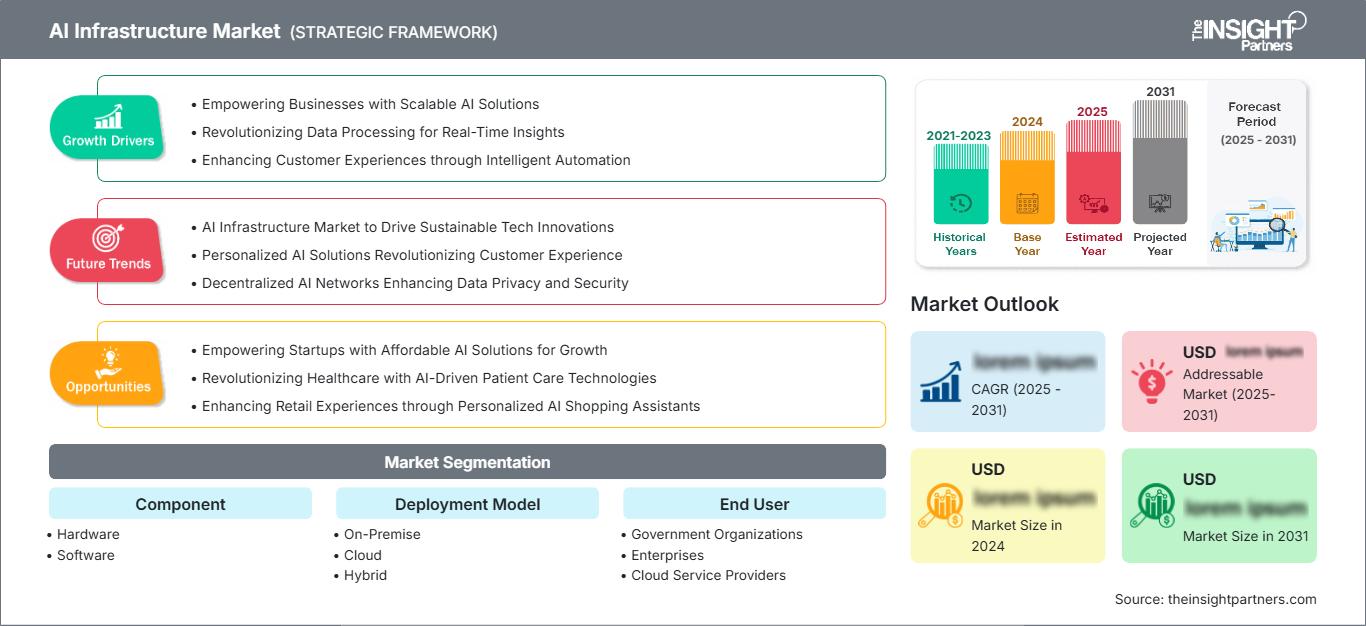
Regional Insights
North America AI infrastructure market
North America is expected to account for 36–38% of global revenue in 2025 and grow at a CAGR of 25–27% during 2026–2034. The region’s AI infrastructure market share reflects concentrated hyperscaler spending, strong enterprise cloud migration, and early adoption of GPU clusters for training and inference.
Regional growth is driven by the United States through the establishment of AI data centers, strength in semiconductors, and high demand for computing power in finance, healthcare, government, and software sectors. Regional growth is fueled by Canada through research clusters and cloud availability zones, while access to energy and grid readiness are crucial factors in selecting a site.
U.S. AI infrastructure Market
The US is estimated to represent 86–89% of North America in 2025 and grow at a CAGR of 25–27% during 2026–2034. Hyperscale cloud providers, AI model developers, enterprise software vendors, and government agencies are expanding demand for accelerated servers, networking fabrics, and AI-ready storage.
There is widespread company presence across the stack including Amazon Web Services, Microsoft Corporation, Google LLC, NVIDIA Corporation, Intel Corporation, Dell Technologies Inc., and Advanced Micro Devices Inc. Application layer trends include generative AI services, enterprise copilots, cybersecurity automation, health care analytics, and high performance simulations.
Europe AI infrastructure Market
Europe is expected to hold 20–22% share in 2025 and grow at a CAGR of 23–25% during 2026–2034. Demand is shaped by data sovereignty, regulated industry adoption, public cloud expansion, and national compute initiatives. The UK leads in cloud AI services, Germany emphasizes industrial AI, and France supports sovereign compute capacity.
Italy and Spain continue to gain relevance through various programs that include digital transformation, public services modernization, and extra cloud regions. European buyers are generally partial to hybrid and compliant solutions. This has an impact on driving demand for software security layers, data centers, and enterprise systems in financial, manufacturing, health care, and government markets.
APAC AI infrastructure Market
Asia Pacific is projected to hold 27–29% share in 2025 and grow at a CAGR of 28–30% during 2026–2034. China, Japan, South Korea, India, and Australia are investing in cloud capacity, AI software ecosystems, semiconductor capabilities, and sovereign AI infrastructure.
The biggest contributors from this region include China, whereas India is increasing business and government application of AI. Japan and South Korea increase the demand via manufacturing automation, robotics, and semiconductor-related ecosystem. Australia increases its AI capabilities through cloud regions, data governance, and mining, banking, and government applications of AI.
Middle East & Africa AI infrastructure Market
Middle East & Africa is expected to grow at a CAGR of 24–26% during 2026–2034, supported by national AI strategies, smart city programs, energy-sector analytics, and cloud region investments. Saudi Arabia and the UAE lead regional adoption through sovereign AI and digital government initiatives.
South Africa participates through cloud modernization and data center capacity additions, while the other countries in MEA participate on a selective, project-by-project basis. Power availability, energy efficiency, and public-private partnerships will significantly shape economic considerations within the region.
Segmentation Analysis
Component
Component is expected to grow at a CAGR of 25–27% during 2026–2034. The market scope across component layers includes hardware for compute-intensive processing and software for orchestration, development, monitoring, and governance. Buyers increasingly evaluate component stacks based on utilization, interoperability, security, lifecycle cost, and readiness for both training and inference workloads.
- Hardware remains the largest value contributor because GPUs, AI accelerators, high-bandwidth memory, servers, storage, and networking equipment are essential for scalable model training and inference.
- Software supports orchestration, model lifecycle management, security, governance, and workload optimization, making it critical for enterprises seeking operational efficiency across distributed AI environments.
Deployment Model
Deployment Model is projected to grow at a CAGR of 26–28% during 2026–2034. Organizations are choosing deployment architectures based on latency, cost, compliance, data sensitivity, and workload variability. Cloud remains the fastest-growing route, but hybrid models are gaining importance as enterprises retain sensitive data on-premise while using cloud platforms for burst capacity.
- On-Premise is favored for regulated workloads, proprietary datasets, low-latency inference, and enterprises requiring direct infrastructure control, especially in finance, defense, healthcare, and manufacturing.
- Cloud leads high-growth adoption because it offers elastic compute, managed AI services, faster experimentation, and access to specialized accelerators without full upfront infrastructure ownership.
- Hybrid is becoming strategically important as organizations combine private data control with cloud-scale training, inference, disaster recovery, and region-specific deployment flexibility.
End User
End User is expected to grow at a CAGR of 26–28% during 2026–2034. Cloud service providers drive large-scale capacity additions, while enterprises are expanding AI infrastructure for automation, analytics, and customer-facing applications. Government organizations are increasing investment in sovereign AI, cybersecurity, public services, defense analytics, and national research infrastructure.
- Government Organizations deploy AI infrastructure for national security, digital public services, research computing, smart infrastructure, and sovereign AI programs requiring secure domestic capacity.
- Enterprises use AI infrastructure to scale automation, personalization, analytics, software development, fraud detection, supply chain optimization, and industry-specific decision intelligence.
- Cloud Service Providers remain the most capital-intensive buyers, expanding GPU clusters, custom silicon, storage, networking, and managed AI platforms for global customer workloads.
Opportunity Snapshot
| End User | Revenue Contribution | Trend Tag | Adoption Stage |
| Government Organizations | Medium | Sovereign Compute | Scaling |
| Enterprises | High | Private AI | Scaling |
| Cloud Service Providers | High | GPU Clusters | Mature |
AI Infrastructure Market Growth Drivers and Impact Analysis
Hyperscaler Expansion of Accelerated Computing Capacity
Cloud service providers are increasing capital expenditure on AI data centers, GPU clusters, custom silicon, high-speed networking, and storage to serve demand from model developers and enterprises. This driver directly expands hardware procurement and strengthens cloud-based deployment economics. As utilization rises, providers can spread infrastructure cost across training, fine-tuning, inference, and managed AI services. The impact is especially strong in North America and Asia Pacific, where cloud regions and AI-ready campuses are being scaled around power availability and network access.
Enterprise Shift from AI Pilots to Production Workloads
Enterprises are moving beyond proof-of-concept deployments toward operational AI use cases in software development, customer service, cybersecurity, fraud detection, manufacturing optimization, and analytics. Production workloads require reliable infrastructure, governance, latency control, and predictable cost performance. This transition supports hybrid deployment, private AI systems, and software platforms that manage models across distributed environments. The commercial effect is broader demand beyond hyperscalers, allowing server vendors, software providers, and systems integrators to capture enterprise modernization budgets.
Specialized Silicon and Memory Innovation
AI workloads are pushing demand for GPUs, ASICs, high-bandwidth memory, advanced packaging, and low-latency interconnects. These technologies reduce training time, improve inference efficiency, and support larger models. NVIDIA Corporation remains central in accelerated computing, while hyperscalers are also investing in custom chips to reduce dependency and optimize workload economics. Memory suppliers such as Micron Technology, Inc. and Samsung Electronics Co., Ltd. benefit as bandwidth and capacity become core performance constraints.
AI Infrastructure Market Future Trends
Inference-Optimized Infrastructure Architectures
AI infrastructure market trends are shifting from training-heavy capacity toward inference-optimized systems that reduce cost per query and improve latency. As AI applications move into daily enterprise workflows, infrastructure will need efficient accelerators, caching, model compression, and workload routing. This trend favors providers that can combine hardware efficiency with software orchestration. It also increases demand for regional data centers because inference often requires proximity to users, regulated datasets, and application ecosystems.
Sovereign and Industry-Specific AI Clouds
Governments and regulated sectors are expected to adopt dedicated AI cloud environments that address data residency, cybersecurity, compliance, and national competitiveness. Sovereign AI clouds will create demand for localized compute, certified software stacks, and secure operating models. Industry-specific clouds for healthcare, finance, manufacturing, and public services will also require specialized data pipelines and governance controls. This trend supports hybrid deployment because many organizations will combine national infrastructure with global cloud ecosystems.
AI Infrastructure Market Opportunities
Private AI infrastructure for Regulated Enterprises
Private AI creates a strong opportunity for vendors serving banks, insurers, healthcare providers, defense organizations, and manufacturers that need data control and auditability. AI infrastructure market Forecasts indicate that hybrid architectures will benefit from this demand because customers want cloud-like scalability without moving all sensitive data externally. Vendors can differentiate through integrated servers, security software, model governance, and lifecycle services. The opportunity is action-oriented because buyers are actively evaluating deployments that reduce compliance risk while enabling productivity gains.
Energy-Efficient AI Data Center Modernization
Power availability and cooling efficiency are becoming decisive constraints for AI infrastructure expansion. This creates opportunities for liquid cooling, high-density rack design, power management software, advanced networking, and site optimization services. Data center operators that lower energy cost per compute unit can improve margins and attract capacity-constrained customers. The opportunity is strongest in markets where AI campuses require grid upgrades, renewable power contracts, and faster deployment timelines to support training and inference growth.
Frequently Asked Questions

- Comprehensive Market Sizing and Forecast Analysis
- Detailed Segmentation Analysis
- In-Depth Market Dynamics Assessment
- Regional and Country-Level Insights
- Competitive Landscape and Company Benchmarking
- Strategic Business Intelligence
Recent Reports
Testimonials

The Insight Partners' SCADA System Market report is comprehensive, with valuable insights on current trends and future forecasts. The team was highly professional, responsive, and supportive throughout. We are very satisfied and highly recommend their services.
RAN KEDEM Partner, Reali Technologies LTDs
I requested a report on a very specific software market and the team produced the report in a few days. The information was very relevant and well presented. I then requested some changes and additions to the report. The team was again very responsive and I got the final report in less than a week.
JEAN-HERVE JENN Chairman, Future Analytica
We worked with The Insight Partners for an important market study and forecast. They gave us clear insights into opportunities and risks, which helped shape our plans. Their research was easy to use and based on solid data. It helped us make smart, confident decisions. We highly recommend them.
PIYUSH NAGPAL Sr. Vice President, High Beam Global
The Insight Partners delivered insightful, well-structured market research with strong domain expertise. Their team was professional and responsive throughout. The user-friendly website made accessing industry reports seamless. We highly recommend them for reliable, high-quality research services
YUKIHIKO ADACHI CEO, Deep Blue, LLC.
This is the first time I have purchased a market report from The Insight Partners.While I was unsure at first, I visited their web site and felt more comfortable to take the risk and purchase a market report.I am completely satisfied with the quality of the report and customer service. I had several questions and comments with the initial report, but after a couple of dialogs over email with their analyst I believe I have a report that I can use as input to our strategic planning process.Thank you so much for taking the extra time and making this a positive experience.I will definitely recommend your service to others and you will be my first call when we need further market data.
JOHN SUZUKI President and Chief Executive Officer, Board Director, BK Technologies
I wish to appreciate your support and the professionalism you displayed in the course of attending to my request for information regarding to infectious disease IVD market in Nigeria. I appreciate your patience, your guidance, and the fact that you were willing to offer a discount, which eventually made it possible for us to close a deal. I look forward to engaging The Insight Partners in the future, all thanks to the impression you have created in me as a result of this first encounter.
DR CHIJIOKE ONYIA MANAGING DIRECTOR, PineCrest Healthcare Ltd.Reason to Buy
- Informed Decision-Making
- Understanding Market Dynamics
- Competitive Analysis
- Identifying Emerging Markets
- Customer Insights
- Market Forecasts
- Risk Mitigation
- Boosting Operational Efficiency
- Strategic Planning
- Investment Justification
- Tracking Industry Innovations
- Aligning with Regulatory Trends





 Get Free Sample for