AI Studio Market Size & Overview
The AI studio market was valued at US$ 11.67 Billion in 2025 and is projected to reach US$ 113.99 Billion by 2034, expanding at a CAGR of 28.82% during 2026–2034. The market is being shaped by rising enterprise adoption of generative AI, increasing demand for low-code model development environments, and broader deployment of agentic AI systems. Organizations across multiple industries are investing in platforms that simplify model training, orchestration, governance, and deployment.
Across North America, expansion is supported by mature cloud infrastructure, strong venture funding activity, and widespread enterprise AI implementation. The AI studio market size in the region continues to benefit from platform standardization initiatives and growing use of AI copilots within business workflows. Regional growth is estimated in the range of 26–30% through 2034, supported by increasing spending on AI development environments and model lifecycle management solutions.
The AI studio market growth trajectory is being driven by enterprises seeking standardized environments for building, customizing, and deploying AI applications. Organizations increasingly require unified platforms that reduce development complexity while improving model governance and deployment speed. Growing adoption of large language models, multimodal AI systems, and enterprise copilots is expanding demand across the value chain. Service providers, cloud vendors, data infrastructure providers, and software developers collectively contribute to ecosystem development. In addition, AI application development is moving closer to business users through low-code and no-code interfaces. This transition reduces technical barriers and enables departments such as sales, customer service, finance, and operations to deploy AI-driven workflows more efficiently. Expanding cloud infrastructure availability and increased enterprise investments in data modernization also support platform adoption.
The AI studio market analysis indicates a competitive environment characterized by cloud-native innovation, strategic partnerships, and platform differentiation. Microsoft Corporation, Google LLC, and Amazon Web Services, Inc. continue strengthening integrated AI development ecosystems, while International Business Machines Corporation focuses on enterprise governance and hybrid deployment capabilities. Specialists including DataRobot, Inc., C3.ai, Inc., and Altair Engineering Inc. emphasize industry-specific use cases and enterprise analytical workflows. Investment activity increasingly targets agentic AI, model management, observability, and workflow orchestration technologies. Sprinklr, Inc. and Vonage Holdings Corp. expand AI-enabled customer engagement capabilities, while Blaize Holdings, Inc. targets edge AI applications. Strategic positioning is increasingly determined by model ecosystem breadth, governance capabilities, deployment flexibility, and integration with enterprise data environments.
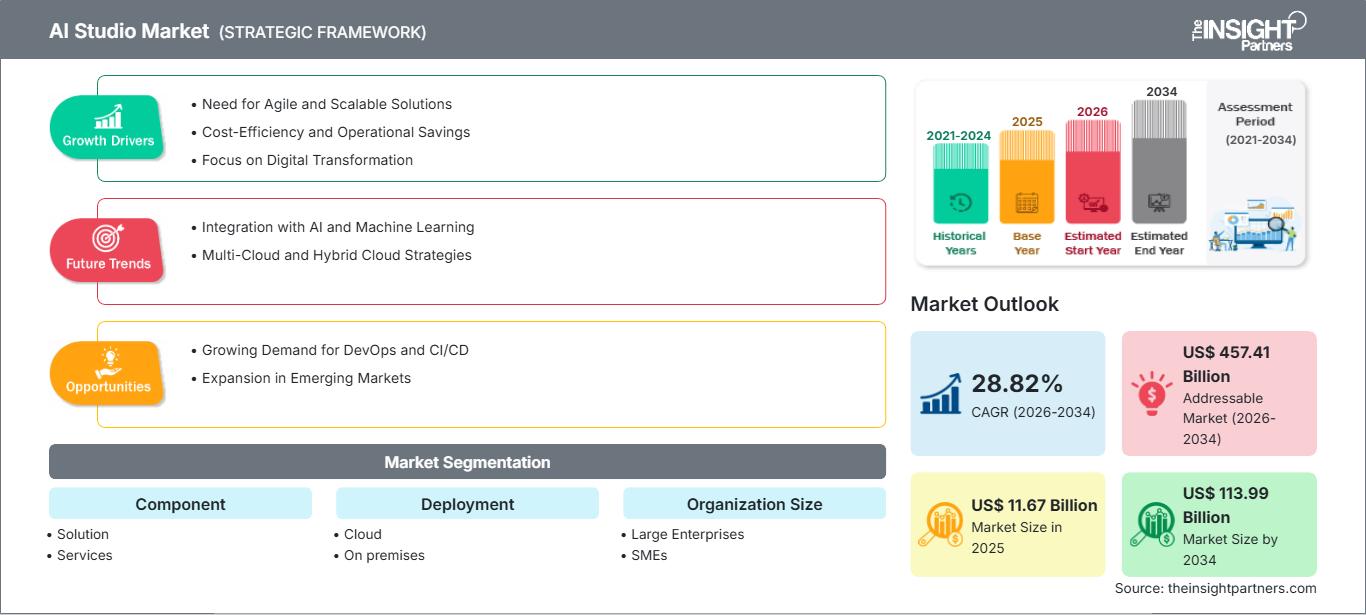
AI Studio Market Assessment and Insights
- North America: Strong concentration of cloud and AI platform providers supports adoption across enterprises. Share in 2025: 38–42%. CAGR between 2026–2034: 26–30%.
- US: Leading contributor driven by hyperscale cloud investments and enterprise AI deployments. Share in 2025: 74–78% of North America. CAGR between 2026–2034: 27–31%.
- Europe: Adoption is led by Germany, the UK, and France, supported by AI governance frameworks and industrial digitization. Share in 2025: 25–29%. CAGR between 2026–2034: 25–29%.
- Asia Pacific: China, Japan, India, and South Korea are accelerating implementation through digital transformation programs. Share in 2025: 23–27%. CAGR between 2026–2034: 31–35%.
- Largest Segment: Cloud deployment remains dominant due to scalability and integration capabilities. Market share in 2025: 60–64%. CAGR 2026–2034: 29–33%.
- High Growth Segment: Healthcare end users are expanding rapidly through clinical AI and workflow automation initiatives. Market share in 2025: 11–15%. CAGR 2026–2034: 33–37%.
- Key companies analyzed in detail: Microsoft Corporation, International Business Machines Corporation, Google LLC, Amazon Web Services, Inc., Vonage Holdings Corp., Sprinklr, Inc., Blaize Holdings, Inc., DataRobot, Inc., Altair Engineering Inc., C3.ai, Inc.
Source: The Insight Partners' analysis based on proprietary research, government publications, company annual reports, investor presentations, industry databases, and expert interviews.
AI Studio Market Trends
Rise of Agentic AI Development Frameworks
The AI studio market trends increasingly point toward platforms optimized for agentic AI systems capable of autonomous task execution and multi-step decision workflows. Future development environments are expected to include orchestration engines, memory management capabilities, tool integration frameworks, and advanced monitoring features. Organizations will increasingly seek platforms capable of managing fleets of AI agents operating across business processes. This transition is likely to increase demand for governance, observability, and lifecycle management capabilities.
Industry-Specific AI studio Platforms
The vendors will be compelled to develop offerings that become increasingly specialized and tailored to the processes and standards applicable within industries. Generic development platforms will not be used by businesses; rather, industry-specific frameworks will be developed for fields such as health care, manufacturing, finance, and government administration. The incorporation of industry datasets, compliance templates, and workflow accelerators is expected to shorten implementation timelines and improve deployment outcomes. This specialization trend will support broader commercialization opportunities across vertical markets.
AI Studio Market Growth Factors
Enterprise Adoption of Generative AI Platforms
The rapid commercialization of generative AI technologies continues to accelerate platform demand across industries. Businesses have come to expect development frameworks that allow models to be customized, tested, deployed, governed, and monitored using a unified architecture. The need for uniform development frameworks becomes increasingly important as the organization progresses from pilot implementations to full-scale production deployments. AI studios make deployment easier and foster collaboration among developers, data scientists, and other business stakeholders. This trend is particularly common in industries like financial services, healthcare, manufacturing, and telecommunications, where governance and scalability requirements are substantial.
Expansion of Low-Code and No-Code AI Development
Low-code platforms enable broader involvement in AI projects within organizations. Business users have a greater ability to design workflows and set up AI applications without requiring deep programming skills. This speeds implementation and increases adoption among mid-size businesses. Further improvements to the visual interface and workflow templates are being made by the vendors, along with model selection automation options. With the talent shortage in AI becoming a challenge, low-code platforms offer an easy way to move forward with implementations.
Increased Demand for AI Governance and Compliance
There is an increased expectation placed on organizations to exhibit transparency, accountability, and security in their use of AI. The emergence of regulations from different geographies has led to the adoption of AI platforms that offer capabilities such as monitoring, auditing, documentation, and risk management. AI development platforms now offer explainability, model tracking, and policy enforcement features. Organizations find these features crucial for large-scale AI deployment without increasing operational or regulatory risks. Demand is particularly strong in highly regulated sectors, including BFSI, healthcare, and government operations.
AI Studio Market Opportunities
Expansion Across Emerging Digital Economies
Rapid adoption of the cloud and digital transformation creates tremendous business opportunities across the Asia-Pacific region, the Middle East, Africa, and certain Latin American countries. It is possible to increase market penetration through vendor strategies that consider local infrastructure, local languages, and regional regulatory requirements. There are growing government efforts to foster AI innovation ecosystems, which present positive conditions for platform adoption. Long-term investment prospects remain attractive where enterprise digitization remains at an earlier stage of development.
Vertical AI Solutions and Enterprise Partnerships
AI Studio Market Forecasts indicating double-digit growth drive companies to pursue sector-specific partnerships and bundled offerings. Collaboration among cloud platforms, software providers, consultancies, and industry experts can expedite deployment. Industry-specific compliance capabilities, processes, and built-in models might lower deployment challenges while creating added value for customers. These features make an attractive proposition for platform vendors in the enterprise segment.
Segmentation Analysis
Component
The component segment is projected to expand at a CAGR of 28–32%. The market scope continues to broaden as organizations require integrated software capabilities alongside implementation and optimization support. Demand increasingly favors platforms capable of managing development workflows, governance requirements, and deployment automation within a single environment.
- Solution: Core platforms provide model development, orchestration, monitoring, governance, and deployment functions, making them central to enterprise AI strategies and long-term digital transformation initiatives.
- Services: Consulting, implementation, integration, and support services remain important for organizations seeking faster deployment, regulatory alignment, and improved operational performance.
Deployment
The deployment segment is anticipated to grow at a CAGR of 29–33%. Deployment preferences are shaped by security requirements, scalability expectations, and infrastructure strategies. Hybrid and multi-cloud architectures increasingly influence purchasing decisions.
- Cloud: Cloud deployment remains dominant because it offers scalability, rapid provisioning, extensive model access, and lower infrastructure management requirements for most enterprises.
- On premises: Organizations handling sensitive information continue adopting on-premises deployment for data control, compliance, and security objectives.
Organization Size
The organization size segment is expected to expand at a CAGR of 27–31%. Adoption patterns differ based on budget availability, technical expertise, and business objectives, yet both categories continue increasing investments.
- Large Enterprises: Broad data assets and complex operational environments encourage platform adoption for governance, automation, and enterprise-wide AI deployment initiatives.
- SMEs: Accessibility improvements through cloud-based and subscription models allow smaller firms to implement AI development capabilities with lower upfront costs.
End Users
The end-user segment is forecast to grow at a CAGR of 30–34%. Industry-specific applications increasingly influence adoption decisions, with organizations investing in platforms tailored to operational requirements and regulatory expectations.
- IT and Telecom: Supports network optimization, customer service automation, and software development acceleration through integrated AI workflows.
- Healthcare: Increasing utilization across clinical decision support, administrative efficiency, medical imaging analysis, and patient engagement programs.
- Manufacturing: Enables predictive maintenance, production optimization, quality monitoring, and supply chain intelligence initiatives.
- Retail and E-commerce: Facilitates personalization, inventory intelligence, dynamic pricing, and customer interaction automation.
- Government: Adoption focuses on digital citizen services, administrative modernization, and operational efficiency enhancement.
- BFSI: Supports fraud detection, risk assessment, customer engagement, and regulatory compliance improvements.
Opportunity Snapshot
| End Users | Revenue Contribution | Trend Tag | Adoption Stage |
| IT and Telecom | High | AI Agents | Mature |
| Healthcare | High | Clinical AI | Scaling |
| Manufacturing | Medium | Smart Factory | Scaling |
| Retail and E-commerce | Medium | Hyperpersonalization | Scaling |
| Government | Medium | Digital Services | Emerging |
| BFSI | High | Fraud Analytics | Mature |
Regional Insights
North America AI studio market
North America accounted for 38–42% of the AI studio market share in 2025 and remains the leading regional contributor. Adoption is supported by extensive cloud infrastructure, mature enterprise software ecosystems, and strong AI research activity. Large organizations increasingly deploy generative AI applications through centralized development platforms, driving demand for governance, monitoring, and lifecycle management functions.
The region is projected to expand at a CAGR of 26–30% through 2034. Demand is reinforced by enterprise spending on productivity automation, customer engagement optimization, and data-driven decision systems. Regulatory attention to responsible AI is encouraging the use of managed development environments with integrated compliance controls. Financial services, healthcare, government, and telecommunications organizations continue to represent major sources of platform demand.
U.S. AI studio Market
The United States represented approximately 74–78% of North American revenue in 2025. The country benefits from the presence of major technology providers, extensive AI talent pools, and strong investment activity across enterprise AI software. Adoption is particularly strong in financial services, healthcare, retail, and telecommunications applications.
The U.S. market is anticipated to register a CAGR of 27–31% through 2034. Organizations increasingly pursue AI platform standardization to streamline deployment and governance across multiple business units. The presence of Microsoft Corporation, Amazon Web Services, Inc., Google LLC, and numerous AI software innovators further accelerates commercialization and enterprise deployment activity.
Europe AI studio Market
Europe accounted for 25–29% of global revenue in 2025 and is forecast to expand at a CAGR of 25–29%. Regional adoption is influenced by digital transformation programs, industrial automation initiatives, and emerging AI governance standards. Enterprise demand increasingly focuses on transparency, security, and explainability features.
The United Kingdom exhibits great dynamism in fintech and enterprise software development. Germany remains the dominant player owing to its digitization efforts in the manufacturing sector and its investments in industrial AI. France is still expanding both its public and private AI initiatives, while Italy and Spain have begun making greater use of AI in their retail, health care, and government sectors. Germany remains the regional leader because of its substantial industrial base and technology spending profile.
APAC AI studio Market
Asia-Pacific is expected to see demand growth of 23-27% in 2025 and is anticipated to grow at the highest rate in the world, with a CAGR of 31-35%. China continues to be the leading market in this region, with significant digital transformation projects and the development of AI ecosystems.
Japan, South Korea, India, and Australia continue to develop enterprise AI solutions across the manufacturing, healthcare, and financial services sectors. Government-backed innovation programs, cloud adoption growth, and growing developer communities contribute to long-term market expansion throughout the region.
Middle East & Africa AI studio Market
The Middle East and Africa segment continues to experience gains from digital economy initiatives and AI programs in nations. Countries such as Saudi Arabia and the UAE are at the forefront of regional rollouts, having invested in cloud technology, smart government initiatives, and AI innovation.
The region is expected to grow at a CAGR rate of 24% to 28% until 2034. South Africa remains a major adopter in Africa, with other infrastructural improvements aiding the platform's implementation in more countries. Energy, public services, and smart infrastructure projects remain key areas for adoption.
AI Studio Market Report Scope
| Report Attribute | Details |
|---|---|
| Market size in 2025 | US$ 11.67 Billion |
| Market Size by 2034 | US$ 113.99 Billion |
| Global CAGR (2026 - 2034) | 28.82% |
| Historical Data | 2021-2024 |
| Forecast period | 2026-2034 |
| Segments Covered | Component, Deployment, Organization Size, End Users |
| Region scope | North America, Europe, Asia-Pacific, South and Central America, Middle East and Africa |
Frequently Asked Questions

Recent Reports






