
Air Conditioning Systems Market Share, Growth & Demand by 2034
Coverage: By Product (Room air conditioners, Packaged air conditioners, Split air conditioners, Mini split air conditioners, Ductless air conditioners, Terminal air conditioners, Central air conditioners, Portable air conditioners, and Packaged central air conditioners); Sales Channel (B2B Sales, Authorized Retail Stores, Electronic stores, and Online); and End-Use (Industrial, Residential, and Commercial), and Geography (North America, Europe, Asia Pacific, and South and Central America)
- Status : Data Released
- Report Code : TIPRE00002902
- Category : Electronics and Semiconductor
- No. of Pages : 150
- Available Report Formats :


- Last update date : July 17, 2026


2025 Market Size
US$ 111.08 Bn
Base year value
2034 Forecast
US$ 198.98 Bn
Projected by 2034
CAGR 2026-2034
6.69 %
Growth rate
Addressable Market
US$ 1,401.36 Bn
(2026-2034)
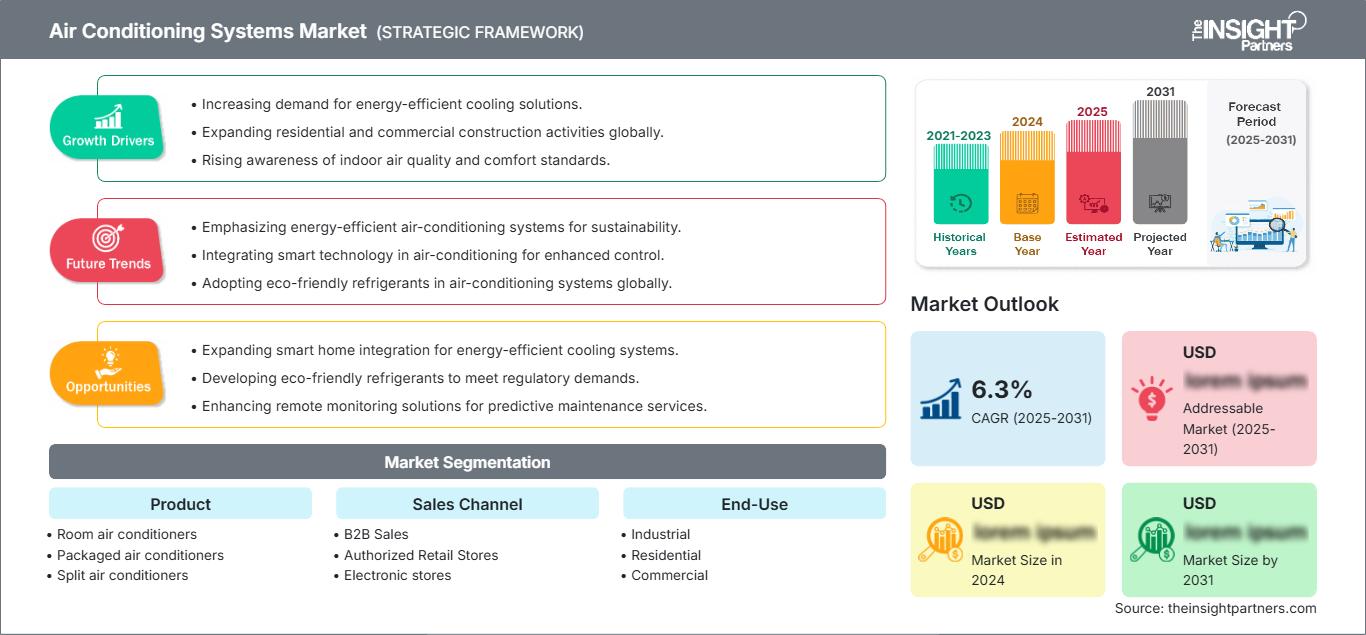
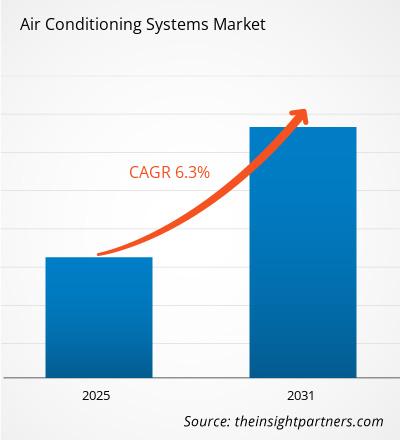
The Air Conditioning Systems Market was valued at US$ 111.08 Billion in 2025 and is projected to reach US$ 198.98 Billion by 2034, growing at a CAGR of 6.69% during 2026–2034. The market is expanding as households, commercial facilities, industrial buildings, and institutional users invest in efficient cooling systems that improve comfort, humidity control, indoor air quality, and energy performance across hotter and more urbanized environments.
North America remains a structurally important market, with the Air Conditioning Systems Market size supported by replacement demand, heat-pump electrification, data center cooling, and commercial retrofit activity. The region is estimated to grow at a CAGR range of 5.7–6.1% during 2026–2034. Demand is reinforced by refrigerant transition rules, high penetration of ducted systems, and investment in connected controls that reduce electricity consumption during peak cooling periods.
Air Conditioning Systems Market Assessment and Insights
- North America: The region holds 21–25% share in 2025 and grows at a CAGR range of 5.7–6.1% during 2026–2034, supported by residential replacement, commercial retrofits, refrigerant transitions, and heat-pump enabled cooling upgrades.
- US: The country represents 78–82% of North America in 2025 and grows at a CAGR range of 5.8–6.2% during 2026–2034, led by ducted replacement and smart cooling demand.
- Europe: The region accounts for 16–20% share in 2025 and grows at a CAGR range of 5.2–5.6% during 2026–2034, with Germany, France, Italy, Spain, and the UK leading adoption.
- Asia Pacific: The region holds 46–50% share in 2025 and grows at a CAGR range of 7.1–7.5% during 2026–2034, led by China, India, Japan, South Korea, and Australia.
- Largest Segment: Split air conditioners hold 34–38% market share in 2025 and grow at a CAGR range of 6.5–6.9% during 2026–2034 because they balance efficiency, affordability, and flexible installation.
- High Growth Segment: Ductless air conditioners hold 11–15% market share in 2025 and grow at a CAGR range of 7.4–7.8% during 2026–2034 as retrofits and zoned cooling accelerate.
- Key companies analyzed in detail: Samsung Electronics Co., Ltd.; Mitsubishi Corporation; Daikin Industries, Ltd.; Siemens Aktiengesellschaft; Panasonic Holdings Corporation; Midea Group Co., Ltd.; DENSO Corporation; Hitachi, Ltd.; LG Electronics Inc.; AB Electrolux.
Source: The Insight Partners' analysis based on proprietary research, government publications, company annual reports, investor presentations, industry databases, and expert interviews.
Air conditioners have progressed from being mere comfort devices to thermal management solutions which are connected. The technologies such as inverter compressors, variable refrigerant flow platforms, low GWP refrigerants, improved air filters, and AI controls will shape new product designs. The production dynamics will change as the manufacturers localize their value chain and redesign their platforms to suit R32 and R454B while integrating sensors, controllers, and service software in all residential, commercial, and industrial solutions.
The forward-looking demands will increase in hot cities, data intensive centers, healthcare buildings, retail outlets, and rising middle income homes. The positive regulatory winds blowing through the Minimum Energy Performance Standards, Refrigerant Phase-Downs, and Building Decarbonization initiatives would likely drive the investment into cooling efficiency.
Air Conditioning Systems Market Report Scope
| Report Attribute | Details |
|---|---|
| Market size in 2025 | US$ 111.08 Billion |
| Market Size by 2034 | US$ 198.98 Billion |
| Global CAGR (2026 - 2034) | 6.69% |
| Historical Data | 2021-2024 |
| Forecast period | 2026-2034 |
Air Conditioning Systems Market Analysis
The Air Conditioning Systems Market growth is driven by rising cooling degree days, urban heat islands, new housing, commercial floor-space expansion, and replacement of inefficient installed equipment. According to the International Energy Agency, households’ air conditioner penetration stood at 36% in 2022 and can climb to 60% by 2050 without increased energy efficiency policies, demonstrating the level of latent demand in warm climates. High efficiency units are turning into important grid resources, and not just products.
The supply chain comprises compressor providers, heat exchanger suppliers, refrigerants producers, electronics and sensors producers, systems producers, distributors, installation services, and maintenance services. Supply conditions are affected by copper supplies, aluminum supplies, semiconductor controls, compressor capacities, and refrigerants supplies. System providers who are capable of managing product development, channel management, service delivery, and documentation comply better to refrigerant switchovers and efficiency standards.
The competition in the market place is varied since companies such as Daikin Industries, Ltd., LG Electronics Inc., Samsung Electronics Co., Ltd., Panasonic Holdings Corporation, and Midea Group Co., Ltd. are competing in residential and light commercial applications. Siemens Aktiengesellschaft enhances automation and building management, while DENSO Corporation and Hitachi, Ltd. cater to mobility, industrial, and infrastructure applications. The Air Conditioning Systems Market analysis shows that differentiation increasingly depends on efficiency, controls, service capability, and regional channel depth.
Investments are being made towards inverter systems, R32 and other low GWP product ranges, heat pump compatible systems, and data center cooling. While Mitsubishi Corporation plays an active role in fostering connections in industrial and distribution networks, AB Electrolux continues to have a presence in consumer appliances distribution channels. Positioning has been repositioned from unit shipment volume towards lifecycle value.
● REPORT CUSTOMIZATION
Tailor This Report To Align With Your Specific Business Requirements
This report can be customized to align precisely with your business objectives, scope, and target markets. Customization options include tailored segmentation, geography, competitive analysis, and strategic insights to support informed decision-making.
Customize This Report →WHAT YOU CAN ADJUST
- ● Segmentations
- ● Geography
- ● Competitive Analysis
- ● Language Preferences
Air Conditioning Systems Market: Strategic Insights
Regional Insights
North America Air Conditioning Systems Market
North America holds 21–25% share in 2025 and is projected to grow at a CAGR range of 5.7–6.1% during 2026–2034. Demand is anchored by high cooling penetration, replacement cycles, commercial retrofit projects, and the transition to new refrigerants in the U.S. and Canada. The Air Conditioning Systems Market share in this region is supported by ducted split systems, packaged units, and growing use of smart thermostats.
More data centers, hospitals, schools, retail stores, and apartments are boosting commercial needs. More residential customers want to consider seasonal performance, indoor air quality, sound, and connectivity of the controls. The region is facing the problem not of introducing the technology for the first time but in upgrading the existing equipment and maintaining load factors.
U.S. Air Conditioning Systems Market
The U.S. represents 78–82% of North America in 2025 and is expected to grow at a CAGR range of 5.8–6.2% during 2026–2034. The country benefits from a large installed base of ducted systems, heat-pump incentives, high summer cooling loads, and commercial replacement activity. Company presence is strong through Daikin Industries, Ltd., Samsung Electronics Co., Ltd., LG Electronics Inc., Panasonic Holdings Corporation, and Siemens Aktiengesellschaft.
The current applications trend includes increased demand for variable speed compressors, rooftop packaged replacement systems, room air conditioners for additional cooling capacity, and service diagnosis through connections. The commercial market is also focusing on redundancy and control applications for data centers, laboratories, hospitals, and logistics centers. Growth within the U.S. market is still tied to installer availability, refrigerant changeover capabilities, and consumer willingness to pay.
Europe Air Conditioning Systems Market
Europe holds the market share between 16-20% in 2025 and is expected to register growth with a CAGR of 5.2-5.6% over 2026-2034. Germany is the largest country owing to the high demand for commercial construction, heat pump strategy, industrial structures, and renovation initiatives that drive efficiency in cooling. The market in the UK is growing with office retrofit projects, data centers, retail complexes, and comfort cooling linked to heat pumps.
France, Italy, and Spain are becoming significant because of heatwaves leading to the demand for cooling in the residential and hospitality sectors. Italy and Spain have more climate change drivers, whereas France focuses on low carbon construction, renovation, and energy efficiency in public sector buildings. Preferences among European customers include energy ratings, refrigerant technology, acoustic performance, and energy efficiency of heating/cooling systems inverter split, VRF, and advanced control.
APAC Air Conditioning Systems Market
Asia-Pacific region is expected to be valued at 46-50% share by 2025 and is expected to have CAGR of 7.1-7.5% between 2026 and 2034. In this regard, China will continue to dominate the market due to manufacturing capability, urban replacement and commercial construction activities, while India will add strong momentum with new homeownership rate.
In this case, Japan and South Korea will focus on high-efficiency inverters and smart technologies, while Australia will boost the market with its replacement activities in residential and light commercial structures.
Middle East & Africa Air Conditioning Systems Market
The Middle East & Africa market is forecast to grow at a CAGR range of 6.3–6.7% during 2026–2034. Saudi Arabia is the leading country as megaprojects, hospitality assets, district cooling links, and commercial construction create large cooling loads.
Demand is met in UAE through the data centers, airports, hotels, and high-rise buildings, while in South Africa, demand is generated by the retail, mining, healthcare, and industrial sectors. Demand from the rest of MEA remains linked to imports and depends on the quality of power, finance, construction, and efficiency parameters.
Segmentation Analysis
Product
Product is projected to grow at a CAGR range of 6.4–6.8% during 2026–2034. The Air Conditioning Systems Market scope within products is shaped by room size, duct availability, climate, building age, energy codes, and installation cost. Split and mini split systems dominate unit additions, central and packaged systems remain critical in North America, and portable products serve renters, small offices, and supplemental cooling needs.
- Room air conditioners: These units address single-room cooling needs in apartments, small homes, dormitories, and temporary spaces where low upfront cost and quick installation remain strategic advantages.
- Packaged air conditioners: Packaged systems serve commercial rooftops, small offices, and institutional buildings where compact outdoor placement, service access, and integrated heating-cooling design support replacement demand.
- Split air conditioners: Split systems hold the strongest position due to efficiency, quieter indoor operation, design flexibility, and suitability across residential and small commercial applications.
- Mini split air conditioners: Mini splits support zoned comfort in retrofits, extensions, apartments, and buildings lacking ductwork, making them strategically important for electrification and targeted cooling upgrades.
- Ductless air conditioners: Ductless systems are gaining share where building owners need efficient retrofits, room-level control, lower installation disruption, and improved comfort without major structural changes.
- Terminal air conditioners: Terminal units remain important in hotels, assisted-living facilities, schools, and apartments because standardized wall installations simplify maintenance and room-by-room replacement.
- Central air conditioners: Central systems are critical in detached homes, large apartments, and commercial buildings where whole-building comfort, duct distribution, and integrated controls are preferred.
- Portable air conditioners: Portable units serve renters, emergency cooling, seasonal use, and spot-cooling applications, offering flexibility despite lower efficiency compared with fixed systems.
- Packaged central air conditioners: Packaged central systems support commercial facilities and homes needing consolidated outdoor equipment, simplified service, and reliable cooling across multiple zones.
Sales Channel
Sales Channel is expected to grow at a CAGR range of 6.2–6.6% during 2026–2034. Channel performance depends on product complexity, financing, installation requirements, warranty support, and regional consumer behavior. B2B sales dominate complex commercial systems, authorized retail stores remain important for trust and service, electronic stores influence appliance-led purchases, and online channels are scaling for standardized room, portable, and replacement products.
- B2B Sales: B2B channels serve developers, contractors, facility managers, industrial users, and institutional buyers requiring design support, compliance documentation, installation planning, and long-term maintenance contracts.
- Authorized Retail Stores: Authorized stores remain important for branded residential systems because buyers value demonstrations, financing, installation referrals, warranty assurance, and after-sales coordination.
- Electronic stores: Electronics retailers influence room, split, and portable purchases by bundling appliances, highlighting energy labels, and targeting households during peak summer sales cycles.
- Online: Online channels are scaling for price comparison, reviews, accessories, and standardized products, though installation-dependent systems still require contractor or brand-partner coordination.
End-Use
End-Use is projected to grow at a CAGR range of 6.6–7.0% during 2026–2034. Residential demand benefits from income growth, heat exposure, and replacement cycles. Commercial demand is strengthened by retail, hospitality, healthcare, data centers, and offices. Industrial demand is more specialized, driven by process cooling, worker safety, electronics manufacturing, cleanrooms, and temperature-sensitive storage.
- Industrial: Industrial users require reliable cooling for production spaces, control rooms, warehouses, electronics plants, pharmaceuticals, and worker comfort, making uptime and service responsiveness crucial.
- Residential: Residential demand is broadest, reflecting new housing, replacement of inefficient units, apartment cooling, heatwave adaptation, and consumer preference for quieter connected systems.
- Commercial: Commercial facilities prioritize lifecycle cost, zoning, redundancy, indoor air quality, and controls across offices, retail, hotels, hospitals, schools, and data-intensive buildings.
Opportunity Snapshot
| End-Use | Revenue Contribution | Trend Tag | Adoption Stage |
| Industrial | Medium | Process Cooling | Scaling |
| Residential | High | Zoned Comfort | Mature |
| Commercial | High | Smart Buildings | Scaling |
Air Conditioning Systems Market Growth Drivers and Impact Analysis
Rising Heat Exposure and Cooling Access Needs
The rise in heat levels is elevating the importance of having effective cooling solutions for the home, work place, health care institutions, and education centers. According to the International Energy Agency, space cooling energy usage is likely to almost double to 2050 without any additional steps being taken; meanwhile, residential air conditioners are expected to increase energy usage up to 2035. Market consequences of this phenomenon include increased frequency of replacements, larger ownership rate for new users in areas where summers are warm, and growing attention to energy efficiency.
Regulatory Shift Toward Efficient and Low-GWP Systems
Efficiency and refrigerant phase-down rules are leading to design change in equipment categories including room units, split units, packaged units, central air conditioners, and ductless systems. For North America, the adoption of R32 and R454B refrigerants means change in product qualification, contractor training, stock management, and safety compliance. F-Gas regulation and energy labeling rules in Europe are continuing to influence buying decisions, whereas the efficient inverter products in Asia are being pushed by the governments due to power system pressures.
Commercial Buildings Requiring Connected Cooling Control
Commercial users are moving from standalone cooling units toward connected systems that support monitoring, scheduling, predictive maintenance, and energy optimization. Offices, hotels, hospitals, malls, schools, and data centers need reliable thermal control because comfort, equipment performance, and occupancy experience directly affect operating outcomes. Building owners increasingly evaluate total cost of ownership rather than purchase price alone. This creates impact through demand for VRF, packaged rooftop units, central systems, sensors, and building-management integration. Suppliers with controls, analytics, and service networks can convert equipment sales into recurring maintenance and lifecycle-management revenue.
Air Conditioning Systems Market Future Trends
AI-Enabled Cooling Optimization Moving Mainstream
Air Conditioning Systems Market trends are expected to center on AI-enabled control that learns occupancy, humidity, outdoor conditions, and user preferences. These systems will increasingly adjust compressor speed, airflow, and dehumidification automatically to reduce energy use without compromising comfort. The trend will also improve remote diagnostics and fault detection, allowing contractors to resolve issues before failures occur. Adoption will be fastest in premium residential, hotel, office, healthcare, and retail applications where energy bills and service continuity are material. Data privacy, interoperability, and technician training will shape implementation pace.
Cooling Systems Converging with Heat Pump Electrification
Cooling products will increasingly be evaluated as part of year-round electrification strategies rather than summer-only appliances. Heat pump-capable systems can provide cooling, heating, and humidity control, improving asset utilization and supporting building decarbonization. This trend is particularly important in North America, Europe, Japan, South Korea, and parts of China where policy incentives and grid-planning frameworks encourage electric thermal systems. Manufacturers will need to optimize low-temperature performance, refrigerant safety, noise, and control integration. The result will be stronger convergence between air conditioning, heating, water heating, and home energy management.
Air Conditioning Systems Market Opportunities
Retrofit Programs for High-Load Residential Buildings
A major opportunity lies in upgrading older residential buildings with efficient split, mini split, and ductless systems. Many apartments and houses have poor insulation, aging room units, or no duct infrastructure, making targeted retrofits attractive. Air Conditioning Systems Market Forecasts support investment in contractor training, financing bundles, and utility partnerships that reduce upfront cost barriers. Suppliers can create differentiated programs around energy audits, right-sized equipment, low-noise indoor units, and remote service. The highest returns will come where heatwaves, electricity tariffs, and policy incentives make efficiency measurable for households and grid operators.
Data Center and Mission-Critical Cooling Expansion
Data centers, telecom hubs, laboratories, hospitals, and high-reliability industrial facilities require cooling systems with redundancy, precision control, and rapid service response. Rising AI compute loads increase demand for chillers, air handling, liquid-assisted thermal management, and smart control integration. Equipment suppliers can invest in application engineering, modular cooling platforms, and service teams that understand uptime requirements. Strategic partnerships with building-automation firms, power-management providers, and data center developers can improve access to high-value projects. The opportunity is less about commodity units and more about engineered systems with performance guarantees.
Recent Developments
- February 2026: Panasonic Life Solutions India (PLSIND) announced the launch of its 2026 lineup of Residential Air Conditioners engineered specifically to tackle the country’s extreme weather conditions. Designed for reliable performance, the new range reflects Panasonic’s focus on delivering durable, energy-efficient, and climate-resilient cooling solutions tailored for Indian homes.
- December 2025: Daikin, Japanese air-conditioning manufacturer announced the launch of the new VRV 6 A/X Series in Cambodia. The new VRV 6 series deliver significant energy savings through advanced technology and innovation. With a more compact and lightweight design, operating performance has been improved in all aspects by introducing unique engineering concepts, cutting-edge technologies, and a wide range of features that enhance design flexibility, simplify installation, and strengthen long-term reliability.
- January 2026: Samsung announced the launch of its 2026 lineup of 100% Bespoke AI WindFree Air Conditioners. The new range comprises 23 models across segments, including the addition of 4 Star air conditioners. The Bespoke AI WindFree range reflects Samsung’s focus on innovation that enhances everyday living through smarter, efficient, and intuitive home-cooling experiences.
Frequently Asked Questions

- Comprehensive Market Sizing and Forecast Analysis
- Detailed Segmentation Analysis
- In-Depth Market Dynamics Assessment
- Regional and Country-Level Insights
- Competitive Landscape and Company Benchmarking
- Strategic Business Intelligence
Recent Reports
Testimonials

The Insight Partners' SCADA System Market report is comprehensive, with valuable insights on current trends and future forecasts. The team was highly professional, responsive, and supportive throughout. We are very satisfied and highly recommend their services.
RAN KEDEM Partner, Reali Technologies LTDs
I requested a report on a very specific software market and the team produced the report in a few days. The information was very relevant and well presented. I then requested some changes and additions to the report. The team was again very responsive and I got the final report in less than a week.
JEAN-HERVE JENN Chairman, Future Analytica
We worked with The Insight Partners for an important market study and forecast. They gave us clear insights into opportunities and risks, which helped shape our plans. Their research was easy to use and based on solid data. It helped us make smart, confident decisions. We highly recommend them.
PIYUSH NAGPAL Sr. Vice President, High Beam Global
The Insight Partners delivered insightful, well-structured market research with strong domain expertise. Their team was professional and responsive throughout. The user-friendly website made accessing industry reports seamless. We highly recommend them for reliable, high-quality research services
YUKIHIKO ADACHI CEO, Deep Blue, LLC.
This is the first time I have purchased a market report from The Insight Partners.While I was unsure at first, I visited their web site and felt more comfortable to take the risk and purchase a market report.I am completely satisfied with the quality of the report and customer service. I had several questions and comments with the initial report, but after a couple of dialogs over email with their analyst I believe I have a report that I can use as input to our strategic planning process.Thank you so much for taking the extra time and making this a positive experience.I will definitely recommend your service to others and you will be my first call when we need further market data.
JOHN SUZUKI President and Chief Executive Officer, Board Director, BK Technologies
I wish to appreciate your support and the professionalism you displayed in the course of attending to my request for information regarding to infectious disease IVD market in Nigeria. I appreciate your patience, your guidance, and the fact that you were willing to offer a discount, which eventually made it possible for us to close a deal. I look forward to engaging The Insight Partners in the future, all thanks to the impression you have created in me as a result of this first encounter.
DR CHIJIOKE ONYIA MANAGING DIRECTOR, PineCrest Healthcare Ltd.Reason to Buy
- Informed Decision-Making
- Understanding Market Dynamics
- Competitive Analysis
- Identifying Emerging Markets
- Customer Insights
- Market Forecasts
- Risk Mitigation
- Boosting Operational Efficiency
- Strategic Planning
- Investment Justification
- Tracking Industry Innovations
- Aligning with Regulatory Trends





 Get Free Sample for