
Air Cooler Market Size, Share & Trends by 2034
Coverage: By Type (Residential, Industrial and Commercial); Size (Spot Cooler, Medium Space Cooler, Large Space Cooler) , and Geography (North America, Europe, Asia Pacific, and South and Central America)
- Status : Data Released
- Report Code : TIPTE100000895
- Category : Electronics and Semiconductor
- No. of Pages : 150
- Available Report Formats :


- Last update date : July 17, 2026


2025 Market Size
US$ 2.67 Bn
Base year value
2034 Forecast
US$ 6.14 Bn
Projected by 2034
CAGR 2026-2034
9.71 %
Growth rate
Addressable Market
US$ 39.30 Bn
(2026-2034)
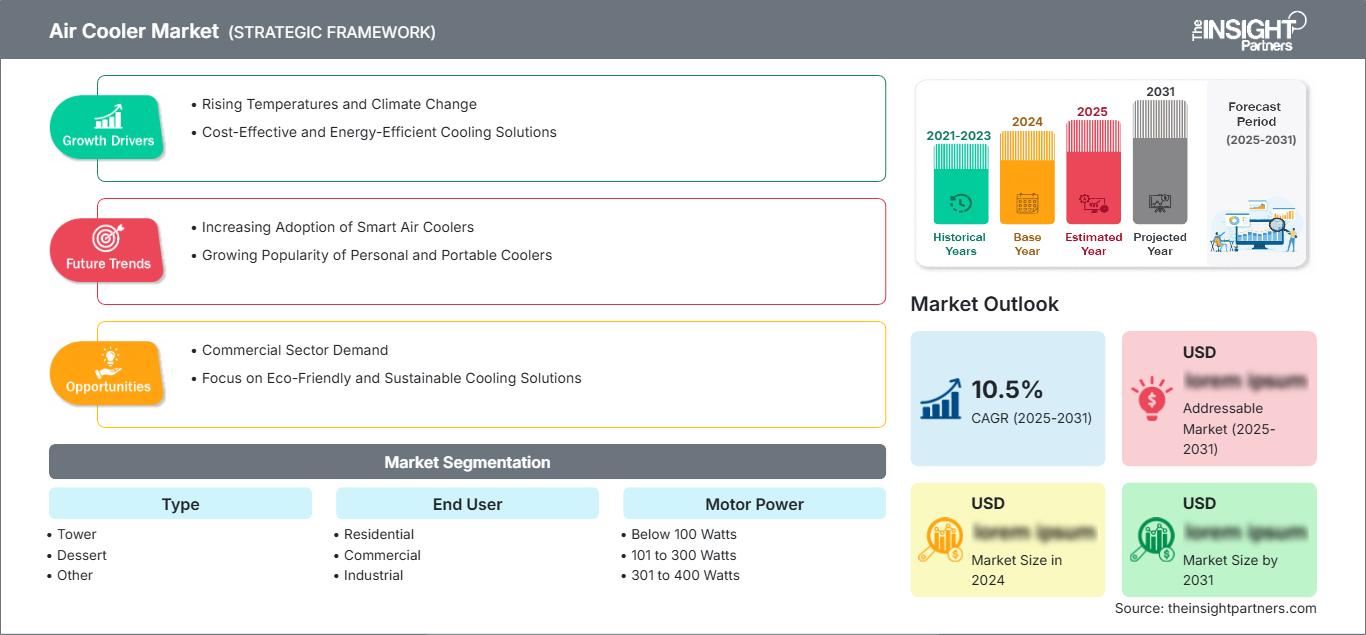
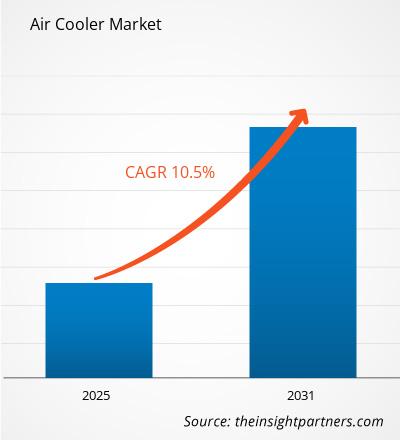
The Air Cooler Market is projected to grow from US$ 2.67 Billion in 2025 to US$ 6.14 Billion by 2034, registering a CAGR of 9.71% during 2026–2034. The demand is being driven by increased cooling requirements, affordability, ease of installation, and an increasing inclination towards electricity-efficient solutions rather than refrigerants-based solutions.
In North America, replacement demand and local cooling requirements are likely to drive the CAGR in the range of 7.2-8.1% up to 2034. The Air Cooler Market size in North America is affected by the warehouse ventilation, outdoor hospitality, garage cooling, and cost considerations in small-scale commercial establishments.
Air Cooler Market Assessment and Insights
- North America accounted for 18–21% share in 2025 and is expected to grow at a CAGR range of 7.2–8.1% during 2026–2034, supported by outdoor commercial use and low-energy cooling demand.
- US represented 72–76% of North America in 2025 and is projected to grow at 7.0–7.8% CAGR during 2026–2034, led by warehouses and patios.
- Europe held 14–17% share in 2025 and is expected to grow at 6.8–7.6% CAGR during 2026–2034, with Germany, the UK, France, Italy, and Spain leading adoption.
- Asia Pacific captured 45–49% share in 2025 and is projected to grow at 10.4–11.6% CAGR during 2026–2034, led by India and China, where affordability and heat exposure drive purchases.
- Largest Segment Residential held 58–62% market share in 2025 and is projected to grow at 8.8–9.7% CAGR during 2026–2034 as households prioritize economical cooling.
- High Growth Segment Commercial held 24–28% market share in 2025 and is projected to grow at 10.1–11.3% CAGR during 2026–2034 due to outdoor dining and retail cooling.
- Key companies analyzed in detail: Bajaj Electricals Limited, Daikin Industries, Ltd., Haier Smart Home Co., Ltd., Intex Technologies (India) Limited, Kenstar, LG Electronics Inc., Orient Electric Limited, Symphony Limited, Usha International Limited, Voltas Limited
Source: The Insight Partners' analysis based on proprietary research, government publications, company annual reports, investor presentations, industry databases, and expert interviews.
The future of product innovation will be the shift from simple evaporative boxes to the development of towers, inverters-friendly motors, anti-bacterial water tanks, digital controls, and greater air flow systems for semi-open spaces. Production will continue being localized in Asia, since high volumes allow competitive prices and seasonal stock management. Another positive influence on the Air Cooler Market is better distribution channels via e-commerce, modern retail and local dealers, which reduce the frequency of replacements.
The future market growth will come due to urban agglomerations, industrial regions, and heated commercial areas. Evaporative systems are supported by energy policies, building comfort policies, and high costs of electricity. Where there is enough water and humidity, there will be an increased demand for such systems.
Air Cooler Market Report Scope
| Report Attribute | Details |
|---|---|
| Market size in 2025 | US$ 2.67 Billion |
| Market Size by 2034 | US$ 6.14 Billion |
| Global CAGR (2026 - 2034) | 9.71% |
| Historical Data | 2021-2024 |
| Forecast period | 2026-2034 |
Air Cooler Market Analysis
Increasing exposure to heat, growing building area, and sensitivity of households towards power bills are some major demand pullers. As reported by the International Energy Agency, buildings consume about 30% of the total energy demand globally, while space cooling will increase in developing countries, which will help in growing Air Cooler Market provided that conditions permit.
The value chain consists of motor producers, makers of the molded body made of plastic, cooling pad providers, pump manufacturers, assembly facilities, distributors, and after-sales service providers. The supply chain is still seasonal, as stock needs to be accumulated before summers. It helps in the success of brands in synchronization with heat wave forecast and finance.
Competition is fragmented between regional competitors and appliances producers. Symphony Limited and Bajaj Electricals Limited deal with evaporative coolers. Voltas Limited, Orient Electric Limited, Usha International Limited, and Kenstar follow price strategy, distribution and durable product strategy. From Air Cooler Market Analysis, features have increasingly become dependent on the following: air flow rate, water tank capacity, portability, and hygiene.
Daikin Industries, Ltd., Haier Smart Home Co., Ltd., LG Electronics Inc., and Intex Technologies (India) Limited boost the overall appliances industry by setting the consumers' standards for connectivity and dependability of services. The investment is now moving towards higher-end tower models, industrial coolers, and exported products with affordability and savings in energy.
● REPORT CUSTOMIZATION
Tailor This Report To Align With Your Specific Business Requirements
This report can be customized to align precisely with your business objectives, scope, and target markets. Customization options include tailored segmentation, geography, competitive analysis, and strategic insights to support informed decision-making.
Customize This Report →WHAT YOU CAN ADJUST
- ● Segmentations
- ● Geography
- ● Competitive Analysis
- ● Language Preferences
Air Cooler Market: Strategic Insights
Regional Insights
North America Air Cooler Market
North America represented 18–21% of 2025 revenue and is expected to grow at a CAGR range of 7.2–8.1% during 2026–2034. The Air Cooler Market share is anchored in the US, where evaporative units are used in garages, patios, warehouses, workshops, and semi-open hospitality areas where full HVAC upgrades are costly.
There is greater demand in dryer western and southern areas, where the system works efficiently. The corporate consumers consider operating costs, portability and ventilation. Growth in the region is further facilitated by advice on managing heat stress, spending for recreation and cooling solutions of small business enterprises without refrigerant and difficult installations.
U.S. Air Cooler Market
In 2025, the US represented 72%–76% of the North American region and is expected to grow at a CAGR of 7.0%–7.8% during 2026–2034. Usage is limited to residential garage cooling, warehouse zones, outdoor restaurants, event venues, agriculture support zones, and workshops where flexible spot cooling is required instead of adding on to existing HVAC systems.
Activities of companies include global brand appliance makers, specialty evaporative coolers, and Indian appliance companies targeting the diaspora and online markets. The end-user buyers are focusing on airflow capacity, tank capacity, pump life, and warranties. Cooling-degree days are growing and there is need to ensure worker productivity in areas not air-conditioned.
Europe Air Cooler Market
The Europe region accounted for 14-17% market share in 2025 and will experience growth at a 6.8-7.6% CAGR from 2026 to 2034. Leading countries include Germany due to its industrial workshops, stores, and environmentally-aware homes. UK’s growth is attributed to home office cooling as well as summer shopping needs, whereas France, Italy, and Spain enjoy warmer summer months along with tourism-related outdoor cooling.
Regional focus on minimizing energy intensity in buildings favors non-refrigerant cooling equipment despite the humidity factor that prevents this type of equipment in some northern regions. Manufacturers promote the compact tower models for apartments and the airflow-oriented devices for commercial terraces. Growth is expected to be moderate, as there is competition from portable ACs and heat pumps in isolated buildings.
APAC Air Cooler Market
APAC holds a share of 45-49% in 2025 and will witness a growth rate of 10.4-11.6% CAGR between 2026-2034. Among these countries, India leads, followed by China, Japan, South Korea, and Australia. Efficient cooling policies, rapid urbanization, and high price sensitivities favor the widespread adoption of the technology.
The demand comes from industrial belts, small shops, schools, and households. Competition is due to the number of dealers, tank capacity, strong desert goods, and seasonal marketing campaigns. Strong local manufacturing power and consumer knowledge about evaporative cooling help APAC.
Middle East & Africa Air Cooler Market
The demand in Middle East and Africa region is anticipated to expand at a CAGR of 8.6-9.5% from 2026-2034. Demand in Saudi Arabia will be the highest, followed by UAE, South Africa, and Rest of MEA. Portables cooling is used in construction sites, storage facilities, mosques, outdoor places, and service establishments for providing relief from heat.
The usage of portables cooling is being driven by energy costs management, and expansion of infrastructure. The factors such as water availability, mineral composition in water, and maintenance practices are some of the important operational aspects, which are driving suppliers towards durable pumps, corrosion-resistant body, and clean cooling fluids.
Segmentation Analysis
Type
Type is projected to grow at 9.0–10.1% CAGR during 2026–2034 as consumers move between compact tower coolers and high-capacity desert models. The market scope covers space-constrained apartments, dry-climate households, retail stores, and industrial sheds requiring different airflow, tank, and mobility configurations.
- Tower models appeal to urban households and offices because they save floor space, offer better aesthetics, and increasingly include remote controls, digital panels, and quieter airflow delivery.
- Dessert coolers remain important in hot, dry locations where large tanks, strong air throw, and rugged bodies support extended use across homes, shops, and workshops.
End User
End User is expected to grow at 9.4–10.5% CAGR during 2026–2034, reflecting diversified demand across homes, commercial areas, and industrial workplaces. Residential buyers drive volume, commercial users add premium and seasonal rental demand, and industrial buyers prioritize worker comfort, ventilation, and low operating cost.
- Residential buyers dominate volume because air coolers remain affordable, easy to maintain, and suitable for bedrooms, living rooms, balconies, and small rental homes in warm climates.
- Commercial demand is scaling in restaurants, shops, gyms, event venues, and offices that need flexible spot cooling for customer comfort and seasonal operations.
- Industrial users adopt large airflow units for warehouses, workshops, assembly areas, and loading bays where ventilation, mobility, and lower electricity use support productivity.
Motor Power
Motor Power is projected to grow at 8.9–9.8% CAGR during 2026–2034 as buyers match motor capacity with room size, airflow distance, and operating duration. Efficient motors are becoming more important as electricity tariffs rise and consumers seek compatible operation with inverters or backup power.
- Below 1 Watts models address very small spaces and personal cooling needs, where portability, low power draw, and affordability matter more than air throw.
- 11 to 3 Watts models serve compact rooms and small offices, balancing limited electricity use with practical airflow for everyday summer comfort.
- 31 to 4 Watts models support larger rooms, shops, and semi-open spaces that require stronger fans, larger tanks, and longer operating cycles.
- Above 4 Watts models are important in commercial and industrial settings where high air delivery, durability, and sustained performance are strategic buying criteria.
Opportunity Snapshot
| Segment Name | Revenue Contribution | Trend Tag | Adoption Stage |
| Residential | High | Budget Cooling | Mature |
| Commercial | Medium | Outdoor Comfort | Scaling |
| Industrial | Medium | Workplace Cooling | Scaling |
Air Cooler Market Growth Drivers and Impact Analysis
Heat Exposure and Affordable Cooling Needs
More frequent heatwaves are increasing demand for accessible cooling in households and workplaces that cannot justify full air-conditioning installation. The World Meteorological Organization has reported persistent global temperature records, while the IEA links hotter summers to rising residential cooling demand. Air coolers answer this affordability gap because they require simpler installation, lower running power, and easier maintenance. The market impact is strongest in middle-income urban areas, small shops, and workshops where comfort directly affects occupancy, sales, and worker productivity.
Energy Efficiency and Refrigerant Avoidance
Electricity affordability is becoming a procurement factor for homes and businesses, especially during summer peaks. Evaporative air coolers use water evaporation rather than refrigerant compression, reducing dependence on refrigerants and supporting lower electricity consumption where climatic conditions are favorable. This driver strengthens the market because buyers can reduce operating cost without complex retrofits. The effect is visible in commercial terraces, warehouses, schools, and small factories, where managers need practical cooling that aligns with energy-efficiency objectives and budget discipline.
Product Innovation and Distribution Expansion
Manufacturers are improving cooling pads, airflow design, tank hygiene, mobility, and digital interfaces to shift demand beyond basic seasonal purchases. E-commerce platforms have expanded product visibility, while dealers remain important for demonstrations, repairs, and regional stock availability. These changes lower buyer hesitation and support repeat purchases. The market impact is a broader price ladder, from entry-level residential coolers to high-capacity commercial models, allowing companies to protect margins through features rather than only competing on discounting.
Air Cooler Market Future Trends
Smart and Sensor-Based Cooling
Connected controls, humidity sensing, auto-fill alerts, and app-based scheduling will define premium Air Cooler Market trends over the forecast period. The shift will be most visible in tower coolers and commercial units where users value convenience, remote monitoring, and energy tracking. Smart features can also help address performance concerns by guiding users on ventilation, water level, and operating mode. As component costs decline, mid-tier models are expected to adopt selective digital functions, improving perceived value without undermining affordability.
Commercial-Grade Portable Cooling Platforms
Future product pipelines are likely to include rugged portable platforms for logistics, hospitality, event management, agriculture, and light manufacturing. These models will emphasize high airflow, heavy-duty wheels, corrosion-resistant bodies, modular pads, and easier servicing. Buyers in semi-open environments need cooling assets that can move with operations rather than fixed systems. This trend creates room for leasing, seasonal rental, and service contracts, especially in markets with intense summers and expanding outdoor commercial activity.
Air Cooler Market Opportunities
Expansion in Tier-2 Cities and Heat-Stressed Districts
Tier-2 and tier-3 cities offer a strong route for Air Cooler Market Forecasts because households and small businesses often prioritize upfront affordability over centralized cooling. Manufacturers can localize tank sizes, body materials, and airflow ratings for regional climates, while distributors can combine seasonal financing with repair support. The opportunity is particularly attractive in India, Southeast Asia, the Middle East, and parts of Africa, where urban expansion and heat exposure are increasing faster than premium HVAC penetration.
B2B Cooling-as-a-Service Models
Commercial and industrial users can benefit from seasonal rental, maintenance bundles, and managed cooling services rather than outright equipment purchases. This model lowers capital expenditure for event venues, construction sites, warehouses, schools, and restaurants that need cooling only during peak heat periods. Suppliers gain recurring revenue and closer customer data on utilization, failures, and replacement timing. The approach also supports fleet standardization, spare-parts planning, and faster scaling in regions where summer demand is intense but seasonal.
Recent Developments
- March 2026: Kenstar launched a new air cooler campaign featuring Rajkummar Rao and Patralekha, promoting its India-first 5-Star BEE-rated air cooler range with a 5-year warranty, highlighting energy efficiency and superior cooling.
- July 2026: CoolCove announced the Cool Cove AC, a portable 2-in-1 air cooler that offers both cooling and heating functions, designed as a compact, energy-efficient climate control solution.
- March 2025: CG Power and Industrial Solutions entered the market by launching a new range featuring JetChill Technology, aimed at delivering faster cooling, optimized airflow, and improved energy efficiency as part of its consumer durables expansion.
Frequently Asked Questions

- Comprehensive Market Sizing and Forecast Analysis
- Detailed Segmentation Analysis
- In-Depth Market Dynamics Assessment
- Regional and Country-Level Insights
- Competitive Landscape and Company Benchmarking
- Strategic Business Intelligence
Recent Reports
Testimonials

The Insight Partners provided valuable market intelligence that supported our global go-to-market strategy. Their team was professional, responsive, and attentive to our feedback, providing thoughtful analysis and helpful methodological clarifications throughout the project.
Junmo Kim Chief Financial Officer (CFO), Enertech Co., Ltd.
The Insight Partners' SCADA System Market report is comprehensive, with valuable insights on current trends and future forecasts. The team was highly professional, responsive, and supportive throughout. We are very satisfied and highly recommend their services.
RAN KEDEM Partner, Reali Technologies LTDs
I requested a report on a very specific software market and the team produced the report in a few days. The information was very relevant and well presented. I then requested some changes and additions to the report. The team was again very responsive and I got the final report in less than a week.
JEAN-HERVE JENN Chairman, Future Analytica
We worked with The Insight Partners for an important market study and forecast. They gave us clear insights into opportunities and risks, which helped shape our plans. Their research was easy to use and based on solid data. It helped us make smart, confident decisions. We highly recommend them.
PIYUSH NAGPAL Sr. Vice President, High Beam Global
The Insight Partners delivered insightful, well-structured market research with strong domain expertise. Their team was professional and responsive throughout. The user-friendly website made accessing industry reports seamless. We highly recommend them for reliable, high-quality research services
YUKIHIKO ADACHI CEO, Deep Blue, LLC.
This is the first time I have purchased a market report from The Insight Partners.While I was unsure at first, I visited their web site and felt more comfortable to take the risk and purchase a market report.I am completely satisfied with the quality of the report and customer service. I had several questions and comments with the initial report, but after a couple of dialogs over email with their analyst I believe I have a report that I can use as input to our strategic planning process.Thank you so much for taking the extra time and making this a positive experience.I will definitely recommend your service to others and you will be my first call when we need further market data.
JOHN SUZUKI President and Chief Executive Officer, Board Director, BK Technologies
I wish to appreciate your support and the professionalism you displayed in the course of attending to my request for information regarding to infectious disease IVD market in Nigeria. I appreciate your patience, your guidance, and the fact that you were willing to offer a discount, which eventually made it possible for us to close a deal. I look forward to engaging The Insight Partners in the future, all thanks to the impression you have created in me as a result of this first encounter.
DR CHIJIOKE ONYIA MANAGING DIRECTOR, PineCrest Healthcare Ltd.Reason to Buy
- Informed Decision-Making
- Understanding Market Dynamics
- Competitive Analysis
- Identifying Emerging Markets
- Customer Insights
- Market Forecasts
- Risk Mitigation
- Boosting Operational Efficiency
- Strategic Planning
- Investment Justification
- Tracking Industry Innovations
- Aligning with Regulatory Trends





 Get Free Sample for