
Air Filtration Media Market Demand, Trends & Forecast by 2034
Coverage: by End-user (Industrial, Commercial, Residential); Application (HVAC, Air purifier, Face mask, APC, Industrial manufacturing, Transportation, Others); Media (Spunbond, Needlefelt, Wet laid, Melt blown, Others); Rating (MERV, HEPA, ULPA, Others) , and Geography (North America, Europe, Asia Pacific, and South and Central America)
- Status : Data Released
- Report Code : TIPRE00008393
- Category : Chemicals and Materials
- No. of Pages : 150
- Available Report Formats :


- Last update date : July 30, 2026


2025 Market Size
US$ 3.35 Bn
Base year value
2034 Forecast
US$ 4.38 Bn
Projected by 2034
CAGR 2026-2034
3.03 %
Growth rate
Addressable Market
US$ 35.11 Bn
(2026-2034)
The air filtration media market continues to hold an important position with regard to enhancing indoor air quality, industrial efficiency, and public health protection across residential, commercial, and industrial premises. The market was estimated to be worth US$ 3.35 Billion in 2025 and will reach up to US$ 4.38 Billion by 2034, exhibiting a compound annual growth rate of 3.03%. Increasing concerns regarding airborne contaminants and stringent emission norms are contributing to the growth of the market.
The air filtration media market size in North America is being boosted by strong indoor air quality norms, upgrades to HVAC systems in commercial establishments, and the replacement of old air filtration media in hospitals and industries. The market in North America is forecast to grow at a compound annual growth rate of 2.8%–3.2%. This growth can be attributed to the increased adoption of filtration media that are at HEPA standards and sustainable buildings across the United States and Canada.
Air Filtration Media Market Assessment and Insights
- North America: Accounted for 30–34% share in 2025 and is projected to expand at a CAGR of 2.8%–3.2% during 2026–2034. Strong regulatory oversight, widespread commercial HVAC retrofits, healthcare infrastructure investments, and established filtration manufacturers continue to sustain regional demand.
- U.S.: Represented 80–84% of the North American market in 2025 and is expected to register a CAGR of 2.9%–3.3% during 2026–2034, supported by commercial building renovations, semiconductor manufacturing investments, and stricter indoor air quality standards.
- Europe: Held 26–30% share in 2025 and is forecast to grow at a CAGR of 2.9%–3.3% during 2026–2034. Germany, France, the UK, and Italy remain leading markets owing to advanced manufacturing industries, environmental regulations, and increasing adoption of energy-efficient ventilation systems.
- Asia Pacific: Captured 33–37% share in 2025 and is anticipated to record the fastest regional CAGR of 3.7%–4.2% during 2026–2034. China, Japan, India, and South Korea continue expanding production capacities while industrialization and urban air quality initiatives stimulate sustained demand.
- Largest Segment: HVAC accounted for 38–42% market share in 2025 and is projected to register a CAGR of 3.0%–3.4% during 2026–2034, driven by replacement demand, green building certifications, and increasing deployment of centralized ventilation systems.
- High Growth Segment: HEPA is projected to witness the fastest expansion with a market share of 24–28% in 2025 and a CAGR of 4.2%–4.7% during 2026–2034, supported by healthcare facilities, pharmaceutical manufacturing, cleanrooms, and premium residential air purification systems.
- Key companies analyzed in detail: 3M Company, Ahlstrom Corporation, AIM Nonwovens and Interiors Private Limited, Air Filters, Inc., Cabot Corporation, Clean & Science Co., Ltd., Elta Group Limited, Hollingsworth & Vose Company, HVDS A/S, Lydall, Inc.
Source: The Insight Partners' analysis based on proprietary research, government publications, company annual reports, investor presentations, industry databases, and expert interviews.
The current developments in filtration technologies have been towards an advance in particulate capture filters to multi-layer filtration media that enhance filtration efficiency, at the same time minimizing flow resistance and energy costs. Developments in melt blown microfibers, nanofibers coating, electrostatic charging technologies, and eco-friendly filtration media from cellulose have further improved the performance of the product in HVACs, industrial dust collection applications, transportation and cleanrooms. Automation and digitalization in the manufacturing process of filtration media products are becoming common.
The future growth of the Air Filtration Media Market would be more dependent on investments in environmentally friendly filtration media, regional manufacturing operations and tightening environment protection regulations for air quality indoors and emissions in industries. The developing economies of South-East Asia, Middle East and Latin America are continuously building up their commercial infrastructure, healthcare establishments, electronics manufacturing plants and industries. This creates potential opportunities for filtration media suppliers in the coming years. Innovations in recycling of synthetic fibers and bio-based filtration media would further create competitive advantage and regulatory compliance in the forecast period.
Air Filtration Media Market Report Scope
| Report Attribute | Details |
|---|---|
| Market size in 2025 | US$ 3.35 Billion |
| Market Size by 2034 | US$ 4.38 Billion |
| Global CAGR (2026 - 2034) | 3.03% |
| Historical Data | 2021-2024 |
| Forecast period | 2026-2034 |
Air Filtration Media Market Analysis
Investments in healthy building construction, industrial emissions management, and modern manufacturing are continually driving the demand for air filtration media products in developed and developing economies. The increasing adoption of highly efficient HVAC systems, development in pharmaceutical, semiconductor, and food processing industries has driven the demand for such filtration media that can sustain high standards of air filtration. On the other hand, changing replacement schedules for commercial ventilation systems and increasing particulate emission controls have resulted in repeated demand for filtration media in both established and developing markets.
The value chain consists of raw material suppliers, non-woven media producers, filter converters, OEMs, distribution, and end-users in residential, commercial, and industrial segments. The key raw materials used in the process include polypropylene, polyester, glass fiber, cellulose, and synthetic materials for producing spun bond, melt blown, needle felt, and wet-laid media. The advancements in fiber engineering, binders, and manufacturing process are continually resulting in more efficient filtration with lower pressure drop and longer service life.
The dynamics of the air filtration media market report are marked by consistent innovation, regional production growth, and partnerships with HVAC equipment companies and industrial filtration systems suppliers. The companies such as 3M Company, Ahlstrom Corporation, Hollingsworth & Vose Company, Cabot Corporation, and Lydall, Inc. are diversifying their product portfolio by producing highly efficient nonwoven media, sustainable filtration materials, and innovative solutions for use in healthcare, transportation, and manufacturing industries. In addition, Asian manufacturers will be expanding their export operations to enhance their competitive edge.
Increasing capital expenditure will be geared towards raising production capacity of melt blown and nanofiber, automation of the production of nonwoven media, and production of recyclable filtration media. Manufacturers will be investing in research of bio-based fibers, PFAS-free solutions, and energy-efficient production technologies to comply with stricter environmental regulations. Strategic acquisition of companies, long-term supply contracts, and localization of manufacturing facilities will allow producers to be better prepared for an increase in regional demand for high-end filtration products.
● REPORT CUSTOMIZATION
Tailor This Report To Align With Your Specific Business Requirements
This report can be customized to align precisely with your business objectives, scope, and target markets. Customization options include tailored segmentation, geography, competitive analysis, and strategic insights to support informed decision-making.
Customize This Report →WHAT YOU CAN ADJUST
- ● Segmentations
- ● Geography
- ● Competitive Analysis
- ● Language Preferences
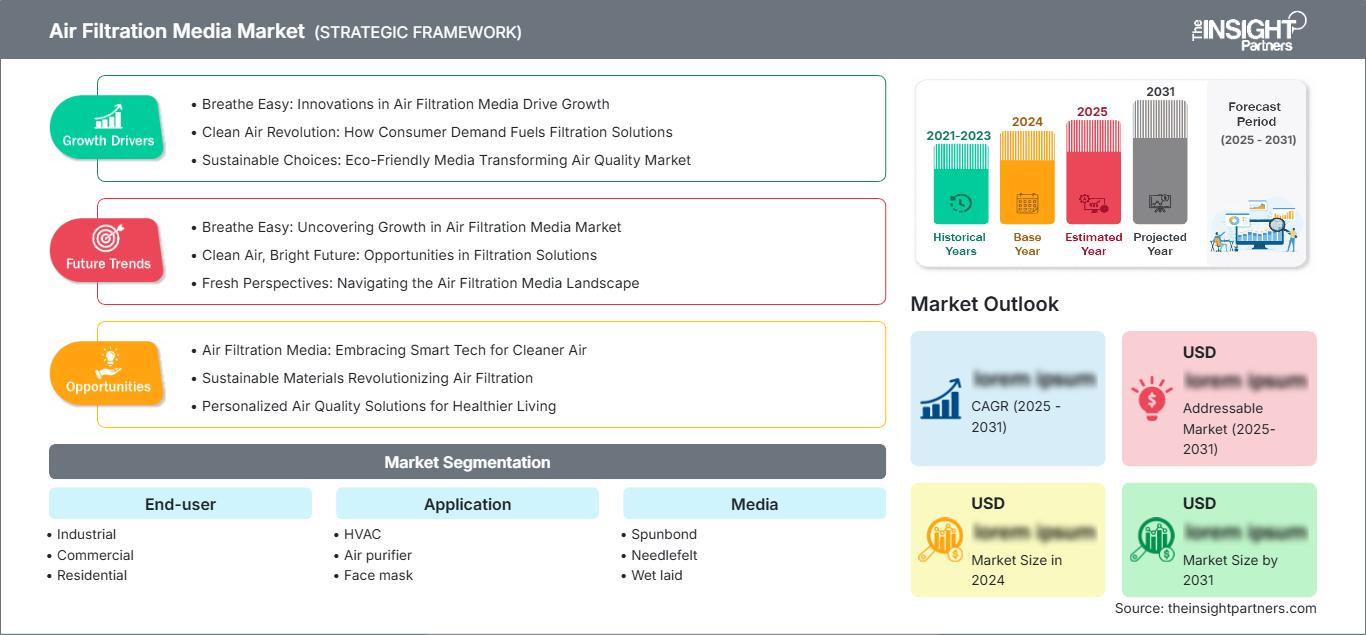
Air Filtration Media Market: Strategic Insights
Regional Insights
North America Air Filtration Media Market
North America accounted for 30–34% of the air filtration media market share in 2025 and is projected to expand at a CAGR of 2.8%–3.2% through 2034. Market growth is supported by strict indoor air quality regulations, replacement of aging HVAC infrastructure, and increasing investments in hospitals, laboratories, pharmaceutical manufacturing, and semiconductor fabrication facilities. Government initiatives promoting healthier indoor environments continue to encourage adoption of high-efficiency filtration media across commercial and institutional buildings.
The United States remains the dominant regional contributor, while Canada benefits from increasing construction of energy-efficient commercial buildings and modernization of healthcare infrastructure. Growing adoption of smart HVAC systems, combined with sustainability initiatives encouraging reduced energy consumption and improved filtration efficiency, continues to stimulate replacement demand for premium filtration media throughout the region.
U.S. Air Filtration Media Market
The United States represented 80–84% of the North American market in 2025 and is expected to register a CAGR of 2.9%–3.3% during the forecast period. Strong investments in pharmaceutical production, life sciences research facilities, data centers, and semiconductor manufacturing continue driving demand for high-performance filtration solutions. Increasing awareness regarding indoor environmental quality also supports replacement of conventional filtration systems across commercial and institutional buildings.
Major manufacturers maintain extensive production, research, and distribution networks throughout the country, ensuring consistent supply of advanced filtration materials. Demand is particularly strong across healthcare facilities, cleanrooms, industrial manufacturing plants, airports, and educational institutions where stringent particulate control and operational efficiency remain essential priorities. Rising adoption of high-efficiency HVAC retrofits further strengthens long-term market prospects.
Europe Air Filtration Media Market
Europe had a share of 26-30% of the world market in 2025 and is projected to grow at a CAGR of 2.9-3.3% during 2034. Germany will dominate the regional market due to strong automobile, pharmaceutical, industrial production, and engineering industries needing highly developed air filtration techniques. The presence of strict environmental norms encouraging installation of efficient energy ventilation systems in commercial and industrial establishments is also favorable for the country.
The UK maintains stable demand in the region driven by the improvement of the healthcare industry, commercial construction, and sustainable construction practices. France, Italy, and Spain have been reporting an increasing use of high-performing filtration media in food processing, pharmaceutical industry, transportation industry, and public infrastructure construction. Increasing air quality regulations and renovation activities are likely to support regional market growth during the forecast period.
APAC Air Filtration Media Market
Asia Pacific held 33–37% share of the global market in 2025 and is expected to exhibit the highest CAGR of 3.7%–4.2% over the period of 2026–2034. China leads as the largest producer and consumer of filtration systems owing to its vast manufacturing industry whereas India shows rising demand due to commercial construction, healthcare, and industrial growth.
The markets of Japan and South Korea show constant demand due to the advanced electronics, semiconductor manufacturing, and precision engineering industries, which require cleanroom filters. The rising investments in healthcare facilities and commercial buildings in Australia are contributing towards market growth in the region.
Middle East & Africa Air Filtration Media Market
The Middle East & Africa market is expected to register a CAGR of 3.4%–3.8% through 2034. Saudi Arabia leads regional demand owing to ongoing industrial diversification, large-scale infrastructure development, and investments in manufacturing under Vision 2030. The UAE continues expanding healthcare, hospitality, and commercial real estate projects requiring modern HVAC filtration systems.
South Africa remains an important market supported by mining, industrial processing, and commercial building upgrades. The Rest of Middle East & Africa is gradually adopting advanced filtration technologies as governments strengthen environmental regulations and invest in transportation, public infrastructure, and industrial facilities that require efficient air quality management.
Segmentation Analysis
Rating
The Rating segment in the Air Filtration Media Market is projected to grow at a CAGR of 3.1%–3.5% during 2026–2034. The air filtration media market scope continues expanding as end users increasingly specify filtration efficiency based on regulatory requirements, indoor air quality standards, and application-specific performance criteria. Growing deployment of premium filtration systems across healthcare facilities, laboratories, commercial buildings, and industrial manufacturing supports sustained demand for higher-rated filtration media.
- MERV: Widely used in commercial buildings and residential HVAC systems due to its balance between filtration efficiency, airflow performance, and operating cost. It remains the preferred choice for routine indoor air quality management.
- HEPA: Demand continues increasing across hospitals, pharmaceutical facilities, cleanrooms, and premium residential air purifiers where extremely high particulate removal efficiency and regulatory compliance are essential operational requirements.
- ULPA: Primarily adopted within semiconductor manufacturing, biotechnology laboratories, aerospace facilities, and advanced electronics production where ultra-clean environments require removal of extremely fine airborne particles.
Media
The Media segment in the Air Filtration Media Market is anticipated to register a CAGR of 3.0%–3.4% through the forecast period. Continuous innovation in fiber engineering, nonwoven manufacturing technologies, and sustainable raw materials is improving filtration efficiency, durability, airflow characteristics, and operational lifespan. Manufacturers increasingly optimize media selection according to dust loading capacity, moisture resistance, thermal stability, and specific industrial operating environments.
- Spunbond: Offers excellent mechanical strength, dimensional stability, and durability, making it suitable for HVAC filters, industrial ventilation, and pre-filtration applications requiring long operational life.
- Needlefelt: Preferred in industrial dust collection systems because of its high dust-holding capacity, abrasion resistance, and ability to perform under demanding operating conditions involving elevated temperatures and heavy particulate loads.
- Wet laid: Delivers uniform fiber distribution and high filtration efficiency, making it appropriate for premium HVAC filters, automotive filtration, and specialty industrial air purification applications.
- Melt blown: Features ultrafine fibers capable of capturing microscopic particles while maintaining relatively low airflow resistance, supporting widespread use in HEPA filters, respirators, face masks, and high-efficiency air purification systems.
Application
The Application segment in the Air Filtration Media Market is forecast to expand at a CAGR of 3.2%–3.6% between 2026 and 2034. Rising investments in clean air infrastructure, industrial emission control, healthcare expansion, and transportation modernization continue diversifying application demand across multiple end-use industries. Product innovation increasingly focuses on delivering higher filtration performance while minimizing pressure drop and maintenance requirements.
- HVAC: Represents the largest application owing to extensive deployment across commercial offices, hospitals, educational institutions, airports, retail complexes, and residential buildings requiring continuous indoor air quality management.
- Air purifier: Growth is supported by increasing consumer awareness regarding airborne pollutants, allergens, and infectious particles, particularly in densely populated urban environments.
- Face mask: Maintains stable demand from healthcare services, occupational safety applications, and emergency preparedness programs requiring high-performance filtration materials.
- APC: Air pollution control systems rely on specialized filtration media to reduce industrial emissions and comply with increasingly stringent environmental regulations across manufacturing industries.
- Industrial manufacturing: Manufacturing facilities require advanced filtration media to protect sensitive production processes, equipment reliability, and employee health while maintaining regulatory compliance.
- Transportation: Automotive, rail, marine, and aerospace sectors increasingly adopt high-efficiency filtration media to improve cabin air quality, equipment protection, and passenger comfort.
End-user
The End-user segment in the Air Filtration Media Market is projected to grow at a CAGR of 3.0%–3.3% during 2026–2034. Demand patterns vary according to operational requirements, regulatory compliance, and indoor air quality objectives. Industrial facilities emphasize process reliability and emission control, while commercial and residential users increasingly prioritize occupant health, energy efficiency, and sustainable building operation. Growing investment in smart buildings and advanced ventilation technologies is expected to strengthen adoption across all end-user categories throughout the forecast period.
- Industrial: Accounts for the largest demand owing to widespread use in manufacturing plants, power generation, pharmaceuticals, food processing, chemicals, electronics, and metal processing facilities where process protection and emission compliance are critical.
- Commercial: Increasing construction of office buildings, healthcare facilities, hotels, airports, educational institutions, and shopping centers continues driving demand for high-performance HVAC filtration systems that improve indoor environmental quality and reduce operating costs.
- Residential: Rising awareness regarding allergens, fine particulate matter, and airborne pathogens is encouraging homeowners to adopt advanced HVAC filters and standalone air purification systems, particularly in urban areas with deteriorating outdoor air quality.
Opportunity Snapshot
| End-user | Revenue Contribution | Trend Tag | Adoption Stage |
| Industrial | High | Clean Manufacturing | Mature |
| Commercial | High | Smart Buildings | Scaling |
| Residential | Medium | Indoor Wellness | Emerging |
Air Filtration Media Market Growth Drivers and Impact Analysis
Stringent indoor air quality and emission regulations
There is an ongoing trend of the establishment of stricter criteria for indoor air quality and emissions from industry, which stimulates the introduction of more effective filtration media for use in commercial, industrial, medical and other types of structures. Standards set by bodies like ASHRAE, ISO, and environmental protection agencies are still having an effect on filtration criteria within various industries. The rise of enforcement of workplace safety standards and green building programs has led to a faster substitution of conventional filters with more advanced ones, which can improve their performance without compromising energy efficiency.
Expansion of healthcare, pharmaceutical, and semiconductor industries
The development of healthcare infrastructure along with investments in drug manufacturing, biotech research, and semiconductor fabrication facilities has been creating steady demand for efficient filter media. In such industries, there is a need for tight control of contamination in order to ensure product quality and comply with regulations. More and more cleanrooms use HEPA and ULPA filters that are capable of capturing ultrafine aerosol particles. Further hospital construction, labs, vaccine production facilities, and semiconductor fabrication plants in North America and the Asia Pacific region should foster market growth while prompting manufacturers to design specialized filtration media.
Growing adoption of energy-efficient HVAC systems
Increasingly, owners of commercial buildings have been focusing on HVAC systems which ensure good air quality in their premises without substantially increasing the cost of running them. The modern filtration media with synthetic fibers, better airflow properties, and reduced pressure drop assist in reducing the consumption of energy by such systems without sacrificing their effectiveness. Renovation works, smart building movements, and more rigorous standards for energy efficiency are all factors pushing towards the replacement of old filtration systems at offices, hospitals, educational institutes, shopping complexes, and hospitality businesses.
Air Filtration Media Market Future Trends
Increasing adoption of sustainable and recyclable filtration media
Growing environmental awareness and circular economy initiatives are reshaping air filtration media market trends as manufacturers increasingly develop recyclable, bio-based, and low-carbon filtration materials. Research into cellulose blends, recyclable synthetic fibers, PFAS-free treatments, and reusable filter structures is accelerating to meet evolving environmental regulations and customer sustainability targets. Commercial building owners and industrial operators are also prioritizing filtration products with longer service life and lower lifecycle emissions. As sustainability becomes an important procurement criterion, manufacturers investing in environmentally responsible production technologies and recyclable filtration solutions are expected to strengthen their competitive positioning while addressing increasingly stringent global environmental requirements.
Integration of smart filtration with connected building systems
The trend of digitalization is revolutionizing filtration systems management by means of employing smart sensors, predictive maintenance programs, and connected HVAC systems. Nowadays, more and more filtration systems include measuring airflow, pressure loss, dust content, and filter lifespan in real time, thus enabling facility managers to arrange maintenance activities in an optimized manner and save on operating expenses. It is also expected that IIoT proliferation in commercial, healthcare, manufacturing, and transportation infrastructures will lead to an increase in the need for advanced filtration media compatible with smart monitoring systems.
Air Filtration Media Market Opportunities
Expansion of filtration manufacturing in emerging economies
Rapid industrialization across Southeast Asia, the Middle East, Latin America, and parts of Africa is creating favorable investment opportunities for filtration media manufacturers. Air filtration media market Forecasts indicate sustained demand from expanding healthcare infrastructure, industrial manufacturing, electronics production, commercial construction, and transportation projects. Companies establishing localized production facilities can reduce logistics costs, improve supply chain resilience, and better serve regional customers. Strategic partnerships with HVAC equipment manufacturers, industrial filter producers, and government infrastructure projects are expected to enhance market penetration while supporting long-term revenue growth in developing economies.
Development of high-performance media for advanced industrial applications
With more investments being made in the manufacturing of semiconductors, batteries, biotech, aerospace, and precision engineering, there is a growing need for specialized filtration media that can provide high particulate removal performance. This provides manufacturers with an opportunity to manufacture highly innovative nanofiber, multilayer, and composite filtration media that provide high efficiency together with low pressure drop and increased durability. The growing trend towards clean manufacturing processes and the need for more stringent contamination controls encourage ongoing product innovations. Manufacturers involved in R&D and specialized product designs are in a better position to capitalize on premium markets.
Recent Developments
- May 26, 2026: Ahlstrom Corporation launched a new generation of glass microfiber media for HVAC filtration designed without intentionally added PFAS. The new filtration media delivers up to 20% lower initial pressure drop, improved pressure build-up, and longer filter lifetime while meeting ISO 16890 ePM1 efficiency requirements for residential, commercial, and industrial HVAC applications. This development strengthens Ahlstrom's sustainable air filtration media portfolio.
- April 28, 2026: Adsorbi AB launched Arbomax, a cellulose-based air filter media designed for recirculating airflow systems, including HVAC units and air purifiers. Engineered to remove gaseous pollutants such as aldehydes, ammonia, sulfur dioxide, and organic acids, the new media offers high adsorption capacity, longer filter service life, and a lower carbon footprint than conventional activated carbon solutions.
Frequently Asked Questions

- Comprehensive Market Sizing and Forecast Analysis
- Detailed Segmentation Analysis
- In-Depth Market Dynamics Assessment
- Regional and Country-Level Insights
- Competitive Landscape and Company Benchmarking
- Strategic Business Intelligence
Recent Reports
Testimonials

The Insight Partners' SCADA System Market report is comprehensive, with valuable insights on current trends and future forecasts. The team was highly professional, responsive, and supportive throughout. We are very satisfied and highly recommend their services.
RAN KEDEM Partner, Reali Technologies LTDs
I requested a report on a very specific software market and the team produced the report in a few days. The information was very relevant and well presented. I then requested some changes and additions to the report. The team was again very responsive and I got the final report in less than a week.
JEAN-HERVE JENN Chairman, Future Analytica
We worked with The Insight Partners for an important market study and forecast. They gave us clear insights into opportunities and risks, which helped shape our plans. Their research was easy to use and based on solid data. It helped us make smart, confident decisions. We highly recommend them.
PIYUSH NAGPAL Sr. Vice President, High Beam Global
The Insight Partners delivered insightful, well-structured market research with strong domain expertise. Their team was professional and responsive throughout. The user-friendly website made accessing industry reports seamless. We highly recommend them for reliable, high-quality research services
YUKIHIKO ADACHI CEO, Deep Blue, LLC.
This is the first time I have purchased a market report from The Insight Partners.While I was unsure at first, I visited their web site and felt more comfortable to take the risk and purchase a market report.I am completely satisfied with the quality of the report and customer service. I had several questions and comments with the initial report, but after a couple of dialogs over email with their analyst I believe I have a report that I can use as input to our strategic planning process.Thank you so much for taking the extra time and making this a positive experience.I will definitely recommend your service to others and you will be my first call when we need further market data.
JOHN SUZUKI President and Chief Executive Officer, Board Director, BK Technologies
I wish to appreciate your support and the professionalism you displayed in the course of attending to my request for information regarding to infectious disease IVD market in Nigeria. I appreciate your patience, your guidance, and the fact that you were willing to offer a discount, which eventually made it possible for us to close a deal. I look forward to engaging The Insight Partners in the future, all thanks to the impression you have created in me as a result of this first encounter.
DR CHIJIOKE ONYIA MANAGING DIRECTOR, PineCrest Healthcare Ltd.Reason to Buy
- Informed Decision-Making
- Understanding Market Dynamics
- Competitive Analysis
- Identifying Emerging Markets
- Customer Insights
- Market Forecasts
- Risk Mitigation
- Boosting Operational Efficiency
- Strategic Planning
- Investment Justification
- Tracking Industry Innovations
- Aligning with Regulatory Trends





 Get Free Sample for