
Air Purification Systems Market Size, Growth & Trends by 2034
Coverage: by Product (Fume and Smoke Collectors, Dust Collectors, Vehicle Exhaust, Mist Eliminators, Emergency Exhaust, Others); Technology (Activated Carbon, Ionic Filters, HEPA, Electrostatic Precipitators, Others); Industry Vertical (Manufacturing, Automotive, Energy and Utility, Construction, Healthcare and Medical, Others) , and Geography (North America, Europe, Asia Pacific, and South and Central America)
- Status : Data Released
- Report Code : TIPRE00009010
- Category : Electronics and Semiconductor
- No. of Pages : 150
- Available Report Formats :


- Last update date : July 17, 2026


2025 Market Size
US$ 25.84 Bn
Base year value
2034 Forecast
US$ 42.28 Bn
Projected by 2034
CAGR 2026-2034
5.63 %
Growth rate
Addressable Market
US$ 308.89 Bn
(2026-2034)
Air Purification Systems Market was valued at US$ 25.84 Billion in 2025 and is projected to reach US$ 42.28 Billion by 2034, advancing at a CAGR of 5.63% from 2026 to 2034. Demand is supported by industrial emission control, indoor air quality priorities, workplace safety compliance, healthcare hygiene needs, and adoption of HEPA, activated carbon, ionic filtration, and electrostatic technologies across complex built and process environments.
Across North America, the Air Purification Systems Market size is supported by retrofit demand in factories, hospitals, schools, and commercial buildings. The region is expected to grow at a 5.1%–5.7% CAGR during 2026–2034, helped by wildfire-smoke preparedness, OSHA-linked exposure controls, healthcare ventilation upgrades, and investment in monitored filtration systems that improve air safety without sharply increasing energy consumption.
Air Purification Systems Market Assessment and Insights
- North America: The region accounted for 32%–36% share in 2025 and is growing at a CAGR of 5.1%–5.7% between 2026–2034, supported by industrial retrofits, healthcare modernization, wildfire response planning, and stricter indoor air expectations.
- US: The country represented 76%–82% of North America in 2025 and is expanding at 5.2%–5.8% between 2026–2034 through manufacturing ventilation upgrades and healthcare air safety spending.
- Europe: Europe held 25%–30% share in 2025 and is growing at 5.0%–5.6% between 2026–2034, with Germany, the UK, and France leading through industrial safety, healthcare estates, and public-building efficiency upgrades.
- Asia Pacific: APAC captured 28%–34% share in 2025 and is advancing at 6.2%–6.9% between 2026–2034, led by China, Japan, South Korea, and India across manufacturing, healthcare, and urban pollution control.
- Largest Segment: Dust Collectors held 27%–31% air purification systems market share in 2025 and is growing at 5.4%–6.0% between 2026–2034 due to particulate control needs in manufacturing and construction.
- High Growth Segment: HEPA held 18%–22% market share in 2025 and is growing at 6.5%–7.2% between 2026–2034, driven by healthcare, clean commercial buildings, and smoke filtration needs.
- Key companies analyzed in detail: 3M Company, Air Products and Chemicals, Inc., Alfa Laval AB, Daikin Industries, Ltd., Honeywell International Inc., Koninklijke Philips N.V., MANN+HUMMEL International GmbH & Co. KG, Parker-Hannifin Corporation, Sharp Corporation, SPX Technologies, Inc.
Source: The Insight Partners' analysis based on proprietary research, government publications, company annual reports, investor presentations, industry databases, and expert interviews.
The market has moved from the collector level to the air quality system level at facilities, health care facilities, transport facilities, energy facilities, and public facilities. Clients assess the configuration of collection, filter media for different pollutants, pressure loss, accessibility, and performance of the system. According to WHO, 99% of people across the globe live in regions where air quality exceeds the guideline limits.
Future demand will be driven by industrialization, health facility preparedness, wildfire smoke preparedness, and greater expectations of building preparedness. EPA guidelines on how to minimize exposure to smoke in commercial and public buildings and the ASHRAE Standard 241 for controlling infectious aerosols increase the need for validated filtration. Up-and-coming markets will provide volume growth opportunities, while established markets will provide retrofit value.
Air Purification Systems Market Report Scope
| Report Attribute | Details |
|---|---|
| Market size in 2025 | US$ 25.84 Billion |
| Market Size by 2034 | US$ 42.28 Billion |
| Global CAGR (2026 - 2034) | 5.63% |
| Historical Data | 2021-2024 |
| Forecast period | 2026-2034 |
Air Purification Systems Market Analysis
The Air Purification Systems market is influenced by increasing demand for the containment of particulates, fumes, smoke, oil mist, VOCs, and exhaust gases before causing harm to humans, processes, or equipment. Manufacturers have needs for dust and fume collection systems; auto makers require exhaust removal solutions; healthcare facilities prefer HEPA air purification systems; and energy companies use mist and emergency exhaust systems.
Value chain components are made up of suppliers of filter media, fan and motor manufacturers, duct work contractors, control systems firms, air quality sensors manufacturers, system integration partners, maintenance service providers, and compliance-oriented customers. Supply chain dynamics favor those vendors who are able to integrate capture mechanism, filtration technology, airflow balancing, monitoring and after-market services, as facility owners seek to prove performance throughout the lifecycle of their purchases.
The Air Purification Systems Market report indicates competitive interactions among various industrial conglomerates, HVAC vendors, filtration firms, and consumer air quality vendors. The major players are Honeywell International Inc., 3M Company, Parker-Hannifin Corporation, MANN+HUMMEL International GmbH & Co. KG, Alfa Laval AB, and SPX Technologies, Inc. in the engineered segment, whereas Daikin Industries, Ltd., Sharp Corporation, and Koninklijke Philips N.V. are prominent in commercial and indoor segments.
Capital is being invested into energy-efficient filtration, automated filter monitoring, small size modular collectors, corrosion-proof mist eliminators, and control system interfaced platforms. The strategic positioning in the market is now dependent on reducing the uncertainties related to compliance and maintenance along with reducing total lifecycle costs.
● REPORT CUSTOMIZATION
Tailor This Report To Align With Your Specific Business Requirements
This report can be customized to align precisely with your business objectives, scope, and target markets. Customization options include tailored segmentation, geography, competitive analysis, and strategic insights to support informed decision-making.
Customize This Report →WHAT YOU CAN ADJUST
- ● Segmentations
- ● Geography
- ● Competitive Analysis
- ● Language Preferences
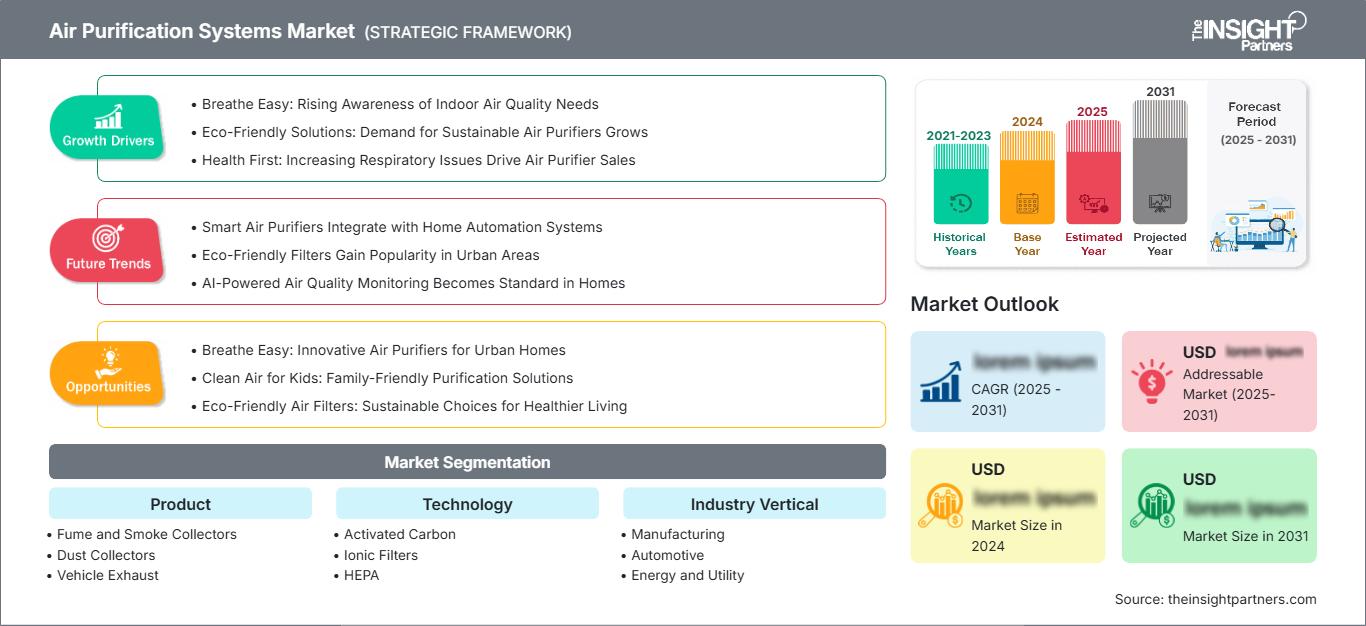
Air Purification Systems Market: Strategic Insights
Regional Insights
North America Air Purification Systems Market
North America accounted for 32%–36% share in 2025 and is expected to expand at 5.1%–5.7% during 2026–2034. Demand is supported by manufacturing ventilation upgrades, healthcare air safety, wildfire-smoke preparedness, and stronger building-readiness planning. EPA guidance on commercial buildings during wildland fire smoke events has raised awareness of filtration, pressurization, and cleaner air spaces.
The regional Air Purification Systems Market share is concentrated in high-value replacement projects where buyers prioritize reliability, energy use, filter availability, and documented contaminant control. Automotive, electronics, metal fabrication, healthcare, schools, and logistics facilities drive adoption. 3M Company, Honeywell International Inc., Parker-Hannifin Corporation, and MANN+HUMMEL International GmbH & Co. KG benefit from technical credibility and service networks.
U.S. Air Purification Systems Market
In 2025, the United States was responsible for 76% to 82% of North America's demand and is expected to record a growth rate of 5.2% to 5.8% by 2034. Reshoring of industrial processes, management of fume from welding operations, exhaust ventilation in car services, improvements in healthcare facilities, and renovation of school indoor air ensure purchasing.
Examples of companies working in this industry are 3M Company, Honeywell International Inc., Parker-Hannifin Corporation, MANN+HUMMEL International GmbH & Co. KG, Daikin Industries, Ltd., and SPX Technologies, Inc. Some of the uses are dust collection from industrial operations, HEPA filters for clinical applications, odor/VOC removal through activated carbon, and portable devices for indoor air quality improvement.
Europe Air Purification Systems Market
Europe was at 25%-30% market share in 2025 and anticipated to be growing at 5.0%-5.6% between 2026-2034. Germany dominates the country landscape due to automotive manufacture, chemical industry, metalworking industries, pharmaceuticals and health care estates driving the need for certified filtration. Energy efficiency, noise reduction, compliance documentation and ability to help industries to achieve decarbonization without compromising exposure control remains a key consideration among buyers.
The UK has demand arising from healthcare estates, laboratories, schools, commercial renovation projects and light industrial ventilation projects. The demand includes HEPA filtration, activated carbon odor control and fixed or portable filtration to enhance air quality in inhabited structures. Air cleaning in facilities is increasingly being tied to resilience and maintenance.
France, Italy and Spain contribute to the demand via pharmaceuticals, food processing, construction dust control, transport workshops and hospitality related IAQ improvements. The France demand is driven by improved air quality in public buildings, Italy has process specific industrial collectors while Spain benefits from construction, tourism infrastructures and health care estate improvements.
APAC Air Purification Systems Market
APAC had a share of 28%-34% in 2025 and is expected to register a CAGR of 6.2%-6.9% during 2034. China leads as the primary country owing to extensive manufacturing, electronics, automobiles manufacturing units, urban pollution, and public spending on healthy indoor spaces. Japan and South Korea prefer compact, efficient, and silent systems.
The involvement of India and Australia is through construction, health care industry, mining facilities, offices and exposure to particulate matter. In India, the growth is linked with manufacturing industries and hospitals while Australia’s interest is bushfire smoke protection and healthy office environment. Key players in this area are Daikin Industries, Ltd., Sharp Corporation, Koninklijke Philips N.V. and Honeywell International Inc.
Middle East & Africa Air Purification Systems Market
Middle East & Africa region is expected to expand in the range of 5.4%–6.1% in the forecast period of 2026–2034 with Saudi Arabia emerging as the dominant nation. Demand will be driven by applications like construction dust removal, oil and gas production units, workshops, hospital applications, airports, and commercial facilities where air filtration is important.
Saudi Arabia and the UAE are undertaking investments in infrastructure, healthcare, hotels, and industrial diversification initiatives that need powerful air handling systems. Selective demand exists in South Africa and the remainder of the MEA region from industries like mining, manufacturing, hospitals, food processing, and public sector infrastructure projects.
Segmentation Analysis
Product
The Product segment is projected to expand at 5.2%–5.9% during 2026–2034, supported by process-specific collection requirements, replacement of aging ventilation assets, and broader use of engineered capture systems. The Air Purification Systems Market scope spans particulate, smoke, fume, mist, and emergency exhaust management, making product selection increasingly tied to contaminant loading, airflow stability, service access, and audit documentation.
- Fume and Smoke Collectors: These systems are critical in welding, cutting, soldering, and thermal processing environments where fine particulates and gases require localized capture and dependable worker exposure control.
- Dust Collectors: Dust collectors lead adoption across manufacturing, construction, woodworking, food processing, and metals operations because they manage combustible dust, airborne particulate loading, housekeeping risk, and regulatory compliance.
- Vehicle Exhaust: Vehicle exhaust systems serve repair shops, logistics depots, transit garages, fire stations, and manufacturing lines where tailpipe emissions must be captured before accumulating in occupied work areas.
- Mist Eliminators: Mist eliminators are used in machining, metalworking, chemical processing, and energy facilities to remove oil mist, coolant aerosols, and liquid droplets affecting air quality.
- Emergency Exhaust: Emergency exhaust systems support laboratories, healthcare spaces, battery rooms, industrial plants, and hazardous storage areas where rapid contaminant removal is needed during abnormal releases.
Technology
The Technology segment is expected to grow at 5.8%–6.5% from 2026 to 2034 as buyers combine HEPA, activated carbon, ionic, and electrostatic methods to address particulate, gaseous, and mixed contaminant loads. Selection increasingly depends on filtration efficiency, by-product safety, pressure drop, sensor integration, and validation against specific operating conditions rather than broad purification claims.
- Activated Carbon: Activated carbon systems target odors, VOCs, chemical vapors, and gaseous contaminants, making them valuable in healthcare, laboratories, commercial buildings, automotive facilities, and solvent environments.
- Ionic Filters: Ionic filters appeal in compact and room-level purification systems where charged particles help remove fine airborne contaminants, though adoption depends on safety perception and suitability.
- HEPA: HEPA filtration is central to healthcare, laboratories, clean commercial spaces, and sensitive industrial environments because it captures fine particles and supports measurable indoor air quality improvement.
- Electrostatic Precipitators: Electrostatic precipitators serve industrial and high-volume air streams where charged collection plates remove smoke, fine particles, oil mist, and process emissions with reusable surfaces.
Industry Vertical
The Industry Vertical segment is forecast to rise at 5.5%–6.2% during 2026–2034, with manufacturing contributing the strongest demand and healthcare showing rapid adoption of high-efficiency purification. Demand is shaped by exposure control, production continuity, public-building resilience, and the need for maintainable systems that do not disrupt facility operations.
- Manufacturing: Manufacturing generates the largest opportunity because welding, machining, cutting, coating, packaging, and material handling produce particulate, fumes, mist, and odors requiring engineered systems.
- Automotive: Automotive demand spans assembly plants, repair workshops, paint shops, testing facilities, and service depots where exhaust extraction, fume control, dust capture, and VOC management matter.
- Energy and Utility: Energy and utility sites require mist eliminators, emergency exhaust, corrosion-resistant filtration, and contaminant control systems for power generation, oil and gas, and maintenance operations.
- Construction: Construction applications involve dust suppression, temporary filtration, equipment exhaust control, and worker protection across demolition, concrete cutting, tunneling, renovation, and infrastructure projects.
- Healthcare and Medical: Healthcare and medical facilities adopt HEPA, activated carbon, and specialized purification systems to support infection-control workflows, odor control, laboratories, and clean treatment environments.
Opportunity Snapshot
| Industry Vertical | Revenue Contribution | Trend Tag | Adoption Stage |
| Manufacturing | High | Fume Control | Mature |
| Automotive | Medium | Exhaust Capture | Scaling |
| Energy and Utility | Medium | Mist Removal | Scaling |
| Construction | Low | Dust Safety | Emerging |
| Healthcare and Medical | Medium | HEPA Upgrade | Scaling |
Air Purification Systems Market Growth Drivers and Impact Analysis
Industrial Exposure Control Moves From Compliance to Productivity
Industrial exposure control becomes another crucial driver because an increasing number of industries start considering clean air as a metric of performance and not just a compliance requirement. Problematic processes include welding, grinding, machining, coating, batteries production, chemicals handling, and materials processing. Processes create emissions of fumes, smoke, dust, mist, and vapor that may impact worker health, product quality, machine longevity, and even insurance. Impact on the market will be in the clearer definition of sizing for dust collectors, fume and smoke collectors, mist eliminators, and emergency ventilation systems depending on processes rather than ventilation requirements. Better documentation, easy filter changing and monitoring become customer demands.
Indoor Air Quality Becomes a Strategic Facility Metric
Indoor air quality has emerged as an important metric in healthcare facilities, offices, schools, retail outlets, and other public buildings. Owners of the facilities have taken steps to meet the demands of their occupants, take care of health issues related to respiration, prepare against the smoke from wildfires, counter city pollution, and address hygiene needs by improving the purification ability of the systems. HEPA, activated carbon, ionic, and hybrid systems are considered based on the nature of contaminants instead of buying the systems to create a comfortable environment. There is increased need for portable, room-based, ducted, and central systems that can be used at the locations where there is high risk of exposure.
Energy-Efficient Filtration Reduces Lifecycle Cost Pressure
Energy-efficient filtration is becoming more important due to the fact that the purification equipment is operated constantly in those facilities where the fan power, pressure drop, and filter exchange cycle play an important role in terms of operation costs. Consumers not only analyze the efficiency of capture when purchasing the system but also pay attention to the resistance of the air flow, efficiency of the motor, servicing intervals, loading behavior of the filters, and compatibility with the control systems. The market reaction includes transition to low-pressure drop filtration media, variable speed fans, intelligent pressure control, and module-based design to minimize downtime in servicing.
Air Purification Systems Market Future Trends
Connected Purification Platforms Enable Predictive Maintenance
Connected purification platforms are moving from premium features toward practical operating tools. Air Purification Systems Market trends favor sensors that track particulate levels, VOC indicators, pressure drop, airflow, filter life, fan performance, and abnormal operating conditions. Adoption will depend on data reliability, interoperability, cybersecurity, and the ability of facility teams to act on alerts without adding complexity. The trend will be strongest in healthcare, electronics manufacturing, automotive plants, and large commercial facilities where downtime, contamination, or poor air quality creates direct cost. Suppliers combining equipment, analytics, service contracts, and dashboards will gain advantage over vendors selling hardware alone.
Hybrid Filtration Designs Address Mixed Contaminant Loads
Hybrid filtration designs are becoming more relevant because many facilities face mixed contaminant loads rather than one pollutant type. A manufacturing site may need dust capture, welding fume removal, oil mist control, and odor reduction in adjacent zones, while healthcare and commercial buildings may require particulate filtration, VOC adsorption, and microbial risk reduction. Future systems will combine HEPA media, activated carbon, electrostatic collection, pre-filtration, and smart airflow control in modular configurations. This supports customized engineering and creates opportunities for suppliers with broad technology portfolios. Differentiation will depend on proving performance under real contaminant loading and variable airflow.
Air Purification Systems Market Opportunities
Manufacturing Modernization Creates High-Value Retrofit Demand
Manufacturing modernization offers a strong opportunity because many plants operate legacy collection systems installed before current expectations for worker exposure, energy efficiency, and process flexibility. Retrofitting these facilities with dust collectors, fume and smoke collectors, mist eliminators, and localized exhaust solutions can improve air quality without requiring full plant redesign. Action-oriented suppliers should target audits, contaminant mapping, hood redesign, filter upgrades, and phased installation programs that minimize production disruption. Air Purification Systems Market Forecasts indicate that retrofit value will be strongest where compliance readiness and lifecycle savings can be quantified. Vendors can differentiate through reduced housekeeping, lower downtime, longer equipment life, and service-backed performance.
Healthcare and Public Buildings Need Resilient IAQ Upgrades
Healthcare and public buildings create investment opportunities because indoor air quality is now tied to resilience, occupant trust, and operational continuity. Hospitals, clinics, laboratories, schools, and government buildings need purification systems that manage particulates, odors, VOCs, and airborne hygiene concerns while fitting existing HVAC and maintenance routines. Action should focus on HEPA upgrades, activated carbon modules, portable high-capacity units, sensor-enabled monitoring, and service plans that keep performance consistent. Buyers value clear filtration data, quiet operation, accessible filters, and low energy penalties. This opportunity rewards vendors that deliver verifiable air quality improvement rather than broad wellness messaging.
Recent Developments
- June 2026: IQAir, a global leader in air quality technology, today announced the launch of the Atem Eco, its most affordable room air purifier to date. Designed to bring medical-grade air purification to more homes and businesses, Atem Eco combines advanced filtration, intelligent air quality monitoring, and connected technology for $799.99 USD ($1,139.99 CAD).
- January 2026: Daikin is expanding its R-32 VRV portfolio with the launch of VKM-JM, a decentralized fresh air solution for commercial buildings. Designed to improve indoor air quality and simplify system design, VKM-JM combines heat recovery, humidity control, pre-cooling, heating, and filtration in one compact unit.
- October 2024: Koninklijke Philips N.V. Philips, under Versuni branding, introduced new air purifier models in India, including 3200, 4200 Pro, 900 Mini, and 900 Mini WiFi units. Reported features included HEPA NanoProtect filtration, active carbon layers, app connectivity, quiet operation, and clean air delivery rates supporting residential indoor air quality needs.
Frequently Asked Questions

- Comprehensive Market Sizing and Forecast Analysis
- Detailed Segmentation Analysis
- In-Depth Market Dynamics Assessment
- Regional and Country-Level Insights
- Competitive Landscape and Company Benchmarking
- Strategic Business Intelligence
Recent Reports
Testimonials

The Insight Partners' SCADA System Market report is comprehensive, with valuable insights on current trends and future forecasts. The team was highly professional, responsive, and supportive throughout. We are very satisfied and highly recommend their services.
RAN KEDEM Partner, Reali Technologies LTDs
I requested a report on a very specific software market and the team produced the report in a few days. The information was very relevant and well presented. I then requested some changes and additions to the report. The team was again very responsive and I got the final report in less than a week.
JEAN-HERVE JENN Chairman, Future Analytica
We worked with The Insight Partners for an important market study and forecast. They gave us clear insights into opportunities and risks, which helped shape our plans. Their research was easy to use and based on solid data. It helped us make smart, confident decisions. We highly recommend them.
PIYUSH NAGPAL Sr. Vice President, High Beam Global
The Insight Partners delivered insightful, well-structured market research with strong domain expertise. Their team was professional and responsive throughout. The user-friendly website made accessing industry reports seamless. We highly recommend them for reliable, high-quality research services
YUKIHIKO ADACHI CEO, Deep Blue, LLC.
This is the first time I have purchased a market report from The Insight Partners.While I was unsure at first, I visited their web site and felt more comfortable to take the risk and purchase a market report.I am completely satisfied with the quality of the report and customer service. I had several questions and comments with the initial report, but after a couple of dialogs over email with their analyst I believe I have a report that I can use as input to our strategic planning process.Thank you so much for taking the extra time and making this a positive experience.I will definitely recommend your service to others and you will be my first call when we need further market data.
JOHN SUZUKI President and Chief Executive Officer, Board Director, BK Technologies
I wish to appreciate your support and the professionalism you displayed in the course of attending to my request for information regarding to infectious disease IVD market in Nigeria. I appreciate your patience, your guidance, and the fact that you were willing to offer a discount, which eventually made it possible for us to close a deal. I look forward to engaging The Insight Partners in the future, all thanks to the impression you have created in me as a result of this first encounter.
DR CHIJIOKE ONYIA MANAGING DIRECTOR, PineCrest Healthcare Ltd.Reason to Buy
- Informed Decision-Making
- Understanding Market Dynamics
- Competitive Analysis
- Identifying Emerging Markets
- Customer Insights
- Market Forecasts
- Risk Mitigation
- Boosting Operational Efficiency
- Strategic Planning
- Investment Justification
- Tracking Industry Innovations
- Aligning with Regulatory Trends





 Get Free Sample for