
Airport Baggage Tracking Systems Market Size, Share & Growth by 2034
Coverage: By Technology (Smart Tags, Radio Frequency Identification (RFID), Internet of Things (IoT), Machine-to-Machine (M2M), Beacon, Other); Application (Narcotic Detection, Metal and Contraband Detection, Explosive Detection, Others) , and Geography (North America, Europe, Asia Pacific, and South and Central America)
- Status : Data Released
- Report Code : TIPRE00020786
- Category : Electronics and Semiconductor
- No. of Pages : 150
- Available Report Formats :


- Last update date : August 26, 2026


2025 Market Size
US$ 2.40 Bn
Base year value
2034 Forecast
US$ 3.79 Bn
Projected by 2034
CAGR 2026-2034
5.19 %
Growth rate
Addressable Market
US$ 28.06 Bn
(2026-2034)
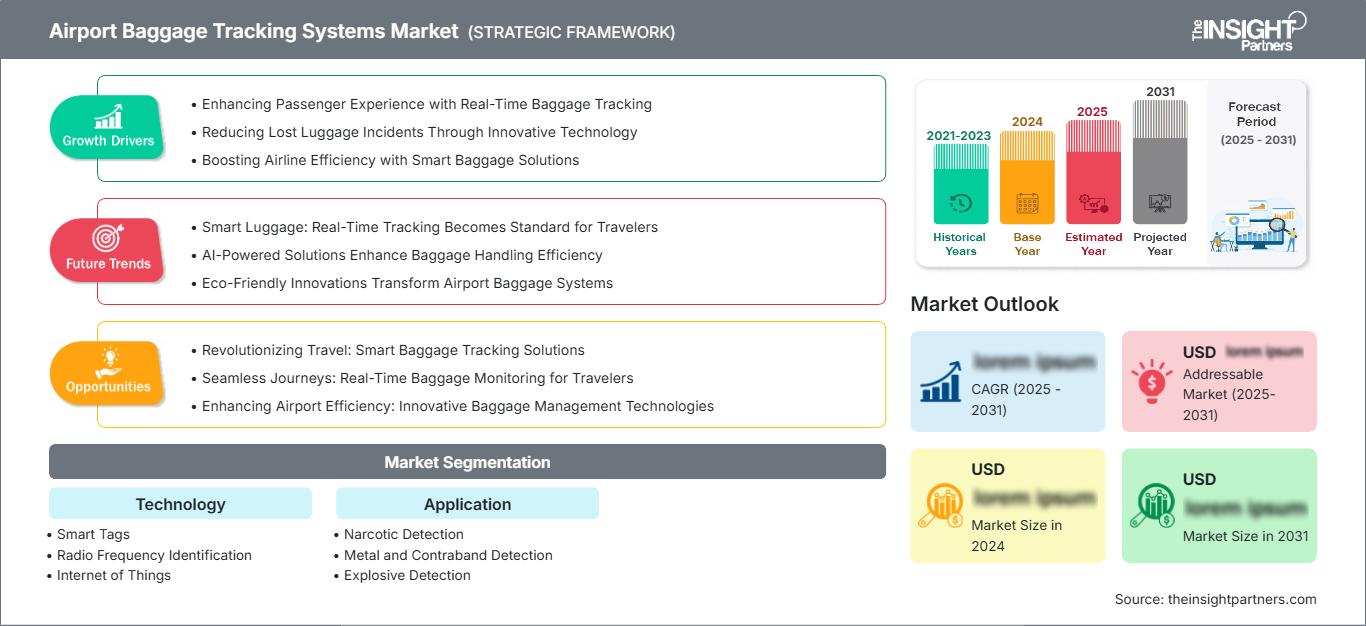
The Airport Baggage Tracking System Market size was evaluated at US$ 2.40 Billion in 2025 and is anticipated to hit US$ 3.79 Billion by 2034, rising at a CAGR of 5.19% between 2026 and 2034. It comprises technology solutions that help in tracking, identifying, reconciling, and making journeys visible for bags through airports, airlines, and handling agents. Increasingly, the adoption of such technologies will be driven by the demand for traceability, automation, customer satisfaction and the need to minimize any disruption.
North America is a technology-driven region, which has been aided by existing airport infrastructure, airline digitization, and investments in automated baggage handling processes. Airport Baggage Tracking System will grow at a projected 4.7-5.4% CAGR over 2034, led by the modernization of RFID systems, mobile bag visibility, and automated bag reconciliation.
Airport Baggage Tracking Systems Market Assessment and Insights
- North America accounts for a modeled 31–35% share in 2025 and is projected to grow at a 4.7–5.4% CAGR between 2026–2034, supported by mature infrastructure, airline digitization, and automation.
- US represents 25–29% share in 2025 and is expected to expand at a 4.6–5.3% CAGR during 2026–2034, led by major airline and airport technology programs.
- Europe holds a modeled 24–28% share in 2025 and is forecast to grow at 4.8–5.5% CAGR during 2026–2034, led by the UK, Germany, France, Italy, and Spain.
- Asia Pacific represents 25–29% share in 2025 and is projected to grow at 5.8–6.6% CAGR during 2026–2034, with China, Japan, South Korea, India, and Australia shaping demand.
- Largest Segment is Radio Frequency Identification, with a modeled 30–34% market share in 2025 and a 5.4–6.1% CAGR during 2026–2034.
- High Growth Segment is Internet of Things, representing 15–19% market share in 2025 and projected to grow at 6.6–7.4% CAGR during 2026–2034.
- Key companies analyzed in detail: Delta Air Lines, Inc.; TRACE ME Luggage Tracker Ltd; LongestChance; SITA; Lyngsoe Systems; BEUMER Group; Quantum ID Technologies; Daifuku; Aeroflot; Glidepath Group.
Source: The Insight Partners' analysis based on proprietary research, government publications, company annual reports, investor presentations, industry databases, and expert interviews.
Airport Baggage Tracking Systems have progressed from identifying using barcodes to connected baggage visibility through technologies such as RFID, smart labels, IoT gateways, machine to machine communication and beacons. The IATA Resolution 753 mandates bag tracking at four different points of travel – passenger hand-off, loading to aircraft, delivery to transfer and passenger receipt. Data from the industry indicates mishandling of 33.4 million bags in 2024, underlining the significance of traceability.
The Airport Baggage Tracking System Market forecast indicates that in the future, the focus is expected to be on interoperable platforms that leverage identification, automation, analytics and visibility. Expansion of airports in emerging countries will expand the addressable market, while constraints due to labor and upgrading of infrastructure will promote the case for automation. Airports handled 9.8 billion travelers in 2025 globally, enhancing the importance of bag visibility.
Airport Baggage Tracking Systems Market Report Scope
| Report Attribute | Details |
|---|---|
| Market size in 2025 | US$ 2.40 Billion |
| Market Size by 2034 | US$ 3.79 Billion |
| Global CAGR (2026 - 2034) | 5.19% |
| Historical Data | 2021-2024 |
| Forecast period | 2026-2034 |
Airport Baggage Tracking Systems Market Analysis
The Airport Baggage Tracking System market trends indicate that market evolution will be driven by increasing costs of baggage mishandling, enhanced traceability needs, and the passengers' need for real-time information. According to IATA, 41% of mishandlings happened at transfers in 2024. Thus, visibility at transfers has become a key value chain need. Hence, systems will have to integrate airline systems, airport baggage handling systems, ground handlers, tagging devices, scanners, databases, and passenger applications rather than operate as separate tracking systems.
The Airport Baggage Tracking System market ecosystem includes hardware providers, providers of the identification technologies, software providers, baggage handling integrators, airlines, airports, and security agencies. The supply situation favors vendors that can integrate legacy barcode systems into their RFID-based solutions. Therefore, Airport Baggage Tracking Systems procurement will be moving towards modular approaches which can be rolled out gradually and thus do not interfere with existing baggage handling system but provide analytics, automation and prediction capabilities.
Integration level in the the Airport Baggage Tracking System market plays an ever more important role compared to just hardware for positioning in the market. SITA integrates the functions of baggage management and journey tracking, whereas Daifuku, BEUMER Group, and Glidepath Group actively participate in automated baggage handling systems. On the side of airlines, Delta Air Lines, Inc. has proven the importance of RFID-enabled visibility; Lyngsoe Systems and technology providers solve the needs of identification and tracking.
The area where investments in the Airport Baggage Tracking System market are currently being made is connected platforms, automated bag reconciliation, and analytics based on tracking data. SITA has developed predictive capabilities related to baggage, and Delta Air Lines, Inc. continues implementing artificial intelligence in their baggage management. Companies like TRACE ME Luggage Tracker Ltd, LongestChance, Quantum ID Technologies, and Aeroflot are some other examples of the competitors in the market, with differentiation based on such criteria as interoperability and flexibility of deployment among others.
● REPORT CUSTOMIZATION
Tailor This Report To Align With Your Specific Business Requirements
This report can be customized to align precisely with your business objectives, scope, and target markets. Customization options include tailored segmentation, geography, competitive analysis, and strategic insights to support informed decision-making.
Customize This Report →WHAT YOU CAN ADJUST
- ● Segmentations
- ● Geography
- ● Competitive Analysis
- ● Language Preferences
Airport Baggage Tracking Systems Market: Strategic Insights
Regional Insights
North America Airport Baggage Tracking System Market
The North American region is expected to account for 31–35% of the worldwide the Airport Baggage Tracking System market share by 2025 and is forecasted to grow at a 4.7–5.4% CAGR during 2023 to 2034. Advanced airport infrastructures, high airline penetration rates of technology, and baggage reconciliation practices enable continued investments.
The United States continues to be the main demand generator, whereas Canada adds through hub airport upgradations. Implementation of Airport Baggage Tracking Systems becomes more related to automatic sorting, passenger mobility, and RFID tagging. Operational resilience, labor efficiency, and compatibility with the existing baggage handling infrastructure become key purchase considerations.
U.S. Airport Baggage Tracking System Market
According to estimations, the U.S. is expected to account for 25-29% of North American's total 2025 market share, growing at 4.6-5.3% CAGR till 2034. High number of passengers as well as hubs ensure steady demands for baggage visibility automation.
The example of usage of RFID for airline luggage automation can be represented by Delta Air Lines, Inc. In addition to that, there is a constant emphasis on security and automation aspects by airports. Baggage screening and infrastructure improvements are also factors affecting the market positively. According to the federal government's proposals, the US $500 million would have been invested annually in explosive detection systems by 2025.
Europe Airport Baggage Tracking System Market
Europe is estimated to hold a 24–28% share in 2025 and is expected to grow at a 4.8–5.5% CAGR through 2034. The UK, Germany, France, Italy, and Spain form the principal demand cluster, with Germany leading the regional market.
The UK enjoys strong international connectivity and needs for modernization. Modern airports link baggage tracing with baggage handling systems and passenger services via regulatory stress on resilience, which is conducive to technology improvements.
Germany enjoys state-of-the-art industrial automation and hub-based large-scale operations. The strategic importance of RFID, automated sorting, and baggage matching lies in its relevance to throughput maximization and minimizing reliance on manual systems.
France, Italy, and Spain form a comprehensive modernization pool, backed by strong tourism hubs and transfer traffic. Region-specific demands will help sustain the estimated 4.8-5.5% CAGR.
APAC Airport Baggage Tracking System Market
APAC is estimated to represent 25–29% of the global market in 2025 and is projected to grow at a 5.8–6.6% CAGR through 2034, making it the leading regional growth market. China leads regional scale, while India provides strong incremental demand.
Japan, South Korea, India, Australia, and China are investing in airport automation, digital passenger processing, and baggage infrastructure. Passenger growth, terminal expansion, labor productivity requirements, and smart-airport policies are supporting adoption. ACI APAC & MID projects 4.8% annual passenger growth across Asia Pacific during 2025–2028, with Southern Asia growing 6.3% annually.
Middle East & Africa Airport Baggage Tracking System Market
The Middle East and Africa market is expected to expand at a 5.0–5.8% CAGR through 2034. Saudi Arabia leads regional investment, followed by the UAE, while South Africa anchors Southern African demand. Airport expansion and tourism diversification support technology procurement.
The Airport Baggage Tracking System Market report indicates that Saudi Arabia's mega-airport development pipeline creates demand for automated baggage infrastructure, while UAE hubs emphasize high-throughput connectivity. South Africa and the Rest of MEA offer more selective opportunities centered on modernization and operational efficiency. Energy revenues, infrastructure investment, and aviation-led economic diversification provide an enabling environment for advanced baggage handling and tracking systems. ACI APAC & MID forecasts 5.4% annual passenger growth for the Middle East during 2025–2028.
Segmentation Analysis
Technology
Technology selection determines the balance between identification accuracy, infrastructure cost, communication range, and real-time visibility. The segment is projected to grow at a 5.2–6.0% CAGR during 2026–2034. Airport Baggage Tracking System scope is widening as airports combine established RFID with connected sensors, mobile interfaces, and automated baggage handling platforms.
- Smart Tags support passenger-facing identification and increasingly connect baggage records with digital travel applications. Their strategic value lies in flexible identification, easier updates, and improved visibility without requiring extensive fixed infrastructure.
- Radio Frequency Identification remains the largest technology category because automated readers can capture baggage identifiers at multiple operational points. Its importance is strongest where airports require consistent reconciliation and scalable tracking.
- Internet of Things connects baggage identifiers, sensors, gateways, and cloud platforms to create continuous operational visibility. Demand is strongest where airports seek predictive monitoring, distributed sensing, and integration with wider smart-airport architectures.
- Machine-to-Machine communication enables baggage equipment and software systems to exchange operational events with limited manual intervention. It is strategically important for automated routing, exception handling, and synchronized baggage handling workflows.
- Beacon technologies support localized proximity and location services, particularly within complex terminal environments. Their role is strongest in targeted visibility applications, asset positioning, passenger services, and supplementary tracking.
Application
Application demand is shaped by the need to combine baggage movement visibility with security and inspection workflows. The segment is projected to expand at a 4.9–5.7% CAGR during 2026–2034. Airport Baggage Tracking System analysis indicates that application integration can improve chain-of-custody visibility and support faster exception resolution.
- Narcotic Detection applications address controlled-substance screening through specialized detection workflows and inspection equipment. Their strategic importance increases where airports strengthen layered security and require clearer links between screening events and baggage records.
- Metal and Contraband Detection supports identification of prohibited metallic objects and other restricted materials. Demand is linked to checkpoint modernization, automated inspection, and the integration of screening results with broader baggage security processes.
- Explosive Detection remains a critical application because airports require high-throughput screening without compromising security. Advanced detection increasingly combines automated imaging, analytics, and baggage handling data to support faster threat identification and controlled intervention.
Opportunity Snapshot
| Application | Revenue Contribution (High/Medium/Low) | Trend Tag | Adoption Stage |
| Narcotic Detection | Medium | Trace Analytics | Scaling |
| Metal and Contraband Detection | High | Automated Screening | Mature |
| Explosive Detection | High | AI Screening | Scaling |
Airport Baggage Tracking Systems Market Growth Drivers and Impact Analysis
Mandatory End-to-End Baggage Traceability
IATA Resolution 753 has transformed baggage tracking from an optional service enhancement into a defined operational requirement for member airlines. The four tracking points that are mandatory will form a common data architecture around the handover of passengers, loading the aircraft, transfer delivery, and handing back to passengers. Standardizing the process opens up more opportunities for equipment that enables identification, reconciliation, data platforms, and integration services. The effect is especially significant in the case of airports serving many airlines, since a standardized tracking process will mitigate visibility fragmentation. According to IATA, the technology-driven tracking of baggage has led to 67% fewer mishandlings since the early 2010s. With increased implementation maturity, procurement is moving from identification towards an interoperable system.
Rising Cost of Baggage Mishandling
Financial exposure from baggage disruption is strengthening the business case for investment in tracking infrastructure. Industry data indicate that mishandled baggage cost the air transport industry US$6.3 billion in 2025, despite a 20% reduction in mishandled bags. Economic benefits go beyond just payment because delayed bags utilize airport, airline, and ground-handling resources while also eroding passenger trust. Thus, airlines are considering implementation of bag tracking programs based on measurable operational benefits, including decreased manual searching, faster retrieval, better handling of transfers, and decreased number of claims. Bag tracking solutions that provide for real-time conversion of location triggers to an operational alert are becoming strategically important. Strongest arguments for purchase will be made in the areas of high baggage volumes, difficult transfers, and costly processes.
Expansion of Automated Airport Infrastructure
Airport expansion is increasing demand for automation that can coordinate baggage movement across larger and more decentralized terminals. ACI World reported 9.8 billion global passengers in 2025, while its 2026 forecast places global airport traffic at 10.2 billion passengers. Greater quantities create pressure on baggage management systems to handle greater number of baggage without proportionate additions in manual handling. Automated conveyance, individual carriage systems, self-check bag drop machines, RFID scanning, and machine-to-machine communications are consequently supplementary investments. The effect of this market is not only limited to new airports but even to older airports since they will have to integrate this tracking system into already constrained operations. Companies offering this solution along with automation, analysis, and maintenance services will be able to provide solutions to larger infrastructure needs.
Airport Baggage Tracking Systems Market Future Trends
Predictive Baggage Operations
Airport Baggage Tracking System trends are moving toward predictive rather than purely descriptive visibility. Future platforms will increasingly analyze baggage events, connection timing, equipment status, flight schedules, and operational bottlenecks to identify disruption risks before bags become delayed. Cloud analytics will support centralized monitoring across airports and airline networks, while artificial intelligence can prioritize exceptions according to passenger itineraries and connection sensitivity. SITA introduced Bag Radar in March 2026, illustrating the industry's movement toward predictive baggage intelligence. Over time, predictive systems are likely to become embedded in operational control centers rather than used only by baggage service teams. This shift can change tracking from a record-keeping function into an active decision-support layer for baggage operations.
Connected Passenger Baggage Journeys
The next stage of Airport Baggage Tracking System trends will connect airline applications, smart baggage identifiers, airport infrastructure, and passenger communication into a continuous journey record. Travelers will increasingly expect location information to remain available across check-in, transfer, loading, arrival, and irregular operations. Interoperability will become more important as passengers move between airlines and airports, requiring consistent data exchange rather than isolated tracking applications. Battery-free or low-maintenance identifiers will remain important where operational scale makes device management costly. The combination of connected identifiers and cloud-based event processing should also support more personalized notifications, faster recovery instructions, and better service prioritization when disruptions occur. This model places passenger visibility alongside operational efficiency as a core design objective.
Airport Baggage Tracking Systems Market Opportunities
Modernization of Emerging Airport Networks
Emerging airport networks offer an investment opportunity where new terminals can adopt integrated baggage tracking without extensive legacy constraints. India, Southeast Asia, the Middle East, and selected African markets are expanding airport capacity while pursuing digital passenger services and automated handling. Investors and technology providers can target projects that combine baggage identification, reconciliation, security screening, and automated sorting from the design stage. Airport Baggage Tracking System Forecasts should therefore be evaluated alongside terminal capacity plans, airline network expansion, and planned baggage handling system upgrades. Greenfield deployments can also provide stronger data interoperability than fragmented retrofits, creating opportunities for platform providers to establish multi-year service relationships. Strategic partnerships with airport developers, system integrators, and airlines can improve deployment scalability and reduce implementation risk.
Data-Led Services and Lifecycle Management
A second opportunity lies in converting baggage tracking infrastructure into recurring software and lifecycle services. Once airports collect standardized baggage events, vendors can provide analytics, predictive maintenance, operational benchmarking, exception management, and system optimization. This model can broaden revenue beyond initial hardware procurement while giving airport operators tools to measure performance continuously. The opportunity is particularly relevant for large hubs where baggage systems contain multiple equipment types and technology generations. Providers that offer open interfaces, secure cloud architecture, and flexible subscription models can address airports seeking modernization without full replacement. Strategic value will increasingly depend on data governance, cybersecurity, integration capabilities, and measurable operational outcomes rather than on tracking hardware specifications alone.
Recent Developments
- May 2026: The International Air Transport Association (IATA) launched the Baggage Community System (BCS), a secure digital platform designed to support the adoption of its Modern Baggage Messaging (BIX) standard and modernize global baggage information exchange. BCS enables airlines, airports, ground handlers, and solution providers to exchange real-time, structured baggage data while maintaining interoperability with legacy Type B messaging systems.
- March 2026: Google launched a new Find Hub feature that enables passengers to securely share the real-time location of lost or delayed baggage with participating airlines, helping accelerate baggage recovery. The feature allows travelers using Find Hub-compatible tracking devices to generate a secure location link and submit it through an airline’s baggage-recovery system, giving staff updated information on the bag’s location. Google has partnered with more than 10 airlines, including Air India, Turkish Airlines, China Airlines,
- April 2025: SITA and Airportr signed a five-year service agreement to enhance baggage delivery and tracking services by integrating their data systems for comprehensive, end-to-end visibility of baggage status. SITA will support Airportr with its cloud-based Flex platform and Bag Journey service, which provides real-time baggage tracking and API-based data integration.
Frequently Asked Questions

- Comprehensive Market Sizing and Forecast Analysis
- Detailed Segmentation Analysis
- In-Depth Market Dynamics Assessment
- Regional and Country-Level Insights
- Competitive Landscape and Company Benchmarking
- Strategic Business Intelligence
Recent Reports
Testimonials

The Insight Partners provided valuable market intelligence that supported our global go-to-market strategy. Their team was professional, responsive, and attentive to our feedback, providing thoughtful analysis and helpful methodological clarifications throughout the project.
Junmo Kim Chief Financial Officer (CFO), Enertech Co., Ltd.
The Insight Partners' SCADA System Market report is comprehensive, with valuable insights on current trends and future forecasts. The team was highly professional, responsive, and supportive throughout. We are very satisfied and highly recommend their services.
RAN KEDEM Partner, Reali Technologies LTDs
I requested a report on a very specific software market and the team produced the report in a few days. The information was very relevant and well presented. I then requested some changes and additions to the report. The team was again very responsive and I got the final report in less than a week.
JEAN-HERVE JENN Chairman, Future Analytica
We worked with The Insight Partners for an important market study and forecast. They gave us clear insights into opportunities and risks, which helped shape our plans. Their research was easy to use and based on solid data. It helped us make smart, confident decisions. We highly recommend them.
PIYUSH NAGPAL Sr. Vice President, High Beam Global
The Insight Partners delivered insightful, well-structured market research with strong domain expertise. Their team was professional and responsive throughout. The user-friendly website made accessing industry reports seamless. We highly recommend them for reliable, high-quality research services
YUKIHIKO ADACHI CEO, Deep Blue, LLC.
This is the first time I have purchased a market report from The Insight Partners.While I was unsure at first, I visited their web site and felt more comfortable to take the risk and purchase a market report.I am completely satisfied with the quality of the report and customer service. I had several questions and comments with the initial report, but after a couple of dialogs over email with their analyst I believe I have a report that I can use as input to our strategic planning process.Thank you so much for taking the extra time and making this a positive experience.I will definitely recommend your service to others and you will be my first call when we need further market data.
JOHN SUZUKI President and Chief Executive Officer, Board Director, BK Technologies
I wish to appreciate your support and the professionalism you displayed in the course of attending to my request for information regarding to infectious disease IVD market in Nigeria. I appreciate your patience, your guidance, and the fact that you were willing to offer a discount, which eventually made it possible for us to close a deal. I look forward to engaging The Insight Partners in the future, all thanks to the impression you have created in me as a result of this first encounter.
DR CHIJIOKE ONYIA MANAGING DIRECTOR, PineCrest Healthcare Ltd.Reason to Buy
- Informed Decision-Making
- Understanding Market Dynamics
- Competitive Analysis
- Identifying Emerging Markets
- Customer Insights
- Market Forecasts
- Risk Mitigation
- Boosting Operational Efficiency
- Strategic Planning
- Investment Justification
- Tracking Industry Innovations
- Aligning with Regulatory Trends





 Get Free Sample for