
Airport Parking Management Market Share, Size & Demand by 2034
Coverage: By Product (Parking Fee and Revenue Management, Parking Guidance and Slot Management, Security and Surveillance); Component (Service, Software) , and Geography (North America, Europe, Asia Pacific, and South and Central America)
- Status : Data Released
- Report Code : TIPRE00021928
- Category : Technology, Media and Telecommunications
- No. of Pages : 150
- Available Report Formats :


- Last update date : August 10, 2026


2025 Market Size
US$ 2.36 Bn
Base year value
2034 Forecast
US$ 5.31 Bn
Projected by 2034
CAGR 2026-2034
10.67 %
Growth rate
Addressable Market
US$ 36.48 Bn
(2026-2034)
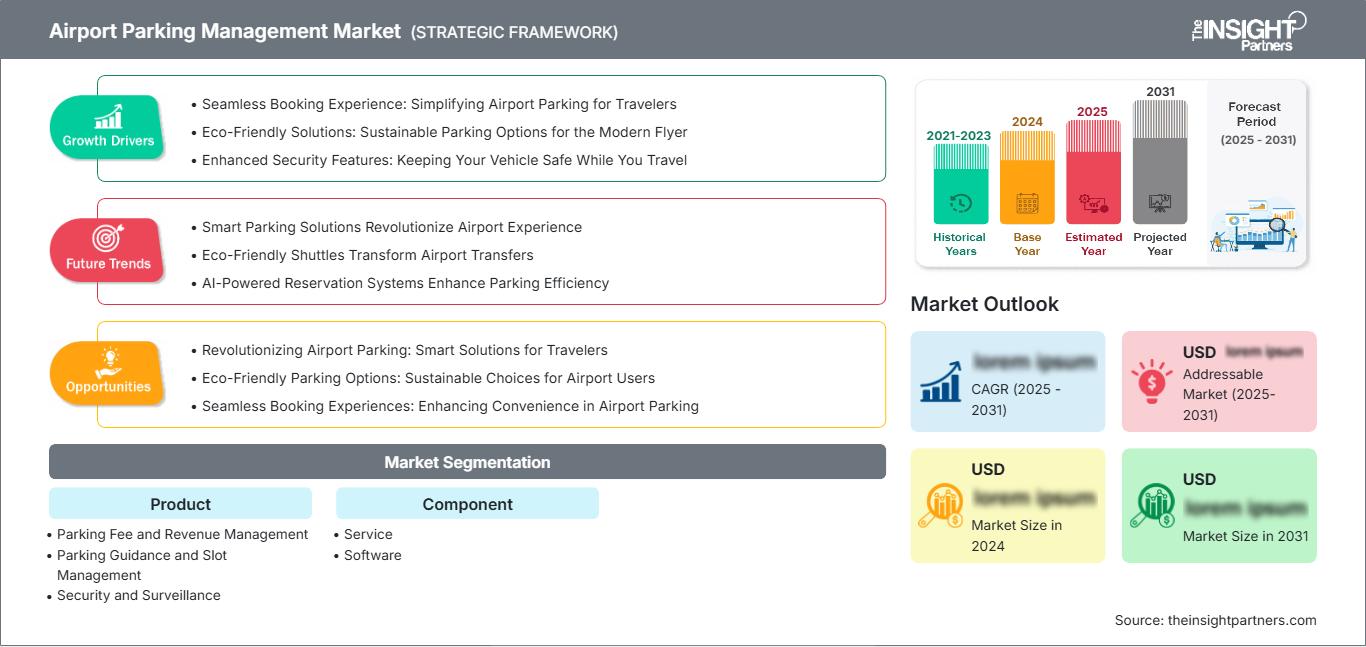
The airport parking management market is projected to grow from US$ 2.36 Billion in 2025 to US$ 5.31 Billion by 2034, registering a CAGR of 10.67% during 2026–2034. Growth is being shaped by rising passenger volumes, higher airport commercial revenue targets, and wider deployment of reservation, license plate recognition, parking guidance, surveillance, and automated revenue control systems across major global airports.
North America remains a priority region as airports modernize curbside, garage, and employee parking operations. The airport parking management market size in the region is supported by contactless payment, digital reservations, and camera-based occupancy monitoring, with regional demand estimated to expand at a CAGR of 9.8–10.4% during 2026–2034.
Airport Parking Management Market Assessment and Insights
- North America: Accounted for 34–37% share in 2025 and is expected to grow at a CAGR of 9.8–10.4% during 2026–2034, supported by airport modernization, high car access rates, and digital parking upgrades.
- US: Represented 72–76% of North America in 2025 and is projected to expand at a CAGR of 9.9–10.5% through airport concessions, off-airport operators, and cloud-based access control adoption.
- Europe: Held 26–29% share in 2025 and is forecast to grow at a CAGR of 9.4–10.0%, led by the UK, Germany, France, Italy, and Spain.
- Asia Pacific: Captured 22–25% share in 2025 and is projected to grow at a CAGR of 11.4–12.2%, led by China, India, Japan, South Korea, and Australia.
- Largest Segment: Parking Fee and Revenue Management held 41–44% market share in 2025 and is expected to grow at a CAGR of 10.1–10.8% during 2026–2034.
- High Growth Segment: Parking Guidance and Slot Management held 31–34% share in 2025 and is forecast to grow at a CAGR of 11.6–12.4% during 2026–2034.
- Key companies analyzed in detail: 3M Company, Amano Corporation, Amano McGann, Inc., APCOA PARKING Holdings GmbH, Bond Traffic Solutions Ltd, Cleverciti Systems GmbH, Cubic Corporation, FlashParking, Inc., International Business Machines Corporation, Kapsch TrafficCom AG.
Source: The Insight Partners' analysis based on proprietary research, government publications, company annual reports, investor presentations, industry databases, and expert interviews.
Parking at airports has evolved from paper tickets and passive parking facilities into comprehensive access systems, reservations, payments, analytics, and enforcement solutions. Such changes occur due to the need to handle the variable number of flights, cut down on queue times for entering/exiting the facility, and increase revenues through non-aeronautical sources. The market evolution is connected with the aviation industry recovery: IATA reported unprecedented demand among passengers worldwide in 2024, while ACI estimated 9.5 billion people flying from airports in 2024.
The funding is going towards cloud-based software, AI-licensed plate recognition technologies, dynamic pricing, and parking guidance, which all is related to the need for yield management in short, long-term, valet, staff, and premium parking facilities. Emerging airport expansions in Asia Pacific and Middle East hubs are expected to widen the airport parking management market share for digital-first systems, while mature regions focus on upgrades, interoperability, and customer experience.
Airport Parking Management Market Report Scope
| Report Attribute | Details |
|---|---|
| Market size in 2025 | US$ 2.36 Billion |
| Market Size by 2034 | US$ 5.31 Billion |
| Global CAGR (2026 - 2034) | 10.67% |
| Historical Data | 2021-2024 |
| Forecast period | 2026-2034 |
Airport Parking Management Market Analysis
Airport parking management market growth is being driven by passenger traffic recovery, higher private vehicle access to airports, and the need to reduce congestion around terminals. Parking is a very important initial and final experience point for the passengers, hence the focus on live parking capacity management, booking, gateless entry, and mobile payments. Such systems increase efficiency as well as help the airports retain their revenues from parking amid commercial strategies.
There are changes in the supply dynamics in that the vendors of parking solutions are bringing into the game software solutions, cameras, payment gateways, gates, and analytics on an integrated platform basis. There is more demand by the airports for systems that can manage public parking, surface parking, employee parking, valet parking, and EV parking.
Market analysis of Airport Parking Management indicates that the competitive landscape consists of traditional players in parking access, mobility software vendors, traffic technology vendors, and IT integration specialists. The main competitors include Amano Corporation, Amano McGann, FlashParking, Cubic Corporation, Kapsch TrafficCom, IBM, Cleverciti Systems, and APCOA PARKING, which are competing via platform capabilities, service reach, analytics capabilities, and airport installations experience rather than by equipment costs.
The strategic positioning has been shifting towards recurrent income from software, managed services, and the capability to demonstrate real improvements in queue time and hands-on processing reduction. FlashParking provides examples of airport installations based on AI-powered license plate recognition and automatic lanes, while Amano McGann positions its airport modules, including a frequent parker program, a reservation API, parking guidance, LPR, and valet system integration.
● REPORT CUSTOMIZATION
Tailor This Report To Align With Your Specific Business Requirements
This report can be customized to align precisely with your business objectives, scope, and target markets. Customization options include tailored segmentation, geography, competitive analysis, and strategic insights to support informed decision-making.
Customize This Report →WHAT YOU CAN ADJUST
- ● Segmentations
- ● Geography
- ● Competitive Analysis
- ● Language Preferences
Airport Parking Management Market: Strategic Insights
Regional Insights
North America airport parking management market
North America led with 34–37% share in 2025 and is forecast to grow at a CAGR of 9.8–10.4%. Large hub airports are prioritizing frictionless access, reservation-led demand capture, and LPR-based enforcement to manage high garage utilization and passenger time sensitivity.
The region benefits from early technology adoption, concession modernization, and strong vendor presence. Airports are using parking platforms to improve non-aeronautical income, reduce manual ticket handling, and support premium products such as valet, pre-booked spaces, and EV-enabled parking.
U.S. airport parking management Market
The US represented 72–76% of North America in 2025 and is estimated to expand at a CAGR of 9.9–10.5%. Demand is supported by major airport parking assets, off-airport competition, and pressure to improve traffic flow at terminal approaches.
Company presence is strong, with Amano McGann, FlashParking, IBM, Cubic Corporation, and 3M Company supporting access, analytics, payment, and automation capabilities. The airport parking management market share in the US is also shaped by airport-specific pilots for ticketless entry and automated payment.
Europe airport parking management Market
Europe accounted for 26–29% share in 2025 and is forecast to grow at a CAGR of 9.4–10.0%. The UK and Germany lead adoption because of large airport networks, sophisticated parking operators, and emphasis on pre-booking and revenue optimization.
France, Italy, and Spain are progressing through airport redevelopment, digital payment penetration, and demand for integrated off-airport and on-airport parking visibility. APCOA PARKING Holdings GmbH strengthens regional service depth, while Kapsch TrafficCom AG contributes traffic and mobility technology expertise.
APAC airport parking management Market
APAC held 22–25% share in 2025 and is expected to grow at a CAGR of 11.4–12.2%. China and India are the leading growth engines as airport capacity expansion, urban air travel, and new terminal projects increase parking complexity.
Japan, South Korea, and Australia add demand for automated payment, surveillance, and occupancy monitoring. Regional airports are increasingly considering airport parking management market scope beyond basic access control to include guidance, reservations, analytics, and multimodal curbside coordination.
Middle East & Africa airport parking management Market
The Middle East and Africa are projected to grow at a CAGR of 10.2–10.9%, supported by airport infrastructure investments in Saudi Arabia, the UAE, and South Africa. Premium travel, airport retail strategies, and large terminal projects support digital parking upgrades.
Adoption remains uneven across the wider region, but major hubs are moving toward integrated systems that combine security, surveillance, paid parking, and passenger convenience. The rest of MEA's growth is tied to airport expansion and the gradual modernization of payment infrastructure.
Segmentation Analysis
Product
The product segment is expected to grow at a CAGR of 10.4–11.1% during 2026–2034, according to the Airport Parking Management Market report. Demand is led by integrated platforms that combine pricing, access control, occupancy visibility, and surveillance. Product-level decisions increasingly depend on how well systems reduce congestion, protect revenue leakage, and integrate with airport mobile applications, payment systems, and security ecosystems. Continuous adoption of automated parking technologies and real-time monitoring solutions is further enhancing operational efficiency and customer convenience across airport facilities.
- Parking Fee and Revenue Management remains the largest product area because airports need accurate payments, dynamic pricing, pre-booking, and reconciliation tools across short-term, long-term, valet, and employee parking assets.
- Parking Guidance and Slot Management is gaining strategic importance as real-time space visibility reduces circulation time, improves traveler confidence, and supports better garage utilization during peak flight waves.
- Security and Surveillance supports vehicle monitoring, incident review, license plate capture, and compliance needs, making it essential for airports that manage large public parking estates and restricted zones.
Component
Component is projected to grow at a CAGR of 10.2–10.9% during 2026–2034. The mix is shifting toward software-enabled recurring value, but services remain critical because airport installations require planning, lane configuration, integration, maintenance, cybersecurity review, and operational training for high-availability environments.
- Service includes consulting, installation, integration, support, and managed operations, which are important for airports replacing legacy systems without disrupting active parking revenue streams.
- Software enables reservations, analytics, access rules, payment orchestration, LPR workflows, occupancy dashboards, and customer communication, making it central to scalable digital airport parking operations.
Opportunity Snapshot
| Segments | Revenue Contribution | Trend Tag | Adoption Stage |
| Parking Fee and Revenue Management | High | Dynamic Pricing | Mature |
| Parking Guidance and Slot Management | High | Space Visibility | Scaling |
| Security and Surveillance | Medium | LPR Enforcement | Scaling |
| Service | Medium | Managed Integration | Mature |
| Software | High | Cloud Control | Scaling |
Airport Parking Management Market Growth Drivers and Impact Analysis
Passenger Growth and Terminal Congestion
Rising air travel is increasing vehicle entries, longer dwell times, and demand spikes around flight banks. IATA reported that 2024 air passenger demand reached a record high, while ACI projected 9.5 billion airport passengers in 2024. This traffic base creates a direct need for systems that shorten queue times, guide drivers to available spaces, and reduce manual payment friction. Airports that improve parking flow can protect passenger satisfaction and increase commercial revenue without necessarily expanding physical parking capacity.
Shift Toward Ticketless and Contactless Operations
The change from paper boarding passes and cash-based exits will continue as customers demand efficiency through their apps. No boarding pass, payments via mobile phone, license plate reader, and automatic gates ease manpower burden and increase lane capacity. These features also help eliminate any revenue leakage through matching vehicle identification with payment transactions. The impact on operations is most felt in large airports where any small delay builds up fast through thousands of vehicles each day.
Need to Maximize Non-Aeronautical Revenue
It is important to note that parking is among the easiest sources of income for airport authorities to control. This is because the management systems enable them to set prices according to the duration, demand, distance, booking method, and types of customers. It also enables them to offer value-added services such as valet, reserved, and EV charge parking. Therefore, the revenue management system is much better compared to a flat rate system.
Airport Parking Management Market Future Trends
AI-Led Parking Guidance and Predictive Pricing
Airport parking management market trends will increasingly center on AI-assisted occupancy prediction, camera analytics, and dynamic pricing. Instead of displaying only current availability, systems will forecast demand by flight schedules, booking patterns, weather, events, and historical utilization. Airports can then direct customers to the right facility before arrival and adjust prices to balance demand across assets. This trend will improve yield management while reducing last-minute congestion at the most popular garages.
Integration of EV Charging with Parking Revenue Platforms
EV charging will become more closely integrated with airport parking software as travelers seek guaranteed access during long dwell times. Airports will need platforms that reserve chargers, manage dwell limits, process payments, and monitor utilization. This creates a new layer of revenue and customer service within existing parking assets. Vendors that combine parking access, reservation, and charging visibility will be better positioned than single-function hardware suppliers.
Airport Parking Management Market Opportunities
Cloud Migration for Legacy Airport Parking Estates
Airport parking management market Forecasts indicate a strong opportunity in upgrading fragmented legacy systems to cloud-connected platforms. Many airports still operate separate access control, payment, surveillance, and guidance tools, limiting data visibility and customer experience. Vendors can create value by offering phased migrations that preserve revenue continuity while introducing analytics, mobile booking, and automated reconciliation. The opportunity is especially attractive in mature markets where physical parking capacity is difficult to expand, but digital optimization can improve yield.
Expansion in High-Growth Airport Infrastructure Markets
New airports and terminal expansions in the Asia Pacific and the Middle East create opportunities to embed parking technology at the design stage. Early integration allows better lane layouts, sensor placement, payment architecture, EV charging allocation, and security coverage. Suppliers that partner with airport developers, mobility planners, and concessionaires can capture long-term service revenue. These projects also allow airports to avoid costly retrofits and launch with digitally enabled parking operations from day one.
Frequently Asked Questions

- Comprehensive Market Sizing and Forecast Analysis
- Detailed Segmentation Analysis
- In-Depth Market Dynamics Assessment
- Regional and Country-Level Insights
- Competitive Landscape and Company Benchmarking
- Strategic Business Intelligence
Recent Reports
Testimonials

The Insight Partners' SCADA System Market report is comprehensive, with valuable insights on current trends and future forecasts. The team was highly professional, responsive, and supportive throughout. We are very satisfied and highly recommend their services.
RAN KEDEM Partner, Reali Technologies LTDs
I requested a report on a very specific software market and the team produced the report in a few days. The information was very relevant and well presented. I then requested some changes and additions to the report. The team was again very responsive and I got the final report in less than a week.
JEAN-HERVE JENN Chairman, Future Analytica
We worked with The Insight Partners for an important market study and forecast. They gave us clear insights into opportunities and risks, which helped shape our plans. Their research was easy to use and based on solid data. It helped us make smart, confident decisions. We highly recommend them.
PIYUSH NAGPAL Sr. Vice President, High Beam Global
The Insight Partners delivered insightful, well-structured market research with strong domain expertise. Their team was professional and responsive throughout. The user-friendly website made accessing industry reports seamless. We highly recommend them for reliable, high-quality research services
YUKIHIKO ADACHI CEO, Deep Blue, LLC.
This is the first time I have purchased a market report from The Insight Partners.While I was unsure at first, I visited their web site and felt more comfortable to take the risk and purchase a market report.I am completely satisfied with the quality of the report and customer service. I had several questions and comments with the initial report, but after a couple of dialogs over email with their analyst I believe I have a report that I can use as input to our strategic planning process.Thank you so much for taking the extra time and making this a positive experience.I will definitely recommend your service to others and you will be my first call when we need further market data.
JOHN SUZUKI President and Chief Executive Officer, Board Director, BK Technologies
I wish to appreciate your support and the professionalism you displayed in the course of attending to my request for information regarding to infectious disease IVD market in Nigeria. I appreciate your patience, your guidance, and the fact that you were willing to offer a discount, which eventually made it possible for us to close a deal. I look forward to engaging The Insight Partners in the future, all thanks to the impression you have created in me as a result of this first encounter.
DR CHIJIOKE ONYIA MANAGING DIRECTOR, PineCrest Healthcare Ltd.Reason to Buy
- Informed Decision-Making
- Understanding Market Dynamics
- Competitive Analysis
- Identifying Emerging Markets
- Customer Insights
- Market Forecasts
- Risk Mitigation
- Boosting Operational Efficiency
- Strategic Planning
- Investment Justification
- Tracking Industry Innovations
- Aligning with Regulatory Trends





 Get Free Sample for