
Ambient Air Monitoring System Market Trends, Size & Growth by 2034
Coverage: By Product Type (Portable, Stationary); Application (Indoor Monitoring, Outdoor Monitoring) , and Geography (North America, Europe, Asia Pacific, and South and Central America)
- Status : Data Released
- Report Code : TIPRE00006374
- Category : Electronics and Semiconductor
- No. of Pages : 150
- Available Report Formats :


- Last update date : July 17, 2026


2025 Market Size
US$ 5.05 Bn
Base year value
2034 Forecast
US$ 8.46 Bn
Projected by 2034
CAGR 2026-2034
5.90 %
Growth rate
Addressable Market
US$ 61.20 Bn
(2026-2034)
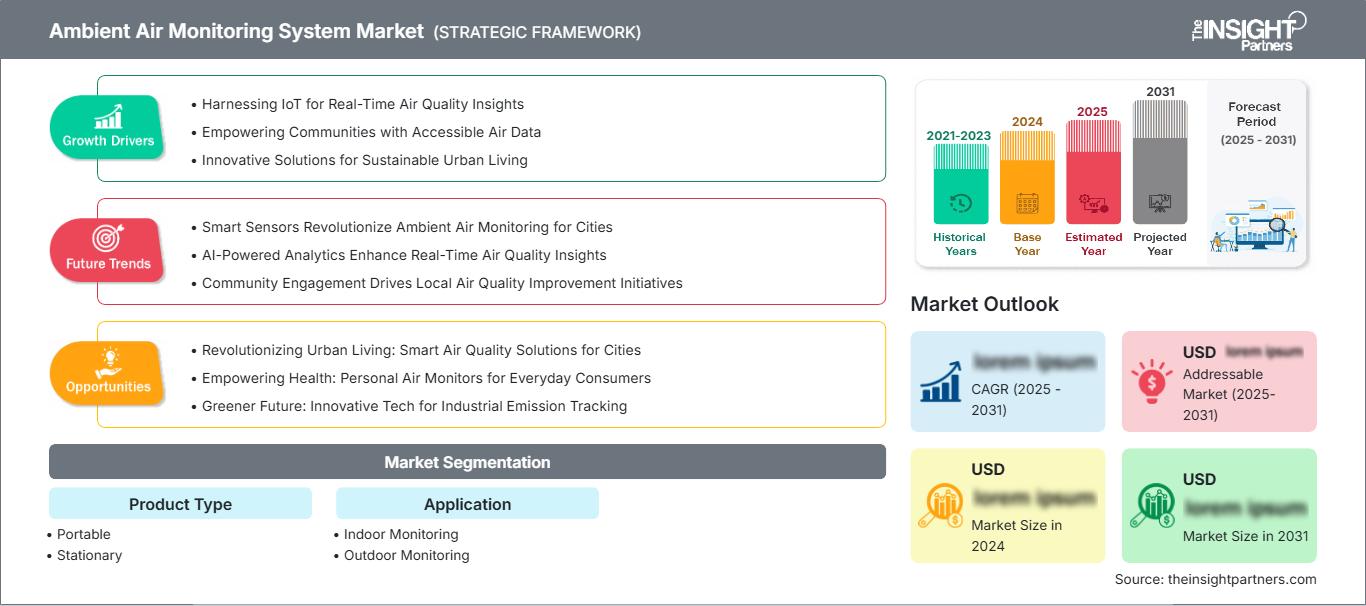
The Ambient Air Monitoring System Market was valued at US$ 5.05 Billion in 2025 and is projected to reach US$ 8.46 Billion by 2034; it is expected to register a CAGR of 5.90% during 2026–2034. Demand is supported by stricter air quality enforcement, continuous pollutant tracking requirements, and the transition from periodic sampling to connected systems that deliver reliable data for public agencies, industrial operators, and building managers.
Across North America, the Ambient Air Monitoring System Market size is expected to expand at a 5.5–6.1% CAGR, supported by federal network assessments, wildfire exposure tracking, and higher municipal investment in near-real-time monitoring. The region benefits from mature reference station infrastructure, but incremental spending is shifting toward portable nodes, fence-line systems, and indoor monitoring linked with ventilation and occupational safety programs.
Ambient Air Monitoring System Market Assessment and Insights
- North America held 31–34% share in 2025 and is projected to grow at a 5.5–6.1% CAGR between 2026–2034, led by wildfire monitoring, EPA network reviews, and industrial compliance spending.
- US accounted for 78–82% of North America in 2025 and is expected to grow at a 5.6–6.2% CAGR between 2026–2034.
- Europe represented 25–28% share in 2025 and is projected to grow at a 5.1–5.7% CAGR between 2026–2034, with Germany, the UK, and France leading deployments.
- Asia Pacific captured 27–30% share in 2025 and is expected to grow at a 6.4–7.0% CAGR between 2026–2034, supported by China, India, Japan, and South Korea.
- Largest Segment Stationary systems held 62–66% market share in 2025 and are projected to grow at a 5.2–5.8% CAGR between 2026–2034.
- High Growth Segment Indoor monitoring held 34–38% market share in 2025 and is expected to grow at a 6.2–6.8% CAGR between 2026–2034.
- Key companies analyzed in detail: 3M Company, Aeroqual Limited, Ecotech Pty Ltd, Envirotech Instruments Pvt. Ltd., HORIBA, Ltd., PerkinElmer Inc., Siemens AG, Teledyne Technologies Incorporated, Thermo Fisher Scientific Inc., TSI Incorporated.
Source: The Insight Partners' analysis based on proprietary research, government publications, company annual reports, investor presentations, industry databases, and expert interviews.
The technology innovation cycle in the Ambient Air Monitoring System Market has shifted from isolated analyzers to hybrid networks comprised of reference grade sites, optical particulate monitors, electrochemical gas detectors, telemetry, and cloud QA/QC services. There have also been developments in production trends through local assembly, inclusion of modular pollutant cartridges, and a decrease in downtime via remote diagnostics. Such trends will result in higher replacements while allowing cities and industry players to increase monitoring capability without being restricted to expensive fixed stations.
In the coming years, the emerging cities in Asia, the Middle East, and Latin America are likely to emphasize their need for denser monitoring networks, as the air quality plans are going to be tied to health, transportation, and industrial permits. Funding will tend to flow towards portable and stationary systems, which can prove hotspots, create evidence for regulations, and provide information on public dashboards.
Ambient Air Monitoring System Market Report Scope
| Report Attribute | Details |
|---|---|
| Market size in 2025 | US$ 5.05 Billion |
| Market Size by 2034 | US$ 8.46 Billion |
| Global CAGR (2026 - 2034) | 5.90% |
| Historical Data | 2021-2024 |
| Forecast period | 2026-2034 |
Ambient Air Monitoring System Market Analysis
The demand in the Ambient Air Monitoring System market growth cycle is fueled by expanding concerns regarding exposure to PM2.5, NO2, ozone, VOCs, and ultrafine particles. The tightening of the WHO guideline and the new EU Directive 2024/2881, as well as ambient air monitoring initiatives by the EPA, are spurring authorities to upgrade monitoring network density, QA measures, and real-time reporting. Industrial facilities, airports, construction sites, and schools are embracing air monitoring in order to control compliance, risk, and occupant health needs.
The ecosystem includes optical sensor makers, instrument vendors, systems integrators, calibration labs, data software vendors, and environmental consultants. Supply-side dynamics are still positive due to cost reductions from advances in optical sensors and wireless technology on the one hand, while maintaining relevance of reference analyzers for regulatory networks on the other. Buyers seek interoperability and data traceability, giving competitive edge to vendors with hardware portfolio and service capabilities.
The Ambient Air Monitoring Systems Market reveals competition amongst diversified instrumentation providers and specialized sensors manufacturers. The competitors for validated analyzers include Thermo Fisher Scientific Inc., Teledyne Technologies Incorporated, HORIBA, Ltd., Siemens AG, and TSI Incorporated, whereas the companies focusing on modular and portable systems are Aeroqual Limited and Ecotech Pty Ltd. 3M Company and PerkinElmer Inc. are providing solutions related to exposure and workflow, which help in making ambient air monitoring decisions.
The capital investment is directed towards local production facilities, software-enabled maintenance, and multi-pollutant systems, which lower down the cost of ownership. The positioning strategy involves gaining credibility in terms of regulatory requirements, calibration, and provision of solutions to indoor and outdoor applications. The cloud analytics, service delivery capability, and validation for particle measurement give an edge over others in securing public sector and industrial fence-line tenders.
● REPORT CUSTOMIZATION
Tailor This Report To Align With Your Specific Business Requirements
This report can be customized to align precisely with your business objectives, scope, and target markets. Customization options include tailored segmentation, geography, competitive analysis, and strategic insights to support informed decision-making.
Customize This Report →WHAT YOU CAN ADJUST
- ● Segmentations
- ● Geography
- ● Competitive Analysis
- ● Language Preferences
Ambient Air Monitoring System Market: Strategic Insights
Regional Insights
North America Ambient Air Monitoring System Market
North America held 31–34% share in 2025 and is projected to record a 5.5–6.1% CAGR through 2034. The Ambient Air Monitoring System Market share is supported by EPA air monitoring network assessments, wildfire smoke response, environmental justice mapping, and state-level investments in particulate and ozone measurement infrastructure.
Public agencies remain the largest purchasers, but utilities, mining operators, ports, and transportation authorities are expanding fence-line and community deployments. The region’s mature installed base favors replacement cycles for analyzers, while portable systems gain traction where temporary incidents, construction projects, or neighborhood-level exposure questions require flexible coverage.
U.S. Ambient Air Monitoring System Market
The US accounted for 78–82% of North America in 2025 and is expected to grow at a 5.6–6.2% CAGR. The demand is supported by federal reference methods, state implementation plans, wildfire episodes, and community monitoring grants that enhance visibility spatially in communities adjacent to highways, industry, and ports.
Thermo Fisher Scientific Inc., Teledyne Technologies Incorporated, TSI Incorporated, 3M Company, and Siemens AG have a significant presence in the United States because of analyzers, occupational exposure equipment, and digital infrastructure. Application trend indicates that outdoor monitoring will continue to dominate regulatory budgets whereas indoor monitoring is gaining momentum in educational institutions, labs, commercial buildings, and health care centers.
Europe Ambient Air Monitoring System Market
Europe represented 25–28% share in 2025 and is projected to expand at a 5.1–5.7% CAGR. Germany is the market leader because the federation and state monitoring organizations are improving their capacity to measure particulates, nitrogen oxides, and ozone emissions due to stringent EU standards. The UK focuses on local authority networks and evidence from roadside pollution.
France, Italy, and Spain have rising demands due to low-emission zones in cities, industrial licensing, and ozone and particulates in the Mediterranean. The EU Directive 2024/2881 that entered into force in December 2024 will aid in the renewal of instruments and sampling sites due to stringent monitoring standards.
APAC Ambient Air Monitoring System Market
Asia Pacific held 27–30% share in 2025 and is expected to grow at a 6.4–7.0% CAGR, the fastest regional pace. The reason why China is still on top of the ranking is because of the dense urban network, industrial compliance, and air quality monitoring. Japan and South Korea, however, emphasize exactitude in monitoring and combining public information. India and Australia gain speed because of their national clean air programs, mining regulations, wildfire smoke control, and localized production. The procurement includes sturdy stationary sensors in large cities and portable ones in construction areas, traffic zones, and localized pollution areas.
Middle East & Africa Ambient Air Monitoring System Market
The Middle East and Africa are projected to grow at a 5.3–5.9% CAGR. The largest market is Saudi Arabia, which sees increased demand as energy diversification, refinery monitoring, smart city applications, and dust management applications increase. The UAE is focusing its investments on urban air quality systems that are connected to sustainability and health goals.
South Africa plays an important role due to mining and power generation as well as compliance requirements, while other MEA markets use infrastructure-based installations in ports, airports, and energy corridors. Extreme weather increases the desire for robust enclosures, calibration reliability, and remote diagnostics capabilities.
Segmentation Analysis
Product Type
The forecasted growth rate for Product Type during 2026-2034 is estimated to be between 5.4-6.0% CAGR. Scope of the Ambient Air Monitoring System Market in this type includes the equilibrium of reference-quality stationary devices and mobile devices that broaden the scope of area measurement. More buyers are opting to use both stationary and mobile devices together for different purposes.
- Portable systems are growing in strategic importance for short-term campaigns, firefighting, construction sites, and community investigations where fast set up, power from batteries, cloud computing capability, and less site prep are critical.
- Stationary systems form the core of the industry due to the need of regulatory agencies, industrial plants, and municipalities for continuous, calibrated multi-pollutant monitoring data for record keeping and reporting.
Application
Application is projected to grow at a 5.7–6.3% CAGR between 2026–2034. Outdoor monitoring accounts for large compliance budgets, but indoor monitoring is expanding as building owners connect air data to ventilation control, occupational safety, and occupant assurance. The Ambient Air Monitoring System Market is therefore moving toward integrated indoor-outdoor datasets that help identify exposure sources more accurately.
- Indoor Monitoring is becoming strategically important in offices, schools, laboratories, and healthcare buildings as facility teams track CO2, particulate matter, VOCs, and ventilation performance.
- Outdoor Monitoring continues to dominate regulatory and municipal purchasing because ambient stations support compliance reporting, pollution source attribution, community alerts, and long-term environmental policy evaluation.
Opportunity Snapshot
| Application | Revenue Contribution | Trend Tag | Adoption Stage |
| Indoor Monitoring | Medium | Smart Ventilation | Scaling |
| Outdoor Monitoring | High | Urban Networks | Mature |
Ambient Air Monitoring System Market Growth Drivers and Impact Analysis
Regulatory tightening across particulate and gas pollutants
The adoption of revised standards has increased the need for robust monitoring data. The new EU directive from 2024 lowers the annual limit on PM2.5 emissions by over half and raises the bar for measurement expectations, whereas the US EPA remains committed to five-year assessments of networks as well as approved methodologies for monitoring. This influences purchasing, as governments will have to prove compliance using proven equipment, calibration processes, and reporting capabilities. The effect for suppliers of this trend is a consistent replacement schedule for stationary analyzers and an increased need for software supporting quality assurance in larger networks.
Urban exposure mapping and community-level monitoring
Reference stations alone are no longer sufficient for cities, as pollution levels vary depending on proximity to roads, building density, industrial operations, and meteorological conditions. Portable monitoring stations and near-reference devices are useful in helping city authorities pinpoint pollution hot spots, evaluate the effectiveness of measures implemented in traffic management and address complaints with timely information. City communities are also deploying monitor devices to increase transparency in the matter, particularly near port and logistics centers, as well as construction zones. This market driver is influencing purchasing decisions in terms of the need for network solutions incorporating cheaper sensors together with reference stations.
Indoor air quality integration with building operations
Indoor monitoring is fast turning into an operating requirement that can be measured rather than just an optional wellness feature. Commercial properties, school premises, laboratories, and healthcare institutions are making use of particulate matter, carbon dioxide, VOC, and temperature-humidity measurements to control air flows, keep records of people’s condition, and make better energy decisions. This has a direct effect on the market since the application range increases from environmental agencies to facility management and occupational health departments. Another trend characteristic of the market segment under discussion is the tendency to incorporate devices into building automation and alerting systems.
Ambient Air Monitoring System Market Future Trends
AI-enabled data validation and predictive pollution alerts
Ambient Air Monitoring System Market trends are shifting toward analytics that convert high-volume sensor readings into decision-ready intelligence. Models driven by artificial intelligence will increasingly detect drift, counteract sensor bias, find out about irregular periods, and predict the accumulation of pollution based on meteorology, traffic flow, and historical data. This is important as the authorities and plant crews require reliable information from more complex systems but cannot grow their team of people responsible for verifying the output at the same rate. Predictions will allow the cities to regulate traffic flow, carry out factory controls, and warn the population in advance.
Multi-layer networks combining fixed, portable, and mobile nodes
The future systems will employ layered designs rather than just one format of monitoring. Regulatory accuracy will be ensured by reference stations, investigation of localized incidents by portable monitors, and mapping of shifting exposure environments by mobile or temporary stations. This makes it possible for agencies to make better use of their money, as well as offering capabilities to industrial facilities that require ongoing fence line monitoring, along with temporary monitoring during maintenance and construction. Companies will have to compete for better compatibility and durability since users will demand seamless network from various device types.
Ambient Air Monitoring System Market Opportunities
Localized manufacturing and service-led deployment models
Ambient Air Monitoring System Market Forecasts point to meaningful opportunities in countries that want shorter lead times, lower downtime, and domestic technical capability. Assemblage of analyzers and cabinets as well as the integration solutions locally can make the tenders more competitive when the government favors the value addition locally. The services models offer an additional avenue whereby the city and the industry can purchase monitoring results, calibrations, maintenance, and reporting via the multi-year agreements. This will make it easier to enter the market and provide continuous income for the companies.
Indoor-outdoor exposure intelligence for institutions
There is a need for more integration between the outdoor pollutants, air handling in the indoors and exposure levels among the occupants within the buildings such as schools, hospitals, laboratories, universities and commercial property owners. This presents an opportunity to integrate different monitoring systems which will be able to monitor the conditions in the outside environment, the particle and gas levels inside and the ventilation process all on the same system. The decision makers can then use the information in order to make necessary adjustments and record the performance during cases of pollution due to smoke, dust, or even traffic.
Recent Developments
- April 2025: AXIS D6210 and AXIS D6310 monitor indoor air quality by detecting vaping and smoking, and air pollutants such as particulate matter, volatile organic compounds, nitrogen oxides, and carbon dioxide, in addition to measuring relative humidity and temperature. AXIS D6210, available in the first half of 2025, can be integrated with certain other Axis IP devices, including a number of cameras and a strobe siren, and used in combination with Axis speakers to give customers a cost-effective, “plug-and-play” solution to air quality monitoring and response.
- August 2025: Vasthi, announce the launch of the Vair 9000 range of Continuous Ambient Air Quality Monitoring Systems (CAAQMS). Designed to meet the growing demand for real-time, reliable air quality monitoring, the Vair 9000 series will provide cities, environmental agencies, and industrial sectors with unparalleled capabilities to monitor air pollution levels continuously and accurately.
- February 2026: The Commission for Air Quality Management (CAQM) will install 46 additional Continuous Ambient Air Quality Monitoring Stations (CAAQMS) in Delhi-NCR as part of the ongoing strengthening of the air quality monitoring network across the region. These stations include 14 in Delhi, 16 in Haryana, one in Rajasthan and 15 in Uttar Pradesh, constituting the NCR region. The Commission has been reviewing the status of augmentation of 27 new CAAQMS across the region.
Frequently Asked Questions

- Comprehensive Market Sizing and Forecast Analysis
- Detailed Segmentation Analysis
- In-Depth Market Dynamics Assessment
- Regional and Country-Level Insights
- Competitive Landscape and Company Benchmarking
- Strategic Business Intelligence
Recent Reports
Testimonials

The Insight Partners' SCADA System Market report is comprehensive, with valuable insights on current trends and future forecasts. The team was highly professional, responsive, and supportive throughout. We are very satisfied and highly recommend their services.
RAN KEDEM Partner, Reali Technologies LTDs
I requested a report on a very specific software market and the team produced the report in a few days. The information was very relevant and well presented. I then requested some changes and additions to the report. The team was again very responsive and I got the final report in less than a week.
JEAN-HERVE JENN Chairman, Future Analytica
We worked with The Insight Partners for an important market study and forecast. They gave us clear insights into opportunities and risks, which helped shape our plans. Their research was easy to use and based on solid data. It helped us make smart, confident decisions. We highly recommend them.
PIYUSH NAGPAL Sr. Vice President, High Beam Global
The Insight Partners delivered insightful, well-structured market research with strong domain expertise. Their team was professional and responsive throughout. The user-friendly website made accessing industry reports seamless. We highly recommend them for reliable, high-quality research services
YUKIHIKO ADACHI CEO, Deep Blue, LLC.
This is the first time I have purchased a market report from The Insight Partners.While I was unsure at first, I visited their web site and felt more comfortable to take the risk and purchase a market report.I am completely satisfied with the quality of the report and customer service. I had several questions and comments with the initial report, but after a couple of dialogs over email with their analyst I believe I have a report that I can use as input to our strategic planning process.Thank you so much for taking the extra time and making this a positive experience.I will definitely recommend your service to others and you will be my first call when we need further market data.
JOHN SUZUKI President and Chief Executive Officer, Board Director, BK Technologies
I wish to appreciate your support and the professionalism you displayed in the course of attending to my request for information regarding to infectious disease IVD market in Nigeria. I appreciate your patience, your guidance, and the fact that you were willing to offer a discount, which eventually made it possible for us to close a deal. I look forward to engaging The Insight Partners in the future, all thanks to the impression you have created in me as a result of this first encounter.
DR CHIJIOKE ONYIA MANAGING DIRECTOR, PineCrest Healthcare Ltd.Reason to Buy
- Informed Decision-Making
- Understanding Market Dynamics
- Competitive Analysis
- Identifying Emerging Markets
- Customer Insights
- Market Forecasts
- Risk Mitigation
- Boosting Operational Efficiency
- Strategic Planning
- Investment Justification
- Tracking Industry Innovations
- Aligning with Regulatory Trends





 Get Free Sample for