
Androgen Deprivation Therapy Market Trends, Demand & Growth by 2034
Coverage: By Drug Class (Antiandrogens, Luteinizing Hormone Releasing Hormone (LHRH) Agonists, LHRH Antagonists, and Other Drug Classes); Mode of Administration (Injectable and Oral); Distribution Channel (Hospital Pharmacies, Online Pharmacies and Retail Pharmacies), and Geography (North America, Europe, Asia Pacific, and South and Central America)
- Status : Data Released
- Report Code : TIPRE00008561
- Category : Life Sciences
- No. of Pages : 150
- Available Report Formats :


- Last update date : August 04, 2026


2025 Market Size
US$ 6.72 Bn
Base year value
2034 Forecast
US$ 10.3 Bn
Projected by 2034
CAGR 2026-2034
4.85 %
Growth rate
Addressable Market
US$ 77.21 Bn
(2026-2034)
The androgen deprivation therapy market is projected to increase from US$ 6.72 Billion in 2025 to US$ 10.3 Billion by 2034, registering a CAGR of 4.85% during 2026–2034. The market reflects sustained demand for prostate cancer treatment regimens that suppress androgen signaling, combining injectable depot therapies, oral androgen receptor inhibitors, LHRH antagonists, and pharmacy-led access across hospital, retail, and digital channels.
Within North America, the androgen deprivation therapy market size is supported by high prostate cancer diagnosis rates, strong oncology reimbursement, and broad use of treatment intensification in hormone-sensitive and castration-resistant settings. The region is expected to grow at a CAGR range of 4.3–4.8% during 2026–2034, driven by earlier systemic therapy use and expanding oral therapy adoption.
Androgen Deprivation Therapy Market Assessment and Insights
- North America held 43–46% share in 2025 and is growing at a CAGR of 4.3–4.8% between 2026–2034, supported by oncology infrastructure, guideline-based treatment intensification, and broad access to injectable and oral therapies.
- US accounted for 85–88% of North America in 2025 and is growing at a CAGR of 4.4–4.9% between 2026–2034, driven by specialty pharmacy scale and clinical trial adoption.
- Europe held 28–31% share in 2025 and is growing at a CAGR of 4.0–4.5% between 2026–2034, led by Germany, the UK, France, Italy, and Spain through structured oncology care.
- Asia Pacific held 18–21% share in 2025 and is growing at a CAGR of 5.7–6.3% between 2026–2034, with China, Japan, India, South Korea, and Australia expanding access.
- Largest Segment Luteinizing Hormone Releasing Hormone Agonists held 44–48% market share in 2025 and is growing at a CAGR of 4.2–4.7% between 2026–2034 due to established long-acting use.
- High Growth Segment LHRH Antagonists held 18–22% market share in 2025 and is growing at a CAGR of 6.2–6.8% between 2026–2034 as rapid testosterone suppression gains clinical preference.
- Key companies analyzed in detail: AbbVie Inc., Amgen Inc., Astellas Pharma Inc., AstraZeneca PLC, Bayer AG, Johnson & Johnson, Orion Corporation, Pfizer Inc., Sanofi, Veru Inc., Takeda Pharmaceutical Company Limited.
Source: The Insight Partners' analysis based on proprietary research, government publications, company annual reports, investor presentations, industry databases, and expert interviews.
Treatment evolution in the androgen deprivation therapy market has moved from surgical castration and older hormonal suppression toward depot injections, oral antagonists, androgen receptor pathway inhibitors, and combination regimens. The production dynamic will be affected by peptide production, sterile injectable production, controlled release products, oncology tablets production capability, and reliable distribution channels for specialized products. There is also the need to control patent transitions, pharmacovigilance, cardiovascular risk assessment, and the evidence requirement from payers at different stages of prostate cancer treatment.
The future demand will be driven by early diagnosis, stratification, and an increase in the use of systemic therapy before the development of resistance to the treatment. The new geographies will improve access through the cancer centers and the expansion of public insurance. The regulatory tailwinds will be in favor of drugs that provide survival benefits, improved tolerance, and flexibility in administration.
Androgen Deprivation Therapy Market Report Scope
| Report Attribute | Details |
|---|---|
| Market size in 2025 | US$ 6.72 Billion |
| Market Size by 2034 | US$ 10.3 Billion |
| Global CAGR (2026 - 2034) | 4.85% |
| Historical Data | 2021-2024 |
| Forecast period | 2026-2034 |
Androgen Deprivation Therapy Market Analysis
The androgen deprivation therapy market growth is driven by the continued clinical importance of testosterone suppression in prostate cancer management. Prostate cancer continues to be one of the most common forms of cancer diagnosed in men worldwide. Treatment paradigms include combining androgen deprivation therapy and inhibitors of androgen receptors together with chemotherapy, PARP inhibitors, or targeted drugs in selected patients. The demand includes urologists, medical oncologists, radiation oncologists, hospitals' pharmacies, specialty pharmacies, and payer programs.
The supply chain differs depending on the therapy class. Injectable depots require adherence to cold-chain management and appointments at the clinics, while oral therapies necessitate coordination between specialty pharmacies, prior authorization, and patient adherence. Safety management in terms of bone, metabolic, cardiovascular, and quality-of-life effects adds additional services.
The analysis of the androgen deprivation therapy market indicates the presence of an industry environment dominated by mature hormone therapy drugs, branded androgen receptor inhibitors, novel oral antagonists, and combination therapies. The leading players, Astellas Pharma Inc. and Pfizer Inc., have an edge with the help of enzalutamide; Bayer AG and Orion Corporation provide support to darolutamide-based regimens. Johnson & Johnson is one of the influential players with the support of apalutamide, whereas AstraZeneca PLC develops targeted combinations along with endocrine backbone therapy.
Companies like AbbVie Inc., Amgen Inc., Sanofi, Veru Inc. and Takeda Pharmaceutical Company Limited help through their oncology, supportive care or specialty pharmaceutical competencies. The strategic positioning becomes more dependent on evidence in early disease stage, tolerability differentiation, biomarker-guided treatment, and execution of the channel. Those who are involved in the process of decision making for oncologists and patients will gain more value than those who depend just on the availability of the drug.
● REPORT CUSTOMIZATION
Tailor This Report To Align With Your Specific Business Requirements
This report can be customized to align precisely with your business objectives, scope, and target markets. Customization options include tailored segmentation, geography, competitive analysis, and strategic insights to support informed decision-making.
Customize This Report →WHAT YOU CAN ADJUST
- ● Segmentations
- ● Geography
- ● Competitive Analysis
- ● Language Preferences
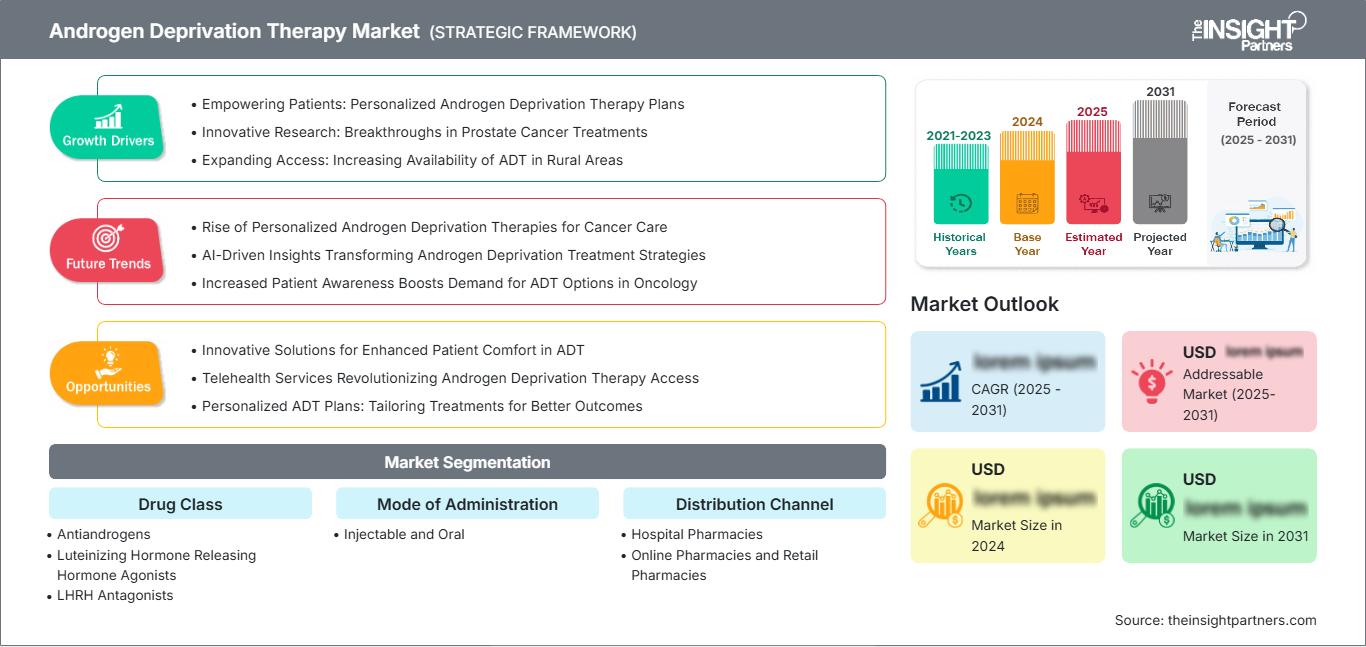
Androgen Deprivation Therapy Market: Strategic Insights
Regional Insights
North America androgen deprivation therapy market
North America held 43–46% share in 2025 and is expected to grow at a CAGR of 4.3–4.8% during 2026–2034. The region benefits from high prostate cancer screening awareness, broad oncology coverage, specialty pharmacy infrastructure, and rapid uptake of treatment intensification. These factors support the androgen deprivation therapy market share across advanced, metastatic, and high-risk localized disease pathways.
Demand is reinforced by integrated cancer centers, clinical trial participation, and payer acceptance of evidence-backed combination regimens. Injectable therapies remain important in clinics, while oral agents are gaining relevance through convenience and rapid adoption in specialty channels. The region’s growth is moderated by pricing scrutiny, prior authorization complexity, and the need to manage long-term adverse effects.
U.S. androgen deprivation therapy Market
The U.S. represented 85–88% of North America in 2025 and is projected to grow at a CAGR of 4.4–4.9% during 2026–2034. Support for demand comes from the size of oncology networks, urology clinics, Medicare coverage, and extensive use of specialty pharmacies. There is also the intensification of therapy in metastatic hormone-sensitive prostate cancer and high-risk localized cases, which has influenced changes to the treatment of such conditions.
There is widespread company participation in the market and this includes Astellas Pharma Inc., Pfizer Inc., Bayer AG, Johnson & Johnson, AstraZeneca PLC, Sanofi, Amgen Inc., AbbVie Inc., and Veru Inc. The application focus includes oral androgen receptor inhibitors, LHRH antagonists, and combination therapies.
Europe androgen deprivation therapy Market
Europe held 28–31% share in 2025 and is expected to expand at a CAGR of 4.0–4.5% during 2026–2034, with Germany leading demand. There are benefits of having centralized cancer pathways and adherence to oncology guidelines in the UK, but the issue of health technology assessment ensures that the pricing is kept reasonable. The hospital pharmacies play an important role in the administration of injectables.
Germany demonstrates excellent uptake through advanced oncology infrastructure, high diagnostic capability, and specialist urology networks. There is a need created through the prostate cancer treatment pathways with hormone suppression coupled with systemic intensification if there is enough clinical proof that it can do well for the patient. France, Italy, and Spain demonstrate continued growth due to improvements in public coverage systems and access to oral treatments.
APAC androgen deprivation therapy Market
APAC held 18–21% share in 2025 and is projected to grow at a CAGR of 5.7–6.3% during 2026–2034. Japan leads regional demand through advanced oncology care, aging demographics, and established reimbursement for prostate cancer medicines. China is scaling rapidly through hospital expansion and oncology drug access reforms.
India, South Korea, and Australia add momentum through private oncology networks, growing cancer detection, and increasing use of oral therapies. Policy support for domestic pharmaceutical manufacturing and broader insurance coverage is improving access. Suppliers must balance premium branded therapy demand with affordability and physician education.
Middle East & Africa androgen deprivation therapy Market
The Middle East & Africa is expected to grow at a CAGR of 4.8–5.4% during 2026–2034, led by Saudi Arabia. Growth is supported by oncology center investment, national cancer screening programs, and hospital infrastructure modernization across Gulf markets.
The UAE shows demand for branded oncology medicines and specialty pharmacy services, while South Africa remains important due to established oncology networks. The rest of MEA adoption is uneven because reimbursement, diagnosis timing, and medicine availability vary. Energy-funded healthcare investment supports advanced prostate cancer treatment access in selected countries.
Segmentation Analysis
Drug Class
The Drug Class segment is expected to grow at a CAGR of 4.6–5.2% during 2026–2034. Demand is shaped by clinical stage, testosterone suppression speed, tolerability, cardiovascular risk, and combination strategy. The androgen deprivation therapy market scope is widening as oncologists use hormonal backbones alongside androgen receptor inhibitors, targeted therapies, chemotherapy, and radiation to improve disease control.
- Antiandrogens remain strategically important because they block androgen receptor signaling and are commonly combined with castration-based therapy in advanced and metastatic prostate cancer treatment pathways.
- Luteinizing Hormone Releasing Hormone Agonists continue to dominate established treatment because long-acting depot formulations support predictable administration, clinic familiarity, and broad reimbursement acceptance.
- LHRH Antagonists are gaining clinical relevance because they suppress testosterone rapidly without flare, making them attractive for selected patients with symptomatic or high-risk disease.
- Other Drug Classes include supportive and emerging hormonal approaches that complement established androgen suppression strategies where patient-specific disease biology or tolerability requires alternative therapy planning.
Mode of Administration
The Mode of Administration segment is expected to grow at a CAGR of 4.5–5.1% during 2026–2034. Injectable products remain foundational because depot dosing supports physician oversight and durable testosterone suppression. Oral therapy is expanding because it can improve convenience, enable faster initiation, and support combination regimens, although adherence monitoring and payer authorization remain important operational requirements.
- Injectable therapies remain central in hospital and urology clinics because depot dosing, clinician administration, and established monitoring workflows support long-term testosterone suppression.
- Oral therapies are gaining momentum as patients and clinicians value convenience, rapid access, combination flexibility, and reduced clinic visit burden when adherence can be managed effectively.
Distribution Channel
The Distribution Channel segment is expected to grow at a CAGR of 4.4–5.0% during 2026–2034. Hospital pharmacies remain important for injectable administration and high-acuity cancer care. Online pharmacies are growing through specialty fulfillment and refill coordination, while retail pharmacies support ongoing access for oral medicines and supportive therapies, especially where patient proximity influences adherence.
- Hospital Pharmacies handle injectable, high-cost, and protocol-driven therapies where formulary control, reimbursement documentation, and coordination with oncology teams are essential.
- Online Pharmacies are expanding through specialty delivery, digital refill management, benefits verification, and patient support services for oral prostate cancer therapies.
- Retail Pharmacies retain relevance for accessible dispensing, supportive medicines, and refill continuity, particularly for stable patients receiving oral treatment outside hospital settings.
Opportunity Snapshot
| Segment Name | Revenue Contribution | Trend Tag | Adoption Stage |
| Hospital Pharmacies | High | Oncology Access | Mature |
| Online Pharmacies | Medium | Specialty Refill | Scaling |
| Retail Pharmacies | Medium | Local Access | Mature |
Androgen Deprivation Therapy Market Growth Drivers and Impact Analysis
Rising Prostate Cancer Diagnosis and Treatment Intensification
Better prostate cancer diagnosis, older male patients, and better understanding of metastatic hormone-sensitive cancer will be the driving factors that will expand the pool of patients under treatment. Androgen deprivation is now used as a base for stronger treatments, including the addition of AR inhibitors, chemotherapy, and targeted treatment according to risks and molecular characteristics. Market implications are represented by extended periods of prescription, increasing treatment value and usage of medications within various stages of the disease. Hospitals and specialty pharmacies have increased complexity in treatment, while pharmaceutical companies can capitalize on survival rates. The key commercial barrier is to achieve clinical success despite payer pressures, toxicity and affordability issues.
Shift Toward Oral Agents and Patient-Centered Administration
The rising interest in oral hormonal agents has been prompted by their reduced dependence on clinics, ease of starting, and ability to serve patients in community oncology and urology settings. Oral hormones will be of great relevance to those patients needing long-term treatment. The commercial effect will include increased use of specialty pharmacies, digital refills, and patient assistance programs. The importance of injectable depot agents will not diminish; however, oral products could gain in the places where flexibility and rapid changes are desirable. Companies have to show that convenience does not undermine persistence, safety management, or value to payers.
Expanding Evidence for Combination and Earlier-Stage Use
Clinical evidence is pushing androgen suppression beyond traditional late-stage use into intensified and earlier treatment strategies. Trials evaluating androgen receptor inhibitors with hormonal therapy in metastatic, high-risk localized, and biochemical recurrence settings are changing physician expectations. The market impact includes longer treatment pathways, higher demand for sequencing guidance, and stronger need for biomarker and imaging integration. Companies that generate robust data in defined patient groups can expand indications and defend premium pricing. At the same time, health systems will demand evidence that earlier intervention improves metastasis-free survival, overall survival, or quality-adjusted outcomes enough to justify additional treatment cost.
Androgen Deprivation Therapy Market Future Trends
Biomarker-Led Combination Therapy Selection
Future treatment decisions will increasingly use biomarkers, imaging, disease volume, and prior therapy exposure to select the right hormonal backbone and companion regimen. The androgen deprivation therapy market trends point toward precision combinations in which hormonal suppression is paired with androgen receptor inhibitors, targeted agents, or radiopharmaceuticals for defined patient subsets. This approach could reduce ineffective treatment and improve payer confidence in high-cost regimens. Implementation will depend on test availability, clinician education, and guideline updates. Companies that integrate diagnostic partnerships with drug development should gain an advantage as prostate cancer management becomes more stratified.
Finite-Duration and De-Escalation Strategies
Long-term androgen suppression can affect bone health, cardiovascular risk, metabolism, muscle mass, and quality of life. Future trials are expected to test whether selected patients with deep responses can safely pause or shorten therapy after intensified treatment. This trend does not reduce the importance of hormonal treatment; instead, it shifts value toward response monitoring, patient selection, and evidence-based sequencing. If validated, finite-duration strategies could improve patient acceptance while preserving outcomes. Drug developers and health systems will need clear criteria for stopping, restarting, and monitoring therapy to avoid undertreatment in high-risk disease.
Androgen Deprivation Therapy Market Opportunities
Specialty Pharmacy Adherence and Monitoring Programs
A practical opportunity exists in building adherence programs around oral hormonal therapy, refill tracking, toxicity screening, and benefits navigation. The androgen deprivation therapy market Forecasts indicate stronger value capture where pharmaceutical companies and pharmacies reduce discontinuation, missed refills, and unmanaged adverse effects. Investment should focus on nurse support, digital reminders, cardiovascular and bone health prompts, and payer documentation workflows. These services are particularly relevant for older men managing multiple medicines. Commercial success will depend on proving that support programs improve persistence and reduce avoidable treatment interruptions without adding administrative burden for oncology practices.
Emerging-Market Access and Oncology Infrastructure Partnerships
Emerging economies offer opportunities as cancer centers, diagnostic capacity, and public insurance coverage expand. Companies can create tiered access strategies that combine branded therapies, patient assistance, physician education, and partnerships with government oncology programs. This opportunity is strongest in China, India, Southeast Asia, the Gulf region, and selected Latin American markets where prostate cancer treatment capacity is improving. Suppliers should prioritize reimbursement evidence, local guideline engagement, and reliable distribution for both injectables and oral products. Market entry will require affordability planning because long-term hormonal treatment can create substantial cumulative costs for patients and payers.
Recent Developments
- June 2026: AstraZeneca PLC received U.S. FDA approval for TRUQAP, or capivasertib, in combination with abiraterone and prednisone for PTEN-deficient metastatic androgen pathway modulation-naïve or sensitive prostate cancer. The approval was based on CAPItello-281 results showing a 19% reduction in risk of radiographic progression or death when used with androgen-deprivation therapy.
- May 2026: Johnson & Johnson reported final Phase 3 PROTEUS data showing ERLEADA, or apalutamide, plus hormone therapy before and after prostate cancer surgery significantly improved outcomes in high-risk localized or locally advanced disease. Patients were nine times more likely to have little to no residual cancer and had a 20% lower risk of metastasis or death.
- June 2025: Orion Corporation announced that the U.S. FDA approved darolutamide in combination with androgen deprivation therapy for metastatic hormone-sensitive prostate cancer, with or without chemotherapy. The decision was based on Phase 3 ARANOTE data showing a 46% reduction in risk of radiological progression or death compared with placebo plus ADT.
Frequently Asked Questions

- Comprehensive Market Sizing and Forecast Analysis
- Detailed Segmentation Analysis
- In-Depth Market Dynamics Assessment
- Regional and Country-Level Insights
- Competitive Landscape and Company Benchmarking
- Strategic Business Intelligence
Recent Reports
Testimonials

The Insight Partners' SCADA System Market report is comprehensive, with valuable insights on current trends and future forecasts. The team was highly professional, responsive, and supportive throughout. We are very satisfied and highly recommend their services.
RAN KEDEM Partner, Reali Technologies LTDs
I requested a report on a very specific software market and the team produced the report in a few days. The information was very relevant and well presented. I then requested some changes and additions to the report. The team was again very responsive and I got the final report in less than a week.
JEAN-HERVE JENN Chairman, Future Analytica
We worked with The Insight Partners for an important market study and forecast. They gave us clear insights into opportunities and risks, which helped shape our plans. Their research was easy to use and based on solid data. It helped us make smart, confident decisions. We highly recommend them.
PIYUSH NAGPAL Sr. Vice President, High Beam Global
The Insight Partners delivered insightful, well-structured market research with strong domain expertise. Their team was professional and responsive throughout. The user-friendly website made accessing industry reports seamless. We highly recommend them for reliable, high-quality research services
YUKIHIKO ADACHI CEO, Deep Blue, LLC.
This is the first time I have purchased a market report from The Insight Partners.While I was unsure at first, I visited their web site and felt more comfortable to take the risk and purchase a market report.I am completely satisfied with the quality of the report and customer service. I had several questions and comments with the initial report, but after a couple of dialogs over email with their analyst I believe I have a report that I can use as input to our strategic planning process.Thank you so much for taking the extra time and making this a positive experience.I will definitely recommend your service to others and you will be my first call when we need further market data.
JOHN SUZUKI President and Chief Executive Officer, Board Director, BK Technologies
I wish to appreciate your support and the professionalism you displayed in the course of attending to my request for information regarding to infectious disease IVD market in Nigeria. I appreciate your patience, your guidance, and the fact that you were willing to offer a discount, which eventually made it possible for us to close a deal. I look forward to engaging The Insight Partners in the future, all thanks to the impression you have created in me as a result of this first encounter.
DR CHIJIOKE ONYIA MANAGING DIRECTOR, PineCrest Healthcare Ltd.Reason to Buy
- Informed Decision-Making
- Understanding Market Dynamics
- Competitive Analysis
- Identifying Emerging Markets
- Customer Insights
- Market Forecasts
- Risk Mitigation
- Boosting Operational Efficiency
- Strategic Planning
- Investment Justification
- Tracking Industry Innovations
- Aligning with Regulatory Trends





 Get Free Sample for