
Ankle Syndesmosis Treatment Device Market Share, Growth & Forecast by 2034
Coverage: By Product (Syndesmosis Implant Systems, Titanium-based Plate Implants, Stainless Steel-based Plate Implants, Biodegradable Material-based Implants, Syndesmosis Plate Kits, Syndesmosis Clamps); Application (Ankle Fractures, Syndesmosis Reduction, Postoperative Management); End-users (Hospitals, Ambulatory Surgical Centers, Others) , and Geography (North America, Europe, Asia Pacific, and South and Central America)
- Status : Data Released
- Report Code : TIPRE00023274
- Category : Life Sciences
- No. of Pages : 150
- Available Report Formats :


- Last update date : August 04, 2026


2025 Market Size
US$ 203.46 Mn
Base year value
2034 Forecast
US$ 373.04 Mn
Projected by 2034
CAGR 2026-2034
7.87 %
Growth rate
Addressable Market
US$ 2,725.84 Mn
(2026-2034)
The ankle syndesmosis treatment device market is valued at US$ 203.46 Million in 2025 and is projected to reach US$ 373.04 Million by 2034, registering a CAGR of 7.87% during 2026–2034. The market is expanding as unstable ankle fractures, high ankle sprains, sports injuries, and fixation failures increase the need for precise reduction and durable stabilization technologies.
Across North America, the ankle syndesmosis treatment device market size is supported by high procedural volumes in trauma centers, strong adoption of flexible fixation systems, and rapid migration of foot and ankle procedures into ambulatory surgical centers. The region is estimated to expand at a CAGR range of 7.20–8.00% during 2026–2034, shaped by sports medicine demand and reimbursement-backed orthopedic innovation.
Ankle Syndesmosis Treatment Device Market Assessment and Insights
- North America is estimated to hold 38–41% share in 2025, growing at a CAGR range of 7.20–8.00% during 2026–2034, supported by sports injury care, trauma fixation adoption, and outpatient orthopedic infrastructure.
- US accounts for 82–86% of North America in 2025 and is projected to grow at a CAGR range of 7.30–8.10% during 2026–2034, led by ASC migration and surgeon preference for flexible fixation.
- Europe holds 25–28% share in 2025, growing at a CAGR range of 6.80–7.50% during 2026–2034, with Germany, the UK, France, Italy, and Spain leading procedural adoption.
- Asia Pacific represents 21–24% share in 2025 and is expected to grow at a CAGR range of 8.40–9.30% during 2026–2034, led by China, Japan, India, South Korea, and Australia.
- Largest Segment Syndesmosis Implant Systems holds 39–43% market share in 2025, growing at a CAGR range of 7.80–8.50% during 2026–2034, supported by suture-button and flexible fixation adoption.
- High Growth Segment Ambulatory Surgical Centers holds 26–30% market share in 2025, growing at a CAGR range of 8.70–9.60% during 2026–2034, driven by outpatient ankle trauma procedures.
- Key companies analyzed in detail: Arthrex, Inc., Zimmer Biomet Holdings, Inc., Jeil Medical Corporation, Smith & Nephew plc, Wright Medical Group N.V., Johnson & Johnson MedTech, Exactech, Inc., Paragon 28, Inc., Tulpar Medical Solutions, Orthomed, Stryker Corporation.
Source: The Insight Partners' analysis based on proprietary research, government publications, company annual reports, investor presentations, industry databases, and expert interviews.
The technique of syndesmotic reconstruction has moved from stiff screws to a dynamic system that facilitates physiological motion between the two bones (the tibia and the fibula). The production of these products has also changed as companies manufacture sterile packages, low profile plates, titanium devices, and implant systems suitable for ankle fractures procedures. The market for ankle syndesmosis devices is becoming more and more driven by surgeons who want reduction techniques, low removal rates, and surgical instruments that help simplify the inventory in the operating room.
The future demand will be driven by sports-related injuries, fragility fractures among the elderly, and orthopedic capacities in the Asia Pacific and Middle East regions. Investment is being made in procedure-specific implants, surgeons' training, and outpatient-friendly systems. Device traceability, evidence-based medicine, and value analysis committees at hospitals provide positive regulatory trends that encourage suppliers with track record of outcomes, logistics and training modules for orthopedics and trauma surgeons.
Ankle Syndesmosis Treatment Device Market Report Scope
| Report Attribute | Details |
|---|---|
| Market size in 2025 | US$ 203.46 Million |
| Market Size by 2034 | US$ 373.04 Million |
| Global CAGR (2026 - 2034) | 7.87% |
| Historical Data | 2021-2024 |
| Forecast period | 2026-2034 |
Ankle Syndesmosis Treatment Device Market Analysis
Market drivers for the development of the ankle syndesmosis repair device market include better identification of syndesmosis instability in cases of fractures and high ankle sprains. The demand arises from trauma surgeons, foot and ankle surgeons, orthopedic sports medicine physicians, hospitals, and ambulatory surgery centers. The focus of the care pathway is on anatomical reduction, rotational stability, preservation of joint motion, and secondary hardware removal.
The supply of ankle syndesmosis devices is influenced by precise manufacturing, validation of implants material, packaging of surgical instruments, and training of surgeons. Value chain participants include orthopedic device designers, contract manufacturers, sterilization facilities, hospital buying departments, distributors, implant reps, and clinical educators. Standardization of the procedure is crucial because undetected syndesmotic injury may cause long-term instability, pain, arthritis, and surgery revision.
Positioning competition revolves around different fixation mechanics, implants’ profiles, kit efficiency, and sales distribution channels. According to the ankle syndesmosis treatment device market report the main players of this industry include Arthrex, Inc., Zimmer Biomet Holdings, Inc., Johnson & Johnson MedTech, Smith & Nephew plc, Exactech, Inc., and Stryker Corporation that compete on their range of products, surgeon education, and fixation technologies.
The specialists’ companies enhance the market by concentrating on the anatomy of foot and ankle, their trauma plates and instrumentation for procedures. Paragon 28, Inc. has made an impact on the market due to the focus on the anatomy of foot and ankle, while Jeil Medical Corporation, Tulpar Medical Solutions, Orthomed, and Wright Medical Group N.V. have additional geographical or portfolio legacy.
● REPORT CUSTOMIZATION
Tailor This Report To Align With Your Specific Business Requirements
This report can be customized to align precisely with your business objectives, scope, and target markets. Customization options include tailored segmentation, geography, competitive analysis, and strategic insights to support informed decision-making.
Customize This Report →WHAT YOU CAN ADJUST
- ● Segmentations
- ● Geography
- ● Competitive Analysis
- ● Language Preferences
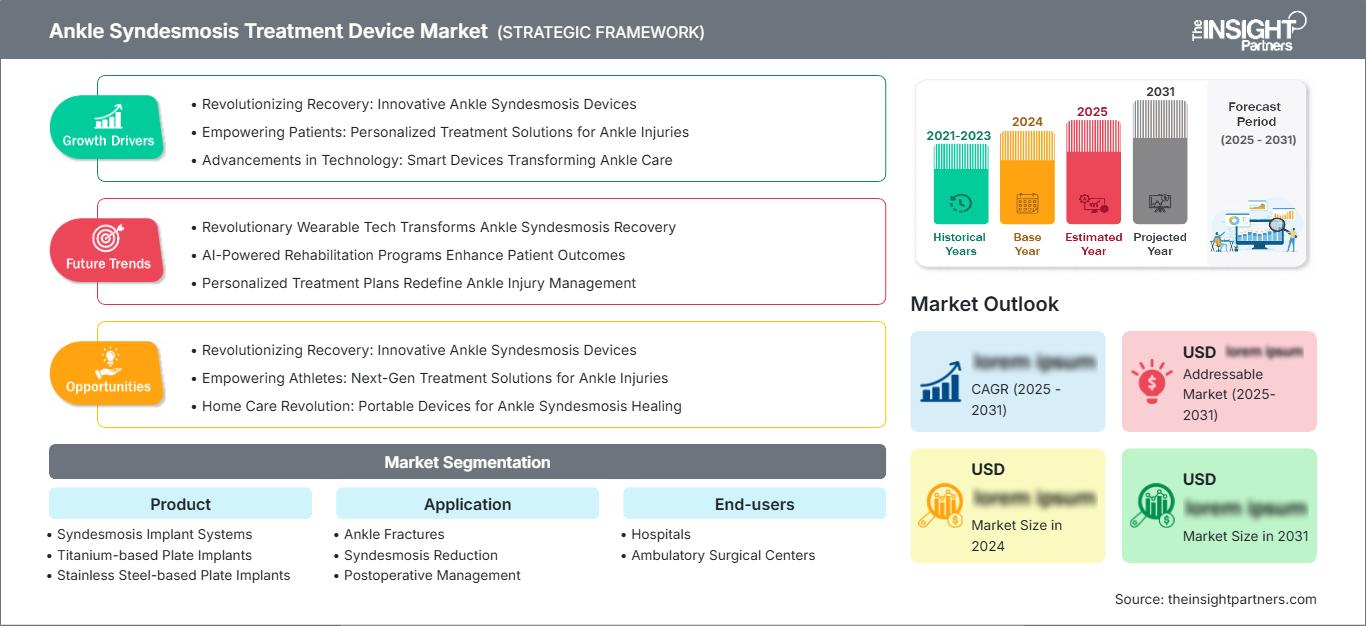
Ankle Syndesmosis Treatment Device Market: Strategic Insights
Regional Insights
North America ankle syndesmosis treatment device market
North America is estimated to hold 38–41% share in 2025 and to grow at a CAGR range of 7.20–8.00% during 2026–2034. The ankle syndesmosis treatment device market share is supported by high sports participation, advanced trauma systems, established coding pathways, and greater surgeon familiarity with suture-button fixation and low-profile plate integration.
Demand is reinforced by outpatient orthopedic growth, bundled procurement, and surgeon preference for systems that reduce routine implant removal. US and Canadian centers use fluoroscopy, CT-based assessment, and standardized postoperative protocols to confirm reduction quality. The region’s adoption profile favors premium implants when clinical evidence demonstrates lower reoperation burden and faster rehabilitation.
U.S. ankle syndesmosis treatment device Market
The US accounts for 82–86% of North America in 2025 and is projected to grow at a CAGR range of 7.30–8.10% during 2026–2034. Procedural demand is driven by ankle fractures, athletic high ankle sprains, work-related injuries, and increasing recognition of syndesmotic instability in emergency and orthopedic settings.
Presence in this market is quite extensive with Arthrex, Inc., Zimmer Biomet Holdings, Inc., Johnson & Johnson MedTech, Exactech, Inc., Paragon 28, Inc., and Stryker Corporation having significant surgeon access channels. Application trends are moving towards dynamic implants, plates for buttress plate application, and early mobility programs postoperatively. Usage in the ASC is increasing since some ankle fixation procedures can be performed in an outpatient setting.
Europe ankle syndesmosis treatment device Market
Europe accounts for 25-28% share in 2025 and is forecast to register a CAGR growth of 6.80-7.50% from 2026 to 2034. In UK, there is an increasing need for sports medicine referrals, stringent National Health Service procurement, and orthopedic care in private hospitals for active individuals. The region of Germany is dominated owing to trauma networks and orthopedic specialist centers that favor fixation.
In France, Italy, and Spain, there is consistent demand for sports injuries, trauma, and ankle fractures treatments in public as well as private hospitals. Market adoption depends upon value assessment, medical device regulation in Europe for tracking implants and surgeons' training. Suppliers offering clinical results, anatomical plates, and sterilization kit will have an edge despite the pricing competition.
APAC ankle syndesmosis treatment device Market
APAC represents 21–24% share in 2025 and is forecast to grow at a CAGR range of 8.40–9.30% during 2026–2034. China is the leading country, supported by large trauma volumes, hospital modernization, and increasing access to orthopedic implants.
Japan and South Korea focus on premium fixation and sports injury reconstruction, India focuses on procedure volume by increasing hospital capacity in private hospitals, and Australia focuses on high adoption due to the sports medicine and orthopedic skills of doctors there. The policy emphasis on surgical capability, device registration, and hospitals will fast-track adoption.
Middle East & Africa ankle syndesmosis treatment device Market
The Middle East & Africa market is projected to grow at a CAGR range of 7.70–8.50% during 2026–2034. Saudi Arabia leads adoption through healthcare infrastructure investment, sports medicine programs, and expanding trauma services.
In the UAE, superior orthopedic treatment procedures are provided through private hospitals and medical tourism, whereas trauma treatment is the foundation of regional demand in South Africa. Rest of MEA acceptance of these fixation systems is variable; however, the level of surgical training, imaging, and hospital logistics investments has increased.
Segmentation Analysis
Product
Product is projected to grow at a CAGR range of 7.60–8.40% during 2026–2034. The ankle syndesmosis treatment device market scope within this segment is defined by the shift from standalone screws toward implant systems, plate-compatible solutions, and procedure kits. Surgeons increasingly evaluate products by reduction control, fixation strength, soft-tissue safety, profile, material selection, and ability to reduce revision or removal requirements.
- Syndesmosis Implant Systems dominate demand because they offer dynamic stabilization, controlled tibiofibular motion, and compatibility with ankle fracture fixation workflows requiring reliable reduction maintenance.
- Titanium-based Plate Implants are preferred where strength, biocompatibility, lower weight, and imaging compatibility are important for complex ankle fracture constructs and premium orthopedic procedures.
- Stainless Steel-based Plate Implants remain relevant in cost-sensitive settings because they provide practical strength, established surgeon familiarity, and availability across trauma inventory systems.
- Biodegradable Material-based Implants represent a developing category focused on reducing long-term hardware burden, although adoption depends on degradation profile, fixation confidence, and clinical evidence.
- Syndesmosis Plate Kits support procedural efficiency by combining plates, screws, and fixation accessories into organized configurations that simplify hospital inventory and operating-room preparation.
- Syndesmosis Clamps remain important instruments for temporary reduction, alignment confirmation, and intraoperative control before final fixation in fracture-associated or isolated syndesmotic injuries.
Application
Application is projected to grow at a CAGR range of 7.50–8.20% during 2026–2034. Ankle fractures represent the largest procedural base because syndesmotic disruption often accompanies rotational injury. Syndesmosis reduction requires precision to restore congruity, while postoperative management increasingly focuses on implant durability, rehabilitation timing, imaging follow-up, and avoidance of malreduction-related complications.
- Ankle Fractures generate the largest demand because unstable fractures often require fixation that addresses both bony injury and distal tibiofibular ligament disruption.
- Syndesmosis Reduction is strategically important because accurate alignment directly influences joint mechanics, postoperative stability, patient mobility, and long-term ankle function.
- Postoperative Management supports device selection through rehabilitation planning, imaging verification, weightbearing decisions, and monitoring for pain, loosening, malreduction, or need for revision procedures.
End-users
End-users are projected to grow at a CAGR range of 7.70–8.60% during 2026–2034. Hospitals remain the principal treatment setting for complex ankle fractures, polytrauma, and inpatient trauma care. Ambulatory Surgical Centers are expanding faster because selected ankle fixation procedures can be performed efficiently with standardized kits, experienced surgeons, lower facility costs, and predictable postoperative pathways.
- Hospitals account for high-value demand because they manage complex fractures, emergency trauma, revision cases, imaging resources, and multidisciplinary orthopedic services requiring broad implant inventories.
- Ambulatory Surgical Centers are gaining share as outpatient ankle fixation increases, supported by efficient scheduling, sterile kits, surgeon ownership models, and recovery protocols suitable for selected patients.
Opportunity Snapshot
Market Opportunity Snapshot
| End-users | Revenue Contribution | Trend Tag | Adoption Stage |
|---|---|---|---|
| Hospitals | High | Trauma Networks | Mature |
| Ambulatory Surgical Centers | Medium | Outpatient Fixation | Scaling |
Ankle Syndesmosis Treatment Device Market Growth Drivers and Impact Analysis
Rising ankle fracture and sports-related syndesmotic injuries
Growing participation in running, football, basketball, skiing, and recreational fitness is increasing exposure to rotational ankle injuries. Syndesmotic disruption is clinically relevant because it can accompany unstable ankle fractures or present as a high ankle sprain requiring careful assessment. The market impact is higher use of fixation systems that restore tibiofibular stability and reduce chronic pain risk. Orthopedic surgeons are also diagnosing these injuries more consistently through imaging, stress testing, and intraoperative evaluation. This improves procedural capture and expands demand for implant systems, clamps, and plate kits. Hospitals and ASCs benefit from standardized workflows that convert injury recognition into timely operative treatment.
Shift from rigid screws to dynamic fixation systems
Dynamic fixation is gaining acceptance because it can stabilize the syndesmosis while allowing controlled physiologic micromotion. Traditional screw fixation remains important, but surgeons increasingly consider suture-button and hybrid systems when seeking reduced implant removal, better functional recovery, and lower risk of overconstraint. The commercial impact is a migration toward premium implant systems, titanium constructs, and instrumentation that improves reduction reproducibility. Device manufacturers are responding with systems that combine strength, tension control, low-profile design, and compatibility with ankle plates. This driver strengthens category value because buyers are evaluating total episode cost, not only implant purchase price, especially when secondary procedures can be avoided.
Expansion of outpatient orthopedic surgery capacity
Ambulatory Surgical Centers are becoming more relevant for selected ankle syndesmosis procedures because they offer scheduling efficiency, focused orthopedic teams, and lower facility costs than inpatient settings. The shift is strongest in the US, but private hospital networks in Europe, the Middle East, and Asia Pacific are adopting similar models for appropriate trauma and sports medicine cases. Device demand changes as ASCs prefer compact sterile kits, predictable instrumentation, and vendor support that reduces procedure time. This creates a real-world market impact by favoring suppliers with simplified workflows, strong representative coverage, and implants that fit outpatient postoperative protocols. It also supports faster adoption of premium systems.
Ankle Syndesmosis Treatment Device Market Future Trends
Digital planning and reduction verification
Digital planning, intraoperative imaging, and objective reduction verification will shape ankle syndesmosis treatment device market trends over the next decade. Surgeons are likely to use CT-informed planning, fluoroscopic analytics, and navigation-enabled workflows to improve alignment consistency. This trend is important because small rotational errors can affect ankle mechanics and long-term outcomes. Device suppliers will increasingly support implants with digital education, procedure planning tools, and evidence packages showing reduction accuracy. Adoption will be strongest in trauma centers, teaching hospitals, and premium ASCs before expanding into broader orthopedic practice.
Material innovation and lower-profile fixation
Future device design will focus on low-profile constructs, improved biocompatibility, and materials that reduce irritation near the ankle’s limited soft-tissue envelope. Titanium systems, engineered polymers, and biodegradable concepts will compete with stainless steel implants where clinical evidence supports reliable fixation. Surgeons will seek systems that maintain strength while reducing hardware prominence and secondary removal risk. Manufacturers are expected to refine plate geometry, suture loop behavior, and button placement to protect anatomy around the tibia and fibula. These advances will support premium positioning when linked to measurable operative and recovery benefits.
Ankle Syndesmosis Treatment Device Market Opportunities
Procedure-specific bundled systems for outpatient settings
Strong ankle syndesmosis treatment device market Forecasts are linked to bundled systems that simplify outpatient fixation. ASCs and specialty orthopedic centers need sterile-packed implants, compatible instruments, reduction tools, and clear procedural guidance that minimize setup complexity. Suppliers can invest in kits tailored to ankle fractures, isolated high ankle sprains, and postoperative pathway requirements. The opportunity is commercially attractive because procedure efficiency affects surgeon satisfaction and facility economics. Companies that pair products with training, inventory control, and digital support can improve adoption while reducing procedural variability across outpatient networks.
Emerging market surgeon training and access programs
Emerging markets offer an actionable opportunity for companies that combine implant access with structured surgeon education. Many hospitals in Asia Pacific, Latin America, and the Middle East are upgrading trauma capabilities, but adoption of advanced syndesmosis systems depends on training, imaging familiarity, and local distributor reliability. Manufacturers can build long-term demand through cadaver labs, mobile education, clinical case support, and pricing models aligned with hospital budgets. This approach expands access beyond premium urban centers and supports procedure standardization. It also strengthens brand loyalty among younger orthopedic surgeons building specialized foot and ankle practices.
Recent Developments
- February 2026: Zimmer Biomet Holdings, Inc. and Paragon 28, Inc. launched the Phantom Curved TTC Nail System, a hindfoot fusion solution engineered around the anatomy of the hindfoot arc. Although focused on complex hindfoot fixation, the launch strengthens Zimmer Biomet’s foot and ankle portfolio and expands its surgeon relationships in adjacent trauma and reconstruction procedures.
- March 2025: Exactech, Inc. announced first surgeries using Vantage Ankle 3D and 3D+ tibial implants with GPS Ankle navigation. The company positioned the combination as a precision-oriented ankle surgery platform offering real-time guidance and 3D-printed tibial implant options, reinforcing the broader movement toward navigated foot and ankle procedures.
- September 2024: Paragon 28, Inc. launched the R3FLEX Stabilization System for anatomical repair of ankle syndesmotic injuries. The system was designed to restore stability after ankle fracture or high ankle sprain, with adjustable tensioning, internal tibial implant placement, controlled micromotion, and a single sterile kit configuration for simplified surgical workflow.
Frequently Asked Questions

- Comprehensive Market Sizing and Forecast Analysis
- Detailed Segmentation Analysis
- In-Depth Market Dynamics Assessment
- Regional and Country-Level Insights
- Competitive Landscape and Company Benchmarking
- Strategic Business Intelligence
Recent Reports
Testimonials

The Insight Partners' SCADA System Market report is comprehensive, with valuable insights on current trends and future forecasts. The team was highly professional, responsive, and supportive throughout. We are very satisfied and highly recommend their services.
RAN KEDEM Partner, Reali Technologies LTDs
I requested a report on a very specific software market and the team produced the report in a few days. The information was very relevant and well presented. I then requested some changes and additions to the report. The team was again very responsive and I got the final report in less than a week.
JEAN-HERVE JENN Chairman, Future Analytica
We worked with The Insight Partners for an important market study and forecast. They gave us clear insights into opportunities and risks, which helped shape our plans. Their research was easy to use and based on solid data. It helped us make smart, confident decisions. We highly recommend them.
PIYUSH NAGPAL Sr. Vice President, High Beam Global
The Insight Partners delivered insightful, well-structured market research with strong domain expertise. Their team was professional and responsive throughout. The user-friendly website made accessing industry reports seamless. We highly recommend them for reliable, high-quality research services
YUKIHIKO ADACHI CEO, Deep Blue, LLC.
This is the first time I have purchased a market report from The Insight Partners.While I was unsure at first, I visited their web site and felt more comfortable to take the risk and purchase a market report.I am completely satisfied with the quality of the report and customer service. I had several questions and comments with the initial report, but after a couple of dialogs over email with their analyst I believe I have a report that I can use as input to our strategic planning process.Thank you so much for taking the extra time and making this a positive experience.I will definitely recommend your service to others and you will be my first call when we need further market data.
JOHN SUZUKI President and Chief Executive Officer, Board Director, BK Technologies
I wish to appreciate your support and the professionalism you displayed in the course of attending to my request for information regarding to infectious disease IVD market in Nigeria. I appreciate your patience, your guidance, and the fact that you were willing to offer a discount, which eventually made it possible for us to close a deal. I look forward to engaging The Insight Partners in the future, all thanks to the impression you have created in me as a result of this first encounter.
DR CHIJIOKE ONYIA MANAGING DIRECTOR, PineCrest Healthcare Ltd.Reason to Buy
- Informed Decision-Making
- Understanding Market Dynamics
- Competitive Analysis
- Identifying Emerging Markets
- Customer Insights
- Market Forecasts
- Risk Mitigation
- Boosting Operational Efficiency
- Strategic Planning
- Investment Justification
- Tracking Industry Innovations
- Aligning with Regulatory Trends





 Get Free Sample for